Analytical Applications of Differentiation – Unit 5

Unit 5 covers the application of derivatives to the analysis of functions and graphs. Reasoning and justification of results are also important themes in this unit. (CED – 2019 p. 92 – 107). These topics account for about 15 – 18% of questions on the AB exam and 8 – 11% of the BC questions.

You may want to consider teaching Unit 4 after Unit 5. Notes on Unit 4 are here.

Reasoning and writing justification of results are mentioned and stressed in the introduction to the topic (p. 93) and for most of the individual topics. See Learning Objective FUN-A.4 “Justify conclusions about the behavior of a function based on the behavior of its derivatives,” and likewise in FUN-1.C for the Extreme value theorem, and FUN-4.E for implicitly defined functions. Be sure to include writing justifications as you go through this topic. Use past free-response questions as exercises and also as guide as to what constitutes a good justification. Links in the margins of the CED are also helpful and give hints on writing justifications and what is required to earn credit. See the presentation  Writing on the AP Calculus Exams and its handout

Topics 5.1

Topic 5.1 Using the Mean Value Theorem While not specifically named in the CED, Rolle’s Theorem is a lemma for the Mean Value Theorem (MVT). The MVT states that for a function that is continuous on the closed interval and differentiable over the corresponding open interval, there is at least one place in the open interval where the average rate of change equals the instantaneous rate of change (derivative). This is a very important existence theorem that is used to prove other important ideas in calculus. Students often confuse the average rate of change, the mean value, and the average value of a function – See What’s a Mean Old Average Anyway?

Topics 5.2 – 5.9

Topic 5.2 Extreme Value Theorem, Global Verses Local Extrema, and Critical Points An existence theorem for continuous functions on closed intervals

Topic 5.3 Determining Intervals on Which a Function is Increasing or Decreasing Using the first derivative to determine where a function is increasing and decreasing.

Topic 5.4 Using the First Derivative Test to Determine Relative (Local) Extrema Using the first derivative to determine local extreme values of a function

Topic 5.5 Using the Candidates’ Test to Determine Absolute (Global) Extrema The Candidates’ test can be used to find all extreme values of a function on a closed interval

Topic 5.6 Determining Concavity of Functions on Their Domains FUN-4.A.4 defines (at least for AP Calculus) When a function is concave up and down based on the behavior of the first derivative. (Some textbooks may use different equivalent definitions.) Points of inflection are also included under this topic.

Topic 5.7 Using the Second Derivative Test to Determine Extrema Using the Second Derivative Test to determine if a critical point is a maximum or minimum point. If a continuous function has only one critical point on an interval then it is the absolute (global) maximum or minimum for the function on that interval.

Topic 5.8 Sketching Graphs of Functions and Their Derivatives First and second derivatives give graphical and numerical information about a function and can be used to locate important points on the graph of the function.

Topic 5.9 Connecting a Function, Its First Derivative, and Its Second Derivative First and second derivatives give graphical and numerical information about a function and can be used to locate important points on the graph of the function.

Topics 5.10 – 5.11

Optimization is important application of derivatives. Optimization problems as presented in most text books, begin with writing the model or equation that describes the situation to be optimized. This proves difficult for students, and is not “calculus” per se. Therefore, writing the equation has not be asked on AP exams in recent years (since 1983). Questions give the expression to be optimized and students do the “calculus” to find the maximum or minimum values. To save time, my suggestion is to not spend too much time writing the equations; rather concentrate on finding the extreme values.

Topic 5.10 Introduction to Optimization Problems 

Topic 5.11 Solving Optimization Problems

Topics 5.12

Topic 5.12 Exploring Behaviors of Implicit Relations Critical points of implicitly defined relations can be found using the technique of implicit differentiation. This is an AB and BC topic. For BC students the techniques are applied later to parametric and vector functions.


Timing

Topic 5.1 is important and may take more than one day. Topics 5.2 – 5.9 flow together and for graphing they are used together; after presenting topics 5.2 – 5.7 spend the time in topics 5.8 and 5.9 spiraling and connecting the previous topics. Topics 5.10 and 5.11 – see note above and spend minimum time here. Topic 5.12 may take 2 days.

The suggested time for Unit 5 is 15 – 16 classes for AB and 10 – 11 for BC of 40 – 50-minute class periods, this includes time for testing etc.

Finally, were I still teaching, I would teach this unit before Unit 4. The linear motion topic (in Unit 4) are a special case of the graphing ideas in Unit 5, so it seems reasonable to teach this unit first. See Motion Problems: Same thing, Different Context

This is a re-post and update of the third in a series of posts from last year. It contains links to posts on this blog about the differentiation of composite, implicit, and inverse functions for your reference in planning. Other updated post on the 2019 CED will come throughout the year, hopefully, a few weeks before you get to the topic. 


Previous posts on these topics include:

Then There Is This – Existence Theorems

What’s a Mean Old Average Anyway

Did He, or Didn’t He?   History: how to find extreme values without calculus

Mean Value Theorem

Foreshadowing the MVT

Fermat’s Penultimate Theorem

Rolle’s theorem

The Mean Value Theorem I

The Mean Value Theorem II

Graphing

Concepts Related to Graphs

The Shapes of a Graph

Joining the Pieces of a Graph

Extreme Values

Extremes without Calculus

Concavity

Reading the Derivative’s Graph

        Other Asymptotes

Real “Real-life” Graph Reading

Far Out! An exploration

Open or Closed  Should intervals of increasing, decreasing, or concavity be open or closed?

Others

Lin McMullin’s Theorem and More Gold  The Golden Ratio in polynomials

Soda Cans  Optimization video

Optimization – Reflections   

Curves with Extrema?

Good Question 10 – The Cone Problem

Implicit Differentiation of Parametric Equations    BC Topic


Here are links to the full list of posts discussing the ten units in the 2019 Course and Exam Description.

Limits and Continuity – Unit 1  (8-11-2020)

Definition of t he Derivative – Unit 2  (8-25-2020)

Differentiation: Composite, Implicit, and Inverse Function – Unit 3  (9-8-2020)

Contextual Applications of the Derivative – Unit 4   (9-22-2002)   Consider teaching Unit 5 before Unit 4

Analytical Applications of Differentiation – Unit 5  (9-29-2020) Consider teaching Unit 5 before Unit 4 THIS POST

LAST YEAR’S POSTS – These will be updated in coming weeks

2019 – CED Unit 6 Integration and Accumulation of Change

2019 – CED Unit 7 Differential Equations  Consider teaching after Unit 8

2019 – CED Unit 8 Applications of Integration   Consider teaching after Unit 6, before Unit 7

2019 – CED Unit 9 Parametric Equations, Polar Coordinates, and Vector-Values Functions 

2019 CED Unit 10 Infinite Sequences and Series


Good Question 17

A common question in (older?) textbooks is to give students a function or relation and have them graph it without technology (because in the old days technology was not available). Students had to find all the appropriate information without hints or further direction: they were supposed to know what to do and do it.

AP exam questions, for legitimate and understandable reasons, do not ask for as complete an analysis. Rather, they ask students to find specific information about the function or its graph (extreme values, points of inflection, etc.). For the same legitimate and understandable reason many of the features are not considered; the other concepts are tested on different questions.

I think that the full-analysis-from-scratch approach, while not appropriate for an AP exam question, has its merits. The big difference is that students need to be creative in their investigation; not just focus on a few items pointed to by the question.

With that in mind, let’s consider the following question asked three ways.

A very general form

Consider the relation {{x}^{3}}+3{{x}^{2}}+{{y}^{2}}=4. Discuss the graph of the relation giving reasons for your conclusions. Include a brief mention of any unproductive paths you followed and what you learned from them.

A more directed investigation

Consider the relation {{x}^{3}}+3{{x}^{2}}+{{y}^{2}}=4. Find its extreme values and any asymptotes, and vertical tangents (if any). Discuss in detail the appearance of the graph near x = –2 and discuss the slopes in that area. Explain how you arrived at your results.

Closer to an AP style form. The function here is the top half of the function above.

Consider the function y=\sqrt{{4-{{x}^{3}}-3{{x}^{2}}}}.

(a) Find the local maximum and minimum values of the function. Justify your answer.

(b) Where does the function had a vertical asymptote? Justify your answer.

(c) Find \underset{{x\to -2-}}{\mathop{{\lim }}}\,\frac{{dy}}{{dx}} and \underset{{x\to -2+}}{\mathop{{\lim }}}\,\frac{{dy}}{{dx}}. What does this say about the graph?

The real question is can you ask it the first way?

Here is my solution to the first form; this will also give the answers to the other forms. After the solution, I’ll discuss some ideas on how to score such a solution.

Solution

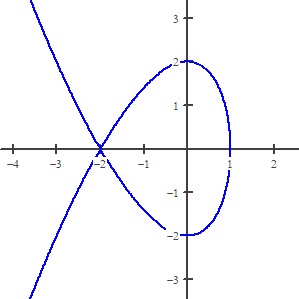
The graph of the relation  {{x}^{3}}+3{{x}^{2}}+{{y}^{2}}=4.  is shown in figure 1.

Figure 1

The domain of the function is x\le 1. Values greater than 1 will make the left side of the equation greater than 4 regardless of the value of y. The range of the relation is all real numbers.


The function is symmetric to the x-axis since substituting (–y) for y will give the same expression. The equation of the top half is  y=\sqrt{{4-{{x}^{3}}-3{{x}^{2}}}} and the lower half is y=-\sqrt{{4-{{x}^{3}}-3{{x}^{2}}}}

The derivative for the top half is \displaystyle {y}'=-\frac{{3{{x}^{2}}+6x}}{{2y}}=-\frac{{3{{x}^{2}}+6x}}{{2\sqrt{{4-{{x}^{3}}-{3{x}^{2}}}}}} by implicit differentiation or by differentiating the equation for the top half.

y'\left( x \right) does not exist at x = 1 specifically, \displaystyle \underset{{x\to 1-}}{\mathop{{\lim }}}\,{y}'\left( x \right)=-\infty . Therefore, the line x = 1 is a vertical tangent. By symmetry for the lower part of the graph \displaystyle \underset{{x\to 1-}}{\mathop{{\lim }}}\,{y}'\left( x \right)=+\infty .  And x = 1 is its vertical asymptote as well. The slope of the original relation changes from positive to negative at x = 1 by going not through zero but from  -\infty to +\infty .

{y}'\left( x \right)=0 when x = 0 and when x = –2. At (0, 2) the derivative changes from positive to negative; this is a local maximum point by the first derivative test. The lower half has a local minimum point at (0, –2) by symmetry.

At (–2, 0) the derivative is an indeterminate form of the type 0/0.

False step: At first, I thought this meant that the two sides were tangent to the line x = –2 making the point (–2, 0) on the top half a cusp. I tried to see if this was true by graphing in a very narrow window. This did not show anything: the graph looked on zooming in, like an absolute value graph. It turned out that an absolute value was involved.

I then made a table of values for the derivative near the point and found that the values appeared to be approaching a number near –1.7 from the left and near +1.7 from the right. I started thinking maybe \displaystyle \sqrt{3}.

Then I changed the constants to parameters and played with the sliders on Desmos (here). With a slight change in the constants the graph appeared to have a nice rounded local minimum near x= –2. Other values showed two separate pieces with vertical tangents near x= –2. This confused me even more.

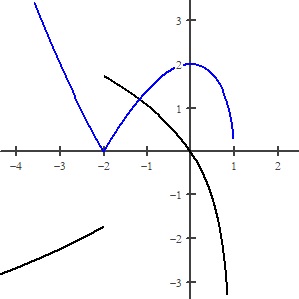
Next, I did what I should have done earlier: I graphed the top half and its derivative (figure 2):

Figure 2. The top half in blue and its derivative in black.

The derivative has a finite jump discontinuity at x = –2. I remembered seeing this kind of thing before and thought it involved an absolute value of some kind. Still confused, I decided to investigate the derivative further (which I also should have done sooner).

The derivative at x = –2 is an indeterminate form of the 0/0 type. This means that by substituting you get an expression that really doesn’t help; you may still evaluate the limit (remember derivatives are limits) by other methods. Factoring the derivative (using synthetic division on the radicand) gives

\displaystyle {y}'\left( x \right)=-\frac{{3x\left( {x+2} \right)}}{{2\sqrt{{{{{\left( {x+2} \right)}}^{2}}\left( {1-x} \right)}}}}=-\frac{{3x\left( {x+2} \right)}}{{2\sqrt{{{{{\left( {x+2} \right)}}^{2}}}}\sqrt{{1-x}}}}=-\frac{{3x}}{{\sqrt{{1-x}}}}\frac{{x+2}}{{\left| {x+2} \right|}}

And now we see that

\displaystyle \underset{{x\to -2-}}{\mathop{{\lim }}}\,\frac{{-3x}}{{2\sqrt{{1-x}}}}\cdot \frac{{x+2}}{{\left| {x+2} \right|}}=-\sqrt{3}  and  \displaystyle \underset{{x\to -2+}}{\mathop{{\lim }}}\,\frac{{-3x}}{{2\sqrt{{1-x}}}}\cdot \frac{{x+2}}{{\left| {x+2} \right|}}=\sqrt{3}

This agrees with the derivative’s graph. The top graph (and bottom’s by symmetry) comes to an arrow-like point (sometimes called a node) at (–2, 0). The slope on the left approaches -\sqrt{3} and on the right approaches +\sqrt{3}.

______________________

I admit I’ve had a few more years of experience with this sort of thing that a first-year calculus student. I expect this would be difficult for most students who have never seen a question like this, so working up to it with simpler questions is how to start.

In grading this sort of question, you need to consider:

  1. If the student found and justified all the pertinent features of the graph. If they missed something, what they included may still be pretty good. For example, I would not expect a student to the use the word “node,” so omitting it should not be held against them and using it may call for praise.
  2. The things they (and I) may have overlooked or things they considered that were unnecessary or even wrong.
  3. Their overall approach. This last may be the most important part. Including their missteps and unproductive paths is important and should, I think, receive credit. After all, they did not know the path would be unproductive until they followed it a way. Hopefully, they made some missteps and learned something from them. That’s what investigating something in math entails.

I would be happy to hear if you tried this or something similar and so would the other readers of this blog. Please use the “Comment” button below to share your thoughts.


2019 CED Unit 5 Analytical Applications of Differentiation

Unit 5 covers the application of derivatives to the analysis of functions and graphs. Reasoning and justification of results are also important themes in this unit. (CED – 2019 p. 92 – 107). These topics account for about 15 – 18% of questions on the AB exam and 8 – 11% of the BC questions.

Reasoning and writing justification of results are mentioned and stressed in the introduction to the topic (p. 93) and for most of the individual topics. See Learning Objective FUN-A.4 “Justify conclusions about the behavior of a function based on the behavior of its derivatives,” and likewise in FUN-1.C for the Extreme value theorem, and FUN-4.E for implicitly defined functions. Be sure to include writing justifications as you go through this topic. Use past free-response questions as exercises and also as guide as to what constitutes a good justification. Links in the margins of the CED are also helpful and give hints on writing justifications and what is required to earn credit. See the presentation Writing on the AP Calculus Exams and its handout

Topics 5.1

Topic 5.1 Using the Mean Value Theorem While not specifically named in the CED, Rolle’s Theorem is a lemma for the Mean Value Theorem (MVT). The MVT states that for a function that is continuous on the closed interval and differentiable over the corresponding open interval, there is at least one place in the open interval where the average rate of change equals the instantaneous rate of change (derivative). This is a very important existence theorem that is used to prove other important ideas in calculus. Students often confuse the average rate of change, the mean value, and the average value of a function – See What’s a Mean Old Average Anyway?

Topics 5.2 – 5.9

Topic 5.2 Extreme Value Theorem, Global Verses Local Extrema, and Critical Points An existence theorem for continuous functions on closed intervals

Topic 5.3 Determining Intervals on Which a Function is Increasing or Decreasing Using the first derivative to determine where a function is increasing and decreasing.

Topic 5.4 Using the First Derivative Test to Determine Relative (Local) Extrema Using the first derivative to determine local extreme values of a function

Topic 5.5 Using the Candidates’ Test to Determine Absolute (Global) Extrema The Candidates’ test can be used to find all extreme values of a function on a closed interval

Topic 5.6 Determining Concavity of Functions on Their Domains FUN-4.A.4 defines (at least for AP Calculus) When a function is concave up and down based on the behavior of the first derivative. (Some textbooks may use different equivalent definitions.) Points of inflection are also included under this topic.

Topic 5.7 Using the Second Derivative Test to Determine Extrema Using the Second Derivative Test to determine if a critical point is a maximum or minimum point. If a continuous function has only one critical point on an interval, then it is the absolute (global) maximum or minimum for the function on that interval.

Topic 5.8 Sketching Graphs of Functions and Their Derivatives. First and second derivatives give graphical and numerical information about a function and can be used to locate important points on the graph of the function.

Topic 5.9 Connecting a Function, Its First Derivative, and Its Second Derivative. First and second derivatives give graphical and numerical information about a function and can be used to locate important points on the graph of the function.

Topics 5.10 – 5.11

Optimization is important application of derivatives. Optimization problems as presented in most text books, begin with writing the model or equation that describes the situation to be optimized. This proves difficult for students, and is not “calculus” per se. Therefore, writing the equation has not be asked on AP exams in recent years (since 1983). Questions give the expression to be optimized and students do the “calculus” to find the maximum or minimum values. To save time, my suggestion is to not spend too much time writing the equations; rather concentrate on finding the extreme values.

Topic 5.10 Introduction to Optimization Problems 

Topic 5.11 Solving Optimization Problems

Topics 5.12

Topic 5.12 Exploring Behaviors of Implicit Relations Critical points of implicitly defined relations can be found using the technique of implicit differentiation. This is an AB and BC topic. For BC students the techniques are applied later to parametric and vector functions.


Timing

Topic 5.1 is important and may take more than one day. Topics 5.2 – 5.9 flow together and for graphing they are used together; after presenting topics 5.2 – 5.7 spend the time in topics 5.8 and 5.9 spiraling and connecting the previous topics. Topics 5.10 and 5.11 – see note above and spend minimum time here. Topic 5.12 may take 2 days.

The suggested time for Unit 5 is 15 – 16 classes for AB and 10 – 11 for BC of 40 – 50-minute class periods, this includes time for testing etc.

Finally, were I still teaching, I would teach this unit before Unit 4. The linear motion topic (in Unit 4) are a special case of the graphing ideas in Unit 5, so it seems reasonable to teach this unit first. See Motion Problems: Same thing, Different Context


Previous posts on these topics include:

Then There Is This – Existence Theorems

What’s a Mean Old Average Anyway

Did He, or Didn’t He?   History: how to find extreme values without calculus

Mean Value Theorem

Foreshadowing the MVT

Fermat’s Penultimate Theorem

Rolle’s theorem

The Mean Value Theorem I

The Mean Value Theorem II

Graphing

Concepts Related to Graphs

The Shapes of a Graph

Joining the Pieces of a Graph

Extreme Values

Extremes without Calculus

Concavity

Reading the Derivative’s Graph

Real “Real-life” Graph Reading

Far Out! An exploration

Open or Closed  Should intervals of increasing, decreasing, or concavity be open or closed?

Others

Lin McMullin’s Theorem and More Gold  The Golden Ratio in polynomials

Soda Cans  Optimization video

Optimization – Reflections   

Curves with Extrema?

Good Question 10 – The Cone Problem

Implicit Differentiation of Parametric Equations    BC Topic


Here are links to the full list of posts discussing the ten units in the 2019 Course and Exam Description.

2019 CED – Unit 1: Limits and Continuity

2019 CED – Unit 2: Differentiation: Definition and Fundamental Properties.

2019 CED – Unit 3: Differentiation: Composite , Implicit, and Inverse Functions

2019 CED – Unit 4 Contextual Applications of the Derivative  Consider teaching Unit 5 before Unit 4

2019 – CED Unit 5 Analytical Applications of Differentiation  Consider teaching Unit 5 before Unit 4

2019 – CED Unit 6 Integration and Accumulation of Change

2019 – CED Unit 7 Differential Equations  Consider teaching after Unit 8

2019 – CED Unit 8 Applications of Integration   Consider teaching after Unit 6, before Unit 7

2019 – CED Unit 9 Parametric Equations, Polar Coordinates, and Vector-Values Functions 

2019 CED Unit 10 Infinite Sequences and Series


Did He, or Didn’t He?

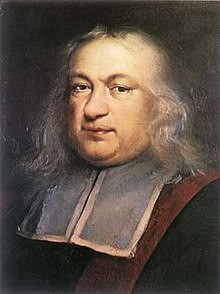
Pierre de Fermat (1607 – 1655)

Since it’s soon time to start derivatives, today we look at one way people found maximums and minimums before calculus was invented. Pierre de Fermat (1607 – 1655) was a French lawyer. His hobby, so to speak, was mathematics. He is considered one of the people who built the foundations of calculus. Along with Descartes, he did a lot of the early work on analytic geometry and did much work leading to calculus, which today we would consider calculus. Neither he nor other mathematicians of his time had the tool of limits to aid him. Derivatives were not yet invented. Nevertheless, he came awfully close to both.

Fermat was working on optimization and that required him to find the maximum or minimum values of functions. Here is how he found extreme values of polynomial functions. Even though he didn’t know limits and derivatives, maybe he used them.

Using Fermat’s method, and some modern notation and terminology, we will demonstrate has method by finding the extreme values of the function:

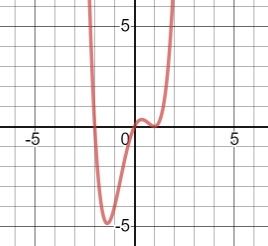
(1)          \displaystyle f\left( x \right)={{x}^{4}}-3{{x}^{2}}+2x               

Near an extreme value Fermat reasoned that a horizontal line would intersect the graph in two points, say where x = a and x = b. (There is a third intersection on this function, since there are three extreme points. The method finds all three.) He thought of this line moving up or down and the two points coming close to the extreme value. Since these two points are on the same horizontal line f(a) = f(b):

(2)          {{a}^{4}}-3{{a}^{2}}+2a={{b}^{4}}-3{{b}^{2}}+2b

After moving everything to the left side and grouping terms by their powers and factoring we have:

(3)          \displaystyle \left( {{{a}^{4}}-{{b}^{4}}} \right)-3\left( {{{a}^{2}}-{{b}^{2}}} \right)+2\left( {a-b} \right)=0

(4)          \displaystyle \left( {a-b} \right)\left( {\left( {a+b} \right)\left( {{{a}^{2}}+{{b}^{2}}} \right)-3\left( {a+b} \right)+2} \right)=0

Near where a = b, (a – b) is not zero, so we may divide by it.

(5)          \displaystyle \left( {a+b} \right)\left( {{{a}^{2}}+{{b}^{2}}} \right)-3\left( {a+b} \right)+2=0

Again, near the extreme value \displaystyle a\approx b, so, substituting  \displaystyle a=b we have

(6)          \displaystyle 2a\left( {2{{a}^{2}}} \right)-3\left( {2a} \right)+2=4{{a}^{3}}-6a+2\approx 0

Now all that remains is to solve this equation (factoring by synthetic division).

(7)          \displaystyle 4{{a}^{3}}-6a+2=2\left( {a-1} \right)\left( {2{{a}^{2}}+2a-1} \right)=0

(8)          \displaystyle a=1,a=\frac{{-1+\sqrt{3}}}{2},a=\frac{{-1-\sqrt{3}}}{2}

These are the x-coordinates of the critical points.


Now, let’s look at all the “calculus” Fermat did not do.

The left side of equations (3) and (4) are

(9)          \displaystyle f\left( a \right)-f\left( b \right)

And after dividing this by (a – b) he had in (5)

(10)         \displaystyle \frac{{f\left( a \right)-f\left( b \right)}}{{a-b}}

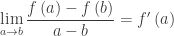
Then by letting a be approximately equal to b, which sounds a lot like finding a limit, he had in modern terms

(11)         \displaystyle \underset{{a\to b}}{\mathop{{\lim }}}\,\frac{{f\left( a \right)-f\left( b \right)}}{{a-b}}={f}'\left( a \right)

Expression (6) is \displaystyle {f}'\left( a \right) – Fermat unknowingly is using the derivative! After which he set it equal to 0 and solved to find the x-coordinates of the critical points.

So, did he or didn’t he use calculus? You decide.


Then there is this – Existence Theorems

Existence Theorems

An existence theorem is a theorem that says, if the hypotheses are met, that something, usually a number, must exist.

For example, the Mean Value Theorem is an existence theorem: If a function f is defined on the closed interval [a, b] and differentiable on the open interval (a, b), then there exists a number c in the open interval (a, b) such that \displaystyle {f}'\left( c \right)\left( {b-a} \right)=f\left( b \right)-f\left( a \right).

The phrase “there exists” can also mean “there is” and “there is at least one.” In fact, it is a good idea when seeing an existence theorem to reword it using each of these other phrases. “There is at least one” reminds you that there may be more than one number that satisfies the condition. The mathematical symbol for these phrases is an upper-case E written backwards: \displaystyle \exists .

Textbooks, after presenting an existence theorem, usually follow-up with some exercises asking students to find the value for a given function on a given interval: “Find the value of c guaranteed by the Mean Value Theorem for the function … on the interval ….” These exercises may help students remember the formula involved but are not very useful otherwise.

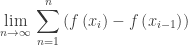
The important thing about most existence theorems is that the number exists, not what the number is. To illustrate this, let’s consider the Fundamental Theorem of Calculus. After partitioning the interval [a, b] into subintervals at various values, xi, we consider the limit of the sum

\displaystyle \underset{{n\to \infty }}{\mathop{{\lim }}}\,\sum\limits_{{n=1}}^{n}{{\left( {f\left( {{{x}_{i}}} \right)-f\left( {{{x}_{{i-1}}}} \right)} \right)}}.

Write out a few terms and you will see that is a telescoping series and its limit is \displaystyle f\left( b \right)-f\left( a \right).

The expression \displaystyle {f\left( {{{x}_{i}}} \right)-f\left( {{{x}_{{i-1}}}} \right)} resembles the right side of the Mean Value Theorem above. Since all the conditions are met, the MVT tells us that in each subinterval \displaystyle [{{x}_{{i-1}}},{{x}_{i}}] there exists a number, call it ci , such that

\displaystyle {f}'\left( {{{c}_{i}}} \right)\left( {{{x}_{i}}-{{x}_{{i-1}}}} \right)=f\left( {{{x}_{i}}} \right)-f\left( {{{x}_{{i-1}}}} \right) and therefore

\displaystyle \underset{{n\to \infty }}{\mathop{{\lim }}}\,\sum\limits_{{n=1}}^{n}{{\left( {f\left( {{{x}_{i}}} \right)-f\left( {{{x}_{{i-1}}}} \right)} \right)}}=\underset{{n\to \infty }}{\mathop{{\lim }}}\,\sum\limits_{{n=1}}^{n}{{{f}'\left( {{{c}_{i}}} \right)\left( {{{x}_{i}}-{{x}_{{i-1}}}} \right)}}=f\left( b \right)-f\left( a \right)

No one is concerned what these ci are, just that there are such numbers, that they exist. (The second limit above is then defined as the definite integral so \displaystyle \underset{{n\to \infty }}{\mathop{{\lim }}}\,\sum\limits_{{n=1}}^{n}{{{f}'\left( {{{c}_{i}}} \right)\left( {{{x}_{i}}-{{x}_{{i-1}}}} \right)}}=\int_{a}^{b}{{{f}'\left( x \right)dx=}}f\left( b \right)-f\left( a \right) – The Fundamental Theorem of Calculus.)

Other important existence theorems in calculus

The Intermediate Value Theorem

If f is continuous on the interval [a, b] and M is any number between f(a) and f(b), then there exists a number c in the open interval (a, b) such that f(c) = M.

If f is continuous on an interval and f changes sign in the interval, then there must be at least one number c in the interval such that f(c) = 0

Extreme Value Theorem

If f is continuous on the closed interval [a, b], then there exists a number c in [a, b] such that \displaystyle f\left( c \right)\ge f\left( x \right) for all x in the interval. Every function continuous on a closed interval has (i.e. there exists) a maximum value in the interval.

If f is continuous on the closed interval [a, b], then there exists a number c in [a, b] such that \displaystyle f\left( c \right)\le f\left( x \right) for all x in the interval. Every function continuous on a closed interval has (i.e. there exists) a minimum value in the interval.

Critical Points

If f is differentiable on a closed interval and \displaystyle {f}'\left( x \right) changes sign in the interval, then there exists a critical point in the interval.

Rolle’s theorem

If a function f is defined on the closed interval [a, b] and differentiable on the open interval (a, b) and f(a) = f(b), then there must exist a number c in the open interval (a, b) such that \displaystyle {f}'\left( c \right)=0.

MVT – other forms

If I drive a car continuously for 150 miles in three hours, then there is a time when my speed was exactly 50 mph.

If a function f is defined on the closed interval [a, b] and differentiable on the open interval (a, b), then there is a point on the graph of f where the tangent line is parallel to the segment between the endpoints.

Taylor’s Theorem

If f is a function with derivatives through order n + 1 on an interval I containing a, then, for each x in I , there exists a number c between x and a such that

\displaystyle f\left( x \right)=\sum\limits_{k=0}^{n}{\frac{{{f}^{\left( k \right)}}\left( a \right)}{k!}{{\left( x-a \right)}^{k}}}+\frac{{{f}^{\left( n+1 \right)}}\left( c \right)}{\left( n+1 \right)!}{{\left( x-a \right)}^{n+1}}

The number \displaystyle R=\frac{{{f}^{\left( n+1 \right)}}\left( c \right)}{\left( n+1 \right)!}{{\left( x-a \right)}^{n+1}} is called the remainder. The equation above says that if you can find the correct c the function is exactly equal to Tn(x) + R. Notice the form of the remainder is the same as the other terms, except it is evaluated at the mysterious c. The trouble is we almost never can find the c without knowing the exact value of f(x), but; if we knew that, there would be no need to approximate. However, often without knowing the exact values of c, we can still approximate the value of the remainder and thereby, know how close the polynomial Tn(x) approximates the value of f(x) for values in x in the interval, i. See Error Bounds and the Lagrange error bound.

Cogito, ergo sum

And finally, we have Descartes’ famous “theorem” Cogito, ergo sum (in Latin) or the original French, Je pense, donc je suis, translated as “I think, therefore I am” proving his own existence.


An Exploration in Differential Equations

This is an exploration based on the AP Calculus question 2018 AB 6. I originally posed it for teachers last summer. This will make, I hope, a good review of many of the concepts and techniques students have learned during the year. The exploration, which will take an hour or more, includes these topics:

  • Finding the general solution of the differential equation by separating the variables
  • Checking the solution by substitution
  • Using a graphing utility to explore the solutions for all values of the constant of integration, C
  • Finding the solutions’ horizontal and vertical asymptotes
  • Finding several particular solutions
  • Finding the domains of the particular solutions
  • Finding the extreme value of all solutions in terms of C
  • Finding the second derivative (implicit differentiation)
  • Considering concavity
  • Investigating a special case or two

I also hope that in working through this exploration students will learn not so much about this particular function, but how to use the tools of algebra, calculus, and technology to fully investigate any function and to find all its foibles.

The exploration is here in a PDF file. Here are the solutions.

As always, I appreciate your feedback and comments. Please share them with me using the reply box below.


The College Board is pleased to offer a new live online event for new and experienced AP Calculus teachers on March 5th at 7:00 PM Eastern.

I will be the presenter.

The topic will be AP Calculus: How to Review for the Exam:  In this two-hour online workshop, we will investigate techniques and hints for helping students to prepare for the AP Calculus exams. Additionally, we’ll discuss the 10 type questions that appear on the AP Calculus exams, and what students need know and to be able to do for each. Finally, we’ll examine resources for exam review.

Registration for this event is $30/members and $35/non-members. You can register for the event by following this link: http://eventreg.collegeboard.org/d/xbqbjz


Foreshadowing the MVT

The Mean Value Theorem (MVT) is proved by writing the equation of a function giving the (directed) length of a segment from the given function to the line between the endpoints as you can see here. Since the function and the line intersect at the endpoints of the interval this function satisfies the hypotheses of Rolle’s theorem and so the MVT follows directly. This means that the derivative of the distance function is zero at the points guaranteed by the MVT. Therefore, these values must also be the location of the local extreme values (maximums and minimums) of the distance function on the open interval. *

Here is an exploration with three similar examples that use this idea to foreshadow the MVT. You, of course, can use your own favorite function. Any differentiable function may be used, in which case a CAS calculator may be helpful. Answers are at the end.

First example:

Consider the function f(x)=x+2\sin (\pi x) defined on the closed interval [–1,3]

  1. Write the equation of the line through the endpoints of the function.
  2. Write an expression for h(x) the vertical distance between f(x) and the line found in part 1.
  3. Find the x-coordinates of the local extreme values of h(x) on the open interval (–1,3).
  4. Find the slope of f(x) at the values found in part 3.
  5. Compare your answer to part 4 with the slope of the line. Is this a coincidence?

Second example: slightly more difficult than the first.

Consider the function f\left( x \right)=1+x+2\cos \left( x \right) defined on the closed interval \left[ {\tfrac{\pi }{2},\tfrac{{9\pi }}{2}} \right]

  1. Write the equation of the line through the endpoints of the function.
  2. Write an expression for h(x) the vertical distance between f(x) and the line found in part 1.
  3. Find the x-coordinates of the local extreme values of h(x) on the open interval \left( {\tfrac{\pi }{2},\tfrac{{9\pi }}{2}} \right)
  4. Find the slope of f(x) at the values found in part 3.
  5. Compare your answer to part 4 with the slope of the line. Is this a coincidence?

Third example: In case you think I cooked the numbers

Consider the function \displaystyle f(x)={{x}^{3}} defined on the closed interval \displaystyle [-4.5]

  1. Write the equation of the line thru the endpoints of the function.
  2. Write an expression for h(x) the vertical distance between f(x) and the line found in part 1.
  3. Find the x-coordinates of the local extreme values of h(x) on the open interval \displaystyle (-4,5)
  4. Find the slope of f(x) at the values found in part 3.
  5. Compare your answer to part 4 with the slope of the line. Is this a coincidence?

Answers

First example:

  1. y = x
  2. \displaystyle h(x)=f(x)-y(x)=\left( {x+2\sin (\pi x)} \right)-\left( x \right)=2\sin (\pi x)
  3. {h}'\left( x \right)=2\pi \cos \left( {\pi x} \right)=0 when x = –1/2, ½, 3/2 and 5/2
  4. \displaystyle {f}'\left( x \right)=1+2\pi \cos \left( {\pi x} \right), the slope = 1 at all four points
  5. They are the same. Not a coincidence.

Second example:

  1. The endpoints are \left( {\tfrac{\pi }{2},1+\tfrac{\pi }{2}} \right) and \left( {\tfrac{{9\pi }}{2},1+\tfrac{{9\pi }}{2}} \right); the line is y=x+1
  2. h\left( x \right)=f\left( x \right)-y\left( x \right)=\left( {1+x+2\cos (x)} \right)-\left( {x+1} \right)=2\cos \left( x \right)
  3. {h}'\left( x \right)-2\sin (x)=0 when x=\pi ,2\pi ,3\pi ,\text{ and }4\pi
  4. {f}'\left( x \right)=1-2\sin \left( x \right), at the points above the slope is 1.
  5. They are the same. Not a coincidence.

Third example:

  1. The endpoints are (-4, -64) and (5, 125), the line is \displaystyle y=125+21(x-5)=21x+20
  2. \displaystyle h(x)={{x}^{3}}-21x-20
  3. \displaystyle {h}'(x)=3{{x}^{2}}-21=0 when \displaystyle x=\sqrt{7},-\sqrt{7}
  4. \displaystyle {f}'\left( {\pm \sqrt{7}} \right)=3{{\left( {\pm \sqrt{7}} \right)}^{2}}=21
  5. They are the same. Not a coincidence.

* It is possible that the derivative is zero and the point is not an extreme value. This is similar to the situation with a point of inflection when the first derivative is zero but does not change sign.