Adapting 2021 AB 4 / BC 4

Four of nine. Continuing the series started in the last three posts, this post looks at the AP Calculus 2021 exam question AB 4 / BC 4. The series considers each question with the aim of showing ways to use the question with your class as is, or by adapting and expanding it.  Like most of the AP Exam questions there is a lot more you can ask from the stem and a lot of other calculus you can discuss.

2021 AB 4 / BC 4

This is a Graph Analysis Problem (type 3) and contains topics from Units 2, 4, and 6 of the current Course and Exam Description. The things that are asked in these questions should be easy for the students, however each year the scores are low. This may be because some textbooks simply do not give students problems like this. Therefore, supplementing with graph analysis questions from past exams is necessary.

There are many additional questions that can be asked based on this stem and the stems of similar problems. Usually, the graph of the derivative is given, and students are asked questions about the graph of the function. See Reading the Derivative’s Graph.

Some years this question is given a context, such as the graph is the velocity of a moving particle. Occasionally there is no graph and an expression for the derivative or function is given.

Here is the 2021 AB 4 / BC 4 stem:

The first thing students should do when they see G\left( x \right)=\int_{0}^{x}{{f\left( t \right)}}dt is to write prominently on their answer page {G}'\left( x \right)=f\left( x \right) and \displaystyle {G}''\left( x \right)={f}'\left( t \right). While they may understand and use this, they must say it.

Part (a): Students were asked for the open intervals where the graph is concave up and to give a reason for their answer. (Asking for an open interval is to remove any concern about the endpoints being included or excluded, a place where textbooks differ. See Going Up.)

Discussion and ideas for adapting this question:

  • Using this or similar graphs go through each of these with your class until the answers and reasons become automatic. There are quite a few other things that may be asked here based on the derivative.
    • Where is the function increasing?
    • Decreasing?
    • Concave down, concave up?
    • Where are the local extreme values?
    • What are the local extreme values?
    • Where are the absolute extreme values?
    • What are the absolute extreme values?
  • There are also integration questions that may be asked, such as finding the value of the functions at various points, such as G(1) = 2 found by using the areas of the regions. Also, questions about the local extreme values and the absolute extreme value including their values. These questions are answered by finding the areas of the regions enclosed by the derivative’s graph and the x-axis. Parts (b) and (c) do some of this.
  • Choose different graphs, including one that has the derivative’s extreme value on the x­-axis. Ask what happens there.

Part (b): A new function is defined as the product of G(x) and f(x) and its derivative is to be found at a certain value of x. To use the product rule students must calculate the value of G(x) by using the area between f(x) and the x-­axis and the value of {f}'\left( x \right) by reading the slope of f(x) from the graph.

Discussion and ideas for adapting this question:

  • This is really practice using the product rule. Adapt the problem by making up functions using the quotient rule, the chain rule etc. Any combination of \displaystyle G,{G}',{G}'',f,{f}',\text{ or }{f}'' may be used. Before assigning your own problem, check that all the values can be found from the given graph.
  • Different values of x may be used.

Part (c): Students are asked to find a limit. The approach is to use L’Hospital’s Rule.

Discussion and ideas for adapting this question:

  • To use L’Hospital’s Rule, students must first show clearly on their paper that the limit of the numerator and denominator are both zero or +/- infinity. Saying the limit is equal to 0/0 is considered bad mathematics and will not earn this point. Each limit should be shown separately on the paper, before applying L’Hospital’s Rule.
  • Variations include a limit where L’Hospital’s Rule does not apply. The limit is found by substituting the values from the graph.
  • Another variation is to use a different expression where L’Hospital’s Rule applies, but still needs values read from the graph.

Part (d): The question asked to find the average rate of change (slope between the endpoints) on an interval and then determine if the Mean Value Theorem guarantees a place where \displaystyle {G}' equals this value. Students also must justify their answer.

Discussion and ideas for adapting this question:

  • To justify their answer students must check that the hypotheses of the MVT are met and say so in their answer.
  • Adapt by using a different interval where the MVT applies.
  • Adapt by using an interval where the MVT does not apply and (1) the conclusion is still true, or (b) where the conclusion is false.

Next week 2021 AB 5.

I would be happy to hear your ideas for other ways to use this questions. Please use the reply box below to share your ideas.


Infinite Sequences and Series – Unit 10

Unit 10 covers sequences and series. These are BC only topics (CED – 2019 p. 177 – 197). These topics account for about 17 – 18% of questions on the BC exam.

Topics 10.1 – 10.2

Topic 10.1: Defining Convergent and Divergent Series.

Topic 10. 2: Working with Geometric Series. Including the formula for the sum of a convergent geometric series.

Topics 10.3 – 10.9 Convergence Tests

The tests listed below are tested on the BC Calculus exam. Other methods are not tested. However, teachers may include additional methods.

Topic 10.3: The nth Term Test for Divergence.

Topic 10.4: Integral Test for Convergence. See Good Question 14

Topic 10.5: Harmonic Series and p-Series. Harmonic series and alternating harmonic series, p-series.

Topic 10.6: Comparison Tests for Convergence. Comparison test and the Limit Comparison Test

Topic 10.7: Alternating Series Test for Convergence.

Topic 10.8: Ratio Test for Convergence.

Topic 10.9: Determining Absolute and Conditional Convergence. Absolute convergence implies conditional convergence.

Topics 10.10 – 10.12 Taylor Series and Error Bounds

Topic 10.10: Alternating Series Error Bound.

Topic 10.11: Finding Taylor Polynomial Approximations of a Function.

Topic 10.12: Lagrange Error Bound.

Topics 10.13 – 10.15 Power Series

Topic 10.13: Radius and Interval of Convergence of a Power Series. The Ratio Test is used almost exclusively to find the radius of convergence. Term-by-term differentiation and integration of a power series gives a series with the same center and radius of convergence. The interval may be different at the endpoints.

Topic 10.14: Finding the Taylor and Maclaurin Series of a Function. Students should memorize the Maclaurin series for \displaystyle \frac{1}{{1-x}}, sin(x), cos(x), and ex.

Topic 10.15: Representing Functions as Power Series. Finding the power series of a function by, differentiation, integration, algebraic processes, substitution, or properties of geometric series.


Timing

The suggested time for Unit 9 is about 17 – 18 BC classes of 40 – 50-minutes, this includes time for testing etc.


Previous posts on these topics:

Before sequences

Amortization Using finite series to find your mortgage payment. (Suitable for pre-calculus as well as calculus)

A Lesson on Sequences An investigation, which could be used as early as Algebra 1, showing how irrational numbers are the limit of a sequence of approximations. Also, an introduction to the Completeness Axiom. 

Everyday Series

Convergence Tests

Reference Chart

Which Convergence Test Should I Use? Part 1 Pretty much anyone you want!

Which Convergence Test Should I Use? Part 2 Specific hints and a discussion of the usefulness of absolute convergence

Good Question 14 on the Integral Test

Sequences and Series

Graphing Taylor Polynomials Graphing calculator hints

Introducing Power Series 1

Introducing Power Series 2

Introducing Power Series 3

New Series from Old 1 substitution (Be sure to look at example 3)

New Series from Old 2 Differentiation

New Series from Old 3 Series for rational functions using long division and geometric series

Geometric Series – Far Out An instructive “mistake.”

A Curiosity An unusual Maclaurin Series

Synthetic Summer Fun Synthetic division and calculus including finding the (finite)Taylor series of a polynomial.

Error Bounds

Error Bounds Error bounds in general and the alternating Series error bound, and the Lagrange error bound

The Lagrange Highway The Lagrange error bound. 

What’s the “Best” Error Bound?

Review Notes

Type 10: Sequences and Series Questions


Integration and Accumulation of Change – Unit 6

Unit 6 develops the ideas behind integration, the Fundamental Theorem of Calculus, and Accumulation. (CED – 2019 p. 109 – 128 ). These topics account for about 17 – 20% of questions on the AB exam and 17 – 20% of the BC questions.

Topics 6.1 – 6.4 Working up to the FTC

Topic 6.1 Exploring Accumulations of Change Accumulation is introduced through finding the area between the graph of a function and the x-axis. Positive and negative rates of change, unit analysis.

Topic 6.2 Approximating Areas with Riemann Sums Left-, right-, midpoint Riemann sums, and Trapezoidal sums, with uniform partitions are developed. Approximating with numerical methods, including use of technology are considered. Determining if the approximation is an over- or under-approximation.

Topic 6.3 Riemann Sums, Summation Notation and the Definite Integral. The definition integral is defined as the limit of a Riemann sum.

Topic 6.4 The Fundamental Theorem of Calculus (FTC) and Accumulation Functions Functions defined by definite integrals and the FTC.

Topic 6.5 Interpreting the Behavior of Accumulation Functions Involving Area Graphical, numerical, analytical, and verbal representations.

Topic 6.6 Applying Properties of Definite Integrals Using the properties to ease evaluation, evaluating by geometry and dealing with discontinuities.

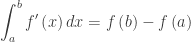
Topic 6.7 The Fundamental Theorem of Calculus and Definite Integrals  Antiderivatives. (Note: I suggest writing the FTC in this form \displaystyle \int_{a}^{b}{{{f}'\left( x \right)}}dx=f\left( b \right)-f\left( a \right) because it seem more efficient then using upper case and lower case f.)

Topics 6.5 – 6.14 Techniques of Integration

Topic 6.8 Finding Antiderivatives and Indefinite Integrals: Basic Rules and Notation. Using basic differentiation formulas to find antiderivatives. Some functions do not have closed-form antiderivatives. (Note: While textbooks often consider antidifferentiation before any work with integration, this seems like the place to introduce them. After learning the FTC students have a reason to find antiderivatives. See Integration Itinerary

Topic 6.9 Integration Using Substitution The u-substitution method. Changing the limits of integration when substituting.

Topic 6.10 Integrating Functions Using Long Division and Completing the Square 

Topic 6.11 Integrating Using Integration by Parts  (BC ONLY)

Topic 6.12 Integrating Using Linear Partial Fractions  (BC ONLY)

Topic 6.13 Evaluating Improper Integrals (BC ONLY) Showing the work requires students to show correct limit notation.

Topic 6.14 Selecting Techniques for Antidifferentiation This means practice, practice, practice.


Timing

The suggested time for Unit 6 is  18 – 20 classes for AB and 15 – 16 for BC of 40 – 50-minute class periods, this includes time for testing etc.


Previous posts on these topics include:

Introducing Integration

Integration Itinerary

The Old Pump and Flying to Integrationland   Two introductory explorations

Working Towards Riemann Sums

Riemann Sums

The Definition of the Definite Integral

Foreshadowing the FTC 

The Fundamental Theorem of Calculus

More About the FTC

Y the FTC?

Area Between Curves

Under is a Long Way Down 

Properties of Integrals 

Trapezoids – Ancient and Modern  On Trapezoid sums

Good Question 9 – Riemann Reversed   Given a Riemann sum can you find the Integral it converges to?  A common and difficult AP Exam problem

Accumulation

Accumulation: Need an Amount?

Good Question 7 – 2009 AB 3

Good Question 8 – or Not?  Unit analysis

AP Exams Accumulation Question    A summary of accumulation ideas.

Graphing with Accumulation 1

Graphing with Accumulation 2

Accumulation and Differential Equations 

Painting a Point

Techniques of Integrations (AB and BC)

Antidifferentiation

Why Muss with the “+C”?

Good Question 13  More than one way to skin a cat.

Integration by Parts – a BC Topic

Integration by Parts 1

Integration by Part 2

Parts and More Parts

Good Question 12 – Parts with a Constant?

Modified Tabular Integration 

Improper Integrals and Proper Areas

Math vs the Real World Why \displaystyle \int_{{-\infty }}^{\infty }{{\frac{1}{x}}}dx does not converge.


Here are links to the full list of posts discussing the ten units in the 2019 Course and Exam Description.

2019 CED – Unit 1: Limits and Continuity

2019 CED – Unit 2: Differentiation: Definition and Fundamental Properties.

2019 CED – Unit 3: Differentiation: Composite , Implicit, and Inverse Functions

2019 CED – Unit 4 Contextual Applications of the Derivative  Consider teaching Unit 5 before Unit 4

2019 – CED Unit 5 Analytical Applications of Differentiation  Consider teaching Unit 5 before Unit 4

2019 – CED Unit 6 Integration and Accumulation of Change

2019 – CED Unit 7 Differential Equations  Consider teaching after Unit 8

2019 – CED Unit 8 Applications of Integration   Consider teaching after Unit 6, before Unit 7

2019 – CED Unit 9 Parametric Equations, Polar Coordinates, and Vector-Values Functions 

2019 CED Unit 10 Infinite Sequences and Series


Riemann Sum & Table Problems (Type 5)

AP  Questions Type 5: Riemann Sum & Table Problems

Tables may be used to test a variety of ideas in calculus including analysis of functions, accumulation, theory and theorems, and position-velocity-acceleration, among others. Numbers and working with numbers is part of the Rule of Four and table problems are one way this is tested. This question often includes an equation in a  latter part of the problem that refers to the same situation.

 What students should be able to do:

  • Find the average rate of change over an interval
  • Approximate the derivative using a difference quotient. Use the two values closest to the number at which you are approximating.  This amounts to finding the slope or rate of change. Show the quotient even if you can do the arithmetic in your head and even if  the denominator is 1.
  • Use a left-, right-, or midpoint- Riemann sums or a trapezoidal approximation to approximate the value of a definite integral using values in the table (typically with uneven subintervals). The Trapezoidal Rule, per se, is not required; it is expected that students will add the areas of a small number of trapezoids without reference to a formula.
  • Average value, average rate of change, Rolle’s theorem, the Mean Value Theorem and the Intermediate Value Theorem. (See 2007 AB 3 – four simple parts that could be multiple-choice questions; the mean on this question was 0.96 out of a possible 9.)
  • These questions are usually presented in some context and answers should be in that context. The context may be something growing (changing over time) or linear motion.
  • Use the table to find a value based on the Mean Value Theorem (2018 AB 4(b)) or Intermediate Value Theorem.
  • One of the parts of this question asks a related question based on a function given by an equation.
  • Unit analysis.

Do’s and Don’ts

Do: Remember that you do not know what happens between the values in the table unless some other information is given. For example, do not assume that the largest number in the table is the maximum value of the function, or that the function is decreasing between two values just because a value is less than the preceding value.

Do: Show what you are doing even if you can do it in your head. If you’re finding a slope, show the quotient even if the denominator is 1.

Do Not do arithmetic: A long expression consisting entirely of numbers such as you get when doing a Riemann sum, does not need to be simplified in any way. If you a simplify correct answer incorrectly, you will lose credit.

Do Not leave expression such as R(3) – pull its numerical value from the table.

Do Not: Find a regression equation and then use that to answer parts of the question. While regression is perfectly good mathematics, regression equations are not one of the four things students may do with their calculator. Regression gives only an approximation of our function. The exam is testing whether students can work with numbers.


This question typically covers topics from Unit 6 of the 2019 CED but may include topics from Units 2, 3, and 4 as well.


Free-response examples:

  • 2007 AB 3 (4 simple parts on various theorems, yet the mean score was 0.96 out of 9),
  • 2017 AB 1/BC 1, and AB 6,
  • 2016 AB 1/BC 1
  • 2018 AB 4

Multiple-choice questions from non-secure exams:

  • 2012 AB 8, 86, 91
  • 2012 BC 8, 81, 86  (81 and 86 are the same on both the AB and BC exams)


Revised March 12, 2021


2019 CED Unit 6: Integration and Accumulation of Change

Unit 6 develops the ideas behind integration, the Fundamental Theorem of Calculus, and Accumulation. (CED – 2019 p. 109 – 128 ). These topics account for about 17 – 20% of questions on the AB exam and 17 – 20% of the BC questions.

Topics 6.1 – 6.4 Working up to the FTC

Topic 6.1 Exploring Accumulations of Change Accumulation is introduced through finding the area between the graph of a function and the x-axis. Positive and negative rates of change, unit analysis.

Topic 6.2 Approximating Areas with Riemann Sums Left-, right-, midpoint Riemann sums, and Trapezoidal sums, with uniform partitions are developed. Approximating with numerical methods, including use of technology are considered. Determining if the approximation is an over- or under-approximation.

Topic 6.3 Riemann Sums, Summation Notation and the Definite Integral. The definition integral is defined as the limit of a Riemann sum.

Topic 6.4 The Fundamental Theorem of Calculus (FTC) and Accumulation Functions Functions defined by definite integrals and the FTC.

Topic 6.5 Interpreting the Behavior of Accumulation Functions Involving Area Graphical, numerical, analytical, and verbal representations.

Topic 6.6 Applying Properties of Definite Integrals Using the properties to ease evaluation, evaluating by geometry and dealing with discontinuities.

Topic 6.7 The Fundamental Theorem of Calculus and Definite Integrals Antiderivatives. (Note: I suggest writing the FTC in this form \displaystyle \int_{a}^{b}{{{f}'\left( x \right)}}dx=f\left( b \right)-f\left( a \right) because it seems more efficient than using upper case and lower-case f.)

Topics 6.5 – 6.14 Techniques of Integration

Topic 6.8 Finding Antiderivatives and Indefinite Integrals: Basic Rules and Notation. Using basic differentiation formulas to find antiderivatives. Some functions do not have closed-form antiderivatives. (Note: While textbooks often consider antidifferentiation before any work with integration, this seems like the place to introduce them. After learning the FTC students have a reason to find antiderivatives. See Integration Itinerary

Topic 6.9 Integration Using Substitution The u-substitution method. Changing the limits of integration when substituting.

Topic 6.10 Integrating Functions Using Long Division and Completing the Square 

Topic 6.11 Integrating Using Integration by Parts (BC ONLY)

Topic 6.12 Integrating Using Linear Partial Fractions (BC ONLY)

Topic 6.13 Evaluating Improper Integrals (BC ONLY) Showing the work requires students to show correct limit notation.

Topic 6.14 Selecting Techniques for Antidifferentiation This means practice, practice, practice.


Timing

The suggested time for Unit 6 is  18 – 20 classes for AB and 15 – 16 for BC of 40 – 50-minute class periods, this includes time for testing etc.


Previous posts on these topics include:

Introducing the Derivative

Integration Itinerary

The Old Pump and Flying to Integrationland   Two introductory explorations

Working Towards Riemann Sums

Riemann Sums

The Definition of the Definite Integral

Foreshadowing the FTC 

The Fundamental Theorem of Calculus

More About the FTC

Y the FTC?

Area Between Curves

Under is a Long Way Down 

Properties of Integrals 

Trapezoids – Ancient and Modern  On Trapezoid sums

Good Question 9 – Riemann Reversed   Given a Riemann sum can you find the Integral it converges to?  A common and difficult AP Exam problem

Accumulation

Accumulation: Need an Amount?

Good Question 7 – 2009 AB 3

Good Question 8 – or Not?  Unit analysis

AP Exams Accumulation Question    A summary of accumulation ideas.

Graphing with Accumulation 1

Graphing with Accumulation 2

Accumulation and Differential Equations 

Painting a Point

Techniques of Integrations (AB and BC)

Antidifferentiation

Why Muss with the “+C”?

Good Question 13  More than one way to skin a cat.

Integration by Parts – a BC Topic

Integration by Parts 1

Integration by Part 2

Parts and More Parts

Good Question 12 – Parts with a Constant?

Modified Tabular Integration 

Improper Integrals and Proper Areas

Math vs the Real World Why \displaystyle \int_{{-\infty }}^{\infty }{{\frac{1}{x}}}dx does not converge.


Here are links to the full list of posts discussing the ten units in the 2019 Course and Exam Description.

2019 CED – Unit 1: Limits and Continuity

2019 CED – Unit 2: Differentiation: Definition and Fundamental Properties.

2019 CED – Unit 3: Differentiation: Composite , Implicit, and Inverse Functions

2019 CED – Unit 4 Contextual Applications of the Derivative  Consider teaching Unit 5 before Unit 4

2019 – CED Unit 5 Analytical Applications of Differentiation  Consider teaching Unit 5 before Unit 4

2019 – CED Unit 6 Integration and Accumulation of Change

2019 – CED Unit 7 Differential Equations  Consider teaching after Unit 8

2019 – CED Unit 8 Applications of Integration   Consider teaching after Unit 6, before Unit 7

2019 – CED Unit 9 Parametric Equations, Polar Coordinates, and Vector-Values Functions 

2019 CED Unit 10 Infinite Sequences and Series


Y the FTC?

So, you’ve finally proven the Fundamental Theorem of Calculus and have written on the board:

\displaystyle \int_{a}^{b}{{{f}'\left( x \right)dx=f\left( b \right)-f\left( a \right)}}

And the students ask, “What good is that?” and “When are we ever going to use that?” Here’s your answer.

There are two very important uses of this theorem. Show them BOTH uses right away to help your students see why the FTC is so useful and important.

First, in words the theorem says that “the integral of a rate of change is the net amount of change.” So, if you are given a rate of change (as you are every year on the AP Calculus exam) and asked to find the amount of change (as you are every year on the AP Calculus exam), this is what you use, Show an example such as 2015 AB 1/BC1 that states,

“The rate at which rainwater flows into a drain pipe is modeled by the function R, where R\left( t \right)=20\sin \left( {\frac{{{{t}^{2}}}}{{35}}} \right) cubic feet per hour….

“(a) How many cubic feet of rainwater flow into the pipe during the 8-hour time interval ?”

The answer is of course, \displaystyle \int_{0}^{8}{{20\sin \left( {\frac{{{{t}^{2}}}}{{35}}} \right)dt}}. (Which they will soon learn how to evaluate.)

Second, a more immediate use is to avoid all that work you’ve been doing setting up Riemann sums and finding their limits. No more of that! Give them this integral to evaluate:

\displaystyle \int_{2}^{7}{{2xdx}}

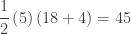
Draw the trapezoid representing the area between the graph of y=2x and the x-axis on the interval [2,7] and find its area =  \displaystyle \frac{1}{2}\left( 5 \right)\left( {18+4} \right)=45
Then ask, “Does anyone know of a function whose derivative is 2x?” Let them think for a minute and someone will say, “Yeah, it’s {{x}^{2}}”  And then show them

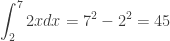
\displaystyle \int_{2}^{7}{{2xdx}}={{7}^{2}}-{{2}^{2}}=45

Then go for a harder one:  \displaystyle \int_{0}^{{\frac{\pi }{2}}}{{\cos \left( x \right)dx}}

“Does anyone know a function whose derivative is \cos \left( x \right)?”

“Why yes, it’s \sin \left( x \right)

So, \displaystyle \int_{0}^{{\frac{\pi }{2}}}{{\cos \left( x \right)dx}}=\sin \left( {\frac{\pi }{2}} \right)-\sin \left( 0 \right)=1-0=1

That was easy!

If you want to challenge them and review some functions of the “special angles” try this one:

\displaystyle \int_{{\frac{\pi }{6}}}^{{\frac{{4\pi }}{3}}}{{\cos \left( x \right)dx}}=\sin \left( {\frac{{4\pi }}{3}} \right)-\sin \left( {\frac{\pi }{6}} \right)=\frac{{\sqrt{3}}}{2}-\frac{1}{2}

Tie the two parts together: Look at the graph of y=\sin \left( x \right). How much does it change from 0 to \frac{\pi }{2}? How much does it change from \frac{\pi }{6} to \frac{{4\pi }}{3}?

Sum up, by looking ahead:

  1. “The function whose derivative is …” is called the antiderivative.
  2. Using antiderivatives to evaluate definite integrals is easy; the hard part is finding the antiderivatives, since they are not all as straightforward as the two examples above. So, next we need to spend a few weeks learning how to find antiderivatives.[1]
  3. Given a derivative, finding its antiderivative is also the start of solving differential equations. This, too, will soon be a concern in the course.

[1] As I’ve written before, this is where it seems logical place to teach antiderivatives. Now students have a reason to find them. Teaching antidifferentiation after differentiation, before integration, seems like an intellectual exercise. Sure, it’s fun, but now we have a need for it.


Riemann Sums – the Theory

The series of post leads up to the Fundamental theorem of Calculus (FTC). Obviously, a very important destination.

  1. Working Towards Riemann Sums
  2. Definition of the Definite Integral and the FTC – a more exact demonstration from last Friday’s post and The Fundamental Theorem of Calculus –  an older demonstration
  3. More about the FTC The derivative of a function defined by an integral – the other half of the FTC.
  4. Good Question 11 Riemann Reversed – How to find the integral, given the Riemann sum. A problem that appears on the AP Calculus exams and can be confusing for students, at first.
  5. Properties of Integrals
  6. Variation on a Theme – 2 Comparing Riemann sums
  7. Trapezoids – Ancient and Modern – some history.


Revised and updated October 22, 2018