Other Asymptotes

A few days ago, a reader asked if you could find the location of horizontal asymptotes from the derivative of a function. The answer, alas, is no. You can determine that a function has a horizontal asymptote from its derivative, but not where it is. This is because a function and its many possible vertical translations have the same derivative but different horizontal asymptotes. To locate it precisely, we need more information, an initial condition (a point on the curve).

I have written a post about the relationship between vertical asymptotes and the derivative of the function here. Today’s post will discuss horizontal asymptotes and their derivatives.

Definition: a straight line associated with a curve such that as a point moves along an infinite branch of the curve the distance from the point to the line approaches zero and the slope of the curve at the point approaches the slope of the line. (Merriam-Webster dictionary). Thus, asymptotes can be vertical, horizontal, or slanted.

Horizontal Asymptotes

Horizontal asymptotes are a form of end behavior: they appear as \displaystyle x\to \infty or \displaystyle x\to -\infty . Specifically, if a function has a horizontal asymptote(s), then \displaystyle \underset{{x\to \pm \infty }}{\mathop{{\lim }}}\,{f}'\left( x \right)=0,  At an asymptote, the curve must approach a horizontal line, therefore its slope must be approaching zero as \displaystyle x\to \infty or \displaystyle x\to -\infty .  The converse is not true: If the derivative approaches zero, the function may not have a horizontal asymptote. A counterexample is \displaystyle f\left( x \right)=\sqrt[3]{x}.

In the first four examples that follow, the derivative approaches 0 as \displaystyle x\to \infty and/or \displaystyle x\to -\infty

Example 1: \displaystyle {f}'\left( x \right)=\frac{1}{{1+{{x}^{2}}}}  (Figure 1 in blue).This is the derivative of \displaystyle f\left( x \right)={{\tan }^{{-1}}}(x),\ -\tfrac{\pi }{2}<f\left( x \right)<\tfrac{\pi }{2}. (Figure 1 in red). We see that the derivative approaches zero in both directions, this tells us that there may be horizontal asymptote(s). We must look at the function to find where they are: \displaystyle y=\tfrac{\pi }{2} and \displaystyle y=-\tfrac{\pi }{2}

Parametric Equations, Polar Coordinates, and Vector-Valued Functions – Unit 9

Unit 9 includes all the topics listed in the title. These are BC only topics (CED – 2019 p. 163 – 176). These topics account for about 11 – 12% of questions on the BC exam.

Comments on Prerequisites: In BC Calculus the work with parametric, vector, and polar equations is somewhat limited. I always hoped that students had studied these topics in detail in their precalculus classes and had more precalculus knowledge and experience with them than is required for the BC exam. This will help them in calculus, so see that they are included in your precalculus classes.

Topics 9.1 – 9.3 Parametric Equations

Topic 9.1: Defining and Differentiation Parametric Equations. Finding dy/dx in terms of dy/dt and dx/dt

Topic 9.2: Second Derivatives of Parametric Equations. Finding the second derivative. See Implicit Differentiation of Parametric Equations this discusses the second derivative.

Topic 9.3: Finding Arc Lengths of Curves Given by Parametric Equations. 

Topics 9.4 – 9.6 Vector-Valued Functions and Motion in the plane

Topic 9.4 : Defining and Differentiating Vector-Valued Functions. Finding the second derivative. See this A Vector’s Derivatives which includes a note on second derivatives. 

Topic 9.5: Integrating Vector-Valued Functions

Topic 9.6: Solving Motion Problems Using Parametric and Vector-Valued Functions. Position, Velocity, acceleration, speed, total distance traveled, and displacement extended to motion in the plane. 

Topics 9.7 – 9.9 Polar Equation and Area in Polar Form.

Topic 9.7: Defining Polar Coordinate and Differentiation in Polar Form. The derivatives and their meaning.

Topic 9.8: Find the Area of a Polar Region or the Area Bounded by a Single Polar Curve

Topic 9.9: Finding the Area of the Region Bounded by Two Polar Curves. Students should know how to find the intersections of polar curves to use for the limits of integration. 


Timing

The suggested time for Unit 9 is about 10 – 11 BC classes of 40 – 50-minutes, this includes time for testing etc.


Previous posts on these topics :

Parametric Equations

Vector Valued Functions

Polar Form

Graph Analysis Questions (Type 3)

AP  Questions Type 3: Graph Analysis

The long name is “Here’s the graph of the derivative, tell me things about the function.”

Students are given either the equation of the derivative of a function or a graph identified as the derivative of a function with no equation is given. It is not expected that students will write the equation of the function from the graph (although this may be possible); rather, students are expected to determine important features of the function directly from the graph of the derivative. They may be asked for the location of extreme values, intervals where the function is increasing or decreasing, concavity, etc. They may be asked for function values at points. They will be asked to justify their conclusions.

The graph may be given in context and student will be asked about that context. The graph may be identified as the velocity of a moving object and questions will be asked about the motion. See Linear Motion Problems (Type 2)

Less often the function’s graph may be given and students will be asked about its derivatives.

What students should be able to do:

  • Read information about the function from the graph of the derivative. This may be approached by derivative techniques or by antiderivative techniques.
  • Find and justify where the function is increasing or decreasing.
  • Find and justify extreme values (1st and 2nd derivative tests, Closed interval test a/k/a Candidates’ test).
  • Find and justify points of inflection.
  • Find slopes (second derivatives, acceleration) from the graph.
  • Write an equation of a tangent line.
  • Evaluate Riemann sums from geometry of the graph only. This usually involves familiar shapes such as triangles or semicircles.
  • FTC: Evaluate integral from the area of regions on the graph.
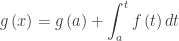
  • FTC: The function, g(x), maybe defined by an integral where the given graph is the graph of  the integrand, f(t), so students should know that if,

\displaystyle g\left( x \right)=g\left( a \right)+\int_{a}^{t}{f\left( t \right)dt} then  {g}'\left( x \right)=f\left( x \right)  and  {{g}'}'\left( x \right)={f}'\left( x \right).

In this case, students should write {g}'(t)=f\left( t \right) on their answer paper, so it is clear to the reader that they understand this.

Not only must students be able to identify these things, but they are usually asked to justify their answer and reasoning. See Writing on the AP Exams for more on justifying and explaining answers.

The ideas and concepts that can be tested with this type question are numerous. The type appears on the multiple-choice exams as well as the free-response. Between multiple-choice and free-response this topic may account for 15% or more of the points available on recent tests. It is very important that students are familiar with all the ins and outs of this situation.

As with other questions, the topics tested come from the entire year’s work, not just a single unit. In my opinion many textbooks do not do a good job with integrating these topics, so be sure to use as many actual AP Exam questions as possible. Study past exams; look them over and see the different things that can be asked. The Graph Analysis problem may cover topics primarily from primarily from Unit 4, Unit 5, and Unit 8 of the 2019 CED 

For some previous posts on this subject see October 1517192426 (my most read post), 2012 and  January 2528, 2013

Free-response questions:

  • Function given as a graph, questions about its integral (so by FTC the graph is the derivative):  2016 AB 3/BC 3, 2018 AB3
  • Table and graph of function given, questions about related functions: 2017 AB 6,
  • Derivative given as a graph: 2016 AB 3 and 2017 AB 3
  • Information given in a table 2014 AB 5

Multiple-choice questions from non-secure exam. Notice the number of questions all from the same year; this is in addition to one free-response question (~25 points on AB and ~23 points on BC out of 108 points total)

  • 2012 AB: 2, 5, 15, 17, 21, 22, 24, 26, 76, 78, 80, 83, 82, 84, 85, 87
  • 2012 BC 3, 11, 12, 15, 12, 18, 21, 76, 78, 80, 81, 84, 88, 89

A good activity on this topic is here. The first pages are the teacher’s copy and solution. Then there are copies for Groups A, B, and C. Divide your class into 3 or 6 or 9 groups and give one copy to each. After they complete their activity have the students compare their results with the other groups.


Revised March 12, 2021


π from Collisions

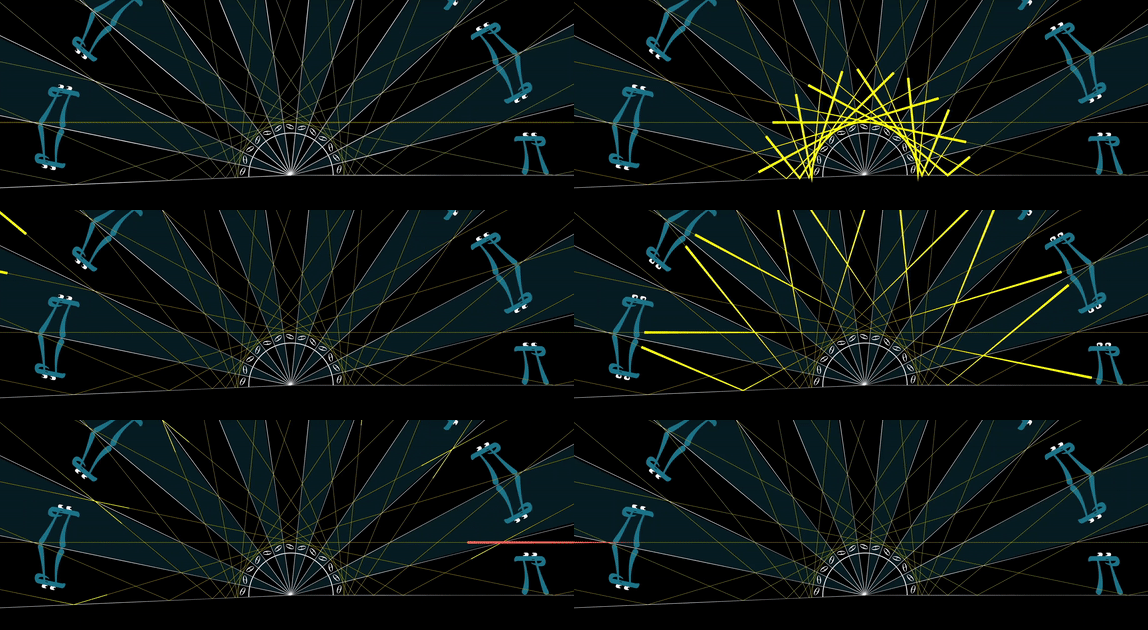
One of my sons sent me the link to the videos below. They show a very unusual way to find the digits of π. The problems and its two solutions show the connections and the interplay between mathematics and physics. The quality of the illustrations and the verbal explanations are excellent.

Here are the main concepts used in solving the problem:

From physics:

  • Conservation of energy,
  • Conservation of momentum,
  • Phase space,
  • Phase diagram,
  • Optics (angle of incidence equals angle of reflection),
  • Dot product and column vectors.

From high school math:

  • Geometry (the inscribed angle theorem),
  • Simultaneous equations,
  • Analytic geometry,
  • Equation of a line and translations,
  • Equation of a circle.

From calculus:

  • power series for the Inverse Tangent function,
  • related rates,
  • error analysis (not the Lagrange or alternating series error bounds),
  • slope in parametric form dy/dt, and dx/dt.

Here are the videos. (The second should open after the first, and the third after the second; or, you may click on one at a time.)

The most unexpected answer to a counting puzzle (5:12)

So why do colliding blocks compute pi? (15.15)

How colliding blocks act like a beam of light … to compute pi  (14:40)


The videos are on the YouTube site 3blue1brown, by Grant Sanderson. The site describes itself as some combination of math and entertainment, depending on your disposition. The goal is for explanations to be driven by animations and for difficult problems to be made simple with changes in perspective.

The site contains a number of other videos that look like they are worth watching.


Asymptotes and the Derivative

What does an asymptote of the derivative tell you about the function? How do asymptotes of a function appear in the graph of the derivative?

One of my most read posts is Reading the Derivative’s Graph, first published seven years ago. The long title is “Here’s the graph of the derivative; tell me about the function.” It tells how to quickly find information about the graph of a function from the derivative’s graph. I received a question from a reader recently that asked about asymptotes and the derivative, a topic that I did not cover in that post. So, I tried to find the relationship. The short answer is that an asymptote of the derivatives does not tell you much about the graph of the function. (This is probably why the idea has never been tested on the AP Calculus Exams.)

Nevertheless, there is some calculus to be learned here. You may be able to find some questions for your students to investigate on this topic. Here’s what i determined.

Before we start, here are two terms that are useful, but not commonly used.

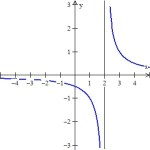
  • An even vertical asymptote is one for which the function increases or decreases without limit on both sides of the asymptote. In other words, as x approaches a the function approaches infinity or negative infinity from both sides. The function f\left( x \right)=\frac{1}{{{{{\left( {x-2} \right)}}^{2}}}} has an even vertical asymptote at x = 2. (Figure 1)
  • An odd vertical asymptote is one for which the function increases without bound on one side and decreases without bound on the other. The function g\left( x \right)=\frac{1}{{x-2}} has an odd vertical asymptote at x = 2. (Figure 2) Likewise, the tangent, cotangent, secant, and cosecant functions have odd vertical asymptotes.

If a function has an odd vertical asymptote, then its derivative will have an even vertical asymptote. (Ask your students to explain why.)

If a function has an even vertical asymptote, then its derivative will have an odd vertical asymptote. (Ask your students to explain why.)

The converses of these two statements are false. That is, a vertical asymptote of the derivative does not necessarily indicate an asymptote of the function. The catch is continuity.

Continuous Functions

If the derivative exists at xa, then the function is continuous there. But, since we are considering asymptotes of the derivative, we cannot know from the derivative alone if the function is continuous where the derivative has an asymptote.

A simple cusp is a situation in which at an extreme point the graph is tangent to a vertical line. See Figure 3. (Or, you could say, the tangent lines from each side are coincident. Here we will limit the discussion to a vertical tangent line.) A continuous function that has a cusp will show an odd vertical asymptote on its derivative’s graph. 

An example is\displaystyle h\left( x \right)=\sqrt[3]{{{{{\left( {x-2} \right)}}^{2}}}}+1  that has a cusp at the point (2,1). (Figure 3).

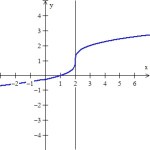
A continuous function that has a vertical tangent line not a cusp, has an even vertical asymptote on its derivative’s graph. For example, k\left( x \right)={{\left( {x-2} \right)}^{{1/3}}}+1 at (2,0) (Figure 4).

If you are given the graph of the derivative and it shows a vertical asymptote at x = a, and you know the function is continuous there, then

  • an odd vertical asymptote of the derivative indicates cusp on the graph of the function. This will also be an extreme value. (Ask your students to explain why.)
  • an even vertical asymptote of the derivative indicates vertical tangent line on the graph of the function, but not an extreme value. (Ask your students to explain why.)

Other than these, there is no easy way to tell what situation produced an asymptote on the derivative.

Functions that are not continuous

If the function is not continuous at xa, then things get a lot more complicated.

  • If the function is not continuous at x = a, then an even vertical asymptote of the derivative may indicate an odd vertical asymptote on the graph of the function. There is no way to be sure.
  • If the function is not continuous at x = a, then an odd vertical asymptote of the derivative may indicate an even vertical asymptote on the graph of the function. There is no way to be sure.

Consider this function: \displaystyle z\left( x \right)=\left\{ {\begin{array}{*{20}{c}} {\sqrt[3]{{{{{\left( {x-2} \right)}}^{2}}}}-1} & {x<2} \\ {\sqrt[3]{{{{{\left( {x-2} \right)}}^{2}}}}+1} & {x\ge 2} \end{array}} \right.

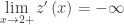
See Figure 5. The function is defined for all Real numbers and has a jump discontinuity at x = 2. The derivative has an odd vertical asymptote there: \displaystyle \underset{{x\to 2-}}{\mathop{{\lim }}}\,{z}'\left( x \right)=-\infty and \displaystyle \underset{{x\to 2+}}{\mathop{{\lim }}}\,{z}'\left( x \right)=-\infty . Compare this with h(x) above.

In fact,\displaystyle {h}'\left( x \right)={z}'\left( x \right)=\tfrac{2}{3}{{\left( {x-2} \right)}^{{-1/3}}},x\ne 2. Go figure.

For considerations of horizontal asymptotes and the derivative see Other Asymptotes 


2019 CED Unit 5 Analytical Applications of Differentiation

Unit 5 covers the application of derivatives to the analysis of functions and graphs. Reasoning and justification of results are also important themes in this unit. (CED – 2019 p. 92 – 107). These topics account for about 15 – 18% of questions on the AB exam and 8 – 11% of the BC questions.

Reasoning and writing justification of results are mentioned and stressed in the introduction to the topic (p. 93) and for most of the individual topics. See Learning Objective FUN-A.4 “Justify conclusions about the behavior of a function based on the behavior of its derivatives,” and likewise in FUN-1.C for the Extreme value theorem, and FUN-4.E for implicitly defined functions. Be sure to include writing justifications as you go through this topic. Use past free-response questions as exercises and also as guide as to what constitutes a good justification. Links in the margins of the CED are also helpful and give hints on writing justifications and what is required to earn credit. See the presentation Writing on the AP Calculus Exams and its handout

Topics 5.1

Topic 5.1 Using the Mean Value Theorem While not specifically named in the CED, Rolle’s Theorem is a lemma for the Mean Value Theorem (MVT). The MVT states that for a function that is continuous on the closed interval and differentiable over the corresponding open interval, there is at least one place in the open interval where the average rate of change equals the instantaneous rate of change (derivative). This is a very important existence theorem that is used to prove other important ideas in calculus. Students often confuse the average rate of change, the mean value, and the average value of a function – See What’s a Mean Old Average Anyway?

Topics 5.2 – 5.9

Topic 5.2 Extreme Value Theorem, Global Verses Local Extrema, and Critical Points An existence theorem for continuous functions on closed intervals

Topic 5.3 Determining Intervals on Which a Function is Increasing or Decreasing Using the first derivative to determine where a function is increasing and decreasing.

Topic 5.4 Using the First Derivative Test to Determine Relative (Local) Extrema Using the first derivative to determine local extreme values of a function

Topic 5.5 Using the Candidates’ Test to Determine Absolute (Global) Extrema The Candidates’ test can be used to find all extreme values of a function on a closed interval

Topic 5.6 Determining Concavity of Functions on Their Domains FUN-4.A.4 defines (at least for AP Calculus) When a function is concave up and down based on the behavior of the first derivative. (Some textbooks may use different equivalent definitions.) Points of inflection are also included under this topic.

Topic 5.7 Using the Second Derivative Test to Determine Extrema Using the Second Derivative Test to determine if a critical point is a maximum or minimum point. If a continuous function has only one critical point on an interval, then it is the absolute (global) maximum or minimum for the function on that interval.

Topic 5.8 Sketching Graphs of Functions and Their Derivatives. First and second derivatives give graphical and numerical information about a function and can be used to locate important points on the graph of the function.

Topic 5.9 Connecting a Function, Its First Derivative, and Its Second Derivative. First and second derivatives give graphical and numerical information about a function and can be used to locate important points on the graph of the function.

Topics 5.10 – 5.11

Optimization is important application of derivatives. Optimization problems as presented in most text books, begin with writing the model or equation that describes the situation to be optimized. This proves difficult for students, and is not “calculus” per se. Therefore, writing the equation has not be asked on AP exams in recent years (since 1983). Questions give the expression to be optimized and students do the “calculus” to find the maximum or minimum values. To save time, my suggestion is to not spend too much time writing the equations; rather concentrate on finding the extreme values.

Topic 5.10 Introduction to Optimization Problems 

Topic 5.11 Solving Optimization Problems

Topics 5.12

Topic 5.12 Exploring Behaviors of Implicit Relations Critical points of implicitly defined relations can be found using the technique of implicit differentiation. This is an AB and BC topic. For BC students the techniques are applied later to parametric and vector functions.


Timing

Topic 5.1 is important and may take more than one day. Topics 5.2 – 5.9 flow together and for graphing they are used together; after presenting topics 5.2 – 5.7 spend the time in topics 5.8 and 5.9 spiraling and connecting the previous topics. Topics 5.10 and 5.11 – see note above and spend minimum time here. Topic 5.12 may take 2 days.

The suggested time for Unit 5 is 15 – 16 classes for AB and 10 – 11 for BC of 40 – 50-minute class periods, this includes time for testing etc.

Finally, were I still teaching, I would teach this unit before Unit 4. The linear motion topic (in Unit 4) are a special case of the graphing ideas in Unit 5, so it seems reasonable to teach this unit first. See Motion Problems: Same thing, Different Context


Previous posts on these topics include:

Then There Is This – Existence Theorems

What’s a Mean Old Average Anyway

Did He, or Didn’t He?   History: how to find extreme values without calculus

Mean Value Theorem

Foreshadowing the MVT

Fermat’s Penultimate Theorem

Rolle’s theorem

The Mean Value Theorem I

The Mean Value Theorem II

Graphing

Concepts Related to Graphs

The Shapes of a Graph

Joining the Pieces of a Graph

Extreme Values

Extremes without Calculus

Concavity

Reading the Derivative’s Graph

Real “Real-life” Graph Reading

Far Out! An exploration

Open or Closed  Should intervals of increasing, decreasing, or concavity be open or closed?

Others

Lin McMullin’s Theorem and More Gold  The Golden Ratio in polynomials

Soda Cans  Optimization video

Optimization – Reflections   

Curves with Extrema?

Good Question 10 – The Cone Problem

Implicit Differentiation of Parametric Equations    BC Topic


Here are links to the full list of posts discussing the ten units in the 2019 Course and Exam Description.

2019 CED – Unit 1: Limits and Continuity

2019 CED – Unit 2: Differentiation: Definition and Fundamental Properties.

2019 CED – Unit 3: Differentiation: Composite , Implicit, and Inverse Functions

2019 CED – Unit 4 Contextual Applications of the Derivative  Consider teaching Unit 5 before Unit 4

2019 – CED Unit 5 Analytical Applications of Differentiation  Consider teaching Unit 5 before Unit 4

2019 – CED Unit 6 Integration and Accumulation of Change

2019 – CED Unit 7 Differential Equations  Consider teaching after Unit 8

2019 – CED Unit 8 Applications of Integration   Consider teaching after Unit 6, before Unit 7

2019 – CED Unit 9 Parametric Equations, Polar Coordinates, and Vector-Values Functions 

2019 CED Unit 10 Infinite Sequences and Series


Teaching Concavity

As you’ve probably noticed, different authors use different definitions based on how they plan to present topics later in their texts. So, the same concept seems to have different definitions. A definition in one book is a theorem in another. Students should be aware of this; looking at different definitions and related theorems about the same idea helps their mathematical education.

Here is a thought on exploring how concepts may be defined and learning about concavity are the same time.

Start by drawing the 4 shapes of (non-linear) graphs (See Concepts Related to Graphs and The Shapes of a Graph.

  • Increasing, concave up
  • Increasing concave down
  • Decreasing concave up
  • Decreasing concave down

Look at the sine or cosine graphs which show all four and the tangent graph that shows only two. Look at other functions as well and identify which parts (intervals) exhibit each shape.

Next, challenge the students, in groups, individually, in class, or for homework to find analytic ways to say what concavity is or to identify it from equations. If they need hints suggest they look at derivatives (first and second) and tangent lines. Don’t limit them – explain that there are other ways. They should try to find several ways.

Hopefully, they will come up with some of these. (I have purposely listed these in a rough preliminary form. That’s how math is done – get an idea and then develop and formalize it)

A function is concave up (down) when:

  1. The slope (derivative) is increasing (decreasing)
  2. The second derivative is positive (negative).
  3. The tangent line lies below (above) the graph
  4. All (any, every) segments joining points in the interval lie above (below) the graph.
  5. Others ???

Finally, clean these up. Help the students:

  • State them as “if, then” or “if, and only if” statements giving the hypotheses for each.
  • Consider how one can be used to imply the others – in either direction.
  • Determine which implies the inclusion of endpoints (1 and maybe 3).
  • Discuss which the class thinks would make the best definition, and which should become theorems.
  • Taking whichever definition your book uses, show how the others can be proved.

The point here is the thinking, forming ideas, doing the mathematics; the understanding of concavity will follow.