Unit 7 – Differential Equations

Unit 7 is an introduction to the initial ideas and easy techniques related to differential equations . (CED – 2019 p. 129 – 142 ). These topics account for about 6 – 12% of questions on the AB exam and 6 – 9% of the BC questions.

Topics 7.1 – 7.9

Topic 7.1 Modeling Situations with Differential Equations Relating a functions and its derivatives.

Topic 7.2 Verifying Solutions for Differential Equations A proposed solution of a differential equation can be checked by substituting the function and its derivative(s) into the original differential equation. There may be an infinite number of general solutions (solutions with one or more constants).

Topic 7.3 Sketching Slope Fields Slope fields are a graphical representation of a differential equation and provide information about the behavior of the solutions.

Topic 7.4 Reasoning Using Slope Fields 

Topic 7.5 Approximating Solutions Using Euler’s method (BC ONLY) A numerical approach to approximating solutions of a differential equation.

Topic 7.6 Finding General Solutions Using Separation of Variable Since this unit is only an introduction to differential equations, the method of separation of variable is the only solution method tested on the AB and BC exams.

Topic 7.7 Finding Particular Solutions Using Initial Conditions and Separation of Variables An initial condition (i.e. a point on the particular solution) allows you to evaluate the constant in the general solution and find the one solution that contains the initial condition. Also, if \displaystyle \frac{{dy}}{{dx}}=f\left( x \right) has the initial condition\displaystyle \left( {a,F(a))} \right), then the solution is\displaystyle F\left( x \right)=F\left( a \right)+\int_{a}^{x}{{f\left( x \right)dx}}. Solution may also be subject to domain restrictions

Topic 7.8 Exponential Models with Differential Equations Applications include linear motion and exponential growth and decay. The growth and decay model is \displaystyle \frac{{dy}}{{dt}}=kt with the initial condition \displaystyle \left( {0,y\left( 0 \right)} \right) has the solution \displaystyle y=y\left( 0 \right){{e}^{{kt}}}

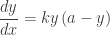
Topic 7.9 Logistic Models with Differential Equations (BC ONLY) The model of logistic growth, \displaystyle \frac{{dy}}{{dx}}=ky\left( {a-y} \right), can be solved by separating the variables and using partial fraction decomposition. This has never been tested (probably because solving requires a large amount of complicated algebra). Students are expected to know how to interpret the properties of the solution directly from the differential equation (asymptotes, carrying capacity, point where changing the fastest, etc.) and discuss what they mean in context without actually solving the equation.

Timing

The suggested time for Unit 7 is  8 – 9 classes for AB and 9 – 10 for BC of 40 – 50-minute class periods, this includes time for testing etc.


Previous posts on these topics for both AB and BC include:

Differential Equations  A summary of the terms and techniques of differential equation and the method of separation of variables

Domain of a Differential Equation – On domain restrictions.

Accumulation and Differential Equations 

Slope Fields

An Exploration in Differential Equations An exploration illustrating many of the ideas of differential equations. The exploration is here in PDF form and the solution is here. The ideas include: finding the general solution of the differential equation by separating the variables, checking the solution by substitution, using a graphing utility to explore the solutions for all values of the constant of integration, finding the solutions’ horizontal and vertical asymptotes, finding several particular solutions, finding the domains of the particular solutions, finding the extreme value of all solutions in terms of C, finding the second derivative (implicit differentiation), considering concavity, and investigating a special case or two. 

Posts on BC Only Topics

Euler’s Method

Euler’s Method for Making Money

The Logistic Equation 

Logistic Growth – Real and Simulated

Adapting 2021 AB 6

Adapting 2021 BC 5


Posts on Accumulation

One of the main uses of the definite integral is summed up (pun intended) in the idea of accumulation. When you integrate a rate of change you get the (net) amount of change. This important idea is often treated very lightly, if at all, in textbooks.

Here are a series of past posts that use, explain, and illustrate that concept.

Accumulation – Need an Amount? The Fundamental Theorem of Calculus says that the integral of a rate of change (a derivative) is the net amount of change. This post shows how that works in practice.

AP Accumulation Questions and Good Question 7 – 2009 AB 3 the “Mighty Cable Company” show how accumulation is tested on the AP Calculus exams. The “Mighty Cable Company” question is a particularly good and difficult example.

The next two posts show how to use the concept of accumulation to analyze a function and its graph without reference to the derivative. The graphical idea of a Riemann sum rectangle moving across the interval of integration makes the features of function much more intuitive than the common approach. You will not find these ideas in textbooks. Nevertheless, a lesson on this idea may help your students.

Graphing with Accumulation 1 explains how to analyze the derivative to determine when a function is increasing or decreasing and finding the locations of extreme values. By thinking of the individual Rieman sum rectangles moving across the interval the features of the function are easy to see and easier to remember. Once understood, this method will help students with their graph analysis work.

Graphing with Accumulation 2 continues the idea of using accumulation to determine information about the concavity of a function.

Unit 8 – Applications of Integration

I haven’t missed Unit 7! This unit seems to fit more logically after the opening unit on integration (Unit 6). The Course and Exam Description (CED) places Unit 7 Differential Equations before Unit 8 probably because the previous unit ended with techniques of antidifferentiation. My guess is that many teachers will teach Unit 8: Applications of Integration immediately after Unit 6 and before Unit 7: Differential Equations. The order is up to you. Unit 7 will post next Tuesday.

Unit 8 includes some standard problems solvable by integration (CED – 2019 p. 143 – 161). These topics account for about 10 – 15% of questions on the AB exam and 6 – 9% of the BC questions.

Topics 8.1 – 8.3 Average Value and Accumulation

Topic 8.1 Finding the Average Value of a Function on an Interval Be sure to distinguish between average value of a function on an interval, average rate of change on an interval and the mean value

Topic 8.2 Connecting Position, Velocity, and Acceleration of Functions using Integrals Distinguish between displacement (= integral of velocity) and total distance traveled (= integral of speed)

Topic 8. 3 Using Accumulation Functions and Definite Integrals in Applied Contexts The integral of a rate of change equals the net amount of change. A really big idea and one that is tested on all the exams. So, if you are asked for an amount, look around for a rate to integrate.

Topics 8.4 – 8.6 Area

Topic 8.4 Finding the Area Between Curves Expressed as Functions of x

Topic 8.5 Finding the Area Between Curves Expressed as Functions of y

Topic 8.6 Finding the Area Between Curves That Intersect at More Than Two Points Use two or more integrals or integrate the absolute value of the difference of the two functions. The latter is especially useful when do the computation of a graphing calculator.

Topics 8.7 – 8.12 Volume

Topic 8.7 Volumes with Cross Sections: Squares and Rectangles

Topic 8.8 Volumes with Cross Sections: Triangles and Semicircles

Topic 8.9 Volume with Disk Method: Revolving around the x– or y-Axis Volumes of revolution are volumes with circular cross sections, so this continues the previous two topics.

Topic 8.10 Volume with Disk Method: Revolving Around Other Axes

Topic 8.11 Volume with Washer Method: Revolving Around the x– or y-Axis See Subtract the Hole from the Whole for an easier way to remember how to do these problems.

Topic 8.12 Volume with Washer Method: Revolving Around Other Axes. See Subtract the Hole from the Whole for an easier way to remember how to do these problems.

Topic 8.13  Arc Length BC Only

Topic 8.13 The Arc Length of a Smooth, Planar Curve and Distance Traveled  BC ONLY


Timing

The suggested time for Unit 8 is  19 – 20 classes for AB and 13 – 14 for BC of 40 – 50-minute class periods, this includes time for testing etc.


Previous posts on these topics for both AB and BC include:

Average Value and Accumulation

Average Value of a Function and 

Most Triangles Are Obtuse!

Half-full or Half-empty

Accumulation: Need an Amount?

AP Accumulation Questions

Good Question 7 – 2009 AB 3 Accumulation, explain the meaning of an integral in context, unit analysis

Good Question 8 – or Not Unit analysis

Graphing with Accumulation 1 Seeing increasing and decreasing through integration

Graphing with Accumulation 2 Seeing concavity through integration

Adapting AB 1 / BC 1

Area

Area Between Curves

Under is a Long Way Down  Avoiding “negative area.”

Improper Integrals and Proper Areas  BC Topic

Math vs. the “Real World”  Improper integrals  BC Topic

Adapting 2021 AB 3 / BC 3

Volume

Volumes of Solids with Regular Cross-sections

Volumes of Revolution

Why You Never Need Cylindrical Shells

Visualizing Solid Figures 1

Visualizing Solid Figures 2

Visualizing Solid Figures 3

Visualizing Solid Figures 4

Visualizing Solid Figures 5

Painting a Point

Subtract the Hole from the Whole and Does Simplifying Make Things Simpler?

Adapting 2021 AB 3 / BC 3

Other Applications of Integrals

Density Functions have been tested in the past, but are not specifically listed on the CED then or now.

Who’d a Thunk It? Some integration problems suitable for graphing calculator solution


Here are links to the full list of posts discussing the ten units in the 2019 Course and Exam Description.

2019 CED – Unit 1: Limits and Continuity

2019 CED – Unit 2: Differentiation: Definition and Fundamental Properties.

2019 CED – Unit 3: Differentiation: Composite , Implicit, and Inverse Functions

2019 CED – Unit 4 Contextual Applications of the Derivative  Consider teaching Unit 5 before Unit 4

2019 – CED Unit 5 Analytical Applications of Differentiation  Consider teaching Unit 5 before Unit 4

2019 – CED Unit 6 Integration and Accumulation of Change

2019 – CED Unit 7 Differential Equations  Consider teaching after Unit 8

2019 – CED Unit 8 Applications of Integration   Consider teaching after Unit 6, before Unit 7

2019 – CED Unit 9 Parametric Equations, Polar Coordinates, and Vector-Values Functions 

2019 CED Unit 10 Infinite Sequences and Series


A Calculus Journey

I think that the path leading up to and including the Fundamental Theorem of Calculus (FTC) is one of the most beautiful walks in mathematics. I have written several posts about it. You will soon be ready to travel that path with your students. (I always try to post on topics shortly before most teachers will get to them, so that you have some time to consider them and work the ideas you like into your lessons.)

Here is an annotated list of some of the posts to guide you on your journey.

Working Towards Riemann Sums gives the preliminary definitions you will need to define and discuss Riemann sums.

Riemann Sums defines the several Riemann sums often used in the calculus left-side sums, right-side sums, midpoint sums and the trapezoidal sums. “The Area Under a Curve” in the iPad app A Little Calculus is a great visual display of these and shows what happens as you use more subintervals.

The Definition of the Definite Integral gives the definition of the definite integral as the limit of any Riemann sum. As with any definition, there is nothing to prove or argue about here. The thing to remember is that the limit of the Riemann sum and the definite integral are the same thing. Behind any definite integral is a Riemann sum. The advantage of the definition’s integral notation is that it shows the interval involved which the Riemann sum does not. (Any Riemann sum may be represented by many definite integrals. See Good Question 11 – Riemann Reversed.)

Foreshadowing the FTC is an example of how a definite integral may be evaluated. It is long and has a lot of notation, so you may not want to use this.

The Fundamental Theorem of Calculus is where the path leads. This post develops the FTC based on the other “big” idea of the calculus: the Mean Value Theorem. (I think the form here is preferable to the usual book notation that uses F(x) and its derivate f (x).)

Y the FTC? Tries to answer the question of what’s so important about the FTC. Example 1: The verbal interpretation of the FTC (the integral of a rate of change is the net amount of change over the interval.) will soon be used in many practical applications. While example 2 shows how the FTC allows one to evaluate a definite integral and, therefore the Riemann sum it represents, by evaluating a function whose derivative is the integrand (its antiderivative).

More About the FTC presents examples leading up to the other form of the FTC: the derivative of the integral is the integrand).

At this point you may go in the direction of learning how to find antiderivatives or working on applications. (See Integration itinerary.)

Bon Voyage!     

The Old Pump

A tank is being filled with water using a pump that is old and slows down as it runs. The table below gives the rate at which the pump pumps at ten-minute intervals. If the tank initially has 570 gallons of water in it, approximately how much water is in the tank after 90 minutes?

Elapsed time (minutes)   0   10  20   30   40   50   60   70   80   90
Rate (gallons / minute)   42   40   38   35   35   32   28   20   19   10

And so, integration begins.

Ask your students to do this problem alone. When they are ready (after a few minutes) collect their opinions.  They will not all be the same (we hope, because there is more than one reasonable way to approximate the amount). Ask exactly how they got their answers and what assumptions they made. Be sure they always include units (gallons).  Here are some points to make in your discussion – points that we hope the kids will make and you can just “underline.”

    1. Answers between 3140 and 3460 gallons are reasonable. Other answers in that range are acceptable. They will not use terms like “left-sum”, “right sum” and “trapezoidal rule” because they do not know them yet, but their explanations should amount to the same thing. An answer of 3300 gallons may be popular; it is the average of the other two, but students may not have gotten it by averaging 3140 and 3460.
    2. Ask if they think their estimate is too large or too small and why they think that.
    3. Ask what they need to know to give a better approximation – more and shorter time intervals.
    4. Assumptions: If they added 570 + 42(10) + 40(10) + … +19(10) they are assuming that the pump ran at each rate for the full ten minutes and then suddenly dropped to the next. Others will assume the rate dropped immediately and ran at the slower rate for the 10 minutes. Some students will assume the rate dropped evenly over each 10-minute interval and use the average of the rates at the ends of each interval (570 + 41(10) + 39(10) + … 14.5(10) = 3300).
    5. What is the 570 gallons in the problem for? Well, of course to foreshadow the idea of an initial condition. Hopefully, someone will forget to include it and you can point it out.
    6. With luck someone will begin by graphing the data. If no one does, you should suggest it; (as always) to help them see what they are doing graphically. They are figuring the “areas” of rectangles whose height is the rate in gallons/minute and whose width is the time in minutes. Thus the “area” is not really an area but a volume (gal/min)(min) = gallons). In addition to unit analysis, graphing is important since you will soon be finding the area between the graph of a function and the x-axis in just this same manner.

Follow up: Flying to Integrationland

Be sure to check the “Thoughts on ‘The Old Pump'” in the comments section below.

Revised from a post of November 30, 2012. 

Unit 6 – Integration and Accumulation of Change

Unit 6 develops the ideas behind integration, the Fundamental Theorem of Calculus, and Accumulation. (CED – 2019 p. 109 – 128). These topics account for about 17 – 20% of questions on the AB exam and 17 – 20% of the BC questions.

Topics 6.1 – 6.4 Working up to the FTC

Topic 6.1 Exploring Accumulations of Change Accumulation is introduced through finding the area between the graph of a function and the x-axis. Positive and negative rates of change, unit analysis.

Topic 6.2 Approximating Areas with Riemann Sums Left-, right-, midpoint Riemann sums, and Trapezoidal sums, with uniform partitions are developed. Approximating with numerical methods, including use of technology are considered. Determining if the approximation is an over- or under-approximation.

Topic 6.3 Riemann Sums, Summation Notation and the Definite Integral. The definition integral is defined as the limit of a Riemann sum.

Topic 6.4 The Fundamental Theorem of Calculus (FTC) and Accumulation Functions Functions defined by definite integrals and the FTC.

Topic 6.5 Interpreting the Behavior of Accumulation Functions Involving Area Graphical, numerical, analytical, and verbal representations.

Topic 6.6 Applying Properties of Definite Integrals Using the properties to ease evaluation, evaluating by geometry and dealing with discontinuities.

Topic 6.7 The Fundamental Theorem of Calculus and Definite Integrals Antiderivatives. (Note: I suggest writing the FTC in this form displaystyle int_{a}^{b}{{{f}'left( x right)}}dx=fleft( b right)-fleft( a right) because it seem more efficient then using upper case and lower case f.)

Topics 6.5 – 6.14 Techniques of Integration

Topic 6.8 Finding Antiderivatives and Indefinite Integrals: Basic Rules and Notation. Using basic differentiation formulas to find antiderivatives. Some functions do not have closed-form antiderivatives. (Note: While textbooks often consider antidifferentiation before any work with integration, this seems like the place to introduce them. After learning the FTC students have a reason to find antiderivatives. See Integration Itinerary

Topic 6.9 Integration Using Substitution The u-substitution method. Changing the limits of integration when substituting.

Topic 6.10 Integrating Functions Using Long Division and Completing the Square 

Topic 6.11 Integrating Using Integration by Parts (BC ONLY)

Topic 6.12 Integrating Using Linear Partial Fractions (BC ONLY)

Topic 6.13 Evaluating Improper Integrals (BC ONLY) Showing the work requires students to show correct limit notation.

Topic 6.14 Selecting Techniques for Antidifferentiation This means practice, practice, practice.


Timing

The suggested time for Unit 6 is  18 – 20 classes for AB and 15 – 16 for BC of 40 – 50-minute class periods, this includes time for testing etc.


Previous posts on these topics include:

Introducing Integration

Integration Itinerary

The Old Pump and Flying to Integrationland   Two introductory explorations

Working Towards Riemann Sums

Riemann Sums

The Definition of the Definite Integral

Foreshadowing the FTC 

The Fundamental Theorem of Calculus

More About the FTC

Y the FTC?

Area Between Curves

Under is a Long Way Down 

Properties of Integrals 

Trapezoids – Ancient and Modern  On Trapezoid sums

Good Question 9 – Riemann Reversed   Given a Riemann sum can you find the Integral it converges to?  A common and difficult AP Exam problem

Adapting 2021 AB 1 / BC 1

Adapting 2021 AB 4 / BC 4

Accumulation

Accumulation: Need an Amount?

Good Question 7 – 2009 AB 3

Good Question 8 – or Not?  Unit analysis

AP Exams Accumulation Question    A summary of accumulation ideas.

Graphing with Accumulation 1

Graphing with Accumulation 2

Accumulation and Differential Equations 

Painting a Point

Techniques of Integrations (AB and BC)

Antidifferentiation

Why Muss with the “+C”?

Good Question 13  More than one way to skin a cat.

Integration by Parts – a BC Topic

Integration by Parts 1

Integration by Part 2

Parts and More Parts

Good Question 12 – Parts with a Constant?

Modified Tabular Integration 

Improper Integrals and Proper Areas

Math vs the Real World Why displaystyle int_{{-infty }}^{infty }{{frac{1}{x}}}dx does not converge.


Here are links to the full list of posts discussing the ten units in the 2019 Course and Exam Description.

2019 CED – Unit 1: Limits and Continuity

2019 CED – Unit 2: Differentiation: Definition and Fundamental Properties.

2019 CED – Unit 3: Differentiation: Composite , Implicit, and Inverse Functions

2019 CED – Unit 4 Contextual Applications of the Derivative  Consider teaching Unit 5 before Unit 4

2019 – CED Unit 5 Analytical Applications of Differentiation  Consider teaching Unit 5 before Unit 4

2019 – CED Unit 6 Integration and Accumulation of Change

2019 – CED Unit 7 Differential Equations  Consider teaching after Unit 8

2019 – CED Unit 8 Applications of Integration   Consider teaching after Unit 6, before Unit 7

2019 – CED Unit 9 Parametric Equations, Polar Coordinates, and Vector-Values Functions 

2019 CED Unit 10 Infinite Sequences and Series


Adapting 2021 BC 5

Eight of nine. We continue our study of the 2021 free-response questions. We will look at ways to adapt, expand, and explore this question to help students better understand it and look at other questions that can be asked based on a similar stem.

2021 BC 5

This is a Differential Equation (Type 6) with a Sequence and Series (Type 10) question included. It contains topics from Units 7 and 10 of the current Course and Exam Description (CED). It is not unusual for AP Calculus exam question to include several of the types in my classification and from several of the units from the CED (here units 7 and 10). In addition, the usual solving an initial value problem and a Euler’s Method approximation are included.

The stem for 2021 BC 5 is:

Part (a): Students were asked to write the second-degree Taylor polynomial for the function centered at x = 1 and then use it to approximate f(2). Students should stop after substituting 2 into their polynomial; no arithmetic or simplification is required, and a simplifying mistake will lose a point.

Discussion and ideas for adapting this question:

  • Ask students to find an expression for the second derivative (implicit differentiation).
  • Verify that \displaystyle {f}''\left( 1 \right)=4
  • Ask students to find the third-degree polynomial and use it to approximate f(2)

Part (b): Students were required to approximate f(2) using Euler’s method with two steps of equal size.

Discussion and ideas for adapting this question:

  • After you solve the equation in part (c), ask students to compare the approximations from parts (a) and (b) with the exact value. Neither approximation is very close to the exact value. Discuss why this is so. Consider the slope of the graph near x = 2.
  • Find a more accurate approximation using 3, 4, or more smaller steps. There are graphing calculator programs that will do the arithmetic. Do not hesitate to use them. Students have already shown they know how to do a Euler’s Method approximation; the point is to understand the situation.

Part (c): Finding the solution of the differential equation by separating the variables is expected in this kind of question. The added twist is that the method of integration by parts is necessary to find one of the antiderivatives.

 Discussion and ideas for adapting this question:

  • Be sure not to skip over removing the absolute value signs. The most efficient way is to realize that at (and near) the initial condition y > 0, so |y| = y. What do you do if y < 0?
  • There is not much you can do differently here. One thing is to change the initial condition. Try a negative value such as f(1) = –4.
  • As suggested in (b), compare, and discuss the approximations with the exact value.

Next week we will conclude this series of posts with a look at 2021 BC 6.

I would be happy to hear your ideas for other ways to use this question. Please use the reply box below to share your ideas.
