Motion Problems: Same Thing, Different Context

Calculus is about things that are changing. Certainly, things that move are changing, changing their position, velocity, and acceleration. Most calculus textbooks deal with things being dropped or thrown up into the air. This is called uniformly accelerated motion since the acceleration is due to gravity and is constant. While this is a good place to start, the problems are by their nature somewhat limited. Students often know all about uniformly accelerated motion from their physics class.

The Advanced Placement exams take motion problems to a new level. AB students often encounter particles moving along the x-axis or the y-axis (i.e. on a number line) according to a function that gives the particle’s position, velocity, or acceleration.  BC students often encounter particles moving around the plane with their coordinates given by parametric equations or their velocity given by a vector. Other times the information is given as a graph or even in a table of the position or velocity. The “particle” may become a car, or a rocket or even chief readers riding bicycles.

While these situations may not be all that “real”, they provide excellent ways to ask both differentiation and integration questions. but be aware that they are not covered that much in some textbooks; supplementing the text may be necessary.

The main derivative ideas are that velocity is the first derivative of the position function, acceleration is the second derivative of the position function and the first derivative of the velocity. Speed is the absolute value of velocity. (There will be more about speed in the next post.) The same techniques used to find the features of a graph can be applied to motion problems to determine things about the moving particle.

So, the ideas are not new, but the vocabulary is. The table below gives the terms used with graph analysis and the corresponding terms used in motion problem.

Vocabulary: Working with motion equations (position, velocity, acceleration) you really do all the same things as with regular functions and their derivatives. Help students see that while the vocabulary is different, the concepts are the same.

Function                                Linear Motion
Value of a function at x               position at time t
First derivative                            velocity
Second derivative                       acceleration
Increasing                                   moving to the right or up
Decreasing                                 moving to the left or down
Absolute Maximum                    farthest right
Absolute Minimum                     farthest left
yʹ = 0                                        “at rest”
yʹ changes sign                          object changes direction
Increasing & cc up                     speed is increasing
Increasing & cc down                speed is decreasing
Decreasing & cc up                   speed is decreasing
Decreasing & cc down              speed is increasing
Speed                                       absolute value of velocity
 

Here is a short quiz on this idea.

Revised and updated from a post originally published on November 16, 2012

Unit 4 – Contextual Applications of the Derivative

Unit 4 covers rates of change in motion problems and other contexts, related rate problems, linear approximation, and L’Hospital’s Rule. (CED – 2019 p. 82 – 90). These topics account for about 10 – 15% of questions on the AB exam and 6 – 9% of the BC questions.

You may want to consider teaching Unit 5 (Analytical Applications of Differentiation) before Unit 4. Notes on Unit 5 will be posted next Tuesday September 29, 2020

Topics 4.1 – 4.6

Topic 4.1 Interpreting the Meaning of the Derivative in Context Students learn the meaning of the derivative in situations involving rates of change.

Topic 4.2 Linear Motion The connections between position, velocity, speed, and acceleration. This topic may work  better after the graphing problems in Unit 5, since many of the ideas are the same. See Motion Problems: Same Thing, Different Context

Topic 4.3 Rates of Change in Contexts Other Than Motion Other applications

Topic 4.4 Introduction to Related Rates Using the Chain Rule

Topic 4.5 Solving Related Rate Problems

Topic 4.6 Approximating Values of a Function Using Local Linearity and Linearization The tangent line approximation

Topic 4.7 Using L’Hospital’s Rule for Determining Limits of Indeterminate Forms. Indeterminate Forms of the type \displaystyle \tfrac{0}{0} and \displaystyle \tfrac{{\pm \infty }}{{\pm \infty }}. (Other forms may be included, but only these two are tested on the AP exams.)

Topic 4.1 and 4.3 are included in the other topics, topic 4.2 may take a few days, Topics 4.4 – 4.5 are challenging for many students and may take 4 – 5 classes, 4.6 and 4.7 two classes each. The suggested time is 10 -11 classes for AB and 6 -7 for BC. of 40 – 50-minute class periods, this includes time for testing etc.

This is a re-post and update of the third in a series of posts from last year. It contains links to posts on this blog about the differentiation of composite, implicit, and inverse functions for your reference in planning. Other updated post on the 2019 CED will come throughout the year, hopefully, a few weeks before you get to the topic. 


Posts on these topics include:

Motion Problems 

Motion Problems: Same Thing, Different Context

Speed

A Note on Speed

Adapting 2021 AB 2

Adapting 2021 AB 4 / BC 4

Related Rates

Related Rate Problems I

Related Rate Problems II

Good Question 9 – Related rates

Linear Approximation

Local Linearity 1

Local Linearity 2 

L’Hospital’s Rule

Locally Linear L’Hôpital  

L’Hôpital Rules the Graph  

Determining the Indeterminate

Determining the Indeterminate 2


Here are links to the full list of posts discussing the ten units in the 2019 Course and Exam Description.

Limits and Continuity – Unit 1  (8-11-2020)

Definition of t he Derivative – Unit 2  (8-25-2020)

Differentiation: Composite, Implicit, and Inverse Function – Unit 3  (9-8-2020)

Contextual Applications of the Derivative – Unit 4  Consider teaching Unit 5 before Unit 4 THIS POST

LAST YEAR’S POSTS – These will be updated in coming weeks

2019 – CED Unit 5 Analytical Applications of Differentiation  Consider teaching Unit 5 before Unit 4

2019 – CED Unit 6 Integration and Accumulation of Change

2019 – CED Unit 7 Differential Equations  Consider teaching after Unit 8

2019 – CED Unit 8 Applications of Integration   Consider teaching after Unit 6, before Unit 7

2019 – CED Unit 9 Parametric Equations, Polar Coordinates, and Vector-Values Functions 

2019 CED Unit 10 Infinite Sequences and Series


Adapting 2021 BC 2

Seven of nine. This week we continue our look at the 2021 free-response questions with an eye to ways to adapt and expand the questions. Hopefully, you will find ways to use this and other free-response questions to help your students learn more and be better prepared for the exams.

2021 BC 2

This is a Parametric and Vector Equation (Type 8) question and contains topic from Unit 9 of the current Course and Exam Description. The vector equation of the velocity of a particle moving in the xy-plane is given along with the position of the particle at t = 0. No units were given.

The stem for 2021 BC 2 is next. (Note the \displaystyle \left\langle \text{ } \right\rangle notation for vectors. Any of the usual notations may be used by students, but be sure to show them the others in case the one their book usage is different than the exam’s.)

Part (a): Students were asked to find the speed and acceleration of the particle at t = 1.2. This is a calculator active questions and the students were expected, but not actually required, to use their calculator. With their calculator in parametric mode, students should begin by entering the velocity as xt1(t) and yt1(t).

Discussion and ideas for adapting this question:

  • There is little I can suggest here other than changing the time.
  • At the given time and other times, you can ask in what direction is the particle moving and which way the acceleration is pulling the velocity.
  • Ask student to do this without using their calculator. The answer need not be simplified or expressed as a decimal.

Part (b): Asked the students to find the total distance traveled by the particle over a given the time interval. This must be done on a calculator. Be sure your students know how to enter the expression using the already entered values for xt1(t) and yt1(t). The calculator entry should look like this.

\displaystyle \int_{0}^{{1.2}}{{\sqrt{{{{{\left( {\text{xt}1(t)} \right)}}^{2}}+{{{\left( {\text{yt1}(t)} \right)}}^{2}}}}}}dt

Discussion and ideas for adapting this question:

  • Use different intervals.
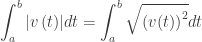
  • Discuss the similarities with the number line distance formula. In linear motion, the distance is simply the integral of the absolute value of the velocity. Since \displaystyle \int_{a}^{b}{{\left| {v\left( t \right)} \right|}}dt=\int_{a}^{b}{{\sqrt{{{{{\left( {v(t)} \right)}}^{2}}}}}}dt, this is the same formula reduced to one dimension.

Part (c): The situation is reduced to a one-dimensional problem: students were asked to find the coordinates of the point at which the particle is farthest left and explain why there is no point farthest to the right.

Discussion and ideas for adapting this question:

  • Discuss how to do this and how students should present their answer and explanation.
  • Show that this is the same as an extreme value problem and done the same way (i.e., find where the derivative is zero, and show that this is a minimum (farthest left), etc.).
  • Discuss how you know there is no maximum and interpret this in the context of the equation.

For further exploration. Try graphing the path of the particle. Discuss how to do that with your class. See what they suggest. Here a few approaches.

  • The first thought may be to integrate the velocity vector as an initial value problem. Unfortunately, this cannot be done. Neither the x-component nor the y-component can be integrated in terms of Elementary Functions. Even WolframAlpha.com is no help.
  • Having entered the velocity vector as xt1(t) and yt1(t), as suggested above, enter something like this depending on your calculator’s syntax and then graph in a suitable window. Compare the graph with the previous analysis in part (c)?

\displaystyle \text{x2t}(t)=-2+\int_{0}^{t}{{\text{x1t}(t)dt}}

\displaystyle \text{y2t}(t)=5+\int_{0}^{t}{{\text{y2t}(t)dt}}

  • You may also try expressing the components of velocity as a Taylor series centered at some positive number, a, not at zero. Integrate that to get an approximation to graph. Be sure to adjust things so the initial point is on the graph. WolframAlpha will help here. The one problem here is that the y-component is not defined for negative numbers. Therefore, zero cannt be then center and the largest the interval of convergence can be is [0, 2a] (Why?) and may not even by that large. This is an interesting approach mathematically but will not help with most of the graph.

Personal opinion: I do not think much of this question because all the first two parts require is entering the formula in your calculator and computing the answer, and the third part is really an AB level question. Just my opinion.


Seven of Nine

Next week 2021 BC 5

I would be happy to hear your ideas for other ways to use this question. Please use the reply box below to share your ideas.


Adapting 2021 AB 6

Six of nine. Continuing the current series of posts, this post looks at the AB Calculus 2021 exam question AB 6. Like most of the AP Exam questions, there is a lot more you can ask based on the stem of this question and a lot of other calculus you can discuss. This series of post offers suggestions as to how to adapt, expand, and use this question to help your students dig deeper and learn more.

2021 AB 6

This is a standard Differential Equation (Type 6) question and contains topics mainly from Unit 7 (Differential equations) and a little from Unit 3 (implicit differentiation) of the current Course and Exam Description. A differential equation with an initial condition is given in a context. The main part is the solution of the initial value question with three short other questions included.

The stem for 2021 AB 6 is:

Part (a): A slope field in the first quadrant with no scale on either axis is given. Students are asked to sketch the solution curve starting at the initial condition, the point (0, 0).  (I prefer this kind of slope field question to those where students are given a few points and asked to sketch the slope field through them. No one draws slope field by hand; slope field drawn by computers are used to study the approximate shape of the solution and determine its interesting properties as is done here and in part (b)). When drawing slope fields, the sketch should extend to from one border to another and contain the initial condition point.

Discussion and ideas for adapting this question:

  • Have student sketch solution through one or more different points. Copy the slope field and add the initial condition point somewhere else.
  • Add an initial point above the horizontal asymptote.
  • Compare and contrast the solutions drawn through several points.
  • Ask what the horizontal segments (at y = 12) tells you in the context of the problem.

Part (b):  Students are given the limit at infinity for the as yet unknow solution and asked to interpret it in the context of the problem including units of measure.

Discussion and ideas for adapting this question:

  • Discuss why this is so.
  • Discuss how to determine the units of the function from the given information.
  • Discuss how to determine the units of the derivative from the given information.
  • Discuss how to determine the units of the derivative from the units of the function.
  • Discuss how to determine the units of the function from the units of the derivative.
  • Discuss whether the interpretation of the limit makes sense in the context of the question.

Part (c): Students are asked to solve the initial value question using the method of separation of variables.

Discussion and ideas for adapting this question:

  • Since separation of variables is the only method for solving a differential equation that students are responsible for knowing, there is not much you can do to adapt or change this question.
  • The initial condition may be substituted immediately after the integration is done the “+ C” is attached, or it may be done later after the expression is solved for y. Show students both method and discuss which is more efficient and which makes more sense to them.
  • Removing the absolute value signs is another place that may confuse students. While some textbooks suggest using a “ ± “ sign and deciding sign which to use later, the better way is to decide as soon as possible. Ask yourself is the expression enclose by the absolute value signs positive or negative near (at) the initial value. If positive, then the absolute value is replaced by the same expression (as in this question); if negative, then the expression is replaced by its opposite. Then complete the question from there.

Part (d): This part needs careful reading. Students are asked, for a slightly different differential equation, if the rate of change in the amount of medicine is increasing or decreasing at a given time. Therefore, students must find the rate of change of the rate of change (the given derivative): the derivative of the derivative (i.e., the second derivative of the function). This requires implicit differentiation of the derivative using the quotient rule.

Discussion and ideas for adapting this question:

  • The second derivative has the first derivative as one of its factors. Students may (automatically) substitute the first derivative before simplifying or evaluating. This correct, but unnecessarily long. Show the students how to find and substitute the value of the first derivative along with the other numbers.
  • Do as little arithmetic as possible. You need only determine if the second derivative is positive or negative.
  • Discuss the meaning of the answer in the context of the problem.

Next week 2021 BC 2

I would be happy to hear your ideas for other ways to use this question. Please use the reply box below to share your ideas.


Adapting 2021 AB 5

Five of nine. Continuing the current series of posts, this post looks at the AB Calculus 2021 exam question AB 5. The series considers each question with the aim of showing ways to use the question in with your class as is, or by adapting and expanding it.  Like most of the AP Exam questions there is a lot more you can ask from the stem and a lot of other calculus you can discuss.

2021 AB 5

This question tests the process of differentiating an implicit function. In my scheme of type posts, it is in the Other Problems (Type 7) category; this type includes the topics of implicit functions, related rate problems, families of functions and a few others. This topic is in Unit 3 of the current Course and Exam Description. Every few exams one of these appears on the exams, but not often enough to be made into its own type.

The question does not lend itself to changes that emphasize the same concepts. Some of the suggestions below are for exploration beyond what is likely to be tested on the AP Exams.

Here is the stem, only one line long:

Part (a): Students were given dy/dx and asked to verify that the expression is correct. This is done so that a student who makes a mistake (or cannot find the derivative at all) will not be shut out of the rest of the question by not having the correct first derivative.

While not required for the exam, you could use a grapher in implicit mode to graph the relation. Without the y > 0 restriction the graph consists of two seemingly parallel graphs similar to a sine graph. They are not sine graphs.

Ideas for exploring this question:

  • Using a graphing utility that allows you to use sliders. Replace the -6 by a variable that will allow you to see all the members of this family using a slider.
  • If the slider value is between -1/8 and 0 the graph no longer looks the same. Explore with this.
  • If the slider value is < -1/8 there is no graph. Why?
  • Explain why these are not sine graphs. (Hint: Use the quadratic formula to solve for y):

\displaystyle y=\frac{{\sin (x)\pm \sqrt{{{{{(\sin (x))}}^{2}}+48}}}}{4}.

 Part (a): There is not much you can change in this part. Ask for the derivative of a different implicit relation. You may use other questions of this type. Good Question 17, 2004 AB 4, 2016 BC 4 (parts a, b, and c are suitable for AB).

Discussion and ideas for adapting this question:

  • Ask for the first derivative without showing student the answer.
  • Find the derivative from the expression when first solved for y. Show that this is equal to the given derivative.

Part (b): An easy, but important question: write the equation of the tangent line at a given point. Writing the equation of a line shows up somewhere on the exam every year. As always, use the point-slope form.

Discussion and ideas for adapting this question:

  • Use a different point.

Part (c): Students were asked to find the point in a specific interval where the tangent line is horizontal.

Discussion and ideas for adapting this question:

  • By enlarging the domain find other points where the tangent line is horizontal. (Not likely to be asked on the exam, but good exercise.)
  • Using y < 0 find where the tangent line is horizontal. (Not likely to be asked on the exam, but good exercise.)
  • Determine if the two parts of the graph are “parallel.”
  • Determine if the two parts of the graph are congruent to y=\tfrac{1}{4}\sin \left( x \right).

Part (d): Students were asked to determine if the point found in the previous part was a relative maximum, minimum or neither, and to justify their answer.  

Discussion and ideas for adapting this question:

  • Have students justify using the Candidates’ test (closed interval test).
  • Have students justify using the first derivative test.
  • Have students justify using the second derivative test.
  • Ask the same question for the branch with y < 0.

Having students justify local extreme values by all three methods is good practice any time there is a justification required. Depending on the problem, it may not be possible to use all three. Discuss why; discuss how to decide which is the most efficient for each problem.


Next week 2021 AB 6.

I would be happy to hear your ideas for other ways to use this question. Please use the reply box below to share your ideas.


Adapting 2021 AB 4 / BC 4

Four of nine. Continuing the series started in the last three posts, this post looks at the AP Calculus 2021 exam question AB 4 / BC 4. The series considers each question with the aim of showing ways to use the question with your class as is, or by adapting and expanding it.  Like most of the AP Exam questions there is a lot more you can ask from the stem and a lot of other calculus you can discuss.

2021 AB 4 / BC 4

This is a Graph Analysis Problem (type 3) and contains topics from Units 2, 4, and 6 of the current Course and Exam Description. The things that are asked in these questions should be easy for the students, however each year the scores are low. This may be because some textbooks simply do not give students problems like this. Therefore, supplementing with graph analysis questions from past exams is necessary.

There are many additional questions that can be asked based on this stem and the stems of similar problems. Usually, the graph of the derivative is given, and students are asked questions about the graph of the function. See Reading the Derivative’s Graph.

Some years this question is given a context, such as the graph is the velocity of a moving particle. Occasionally there is no graph and an expression for the derivative or function is given.

Here is the 2021 AB 4 / BC 4 stem:

The first thing students should do when they see G\left( x \right)=\int_{0}^{x}{{f\left( t \right)}}dt is to write prominently on their answer page {G}'\left( x \right)=f\left( x \right) and \displaystyle {G}''\left( x \right)={f}'\left( t \right). While they may understand and use this, they must say it.

Part (a): Students were asked for the open intervals where the graph is concave up and to give a reason for their answer. (Asking for an open interval is to remove any concern about the endpoints being included or excluded, a place where textbooks differ. See Going Up.)

Discussion and ideas for adapting this question:

  • Using this or similar graphs go through each of these with your class until the answers and reasons become automatic. There are quite a few other things that may be asked here based on the derivative.
    • Where is the function increasing?
    • Decreasing?
    • Concave down, concave up?
    • Where are the local extreme values?
    • What are the local extreme values?
    • Where are the absolute extreme values?
    • What are the absolute extreme values?
  • There are also integration questions that may be asked, such as finding the value of the functions at various points, such as G(1) = 2 found by using the areas of the regions. Also, questions about the local extreme values and the absolute extreme value including their values. These questions are answered by finding the areas of the regions enclosed by the derivative’s graph and the x-axis. Parts (b) and (c) do some of this.
  • Choose different graphs, including one that has the derivative’s extreme value on the x­-axis. Ask what happens there.

Part (b): A new function is defined as the product of G(x) and f(x) and its derivative is to be found at a certain value of x. To use the product rule students must calculate the value of G(x) by using the area between f(x) and the x-­axis and the value of {f}'\left( x \right) by reading the slope of f(x) from the graph.

Discussion and ideas for adapting this question:

  • This is really practice using the product rule. Adapt the problem by making up functions using the quotient rule, the chain rule etc. Any combination of \displaystyle G,{G}',{G}'',f,{f}',\text{ or }{f}'' may be used. Before assigning your own problem, check that all the values can be found from the given graph.
  • Different values of x may be used.

Part (c): Students are asked to find a limit. The approach is to use L’Hospital’s Rule.

Discussion and ideas for adapting this question:

  • To use L’Hospital’s Rule, students must first show clearly on their paper that the limit of the numerator and denominator are both zero or +/- infinity. Saying the limit is equal to 0/0 is considered bad mathematics and will not earn this point. Each limit should be shown separately on the paper, before applying L’Hospital’s Rule.
  • Variations include a limit where L’Hospital’s Rule does not apply. The limit is found by substituting the values from the graph.
  • Another variation is to use a different expression where L’Hospital’s Rule applies, but still needs values read from the graph.

Part (d): The question asked to find the average rate of change (slope between the endpoints) on an interval and then determine if the Mean Value Theorem guarantees a place where \displaystyle {G}' equals this value. Students also must justify their answer.

Discussion and ideas for adapting this question:

  • To justify their answer students must check that the hypotheses of the MVT are met and say so in their answer.
  • Adapt by using a different interval where the MVT applies.
  • Adapt by using an interval where the MVT does not apply and (1) the conclusion is still true, or (b) where the conclusion is false.

Next week 2021 AB 5.

I would be happy to hear your ideas for other ways to use this questions. Please use the reply box below to share your ideas.


Adapting 2021 AB 3 / BC 3

Three of nine. Continuing the series started in the last two posts, this post looks at the AB Calculus 2021 exam question AB 3 / BC 3. The series considers each question with the aim of showing ways to use the question in with your class as is, or by adapting and expanding it. Like most of the AP Exam questions there is a lot more you can ask from the stem and a lot of other calculus you can discuss.

2021 AB 3 / BC 3

This question is an Area and Volume question (Type 4) and includes topics from Unit 8 of the current Course and Exam Description. Typically, students are given a region bounded by a curve and an line and asked to find its area and its volume when revolved around a line. But there is an added concept here that we will look at first.

The stem is:

First, let’s consider the c. This is a family of functions question. Family of function questions appear now and then. They are discussed in the post on Other Problems (Type 7) and topics from Unit 8 of the current Course and Exam Description. My favorite example is 1998 AB 2, BC 2. Also see Good Question 2 and its continuation.

If we consider the function with c = 1 to be the parent function \displaystyle P\left( x \right)=x\sqrt{{4-{{x}^{2}}}} then the other members of the family are all of the form \displaystyle c\cdot P\left( x \right). The c has the same effect as the amplitude of a sine or cosine function:

  • The x-axis intercepts are unchanged.
  • If |c| > 1, the graph is stretched away from the x-axis.
  • If 0 < |c| < 1, the graph is compressed towards the x-axis.
  • And if c < 0, the graph is reflected over the x-axis.

All of this should be familiar to the students from their work in trigonometry. This is a good place to review those ideas. Some suggestions on how to expand on this will be given below.

Part (a): Students were asked to find the area of the region enclosed by the graph and the x-axis for a particular value of c. Substitute that value and you have a straightforward area problem.

Discussion and ideas for adapting this question:

  • The integration requires a simple u-substitution: good practice.
  • You can change the value of c > 0 and find the resulting area.
  • You can change the value of c < 0 and find the resulting area. This uses the upper-curve-minus-the-lower-curve idea with the upper curve being the x-axis (y = 0).
  • Ask students to find a general expression for the area in terms of c and the area of P(x).
  • Another thing you can do is ask the students to find the vertical line that cuts the region in half. (Sometimes asked on exam questions).
  • Also, you could ask for the equation of the horizontal line that cuts the region in half. This is the average value of the function on the interval. See these post 1, 2, 3, and this activity 4.

Part (b): This question gave the derivative of y(x) and the radius of the largest cross-sectional circular slice. Students were asked for the corresponding value of c. This is really an extreme value problem. Setting the derivative equal to zero and solving the equation gives the x-value for the location of the maximum. Substituting this value into y(x) and putting this equal to the given maximum value, and you can solve for the value of c.  

(Calculating the derivative is not being tested here. The derivative is given so that a student who does not calculate the derivative correctly, can earn the points for this part. An incorrect derivative could make the rest much more difficult.)

Discussion and ideas for adapting this question:

  • This is a good problem for helping students plan their work, before they do it.
  • Changing the maximum value is another adaption. This may require calculator work; the numbers in the question were chosen carefully so that the computation could be done by hand. Nevertheless, doing so makes for good calculator practice.

Part (c): Students were asked for the value of c that produces a volume of 2π. This may be done by setting up the volume by disks integral in terms of c, integrating, setting the result equal to 2π, and solving for c.

Discussion and ideas for adapting this question:

  • Another place to practice planning the work.
  • The integration requires integrating a polynomial function. Not difficult, but along with the u-substitution in part (a), you have an example to show people that students still must do algebra and find antiderivatives.
  • Ask students to find a general expression for the volume in terms of c and the volume of P(x).
  • Changing the given volume does not make the problem more difficult.

Next week 2021 AB 3/ BC 3.

I would be happy to hear your ideas for other ways to use this questions. Please use the reply box below to share your ideas.

