Infinite Sequences and Series – Unit 10

Unit 10 covers sequences and series. These are BC only topics (CED – 2019 p. 177 – 197). These topics account for about 17 – 18% of questions on the BC exam.

Topics 10.1 – 10.2

Topic 10.1: Defining Convergent and Divergent Series.

Topic 10. 2: Working with Geometric Series. Including the formula for the sum of a convergent geometric series.

Topics 10.3 – 10.9 Convergence Tests

The tests listed below are tested on the BC Calculus exam. Other methods are not tested. However, teachers may include additional methods.

Topic 10.3: The nth Term Test for Divergence.

Topic 10.4: Integral Test for Convergence. See Good Question 14

Topic 10.5: Harmonic Series and p-Series. Harmonic series and alternating harmonic series, p-series.

Topic 10.6: Comparison Tests for Convergence. Comparison test and the Limit Comparison Test

Topic 10.7: Alternating Series Test for Convergence.

Topic 10.8: Ratio Test for Convergence.

Topic 10.9: Determining Absolute and Conditional Convergence. Absolute convergence implies conditional convergence.

Topics 10.10 – 10.12 Taylor Series and Error Bounds

Topic 10.10: Alternating Series Error Bound.

Topic 10.11: Finding Taylor Polynomial Approximations of a Function.

Topic 10.12: Lagrange Error Bound.

Topics 10.13 – 10.15 Power Series

Topic 10.13: Radius and Interval of Convergence of a Power Series. The Ratio Test is used almost exclusively to find the radius of convergence. Term-by-term differentiation and integration of a power series gives a series with the same center and radius of convergence. The interval may be different at the endpoints.

Topic 10.14: Finding the Taylor and Maclaurin Series of a Function. Students should memorize the Maclaurin series for \displaystyle \frac{1}{{1-x}}, sin(x), cos(x), and ex.

Topic 10.15: Representing Functions as Power Series. Finding the power series of a function by, differentiation, integration, algebraic processes, substitution, or properties of geometric series.


Timing

The suggested time for Unit 9 is about 17 – 18 BC classes of 40 – 50-minutes, this includes time for testing etc.


Previous posts on these topics:

Before sequences

Amortization Using finite series to find your mortgage payment. (Suitable for pre-calculus as well as calculus)

A Lesson on Sequences An investigation, which could be used as early as Algebra 1, showing how irrational numbers are the limit of a sequence of approximations. Also, an introduction to the Completeness Axiom. 

Everyday Series

Convergence Tests

Reference Chart

Which Convergence Test Should I Use? Part 1 Pretty much anyone you want!

Which Convergence Test Should I Use? Part 2 Specific hints and a discussion of the usefulness of absolute convergence

Good Question 14 on the Integral Test

Sequences and Series

Graphing Taylor Polynomials Graphing calculator hints

Introducing Power Series 1

Introducing Power Series 2

Introducing Power Series 3

New Series from Old 1 substitution (Be sure to look at example 3)

New Series from Old 2 Differentiation

New Series from Old 3 Series for rational functions using long division and geometric series

Geometric Series – Far Out An instructive “mistake.”

A Curiosity An unusual Maclaurin Series

Synthetic Summer Fun Synthetic division and calculus including finding the (finite)Taylor series of a polynomial.

Error Bounds

Error Bounds Error bounds in general and the alternating Series error bound, and the Lagrange error bound

The Lagrange Highway The Lagrange error bound. 

What’s the “Best” Error Bound?

Review Notes

Type 10: Sequences and Series Questions


Parametric Equations, Polar Coordinates, and Vector-Valued Functions – Unit 9

Unit 9 includes all the topics listed in the title. These are BC only topics (CED – 2019 p. 163 – 176). These topics account for about 11 – 12% of questions on the BC exam.

Comments on Prerequisites: In BC Calculus the work with parametric, vector, and polar equations is somewhat limited. I always hoped that students had studied these topics in detail in their precalculus classes and had more precalculus knowledge and experience with them than is required for the BC exam. This will help them in calculus, so see that they are included in your precalculus classes.

Topics 9.1 – 9.3 Parametric Equations

Topic 9.1: Defining and Differentiation Parametric Equations. Finding dy/dx in terms of dy/dt and dx/dt

Topic 9.2: Second Derivatives of Parametric Equations. Finding the second derivative. See Implicit Differentiation of Parametric Equations this discusses the second derivative.

Topic 9.3: Finding Arc Lengths of Curves Given by Parametric Equations. 

Topics 9.4 – 9.6 Vector-Valued Functions and Motion in the plane

Topic 9.4 : Defining and Differentiating Vector-Valued Functions. Finding the second derivative. See this A Vector’s Derivatives which includes a note on second derivatives. 

Topic 9.5: Integrating Vector-Valued Functions

Topic 9.6: Solving Motion Problems Using Parametric and Vector-Valued Functions. Position, Velocity, acceleration, speed, total distance traveled, and displacement extended to motion in the plane. 

Topics 9.7 – 9.9 Polar Equation and Area in Polar Form.

Topic 9.7: Defining Polar Coordinate and Differentiation in Polar Form. The derivatives and their meaning.

Topic 9.8: Find the Area of a Polar Region or the Area Bounded by a Single Polar Curve

Topic 9.9: Finding the Area of the Region Bounded by Two Polar Curves. Students should know how to find the intersections of polar curves to use for the limits of integration. 


Timing

The suggested time for Unit 9 is about 10 – 11 BC classes of 40 – 50-minutes, this includes time for testing etc.


Previous posts on these topics :

Parametric Equations

Vector Valued Functions

Polar Form

Discovering the MVT

Today’s Blog is an exploration that will lead up to the Mean Value Theorem (MVT) and, I hope, help your students better understand the MVT and why it is true.

While you may do this by hand, using a graphing calculator will make things way easier. This is good calculator practice and can be done on a graphing, non-CAS, calculator without writing anything down. Try it that way.

Here are the steps to follow. My solution with screen pictures is below.

  1. Choose your favorite differentiable function. Call it f(x) and enter it in your calculator as Y1.
  2. Choose two values, a and b, in the domain of your function. Save (store) these on your calculator as a and b.
  3. Find the slope of the line (a, f(a)) and (b, f(b)). It would be best, but not necessary, that the line intersects the function only at (a, f(a)) and (b, f(b)) not between them, and not be horizontal. Store this in your calculator as m.
  4. Write the equation of the line through (a, f(a)) and (b, f(b)) and enter it as Y2.
  5. Write a function, h(x), that gives the vertical distance between f(x) and the line found in step 3. (Hint: upper curve minus the lower.) Enter this as Y3
  6. Find the x-coordinate local extreme value of h(x). Store this number to c.
  7. Find the slope of the tangent line to f(x) at the value found in step 6.
  8. What do you notice? Compare your result and conclusion with the other in your class. Discuss.

My solution.

Step 1: I choose f\left( x \right)=x+2\sin \left( x \right) and entered this in my calculator as Y1
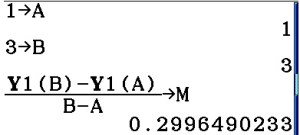

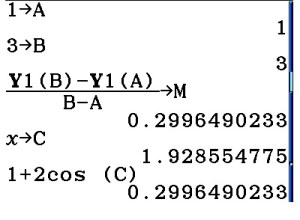
Step 2: I choose a = 1 and b = 3 and stored them in my calculator.

Step 3: I calculated the slope in my calculator – see first figure.

Step 4: The equation of the line is    y=f\left( a \right)+m\left( {x-a} \right). I entered this as Y2 in my calculator.

Step 5  h\left( x \right)=Y1(x)-Y2(x)=\left( {x+2\sin (x)} \right)-\left( {f\left( a \right)+m\left( {x-a} \right)} \right)

Step 6:  {h}'\left( x \right)=1+2\cos (x)-m

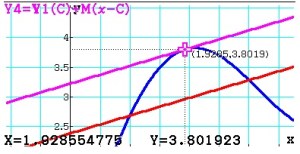
Solve  {h}'\left( x \right)=0 for the value between a and b on your calculator. See second figure.
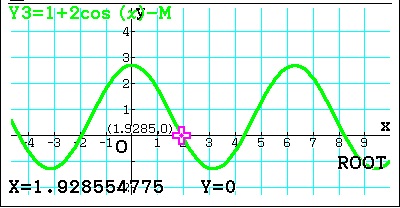
Step 6 and 7: I stored this value to C in my calculator and computed {f}'(c) on the home screen. See third figure.

Step 8: It is no coincidence that {f}'\left( c \right)=m.


The Mean Value Theorem states that for a function that is continuous on the interval [ab] and differentiable on the open interval (ab) there exists a number c in (a, b) such that

\displaystyle {f}'\left( c \right)=\frac{{f\left( b \right)-f\left( a \right)}}{{b-a}}


Additional Exploration:

  1. Can you show why {f}'\left( c \right)=m. ? Hint: Look at the expression for {h}'\left( c \right) in step 5; set it equal to zero. Why must the solution be the value that makes {f}'\left( x \right)=m?
  2. What does this mean graphically?

  1. Pick a different value for a and/or b so that the line between (a, f(a)) and (b, f(b)) intersects f(x) two (or more) times. The derivative will now have two (or more) zeros. Find them and calculate the slope at each one. What do you notice?

Students often confuse the Mean Value Theorem, the Average Rate of Change of a function on an interval, and the Average Value of a function on an interval. This is understandable because of the similarity in their names and the similarity of their results. Be sure to point this out as you teach them and help them learn the meanings of each.


Other posts related to the Mean Value Theorem

Foreshadowing the MVT Other examples using this technique

Existence Theorems

Fermat’s Penultimate Theorem   A lemma for Rolle’s Theorem: Any function extreme value(s) on an open interval must occur where the derivative is zero or undefined.

Rolle’s Theorem   A lemma for the MVT: On an interval if a function is continuous on a closed interval [a, b] and differentiable on the open interval (a, b) and f(a) = f(b), there must exist a number in the open interval (a, b) where ‘(c) = 0.

Mean Value Theorem I   Proof

Mean Value Theorem II   Graphical Considerations

Darboux’s Theorem   the Intermediate Value Theorem for derivatives.

Mean Tables

The Definite Integral and the FTC


Contextual Applications of the Derivative – Unit 4

Unit 4 covers rates of change in motion problems and other contexts, related rate problems, linear approximation, and L’Hospital’s Rule. (CED – 2019 p. 82 – 90). These topics account for about 10 – 15% of questions on the AB exam and 6 – 9% of the BC questions.

You may want to consider teaching Unit 5 (Analytical Applications of Differentiation) before Unit 4. Notes on Unit 5 will be posted next Tuesday September 29, 2020

Topics 4.1 – 4.6

Topic 4.1 Interpreting the Meaning of the Derivative in Context Students learn the meaning of the derivative in situations involving rates of change.

Topic 4.2 Linear Motion The connections between position, velocity, speed, and acceleration. This topic may work  better after the graphing problems in Unit 5, since many of the ideas are the same. See Motion Problems: Same Thing, Different Context

Topic 4.3 Rates of Change in Contexts Other Than Motion Other applications

Topic 4.4 Introduction to Related Rates Using the Chain Rule

Topic 4.5 Solving Related Rate Problems

Topic 4.6 Approximating Values of a Function Using Local Linearity and Linearization The tangent line approximation

Topic 4.7 Using L’Hospital’s Rule for Determining Limits of Indeterminate Forms. Indeterminate Forms of the type \displaystyle \tfrac{0}{0} and \displaystyle \tfrac{\infty }{\infty }. (Other forms may be included, but only these two are tested on the AP exams.)

Topic 4.1 and 4.3 are included in the other topics, topic 4.2 may take a few days, Topics 4.4 – 4.5 are challenging for many students and may take 4 – 5 classes, 4.6 and 4.7 two classes each. The suggested time is 10 -11 classes for AB and 6 -7 for BC. of 40 – 50-minute class periods, this includes time for testing etc.

This is a re-post and update of the third in a series of posts from last year. It contains links to posts on this blog about the differentiation of composite, implicit, and inverse functions for your reference in planning. Other updated post on the 2019 CED will come throughout the year, hopefully, a few weeks before you get to the topic. 


Posts on these topics include:

Motion Problems 

Motion Problems: Same Thing, Different Context

Speed

A Note on Speed

Related Rates

Related Rate Problems I

Related Rate Problems II

Good Question 9 – Related rates

Linear Approximation

Local Linearity 1

Local Linearity 2 

L’Hospital’s Rule

Locally Linear L’Hôpital  

L’Hôpital Rules the Graph  

Determining the Indeterminate

Determining the Indeterminate 2


Here are links to the full list of posts discussing the ten units in the 2019 Course and Exam Description.

Limits and Continuity – Unit 1  (8-11-2020)

Definition of t he Derivative – Unit 2  (8-25-2020)

Differentiation: Composite, Implicit, and Inverse Function – Unit 3  (9-8-2020)

Contextual Applications of the Derivative – Unit 4  Consider teaching Unit 5 before Unit 4 THIS POST

LAST YEAR’S POSTS – These will be updated in coming weeks

2019 – CED Unit 5 Analytical Applications of Differentiation  Consider teaching Unit 5 before Unit 4

2019 – CED Unit 6 Integration and Accumulation of Change

2019 – CED Unit 7 Differential Equations  Consider teaching after Unit 8

2019 – CED Unit 8 Applications of Integration   Consider teaching after Unit 6, before Unit 7

2019 – CED Unit 9 Parametric Equations, Polar Coordinates, and Vector-Values Functions 

2019 CED Unit 10 Infinite Sequences and Series


Differentiation: Composite, Implicit, and Inverse Function – Unit 3

This is a re-post and update of the third in a series of posts from last year. It contains links to posts on this blog about the differentiation of composite, implicit, and inverse functions for your reference in planning. Other updated posts on the 2019 CED will come throughout the year, hopefully, a few weeks before you get to the topic.  Unit 3 covers the Chain Rule, differentiation techniques that follow from it, and higher order derivatives. (CED – 2019 p. 67 – 77). These topics account for about 9 – 13% of questions on the AB exam and 4 – 7% of the BC questions.

Topics 3.1 – 3.6

Topic 3.1 The Chain Rule. Students learn how to apply the Chain Rule in basic situations.

Topic 3.2 Implicit Differentiation. The Chain Rule is used to find the derivative of implicit relations.

Topic 3.3 Differentiation Inverse Functions.  The Chain Rule is used to differentiate inverse functions.

Topic 3.4 Differentiating Inverse Trigonometric Functions. Continuing the previous section, the ideas of the derivative of the inverse are applied to the inverse trigonometric functions.

Topic 3.5 Selecting Procedures for Calculating Derivatives. Students need to be able to choose which differentiation procedure should be used for any function they are given. This is where you can review (spiral) techniques from Unit 2  and practice those from this unit.

Topic 3.6 Calculating Higher Order Derivatives. Second and higher order derivatives are considered. Also, the notations for higher order derivatives are included here.


Topics 3.2, 3.4, and 3.5 will require more than one class period. You may want to do topic 3.6 before 3.5 and use 3.5 to practice all the differentiated techniques learned so far. The suggested number of 40 – 50-minute class periods is about 10 – 11 for AB and 8 – 9 for BC. This includes time for testing etc.
Posts on these topics include:

Foreshadowing the Chain Rule

The Power Rule Implies Chain Rule

The Chain Rule

           Seeing the Chain Rule

Derivative Practice – Numbers

Derivative Practice – Graphs

Experimenting with CAS – Chain Rule

Implicit Differentiation of Parametric Equations


This series of posts reviews and expands what students know from pre-calculus about inverses. This leads to finding the derivative of exponential functions, ax, and the definition of e, from which comes the definition of the natural logarithm.

Inverses Graphically and Numerically

The Range of the Inverse

The Calculus of Inverses

The Derivatives of Exponential Functions and the Definition of e and This pair of posts shows how to find the derivative of an exponential function, how and why e is chosen to help this differentiation.

Logarithms Inverses are used to define the natural logarithm function as the inverse of ex. This follows naturally from the work on inverses. However, integration is involved, and this is best saved until later. I will mention it then.
Here are links to the full list of posts discussing the ten units in the 2019 Course and Exam Description.

Limits and Continuity – Unit 1 (8-11-2020)

Definition of the Derivative – Unit 2 (8-25-2020)

Differentiation: Composite, Implicit, and Inverse Function – Unit 3 (9-8-2020) THIS POST

LAST YEAR’S POSTS – These will be updated in the coming weeks

2019 CED – Unit 4 Contextual Applications of the Derivative Consider teaching Unit 5 before Unit 4

2019 – CED Unit 5 Analytical Applications of Differentiation Consider teaching Unit 5 before Unit 4

2019 – CED Unit 6 Integration and Accumulation of Change

2019 – CED Unit 7 Differential Equations Consider teaching after Unit 8

2019 – CED Unit 8 Applications of Integration   Consider teaching after Unit 6, before Unit 7

2019 – CED Unit 9 Parametric Equations, Polar Coordinates, and Vector-Values Functions 

2019 CED Unit 10 Infinite Sequences and Series


Definition of the Derivative – Unit 2

This is a re-post and update of the second in a series of posts from last year. It contains links to posts on this blog about the definition of the derivative for your reference in planning. Other updated post on the 2019 CED will come throughout the year, hopefully, a few weeks before you get to the topic. 

Unit 2 contains topics rates of change, difference quotients, and the definition of the derivative (CED – 2019 p. 51 – 66). These topics account for about 10 – 12% of questions on the AB exam and 4 – 7% of the BC questions.

Topics 2.1 – 2.4: Introducing and Defining the Derivative 

Topic 2.1: Average and Instantaneous Rate of Change. The forward difference quotient is used to introduce the idea of rate of change over an interval and its limit as the length of the interval approaches zero is the instantaneous rate of change.

Topic 2.2: Defining the derivative and using derivative notation. The derivative is defined as the limit of the difference quotient from topic 1 and several new notations are introduced. The derivative is the slope of the tangent line at a point on the graph. Explain graphically, numerically, and analytically how the three representations relate to each other and the slope.

Topic 2.3 Estimating the derivative at a point.  Using tables and technology to approximate derivatives is used in this topic. The two resources in the sidebar will be helpful here.

Topic 2.4: Differentiability and Continuity. An important theorem is that differentiability implies continuity – everywhere a function is differentiable it is continuous.  Its converse is false – a function may be continuous at a point, but not differentiable there. A counterexample is the absolute value function, |x|, at x = 0.

One way that the definition of derivative is tested on recent exams which bothers some students is to ask a limit like

\displaystyle \underset{{x\to 0}}{\mathop{{\lim }}}\,\frac{{\tan \left( {\tfrac{\pi }{4}+x} \right)-\tan \left( {\tfrac{\pi }{4}} \right)}}{x}.

From the form of the limit students should realize this as the limit definition of the derivative. The h in the definition has been replaced by x. The function is tan(x) at the point where \displaystyle a=\tfrac{\pi }{4}. The limit is \displaystyle {{\sec }^{2}}\left( {\tfrac{\pi }{4}} \right)=2.

Topics 2.5 – 2.10: Differentiation Rules

The remaining topics in this chapter are the rules for calculating derivatives without using the definition. These rules should be memorized as students will be using them constantly. There will be additional rules in Unit 3 (Chain Rule, Implicit differentiation, higher order derivative) and for BC, Unit 9 (parametric and vector equations).

Topic 2.5: The Power Rule

Topic 2.6: Constant, sum, difference, and constant multiple rules

Topic 2.7: Derivatives of the cos(x), sin(x), ex, and ln(x). This is where you use the squeeze theorem.

Topic 2.8. The Product Rule

Topic 2.9: The Quotient Rule

Topic 2.10: Derivative of the other trigonometric functions

The rules can be tested directly by just asking for the derivative or its value at a point for a given function. Or they can be tested by requiring the students to use the rule of an general expression and then find the values from a table, or a graph. See 2019 AB 6(b)


The suggested number of 40 – 50 minute class periods is 13 – 14 for AB and 9 – 10  for BC. This includes time for testing etc. Topics 2.1, 2,2, and 2.3 kind of flow together, but are important enough that you should spend time on them so that students develop a good understanding of what a derivative is. Topics 2.5 thru 2.10 can be developed in 2 -3 days, but then time needs to be spent deciding which rule(s) to use and in practice using them. The sidebar resource in the CED on “Selecting Procedures for Derivative” may be helpful here.


Other post on these topics

DEFINITION OF THE DERIVATIVE

Local Linearity 1  The graphical manifestation of differentiability with pathological examples.

Local Linearity 2   Using local linearity to approximate the tangent line. A calculator exploration.

Discovering the Derivative   A graphing calculator exploration

The Derivative 1  Definition of the derivative

The Derivative 2   Calculators and difference quotients

Difference Quotients 1

Difference Quotients II

Tangents and Slopes

         Differentiability Implies Continuity

FINDING DERIVATIVES 

Why Radians?  Don’t do calculus without them

The Derivative Rules 1  Constants, sums and differences, powers.

The Derivative Rules 2  The Product rule

The Derivative Rules 3  The Quotient rule


Here are links to the full list of posts discussing the ten units in the 2019 Course and Exam Description.the 2019 versions.

2019 CED – Unit 1: Limits and Continuity

2019 CED – Unit 2: Differentiation: Definition and Fundamental Properties.

2019 CED – Unit 3: Differentiation: Composite , Implicit, and Inverse Functions

2019 CED – Unit 4 Contextual Applications of the Derivative  Consider teaching Unit 5 before Unit 4

2019 – CED Unit 5 Analytical Applications of Differentiation  Consider teaching Unit 5 before Unit 4

2019 – CED Unit 6 Integration and Accumulation of Change

2019 – CED Unit 7 Differential Equations  Consider teaching after Unit 8

2019 – CED Unit 8 Applications of Integration   Consider teaching after Unit 6, before Unit 7

2019 – CED Unit 9 Parametric Equations, Polar Coordinates, and Vector-Values Functions 

2019 CED Unit 10 Infinite Sequences and Series


Graph Analysis Questions (Type 3)

AP  Questions Type 3: Graph Analysis

The long name is “Here’s the graph of the derivative, tell me things about the function.”

Students are given either the equation of the derivative of a function or a graph identified as the derivative of a function with no equation is given. It is not expected that students will write the equation of the function from the graph (although this may be possible); rather, students are expected to determine important features of the function directly from the graph of the derivative. They may be asked for the location of extreme values, intervals where the function is increasing or decreasing, concavity, etc. They may be asked for function values at points. They will be asked to justify their conclusions.

The graph may be given in context and student will be asked about that context. The graph may be identified as the velocity of a moving object and questions will be asked about the motion. See Linear Motion Problems (Type 2)

Less often the function’s graph may be given and students will be asked about its derivatives.

What students should be able to do:

  • Read information about the function from the graph of the derivative. This may be approached by derivative techniques or by antiderivative techniques.
  • Find and justify where the function is increasing or decreasing.
  • Find and justify extreme values (1st and 2nd derivative tests, Closed interval test a/k/a Candidates’ test).
  • Find and justify points of inflection.
  • Find slopes (second derivatives, acceleration) from the graph.
  • Write an equation of a tangent line.
  • Evaluate Riemann sums from geometry of the graph only. This usually involves familiar shapes such as triangles or semicircles.
  • FTC: Evaluate integral from the area of regions on the graph.
  • FTC: The function, g(x), maybe defined by an integral where the given graph is the graph of  the integrand, f(t), so students should know that if,

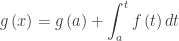
\displaystyle g\left( x \right)=g\left( a \right)+\int_{a}^{t}{f\left( t \right)dt} then  {g}'\left( x \right)=f\left( x \right)  and  {{g}'}'\left( x \right)={f}'\left( x \right).

In this case, students should write {g}'(t)=f\left( t \right) on their answer paper, so it is clear to the reader that they understand this.

Not only must students be able to identify these things, but they are usually asked to justify their answer and reasoning. See Writing on the AP Exams for more on justifying and explaining answers.

The ideas and concepts that can be tested with this type question are numerous. The type appears on the multiple-choice exams as well as the free-response. Between multiple-choice and free-response this topic may account for 15% or more of the points available on recent tests. It is very important that students are familiar with all the ins and outs of this situation.

As with other questions, the topics tested come from the entire year’s work, not just a single unit. In my opinion many textbooks do not do a good job with integrating these topics, so be sure to use as many actual AP Exam questions as possible. Study past exams; look them over and see the different things that can be asked. The Graph Analysis problem may cover topics primarily from primarily from Unit 4, Unit 5, and Unit 8 of the 2019 CED 

For some previous posts on this subject see October 1517192426 (my most read post), 2012 and  January 2528, 2013

Free-response questions:

  • Function given as a graph, questions about its integral (so by FTC the graph is the derivative):  2016 AB 3/BC 3, 2018 AB3
  • Table and graph of function given, questions about related functions: 2017 AB 6,
  • Derivative given as a graph: 2016 AB 3 and 2017 AB 3
  • Information given in a table 2014 AB 5

Multiple-choice questions from non-secure exam. Notice the number of questions all from the same year; this is in addition to one free-response question (~25 points on AB and ~23 points on BC out of 108 points total)

  • 2012 AB: 2, 5, 15, 17, 21, 22, 24, 26, 76, 78, 80, 83, 82, 84, 85, 87
  • 2012 BC 3, 11, 12, 15, 12, 18, 21, 76, 78, 80, 81, 84, 88, 89

A good activity on this topic is here. The first pages are the teacher’s copy and solution. Then there are copies for Groups A, B, and C. Divide your class into 3 or 6 or 9 groups and give one copy to each. After they complete their activity have the students compare their results with the other groups.


Revised March 12, 2021