Determining the Indeterminate 2

The other day someone asked me a question about the implicit relation {{x}^{3}}-{{y}^{2}}+{{x}^{2}}=0. They had been asked to find where the tangent line to this relation is vertical. They began by finding the derivative using implicit differentiation:

3{{x}^{2}}-2y\frac{dy}{dx}+2x=0

\displaystyle \frac{dy}{dx}=\frac{3{{x}^{2}}+2x}{2y}

The derivative will be undefined when its denominator is zero. Substituting y = 0 this into the original equation gives {{x}^{3}}-0+{{x}^{2}}=0. This is true when x = –1 or when x = 0. They reasoned that there will be a vertical tangent when x = –1 (correct) and when x = 0 (not so much). They quite wisely looked at the graph.

relation 1

{{x}^{3}}-{{y}^{2}}+{{x}^{2}}=0

The graph appears to run from the first quadrant, through the origin into the third quadrant, up to the second quadrant with a vertical tangent at x = –1, and then through the origin again and down into the fourth quadrant. It looks like a string looped over itself.

What’s going on at the origin? Where is the vertical tangent at the origin?

The short answer is that vertical tangents occur when the denominator of the derivative is zero and the numerator is not zero.  When x = 0 and y = 0 the derivative is an indeterminate form 0/0.

In this kind of situation an indeterminate form does not mean that the expression is infinite, rather it means that some other way must be used to find its value. L’Hôpital’s Rule comes to mind, but the expression you get results in another 0/0 form and is no help (try it!).

My thought was to solve for y and see if that helps:

y=\pm \sqrt{{{x}^{3}}+{{x}^{2}}}

The graph consists of two parts symmetric to the x-axis, in the same way a circle consists of two symmetric parts above and below the x-axis. The figure below shows the top half.


y=+\sqrt{{{x}^{3}}+{{x}^{2}}}

So, the graph does not run from the first quadrant to the third; rather, at the origin it “bounces” up into the second quadrant. The lower half is congruent and is the reflection of this graph in the x-axis.

So, what happens at the origin and why?

The derivative of the top half is \displaystyle \frac{dy}{dx}=\frac{3{{x}^{2}}+2x}{2\sqrt{{{x}^{3}}+{{x}^{2}}}}. Notice that this is the same as the implicit derivative above. Now a little simplifying; okay a lot of simplifying – who says simplifying isn’t that big a deal?

\displaystyle \frac{dy}{dx}=\frac{x\left( 3x+2 \right)}{2\sqrt{{{x}^{2}}\left( x+1 \right)}}=\frac{x\left( 3x+2 \right)}{2\left| x \right|\sqrt{x+1}}=\left\{ \begin{matrix} \frac{3x+2}{2\sqrt{x+1}} & x>0 \\ -\frac{3x+2}{2\sqrt{x+1}} & x<0 \\ \end{matrix} \right.

Now we see what’s happening. As x approaches zero from the right, the derivative approaches +1, and as x approaches zero from the left, the derivative approaches –1.  This agrees with the graph. Since the derivative approaches different values from each side, the derivative does not exist at the origin – this is not the same as being infinite.  (For the lower half, the signs of the derivative are reversed, due to the opposite sign of the denominator.)

The tangent lines at the origin are x = 1 on the right, and x = –1 on the left, hardly vertical.

What have we learned?

  1. Indeterminate forms do not necessarily indicate an infinite value. An indeterminate form must be investigated further to see what you can learn about a function, relation, or graph.
  2. Sometimes simplifying, or at least changing the form of an expression, is helpful and therefore necessary.

Extension: Using a graphing utility that allows sliders (Winplot, GeoGebra, Desmos, etc)  enter A{{x}^{3}}-B{{y}^{2}}+C{{x}^{2}}=0 and explore the effects of the parameters on the graph.

_________________________

The Man Who Tried to Redeem the World with Logic

WALTER PITTS (1923-1969): Walter Pitts’ life passed from homeless runaway, to MIT neuroscience pioneer, to withdrawn alcoholic. (Estate of Francis Bello / Science Source)

WALTER PITTS (1923-1969): Walter Pitts’ life passed from homeless runaway, to MIT neuroscience pioneer, to withdrawn alcoholic. (Estate of Francis Bello / Science Source)

I ran across this article that you might find interesting. It is about Walter Pitts one of the twentieth century’s most important mathematicians we, or at least I, have never heard of.  It is from the February 5, 2015 of the science magazine Nautilus


Curves with Extrema?

mae-west-curve-the-loveliest-distance-between

We spend a lot of time in calculus studying curves. We look for maximums, minimums, asymptotes, end behavior, and on and on, but what about in “real life”?

For some time, I’ve been trying to find a real situation determined or modeled by a non-trigonometric curve with more than one extreme value. I’ve not been very successful. I knew of only one and discovered a second in writing this post. Here is an example that illustrates what I mean.

Example 1: This is a very common calculus example. Squares are cut from the corners of a cardboard sheet that measures 20 inches by 40 inches. The remaining sides are folded up to make a box. How large should the squares be to make a box of the largest possible volume?

If we let x = the length of the side of the square, then the volume of the box is given by V = x (20 –2 x)(40 – 2x)

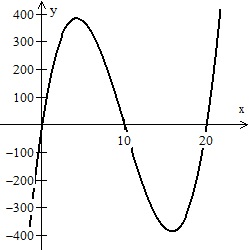
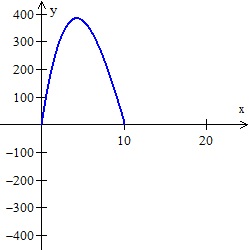
The graph of the volume is shown in Figure 1 and sure enough we have a polynomial curve that has two extreme values. But wait. Do we really have two extreme values? The domain of the equation appears to be all real numbers, but in fact it is 0 < x < 10, since x cannot be negative, and if x > 10, then the (20 ­–2 x) side is negative and that won’t work either. Figure 2 shows the true situation. There is only one extreme value.

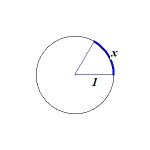
Example 2: This is also an optimization problem, but a bit more difficult. A sector is cut from a circular paper disk of radius 1. The remaining part of the disk is formed into a cone. How long should the curved part of the sector be so that the cone has the maximum volume? You might want to try this before you read further.

Let x be the length of curved part of the sector See Figure 3.

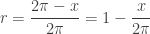
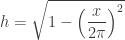
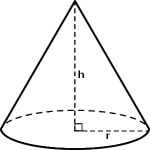
The radius of the disk becomes the slant height of the cone. The circumference of the disk is 2\pi \left( 1 \right) and so the circumference of the base of the cone is C=2\pi \left( 1 \right)-x and its radius is \displaystyle r=\frac{2\pi -x}{2\pi }=1-\frac{x}{2\pi }. The height, h of the cone is \displaystyle h=\sqrt{1-{{\left( \frac{x}{2\pi } \right)}^{2}}}. See figure 4.

The volume of the cone is .\displaystyle V=\frac{\pi }{3}{{\left( 1-\frac{x}{2\pi } \right)}^{2}}\sqrt{{{1}^{2}}-{{\left( 1-\frac{x}{2\pi } \right)}^{2}}}

The graph of this equation is shown in Figure 5, and has two maximum values and a minimum. The domain appears to be 0<x<4\pi . But if x>2\pi  the piece you cut out will be larger than the original disk (and the expression under the radical will be negative). So our domain will be 0<x<2\pi  (the endpoints correspond to not cutting any sector or cutting away the entire disk. The graph is shown in Figure 6 with, alas, only one extreme value.
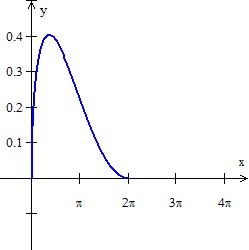
(For the original expression the minimums are at x=0,\ 2\pi ,\text{ and }4\pi and the maximums are at x\approx 1.153\text{ and }x\approx 11.413. A CAS will help with these calculations or just use a graphing calculator.)
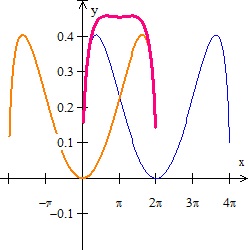
  • Extension 1: Find the value of x that will make the largest volume when the piece cut out is formed into a cone. Compare the two graphs and explain their congruence. See Figure 7.
  • Extension 2: Here I finally found what I was after. – a situation with more than one extreme value. Find the value of x that will make the largest total volume formed when the volume of the original cone and the cone formed by the piece cut out. Compare the first two graphs and the graph of this volume. See figure 8 – the magenta graph.

The Mae West Curve

There is at least one real situation that is modeled by a function with several extreme values. Spud’s blog gives the following explanation and illustration.

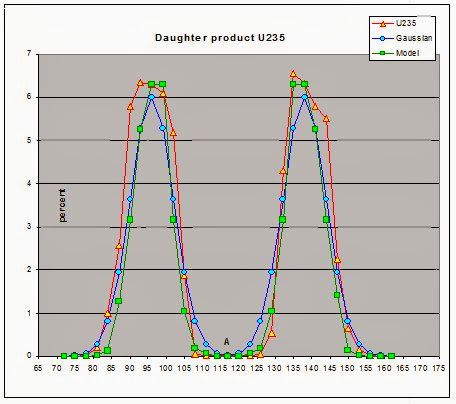
“When a Uranium (or Plutonium) atom fission, or splits, you end up with two much lighter atoms, called fission products, or daughter nuclides.  The U-235 nucleus can split into a myriad of combinations, but some combinations are more likely than others.

“[Figure 9 below] shows the percentage of fission products by [atomic] mass[, A].  [This is] called the Mae West curve. … Note that the more likely fission products have two peaks at a mass of about 95 and 135.”

Thus we have a real life illustration of a model that has three extreme values in its domain.

The model graphed in Figure 9 is known as the “Mae West Curve,” named after Mae West (1893 – 1980) and actress, playwright and screenwriter.

If you know of any other real situations with more than one extreme, please let us know. Use the “comment” button below.

.

Using the Derivative to Graph the Function

In my last post I showed how to use a Desmos graph to discover, by looking at the tangent line as it moved along the graph of the function, the properties of the derivative of a function. This post goes in the opposite direction. Now, instead of discovering the properties of the derivative from the graph of the function, we will use that knowledge to identify important information about the function from the graph of its derivative. We are not discovering anything here; rather we are putting our previous discoveries to use.

One of the uses of the derivative is to deduce properties of its antiderivative, i.e. the function of which it is the derivative. This is an important skill for students to be able to use. It is also a type of question that appears on every Advanced Placement Calculus exam in both the free-response sections and the multiple-choice sections. My previous post on this topic, Reading the Derivative’s Graph, is the most read post on this blog. This post expands on the concepts in that post and shows how to use the Desmos file to help students develop the skills necessary to answer this type of question.

Desmos is free. You and your students can set up their own account and save their own work there. There are also free Desmos apps for tablets and smart phones.

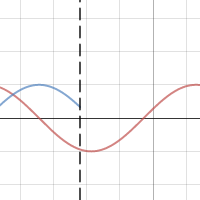
Click on the graph above. Here’s what you should see:

  • The first equation on the left side is f(x). This is the function whose antiderivative we will be trying to create. You may change this to any function you wish.
  • The second equation is F(x) the antiderivative of f(x). That is ‘(x) = f(x). Desmos cannot compute an antiderivative so you will need to enter it yourself. Your students need not trust you on this: have them check your equation by differentiating. Of course, at this point they will not be ready to find the analytic form of the antiderivative except for the simplest functions. This comes later in the year.
  • Note the “+C” is included and later we will manipulate this with a slider.
  • The antiderivative is multiplied by \frac{\sqrt{a-x}}{\sqrt{a-x}}. This is a way of controlling the “a” slider and should always be multiplied by antiderivative. This is just a syntax trick to make the graph work and is not part of the antiderivative. When x is to the left of a, (x < a) the fraction is 1 and the graph will be seen; when x is to the right of a, (x > a) the expression is undefined, and nothing will graph. As you change “a” with the slider the graph of an antiderivative will be drawn.
  • The third equation x = a graphs a dashed vertical to help you line up the corresponding points on the two graphs.
  • The next two lines are the “a” and “C” sliders. Make C = 0 for now and move the “a” slider.

At this point students should know things about the relationship between a function and its first and second derivatives. This includes the things they discovered in the previous post such as when the function is increasing the derivative is non-negative, and when the tangent line is above the graph the slope (derivative) is decreasing and the graph of the function is concave down. All of these concepts are really “if, and only if” situations. So we now consider them in reverse and deduce properties of the antiderivative from the properties of the graph of the derivative.

Using the “a” slider starting at the left side of the graph ask the students what the derivative tells them about the function in this part of the domain. Is the function increasing or decreasing? Is it concave up or down? etc.  Go slowly from left to right asking what happens next, and why (that is, how do you know? What feature of the derivative tells you this?) This is preparing them to write the justifications required on the AP exams.

Certain points on the graph of the derivative are important. The zeros of the derivative and whether the derivative changes from positive to negative, negative to positive, or neither are important. Likewise, the extreme values of the derivative point to important features of the function – points of inflection.

Once you have a complete graph of the antiderivative move the “C” slider.

  • Remind students that the derivative of a constant is zero and therefore, the C does not show up in the derivative.
  • Discuss is why changing the antiderivative does not change the derivative.
  • Ask, how many functions have the same derivative?
  • Point out is that by changing “C” the graph of an antiderivative can be made to go through any (every, all) point in the plane.

Switch to a different function and its derivative to reinforce the concepts. Yo will have to enter both the derivative and the antiderivative.Do this as often as necessary. You could also give students or groups of students the graph of a derivative (on paper) and challenge them to sketch the antiderivative.

A disclaimer: A function and its derivative should not be graphed on the same axes, because the two have different units. Nevertheless, I have done it here, and it is commonly done everywhere, to compare the graphs of a function and its derivative so that the important features of the two can be lined up and easily compared.

.


Tangents and Slopes

Using the function to learn about its derivative. 
In this post we will look at a way of helping students discover the numerical and graphical properties of the derivative and how they can be determined from the graph of the function. These ideas can be used very early, when you are first relating the function and its derivative. (In my next post we will look at the problem the other way around – using the derivative to find out about the function.)
Click on the graph below. This will take you to a graph I posted on the Desmos website (Desmos.com). This is a free and really easy to use grapher, which you and your students can use. If you sign up for your own account, you can make and save graphs for your class or use some of those that are built-in (click on the three horizontal bars at the upper left of the screen). Your students may do this as well. There are also Desmos apps for smart phones and tablets.

When you click on the graph a file called “function => derivative” should open. This is what you should see:
On the left is a list of equations. Those with a colored circle to its left are turned on; click the circle to toggle the graphs on and off. Here’s what they do:

  • f(x) is the equation of the function we will start with. Later you may change this to whatever function you are investigating. You will not have to change any of the others when you change the function. This one should be turned on.
  • g(x) is the derivative of f(x). Leave this turned off.
  • h(x) is a special function. The expression at the end, \frac{\sqrt{a-x}}{\sqrt{a-x}}, is what makes the slider work. This is a syntax trick and not part of the derivative. If x is to the right of a (i.e. x < a) the expression is equal to one and the derivative will graph. If x is to the right of a, (i.e. a < x) then the expression is undefined, and nothing will graph. Initially, turned off.
  • k(x) is the graph of a segment tangent to f at x = a. Click on the equation if you want to see how the segment is drawn by restricting the domain of x. Initially, turned on.
  • The next equation, x = a, is the equation of the dashed vertical line. This is included so that, later, we can see precisely how points on the graph are located above one another. Initially, turned off.
  • (a, f(a)) is the point of tangency. Initially, turned on.
  • The last box is the slider for the variable a. Its domain is shown at the ends. This may be changed by clicking on one end or clicking on the “gear” icon at the top of the list.

The icons at the top right of the graph let you zoom in and out or set the viewing window. You may click on the wrench icon and make other adjustments. “Projector Mode” makes the graph thicker and may help students see better when you project the graph.
Okay, you are now Desmos experts! Really, it’s that easy. The “?” at the top right has a few more instructions and you can download the user’s guide, a brief 13 pages.


Investigating the derivative
Do this before proving all the associated theorems. Let the class discover the relations between the graph of the function and its derivative. Prove them, or explain why they are so, later. You may want to spread all this over several days, perhaps dealing with where the function is increasing or decreasing and extreme values the first day and working with concavity the second.
1. Begin with just f(x), k(x), and the point (a, f(a)) turned on (click the circle to the left of the equation to toggle graphs on and off). Use the slider to move the tangent segment along the graph.
Draw the class’s attention to important things but let them formulate the observations in words. Ask your class a series of questions about what they see. Things like:

  • When the function is increasing, is the slope of the tangent segment positive or negative? When the function is decreasing, is the slope of the tangent segment positive or negative? Why?
  • What happens with the derivative when the function changes from increasing to decreasing or vice versa?
  • Notice that sometimes the tangent segment lies above the function and sometimes below. What does the function look like when the tangent is above (below)?
  • In the box for the slider delete the number and type a = 0; this moves the slider to the origin. Can you see what its slope is here? You can type in other numbers such as pi/6, or pi/2 and read the slope there. (If the slider disappears when you do this, type in a = 0 and it will come back.)
  • If you can project on a white board or are using a Smartboard, mark the points (a, slope at a) and see if you can graph the derivative.

2. Next turn on h(x) and x = a. Move the slider.

  • What are you seeing? As you move the slider the dashed vertical line moves to show you where you are. The graph of the derivative is drawn to the left of the dashed line.
  • Once again question the class about what they observe. Notice such things as on intervals where the function increases, the derivative is greater than or equal to zero, etc. Review all the things you discovered in part 1. Remember often students don’t associate things such as “the derivative is negative” with the “graph of the derivative lies below the x-axis.“
  • How does the concavity relate to the graph of the derivative?

3. Now change the starting function to something else.

  • First, just add a constant to f(x). If you really want to get fancy type f(x) = sin(x) + b. A slider for b will appear. Discuss why this transformation does not change the graph of the derivative one bit.
  • Some good examples are f(x) = cos(x), f(x) = x+2sin(x), a third- or fourth-degree polynomial (find a good example in your textbook and see below). Repeat all of steps 1 and 2 above.

Give the students a new function and see if they can sketch the (approximate) graph of the derivative themselves.


For further exploration click the graph below. This is similar to the first one; however, the function is a fourth degree polynomial with variable coefficients. Use the various sliders at the bottom to adjust the graph to an interesting shape. Make p = 0 to graph a cubic and make both p and q zero to graph a parabola. (This might make a good lesson in an advanced math or Algebra 2 class.)

A disclaimer: A function and its derivative should not be graphed on the same axes, because the two have different units. Nevertheless, I have done it here, and it is commonly done everywhere to compare the graphs of a function and its derivatives so that the important features of the two can be lined up and compared easily.

.


Good Question 3 1995 BC 5

A word before we look at one of my favorite AP exam questions, I put some of my presentations in a new page. Look under the “Resources” tab above, and you will see a new page named “Presentations.” There are PowerPoint slides and the accompanying handouts from some talks I’ve given in the last few years. I also use them in my workshops and AP Summer Institutes.

This continue a discussion of some of my favorite question and how to use them in class.You can find the others by entering “Good Question” in the search box on the right.

Today we look at one of my favorite AP exam questions. This one is from the 1995 BC exam; the question is also suitable for AB students. Even though it is 20 years old, it is still a good question.  1995 was the first year that graphing calculators were required on the AP Calculus exams.They were allowed, but not required for all 6 questions.

1995 BC 5

The question showed the three figures below and identified figure 1 as the graph of f\left( x \right)={{x}^{2}}  and figure 2 as the graph of g\left( x \right)=\cos \left( x \right).  The question then allowed as how one might think of the graph is figure 3 as the graph of h\left( x \right)={{x}^{2}}+\cos \left( x \right), the sum of these two functions. Not that unreasonable an assumption, but apparently not correct.
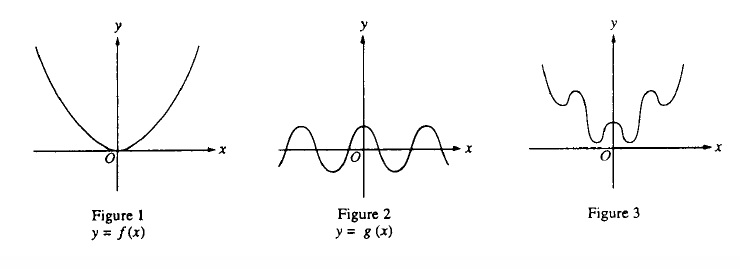
1995 BC 5

Part a: The students first were asked to sketch the graph of h\left( x \right) in a window with [–6, 6] x [–6, 40] (given this way). A box with axes was printed in the answer booklet.  This was a calculator required question and the result on a graphing calculator looks like this:


1995 BC 5

y={{x}^{2}}+\cos \left( x \right).
The window is [-6,6] x [-6, 40]

Students were expected to copy this onto the answer page. Note that the graph exits the screen below the top corners and it does not go through the origin. Both these features had to be obvious on the student’s paper to earn credit.

Part b: The second part of the question instructed students to use the second derivative of h\left( x \right) to explain why the graph does not look like figure 3.

\displaystyle \frac{dy}{dx}=2x-\sin \left( x \right)

\displaystyle \frac{{{d}^{2}}y}{d{{x}^{2}}}=2-\cos \left( x \right)

Students then had to observe that the second derivative was always positive (actually it is always greater than or equal to 1) and therefore the graph is concave up everywhere. Therefore, it cannot look like figure 3.

Part c: The last part of the question required students to prove (yes, “prove”) that the graph of y={{x}^{2}}+\cos \left( kx \right) either had no points of inflection or infinitely many points of inflection, depending on the value of the constant k.
Successful student first calculated the second derivative:

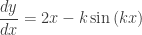
\displaystyle \frac{dy}{dx}=2x-k\sin \left( kx \right)

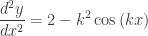
\displaystyle \frac{{{d}^{2}}y}{d{{x}^{2}}}=2-{{k}^{2}}\cos \left( kx \right)

Then considering the sign of the second derivative, if {{k}^{2}}\le 2, \frac{{{d}^{2}}y}{d{{x}^{2}}}\ge 0 and there are no inflection points (the graph is always concave up). But, if {{k}^{2}}>2, then since y” is periodic and changes sign, it does so infinitely many times and there are then infinitely many inflection points. See the figure below.
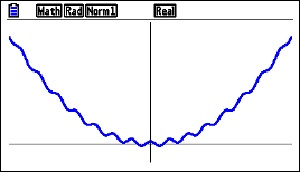

k = 8

k = 8


Using this question as a class exercise

Notice how the question leads the student in the right direction. If they go along with the problem they are going in the right direction. In class, I would be inclined to make them work for it.

  1. First, I would ask the class if figure 3 is the correct graph of h\left( x \right)={{x}^{2}}+\cos \left( x \right). I would let them, individually, in groups, or as a class suggest and defend an answer. I would not even suggest, but certainly not mind, if they used a graphing calculator.
  2. Once they determined the correct answer, I would ask them to justify (or prove) their conjecture. Again, no hints; let the class struggle until they got it. I may give them a hint along the lines of what does figure 3 have or do that the correct graph does not. (Answer: figure 3 changes concavity). Sooner or later someone should decide to check out the second derivative.
  3. Then I’d ask what could be the equation for a graph that does look like figure 3. You could give hints along the line of changing the coefficients of the terms of the second derivative. There are several ways to do this and all are worth considering.
    1. Changing the coefficient of the x2 term (to a proper fraction, say, 0.02) will do the trick. If that’s what they come up with fine – it’s correct.
    2. If you want to be picky, this causes the graph to go negative and figure 3 does not do that, but I ‘d let that go and ask if changing the coefficient of the cosine term in the second derivative can be done and if so how do you do that.
    3. This may be done by simply putting a number in front of the cosine term of the original function, say h\left( x \right)={{x}^{2}}+6\cos \left( x \right), but the results really do not look like figure 3,
    4. If necessary, give them the hint y={{x}^{2}}+\cos \left( kx \right)

1995 was the first year graphing calculators were required on the AP Calculus exams. They were allowed for all questions, but most questions had no place to use them. The parametric equation question on the same test, 1995 BC 1, was also a good question that made use of the graphing capability of calculators to investigate the relative motion of two particles in the plane.   The AB Exam in 1995 only required students to copy one graph from their calculator.

Both BC questions were generally well received at the reading. I know I liked them. I was looking forward to more of the same in coming years.

I was disappointed.

There was an attempt the following year (1997 AB4/BC4), but since then nothing investigating families of functions (i.e.  like these with a parameter that affects the shape of the graph) or anything similar has appeared on the exams. I can understand not wanting to award a lot of points for just copying the graph from your calculator onto the paper, but in a case like this where the graph leads to a rich investigation of a counterintuitive situation I could get over my reluctance.

But that’s just me.

Good Question 1: 2008 AB 6

When I started this blog several years ago I was hoping my readers would ask questions that we could discuss or submit ideas for additional topics to write about. This has not really happened, but I’m still very open to the idea. (That was a HINT.) Since that first year when I had the entire curriculum ahead of me, I have written less not because I dislike writing, but because I am low on ideas.

The other day, I answered a question posted on the AP Calculus Community bulletin board about AB calculus exam question. It occurred to me that this somewhat innocuous looking question was quite good. So I decided to start an occasional series on good questions, from AP exams or elsewhere, that can be used to teaching beyond the actual things asked in the question.  (My last post might be in this category, but that was written several months ago.)

In discussing these questions, I will make numerous comments about the question and how to take it further in your class. My idea is not just to show how to write a good answer, but rather to use the question to look deeper into the concepts involved.

Good Question #1: 2008 AB Calculus exam question 6.

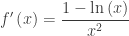
The stem gave students the function \displaystyle f\left( x \right)=\frac{\ln \left( x \right)}{x},\quad x>0. Students were also told that \displaystyle {f}'\left( x \right)=\frac{1-\ln \left( x \right)}{{{x}^{2}}}.

  1. The first thought that occurs is why they gave the derivative. The reason is, as we will see, that the first derivative is necessary to answer the first three parts of the question. Therefore, a student who calculates an incorrect derivative is going to be in big trouble (and the readers may have a great deal of work to do reading with the student’s incorrect work). The derivative is calculated using the quotient rule, and students will have to demonstrate their knowledge of the quotient rule later in this question; there is no reason to ask them to do the same thing twice.
  2. If you are using this with a class, you can, and probably should, ask your students to calculate the first derivative. Then you can see how many giving the derivative would have helped.
  3. When discussing the stem, you should also discuss the domain, x > 0, and the x-intercept (1, 0). Other features of the graph, such as end behavior, are developed later in the question, so they may be put on hold briefly.

Part a asked students to write an equation of the tangent line at x = e2. To do this students need to do two calculations: \displaystyle f\left( {{e}^{2}} \right)=\frac{2}{{{e}^{2}}} and \displaystyle {f}'\left( {{e}^{2}} \right)=-\frac{1}{{{e}^{4}}}. An equation of the tangent line is \displaystyle y=\frac{2}{{{e}^{2}}}-\frac{1}{{{e}^{4}}}\left( x-{{e}^{2}} \right).

  1. Writing the equation of a tangent line is a very important skill and should be straightforward. The point-slope form is the way to go. Avoid slope-intercept.
  2. The tangent line is used to approximate the value of the function near the point of tangency; you can throw in an approximation computation here.
  3. After doing part c, you should return here and discuss whether the approximation is an overestimate or an underestimate and how you can tell. (Answer: underestimate, since the graph is concave up here.)
  4. After doing part c, you can also ask them to write the tangent line at the point of inflection and whether approximations near the point of inflection are overestimates or an underestimates, and why. (Answer: Since the concavity change here, it depends on which side of the point of inflection the approximation is made. To the left is an overestimate; to the right is an underestimate.)

Part b asked students to find the x-coordinate of the critical point, determine whether it is a maximum, a minimum, or neither, and to “justify your answer.” To earn credit students had to write the equation \displaystyle {f}'\left( x \right)=0 and solve it getting x = e. They had to state that this is a maximum because  “{f}'\left( x \right)changes from positive to negative at x = e.”

This is a very standard AP exam question. To expand it in your class:

  1. Discuss how you know the derivative changes sign here. This will get you into the properties of the natural logarithm function.
  2. Discuss why the change in sign tells you this is a maximum. (A positive derivative indicates an increasing function, etc.)
  3. After doing part c, you can return here and try the second derivative test.
  4. The question asks for “the” critical point, hinting that there is only one. Students should learn to pick up on hints like this and be careful if their computation produces more or less than one.
  5. At this point we have also determined that the function is increasing on the interval \left( -\infty ,e \right] and decreasing everywhere else. The question does not ever ask this, but in class this is worth discussing as important features of the graph. On why these are half-open intervals look here.

Part c told students there was exactly one point of inflection and asked them to find its x-coordinate.  To do this they had to use the quotient rule to find that \displaystyle {{f}'}'\left( x \right)=\frac{-3+2\ln \left( x \right)}{{{x}^{3}}}, set this equal to zero and find the x-coordinate to be x = e3/2.

  1. The question did not require any justification for this answer. In class you should discuss what a justification would look like. The reason is that the second derivative changes sign here. So now you need to discuss how you know this.
  2. Also, you can now determine that the function is concave down on the interval \left( -\infty ,{{e}^{3/2}} \right) and concave up on the interval \left({{e}^{3/2}},\infty \right). Ask your class to justify this.

Part d asked student to find \displaystyle \underset{x\to 0+}{\mathop{\lim }}\,\frac{\ln \left( x \right)}{x}. The answer is -\infty . While this seems almost like a throwaway tacked on the end because they needed another point, it is the reason I like this question.

  1. The question is easily solved: \displaystyle \underset{x\to 0+}{\mathop{\lim }}\,\frac{\ln \left( x \right)}{x}=\underset{x\to 0+}{\mathop{\lim }}\,\frac{1}{x}\cdot \underset{x\to 0+}{\mathop{\lim }}\,\ln \left( x \right)=\left( \infty \right)\left( -\infty \right)=-\infty .
  2. While tempting, the limit cannot be found by L’Hôpital’s Rule, because on substitution you get \frac{-\infty }{0},which is not one of the forms that L’Hôpital’s Rule can handle.
  3. The reason I like this part so much is that we have already developed enough information in the course of doing the problem to find this limit! The function is increasing and concave down on the interval \left( -\infty ,e \right). Moving from the maximum to the left, the function crosses the x-axis at (1, 0), keeps heading south, and gets steeper. So the limit as you approach the y-axis from the right is negative infinity.This is the left-side end behavior.
  4. What about the right-side end behavior? (You ask your class.) Well, the function is positive and decreasing to the right of the maximum and becomes concave up after x = e3/2. Thus, it must flatten out and approach the x-axis as an asymptote.
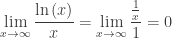
  5. That \displaystyle \underset{x\to \infty }{\mathop{\lim }}\,\frac{\ln \left( x \right)}{x}=0 is clear from the note immediately above. This limit can be found by L’Hôpital’s Rule since it is an indeterminate of the type \infty /\infty . So, \displaystyle \underset{x\to \infty }{\mathop{\lim }}\,\frac{\ln \left( x \right)}{x}=\underset{x\to \infty }{\mathop{\lim }}\,\frac{\tfrac{1}{x}}{1}=0.
  6. Notice also that the first derivative approaches zero as x approaches infinity. This indicates that the function’s graph approaches the horizontal as you travel farther to the right. The second derivative also approaches zero as x approaches infinity indicating that the function’s graph is becoming flatter (less concave).

This question and the discussion is largely done analytically (working with equations). We did find a few important numbers in the course of the work. Hopefully, you students discussed this with many good words. To complete the Rule of Four, here is the graph.

2008 AB 6 - 1

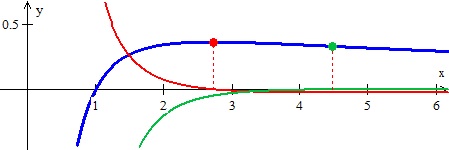
And here is a close up showing the important features of the graph and the corresponding points on the derivatives.

The function is shown in blue, the derivative and maximum in red, and the second derivative and the point of inflection in green.

The function is shown in blue, the derivative and maximum in red, and the second derivative and the point of inflection in green.

Finally, this function and the limit at infinity is similar to the more pathological example discussed in the post of October 31, 2012 entitled Far Out!

Variations on a Theme by ETS

Experienced AP calculus teacher use as many released exam questions during the year as they can. They are good questions and using them gets the students used to the AP style and format.  They can be used “as is”, but many are so rich that they can be tweaked to test other concepts and to make the students think wider and deeper.  

Below is a multiple-choice question from the 2008 AB calculus exam, question 9.

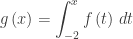
 2008 mc9The graph of the piecewise linear function f  is shown in the figure above. If \displaystyle g\left( x \right)=\int_{-2}^{x}{f\left( t \right)\,dt}, which of the following values is the greatest?

(A)  g(-3)         (B)  g(-2)         (C)  g(0)         (D)  g(1)         (E)  g(2)

I am now going to suggest some ways to tweak this question to bring out other ideas. Here are my suggestions. Some could be multiple-choice others simple short constructed response questions. A few of these questions, such as 3 and 4, ask the same thing in different ways.

      1. Require students to show work or justify their answer even on multiple-choice questions. So for this question they should write, “The answer is (D) g(1) since x = 1 is the only place where {g}'\left( x \right)=f\left( x \right) changes from positive to negative.” 
      2. Ask, “Which of the following values is the least?” (Same choices)
      3. Find the five values listed.
      4. Put the five values in order from smallest to largest.
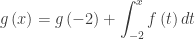
      5. If \displaystyle g\left( x \right)=g\left( -2 \right)+\int_{-2}^{x}{f\left( t \right)dt} and the maximum value of g is 7, what is the minimum value?
      6. If \displaystyle g\left( x \right)=g\left( -2 \right)+\int_{-2}^{x}{f\left( t \right)dt} and the minimum value of g is 7, what is the maximum value?
      7. Pick any number (not just an integers) in the interval [–3, 2] to be a and change the stem to read, “If \displaystyle g\left( x \right)=g\left( a \right)+\int_{a}^{x}{f\left( t \right)dt} ….” And then ask any of the questions above – some answers will be different, some will be the same. Discussing which will not change and why makes a worthwhile discussion.
      8. Change the equation in the stem to \displaystyle g\left( x \right)=3x+\int_{-2}^{x}{f\left( t \right)dt} and ask the questions above. Again most of the answers will change. Also this question and the next start looking like some free-response questions. Compare them with 2011 AB 4 and 2010 AB 5(c)
      9. Change the equation in the stem to \displaystyle g\left( x \right)=-\tfrac{3}{2}x+\int_{-2}^{x}{f\left( t \right)dt} and ask the questions above. This time most of the answers will change.
      10. Change the graph and ask the same questions.

Not all questions offer as many variations as this one. For some about all you can do is use them “as is” or just change the numbers.

Any other adaptations you can think of?

What is your favorite question for tweaking?

 Math in the News Combinatorics and UPS

Revised: August 24, 2014