Riemann Sum & Table Problems (Type 5)

AP  Questions Type 5: Riemann Sum & Table Problems

Tables may be used to test a variety of ideas in calculus including analysis of functions, accumulation, theory and theorems, and position-velocity-acceleration, among others. Numbers and working with numbers is part of the Rule of Four and table problems are one way this is tested. This question often includes an equation in a  latter part of the problem that refers to the same situation.

 What students should be able to do:

  • Find the average rate of change over an interval
  • Approximate the derivative using a difference quotient. Use the two values closest to the number at which you are approximating.  This amounts to finding the slope or rate of change. Show the quotient even if you can do the arithmetic in your head and even if  the denominator is 1.
  • Use a left-, right-, or midpoint- Riemann sums or a trapezoidal approximation to approximate the value of a definite integral using values in the table (typically with uneven subintervals). The Trapezoidal Rule, per se, is not required; it is expected that students will add the areas of a small number of trapezoids without reference to a formula.
  • Average value, average rate of change, Rolle’s theorem, the Mean Value Theorem and the Intermediate Value Theorem. (See 2007 AB 3 – four simple parts that could be multiple-choice questions; the mean on this question was 0.96 out of a possible 9.)
  • These questions are usually presented in some context and answers should be in that context. The context may be something growing (changing over time) or linear motion.
  • Use the table to find a value based on the Mean Value Theorem (2018 AB 4(b)) or Intermediate Value Theorem.
  • One of the parts of this question asks a related question based on a function given by an equation.
  • Unit analysis.

Do’s and Don’ts

Do: Remember that you do not know what happens between the values in the table unless some other information is given. For example, do not assume that the largest number in the table is the maximum value of the function, or that the function is decreasing between two values just because a value is less than the preceding value.

Do: Show what you are doing even if you can do it in your head. If you’re finding a slope, show the quotient even if the denominator is 1.

Do Not do arithmetic: A long expression consisting entirely of numbers such as you get when doing a Riemann sum, does not need to be simplified in any way. If you a simplify correct answer incorrectly, you will lose credit.

Do Not leave expression such as R(3) – pull its numerical value from the table.

Do Not: Find a regression equation and then use that to answer parts of the question. While regression is perfectly good mathematics, regression equations are not one of the four things students may do with their calculator. Regression gives only an approximation of our function. The exam is testing whether students can work with numbers.


This question typically covers topics from Unit 6 of the 2019 CED but may include topics from Units 2, 3, and 4 as well.


Free-response examples:

  • 2007 AB 3 (4 simple parts on various theorems, yet the mean score was 0.96 out of 9),
  • 2017 AB 1/BC 1, and AB 6,
  • 2016 AB 1/BC 1
  • 2018 AB 4

Multiple-choice questions from non-secure exams:

  • 2012 AB 8, 86, 91
  • 2012 BC 8, 81, 86  (81 and 86 are the same on both the AB and BC exams)


Revised March 12, 2021


2019 CED Unit 5 Analytical Applications of Differentiation

Unit 5 covers the application of derivatives to the analysis of functions and graphs. Reasoning and justification of results are also important themes in this unit. (CED – 2019 p. 92 – 107). These topics account for about 15 – 18% of questions on the AB exam and 8 – 11% of the BC questions.

Reasoning and writing justification of results are mentioned and stressed in the introduction to the topic (p. 93) and for most of the individual topics. See Learning Objective FUN-A.4 “Justify conclusions about the behavior of a function based on the behavior of its derivatives,” and likewise in FUN-1.C for the Extreme value theorem, and FUN-4.E for implicitly defined functions. Be sure to include writing justifications as you go through this topic. Use past free-response questions as exercises and also as guide as to what constitutes a good justification. Links in the margins of the CED are also helpful and give hints on writing justifications and what is required to earn credit. See the presentation Writing on the AP Calculus Exams and its handout

Topics 5.1

Topic 5.1 Using the Mean Value Theorem While not specifically named in the CED, Rolle’s Theorem is a lemma for the Mean Value Theorem (MVT). The MVT states that for a function that is continuous on the closed interval and differentiable over the corresponding open interval, there is at least one place in the open interval where the average rate of change equals the instantaneous rate of change (derivative). This is a very important existence theorem that is used to prove other important ideas in calculus. Students often confuse the average rate of change, the mean value, and the average value of a function – See What’s a Mean Old Average Anyway?

Topics 5.2 – 5.9

Topic 5.2 Extreme Value Theorem, Global Verses Local Extrema, and Critical Points An existence theorem for continuous functions on closed intervals

Topic 5.3 Determining Intervals on Which a Function is Increasing or Decreasing Using the first derivative to determine where a function is increasing and decreasing.

Topic 5.4 Using the First Derivative Test to Determine Relative (Local) Extrema Using the first derivative to determine local extreme values of a function

Topic 5.5 Using the Candidates’ Test to Determine Absolute (Global) Extrema The Candidates’ test can be used to find all extreme values of a function on a closed interval

Topic 5.6 Determining Concavity of Functions on Their Domains FUN-4.A.4 defines (at least for AP Calculus) When a function is concave up and down based on the behavior of the first derivative. (Some textbooks may use different equivalent definitions.) Points of inflection are also included under this topic.

Topic 5.7 Using the Second Derivative Test to Determine Extrema Using the Second Derivative Test to determine if a critical point is a maximum or minimum point. If a continuous function has only one critical point on an interval, then it is the absolute (global) maximum or minimum for the function on that interval.

Topic 5.8 Sketching Graphs of Functions and Their Derivatives. First and second derivatives give graphical and numerical information about a function and can be used to locate important points on the graph of the function.

Topic 5.9 Connecting a Function, Its First Derivative, and Its Second Derivative. First and second derivatives give graphical and numerical information about a function and can be used to locate important points on the graph of the function.

Topics 5.10 – 5.11

Optimization is important application of derivatives. Optimization problems as presented in most text books, begin with writing the model or equation that describes the situation to be optimized. This proves difficult for students, and is not “calculus” per se. Therefore, writing the equation has not be asked on AP exams in recent years (since 1983). Questions give the expression to be optimized and students do the “calculus” to find the maximum or minimum values. To save time, my suggestion is to not spend too much time writing the equations; rather concentrate on finding the extreme values.

Topic 5.10 Introduction to Optimization Problems 

Topic 5.11 Solving Optimization Problems

Topics 5.12

Topic 5.12 Exploring Behaviors of Implicit Relations Critical points of implicitly defined relations can be found using the technique of implicit differentiation. This is an AB and BC topic. For BC students the techniques are applied later to parametric and vector functions.


Timing

Topic 5.1 is important and may take more than one day. Topics 5.2 – 5.9 flow together and for graphing they are used together; after presenting topics 5.2 – 5.7 spend the time in topics 5.8 and 5.9 spiraling and connecting the previous topics. Topics 5.10 and 5.11 – see note above and spend minimum time here. Topic 5.12 may take 2 days.

The suggested time for Unit 5 is 15 – 16 classes for AB and 10 – 11 for BC of 40 – 50-minute class periods, this includes time for testing etc.

Finally, were I still teaching, I would teach this unit before Unit 4. The linear motion topic (in Unit 4) are a special case of the graphing ideas in Unit 5, so it seems reasonable to teach this unit first. See Motion Problems: Same thing, Different Context


Previous posts on these topics include:

Then There Is This – Existence Theorems

What’s a Mean Old Average Anyway

Did He, or Didn’t He?   History: how to find extreme values without calculus

Mean Value Theorem

Foreshadowing the MVT

Fermat’s Penultimate Theorem

Rolle’s theorem

The Mean Value Theorem I

The Mean Value Theorem II

Graphing

Concepts Related to Graphs

The Shapes of a Graph

Joining the Pieces of a Graph

Extreme Values

Extremes without Calculus

Concavity

Reading the Derivative’s Graph

Real “Real-life” Graph Reading

Far Out! An exploration

Open or Closed  Should intervals of increasing, decreasing, or concavity be open or closed?

Others

Lin McMullin’s Theorem and More Gold  The Golden Ratio in polynomials

Soda Cans  Optimization video

Optimization – Reflections   

Curves with Extrema?

Good Question 10 – The Cone Problem

Implicit Differentiation of Parametric Equations    BC Topic


Here are links to the full list of posts discussing the ten units in the 2019 Course and Exam Description.

2019 CED – Unit 1: Limits and Continuity

2019 CED – Unit 2: Differentiation: Definition and Fundamental Properties.

2019 CED – Unit 3: Differentiation: Composite , Implicit, and Inverse Functions

2019 CED – Unit 4 Contextual Applications of the Derivative  Consider teaching Unit 5 before Unit 4

2019 – CED Unit 5 Analytical Applications of Differentiation  Consider teaching Unit 5 before Unit 4

2019 – CED Unit 6 Integration and Accumulation of Change

2019 – CED Unit 7 Differential Equations  Consider teaching after Unit 8

2019 – CED Unit 8 Applications of Integration   Consider teaching after Unit 6, before Unit 7

2019 – CED Unit 9 Parametric Equations, Polar Coordinates, and Vector-Values Functions 

2019 CED Unit 10 Infinite Sequences and Series


Then there is this – Existence Theorems

Existence Theorems

An existence theorem is a theorem that says, if the hypotheses are met, that something, usually a number, must exist.

For example, the Mean Value Theorem is an existence theorem: If a function f is defined on the closed interval [a, b] and differentiable on the open interval (a, b), then there exists a number c in the open interval (a, b) such that \displaystyle {f}'\left( c \right)\left( {b-a} \right)=f\left( b \right)-f\left( a \right).

The phrase “there exists” can also mean “there is” and “there is at least one.” In fact, it is a good idea when seeing an existence theorem to reword it using each of these other phrases. “There is at least one” reminds you that there may be more than one number that satisfies the condition. The mathematical symbol for these phrases is an upper-case E written backwards: \displaystyle \exists .

Textbooks, after presenting an existence theorem, usually follow-up with some exercises asking students to find the value for a given function on a given interval: “Find the value of c guaranteed by the Mean Value Theorem for the function … on the interval ….” These exercises may help students remember the formula involved but are not very useful otherwise.

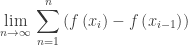
The important thing about most existence theorems is that the number exists, not what the number is. To illustrate this, let’s consider the Fundamental Theorem of Calculus. After partitioning the interval [a, b] into subintervals at various values, xi, we consider the limit of the sum

\displaystyle \underset{{n\to \infty }}{\mathop{{\lim }}}\,\sum\limits_{{n=1}}^{n}{{\left( {f\left( {{{x}_{i}}} \right)-f\left( {{{x}_{{i-1}}}} \right)} \right)}}.

Write out a few terms and you will see that is a telescoping series and its limit is \displaystyle f\left( b \right)-f\left( a \right).

The expression \displaystyle {f\left( {{{x}_{i}}} \right)-f\left( {{{x}_{{i-1}}}} \right)} resembles the right side of the Mean Value Theorem above. Since all the conditions are met, the MVT tells us that in each subinterval \displaystyle [{{x}_{{i-1}}},{{x}_{i}}] there exists a number, call it ci , such that

\displaystyle {f}'\left( {{{c}_{i}}} \right)\left( {{{x}_{i}}-{{x}_{{i-1}}}} \right)=f\left( {{{x}_{i}}} \right)-f\left( {{{x}_{{i-1}}}} \right) and therefore

\displaystyle \underset{{n\to \infty }}{\mathop{{\lim }}}\,\sum\limits_{{n=1}}^{n}{{\left( {f\left( {{{x}_{i}}} \right)-f\left( {{{x}_{{i-1}}}} \right)} \right)}}=\underset{{n\to \infty }}{\mathop{{\lim }}}\,\sum\limits_{{n=1}}^{n}{{{f}'\left( {{{c}_{i}}} \right)\left( {{{x}_{i}}-{{x}_{{i-1}}}} \right)}}=f\left( b \right)-f\left( a \right)

No one is concerned what these ci are, just that there are such numbers, that they exist. (The second limit above is then defined as the definite integral so \displaystyle \underset{{n\to \infty }}{\mathop{{\lim }}}\,\sum\limits_{{n=1}}^{n}{{{f}'\left( {{{c}_{i}}} \right)\left( {{{x}_{i}}-{{x}_{{i-1}}}} \right)}}=\int_{a}^{b}{{{f}'\left( x \right)dx=}}f\left( b \right)-f\left( a \right) – The Fundamental Theorem of Calculus.)

Other important existence theorems in calculus

The Intermediate Value Theorem

If f is continuous on the interval [a, b] and M is any number between f(a) and f(b), then there exists a number c in the open interval (a, b) such that f(c) = M.

If f is continuous on an interval and f changes sign in the interval, then there must be at least one number c in the interval such that f(c) = 0

Extreme Value Theorem

If f is continuous on the closed interval [a, b], then there exists a number c in [a, b] such that \displaystyle f\left( c \right)\ge f\left( x \right) for all x in the interval. Every function continuous on a closed interval has (i.e. there exists) a maximum value in the interval.

If f is continuous on the closed interval [a, b], then there exists a number c in [a, b] such that \displaystyle f\left( c \right)\le f\left( x \right) for all x in the interval. Every function continuous on a closed interval has (i.e. there exists) a minimum value in the interval.

Critical Points

If f is differentiable on a closed interval and \displaystyle {f}'\left( x \right) changes sign in the interval, then there exists a critical point in the interval.

Rolle’s theorem

If a function f is defined on the closed interval [a, b] and differentiable on the open interval (a, b) and f(a) = f(b), then there must exist a number c in the open interval (a, b) such that \displaystyle {f}'\left( c \right)=0.

MVT – other forms

If I drive a car continuously for 150 miles in three hours, then there is a time when my speed was exactly 50 mph.

If a function f is defined on the closed interval [a, b] and differentiable on the open interval (a, b), then there is a point on the graph of f where the tangent line is parallel to the segment between the endpoints.

Taylor’s Theorem

If f is a function with derivatives through order n + 1 on an interval I containing a, then, for each x in I , there exists a number c between x and a such that

\displaystyle f\left( x \right)=\sum\limits_{k=0}^{n}{\frac{{{f}^{\left( k \right)}}\left( a \right)}{k!}{{\left( x-a \right)}^{k}}}+\frac{{{f}^{\left( n+1 \right)}}\left( c \right)}{\left( n+1 \right)!}{{\left( x-a \right)}^{n+1}}

The number \displaystyle R=\frac{{{f}^{\left( n+1 \right)}}\left( c \right)}{\left( n+1 \right)!}{{\left( x-a \right)}^{n+1}} is called the remainder. The equation above says that if you can find the correct c the function is exactly equal to Tn(x) + R. Notice the form of the remainder is the same as the other terms, except it is evaluated at the mysterious c. The trouble is we almost never can find the c without knowing the exact value of f(x), but; if we knew that, there would be no need to approximate. However, often without knowing the exact values of c, we can still approximate the value of the remainder and thereby, know how close the polynomial Tn(x) approximates the value of f(x) for values in x in the interval, i. See Error Bounds and the Lagrange error bound.

Cogito, ergo sum

And finally, we have Descartes’ famous “theorem” Cogito, ergo sum (in Latin) or the original French, Je pense, donc je suis, translated as “I think, therefore I am” proving his own existence.


The Mean Value Theorem

Another application of the derivative is the Mean Value Theorem (MVT). This theorem is very important. One of its most important uses is in proving the Fundamental Theorem of Calculus (FTC), which comes a little later in the year.

See last Fridays post Foreshadowing the MVT  for an  a series of problems that will get your students ready for the MVT.

Here are some previous post on the MVT:

Fermat’s Penultimate Theorem   A lemma for Rolle’s Theorem: Any function extreme value(s) on an open interval must occur where the derivative is zero or undefined.

Rolle’s Theorem   A lemma for the MVT: On an interval if a function is continuous on a closed interval [a, b] and differentiable on the open interval (a, b) and f(a) = f(b), there must exist a number in the open interval (a, b) where ‘(c) = 0.

Mean Value Theorem I   Proof

Mean Value Theorem II   Graphical Considerations

Darboux’s Theorem   The Intermediate Value Theorem for derivatives.

Mean Tables


Revised from a post of October 31, 2017


Foreshadowing the MVT

The Mean Value Theorem (MVT) is proved by writing the equation of a function giving the (directed) length of a segment from the given function to the line between the endpoints as you can see here. Since the function and the line intersect at the endpoints of the interval this function satisfies the hypotheses of Rolle’s theorem and so the MVT follows directly. This means that the derivative of the distance function is zero at the points guaranteed by the MVT. Therefore, these values must also be the location of the local extreme values (maximums and minimums) of the distance function on the open interval. *

Here is an exploration with three similar examples that use this idea to foreshadow the MVT. You, of course, can use your own favorite function. Any differentiable function may be used, in which case a CAS calculator may be helpful. Answers are at the end.

First example:

Consider the function f(x)=x+2\sin (\pi x) defined on the closed interval [–1,3]

  1. Write the equation of the line through the endpoints of the function.
  2. Write an expression for h(x) the vertical distance between f(x) and the line found in part 1.
  3. Find the x-coordinates of the local extreme values of h(x) on the open interval (–1,3).
  4. Find the slope of f(x) at the values found in part 3.
  5. Compare your answer to part 4 with the slope of the line. Is this a coincidence?

Second example: slightly more difficult than the first.

Consider the function f\left( x \right)=1+x+2\cos \left( x \right) defined on the closed interval \left[ {\tfrac{\pi }{2},\tfrac{{9\pi }}{2}} \right]

  1. Write the equation of the line through the endpoints of the function.
  2. Write an expression for h(x) the vertical distance between f(x) and the line found in part 1.
  3. Find the x-coordinates of the local extreme values of h(x) on the open interval \left( {\tfrac{\pi }{2},\tfrac{{9\pi }}{2}} \right)
  4. Find the slope of f(x) at the values found in part 3.
  5. Compare your answer to part 4 with the slope of the line. Is this a coincidence?

Third example: In case you think I cooked the numbers

Consider the function \displaystyle f(x)={{x}^{3}} defined on the closed interval \displaystyle [-4.5]

  1. Write the equation of the line thru the endpoints of the function.
  2. Write an expression for h(x) the vertical distance between f(x) and the line found in part 1.
  3. Find the x-coordinates of the local extreme values of h(x) on the open interval \displaystyle (-4,5)
  4. Find the slope of f(x) at the values found in part 3.
  5. Compare your answer to part 4 with the slope of the line. Is this a coincidence?

Answers

First example:

  1. y = x
  2. \displaystyle h(x)=f(x)-y(x)=\left( {x+2\sin (\pi x)} \right)-\left( x \right)=2\sin (\pi x)
  3. {h}'\left( x \right)=2\pi \cos \left( {\pi x} \right)=0 when x = –1/2, ½, 3/2 and 5/2
  4. \displaystyle {f}'\left( x \right)=1+2\pi \cos \left( {\pi x} \right), the slope = 1 at all four points
  5. They are the same. Not a coincidence.

Second example:

  1. The endpoints are \left( {\tfrac{\pi }{2},1+\tfrac{\pi }{2}} \right) and \left( {\tfrac{{9\pi }}{2},1+\tfrac{{9\pi }}{2}} \right); the line is y=x+1
  2. h\left( x \right)=f\left( x \right)-y\left( x \right)=\left( {1+x+2\cos (x)} \right)-\left( {x+1} \right)=2\cos \left( x \right)
  3. {h}'\left( x \right)-2\sin (x)=0 when x=\pi ,2\pi ,3\pi ,\text{ and }4\pi
  4. {f}'\left( x \right)=1-2\sin \left( x \right), at the points above the slope is 1.
  5. They are the same. Not a coincidence.

Third example:

  1. The endpoints are (-4, -64) and (5, 125), the line is \displaystyle y=125+21(x-5)=21x+20
  2. \displaystyle h(x)={{x}^{3}}-21x-20
  3. \displaystyle {h}'(x)=3{{x}^{2}}-21=0 when \displaystyle x=\sqrt{7},-\sqrt{7}
  4. \displaystyle {f}'\left( {\pm \sqrt{7}} \right)=3{{\left( {\pm \sqrt{7}} \right)}^{2}}=21
  5. They are the same. Not a coincidence.

* It is possible that the derivative is zero and the point is not an extreme value. This is similar to the situation with a point of inflection when the first derivative is zero but does not change sign.


The Mean Value Theorem

Another application of the derivative is the Mean Value Theorem (MVT). This theorem is very important. One of its most important uses is in proving the Fundamental Theorem of Calculus (FTC), which comes a little later in the year. Here are some previous post on the MVT:

Fermat’s Penultimate Theorem   A lemma for Rolle’s Theorem: Any function extreme value(s) on an open interval must occur where the derivative is zero or undefined.

Rolle’s Theorem   A lemma for the MVT: On an interval if a function is continuous on a closed interval [a, b] and differentiable on the open interval (a, b) and f(a) = f(b), there must exist a number in the open interval (a, b) where ‘(c) = 0.

Mean Value Theorem I   Proof

Mean Value Theorem II   Graphical Considerations

Darboux’s Theorem   The Intermediate Value Theorem for derivatives.

Mean Tables


Mean Tables

The AP calculus exams always seem to have a multiple-choice table question in which the stem describes function in words and students are asked which of 5, now 4, tables could be a table of values for the function.  Could be because you can never be sure without other information what happens between values in the table. So, the way to solve the problem is to eliminate choices that are at odds with the description.

The question style nicely makes students relate a verbal description with the numerical information in the tables. This uses two parts of the Rule of Four.

In 2003, question AB 90 told students that a function f had a positive first derivative and a negative second derivative on the closed interval [2, 5]. There were five tables to choose from.

There is a fairly quick way to solve the problem, but I want to go a little slower and discuss the theorems that apply.

First, since the function has first and second derivatives on the interval, the function and its first derivative are continuous on the interval. This is important since, if they were not continuous, there would be no way to solve the problem.

Next, since the first derivative is positive, the function must be increasing. This allowed students to quickly eliminate three choices where the function was obviously decreasing. The remaining tables showed increasing values and thus could not be eliminated based on the first derivative.

The two remaining tables were

Table MVT

Notice that in table A the values are increasing at an increasing rate, and in table B the values are increasing at a decreasing rate. Thus, table B is the correct choice. By the end of the year that kind of reasoning is enough for students to determine the correct answer.

Students could also draw a quick graph and see that table A was concave up and B was concave down. This will give them the correct answer, but technically it is a wrong approach since, once again, there is no way to know what happens between the values; we should not just connect the points and draw a conclusion.

The correct reasoning is based on the Mean Value Theorem (MVT).

In table A, by the MVT there must be a number c1 between 2 and 3 where {f}'\left( {{c}_{1}} \right)=2 the slope between the points (2,7) and (3, 9). Also, there must be a number c2 between 3 and 4 where {f}'\left( {{c}_{2}} \right)=3 the slope between (3, 9) and (4, 12), and likewise a number c3 between 4 and 5 where {f}'\left( {{c}_{3}} \right)=4.

Then applying the MVT to these values of {f}'\left( x \right), there must be a number, say d1 between c1 and c2 where {{f}'}'\left( {{d}_{1}} \right)=\frac{3-2}{{{c}_{2}}-{{c}_{1}}}>0. Since the second derivative should be negative everywhere, table A is eliminated making the remaining table B the correct choice.

If we do a similar analysis of Table B, we find that the MVT values for the second derivative are all negative. However, we cannot be sure this is true for all values of f in table B, since we can never be sure what happens between the values in a table. But table B is the only one that could be the one described since the others clearly are not.

In this post we saw how the MVT can be used in a numerical setting. I discussed the MVT in an analytic setting on September 28, 2012 and graphically on October 1, 2012.