Why the Fundamental Theorem of Calculus?

The Fundamental Theorem of Calculus is, well, fundamental. It relates the derivative and the integral.

Writing a Riemann sum with all that fancy notation is tedious. To speed things up a special notation is used to replace it. The limit of the Riemann sum for a function on an interval [a, b] is written as its definite integral:

\displaystyle \underset{{\left| {\Delta x} \right|\to 0}}{\mathop{{\lim }}}\,\sum\limits_{{i=1}}^{\infty }{{f\left( {{{x}_{i}}} \right)\Delta x}} \displaystyle =\int_{a}^{b}{{f\left( x \right)dx}}

The \displaystyle f\left( x \right) (called the integrand) is the function with no fancy notation and the dx, called differential x replaces the \displaystyle \Delta x. The a and b, called the lower and upper limit of integration respectively, show you the interval the Riemann sum was formed on (which the Riemann sum does not).

Keep in mind that behind every definite integral is a Riemann sum. Therefore, all the properties of limits apply to definite integrals. They can be added and subtracted, a constant may be factored out, and so on.

The Fundamental Theorem of Calculus, the FTC, tells you how to evaluate a definite integral (and therefore its Riemann sum): Simply evaluate the function of which \displaystyle f\left( x \right) is the derivative at the endpoints of the interval and subtract.

To keep this in mind you can write the FTC like this considering the integrand as the derivative (of something):

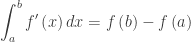
\displaystyle \int_{a}^{b}{{{f}'\left( x \right)dx}}=f\left( b \right)-f\left( a \right).

For example, since  \displaystyle d\sin \left( x \right)=\cos \left( x \right)dx,

\displaystyle \int_{0}^{{\pi /2}}{{\cos \left( x \right)dx=\sin }}\left( {\tfrac{\pi }{2}} \right)-\sin \left( 0 \right)=1-0=1

That’s all there is to it!

But wait! There’s more! This reveals another important idea: Since derivatives are rates of change, the FTC says that the integral of a rate of change is the net amount of change over the interval. Also called the accumulated change.

Well, okay, there is the problem of finding the function whose derivative is the integrand which is not always easy. This function is called the antiderivative of the integrand; another name is the indefinite integral. (The notation for an antiderivative or indefinite integral is the same as for a definite integral without the limits of integration). The truth is that finding the antiderivative is not as straightforward as finding the derivative. We will tackle that soon.


Course and Exam Description Unit 6.3 thru 6.7

A Calculus Journey

I think that the path leading up to and including the Fundamental Theorem of Calculus (FTC) is one of the most beautiful walks in mathematics. I have written several posts about it. You will soon be ready to travel that path with your students. (I always try to post on topics shortly before most teachers will get to them, so that you have some time to consider them and work the ideas you like into your lessons.)

Here is an annotated list of some of the posts to guide you on your journey.

Working Towards Riemann Sums gives the preliminary definitions you will need to define and discuss Riemann sums.

Riemann Sums defines the several Riemann sums often used in the calculus left-side sums, right-side sums, midpoint sums and the trapezoidal sums. “The Area Under a Curve” in the iPad app A Little Calculus is a great visual display of these and shows what happens as you use more subintervals.

The Definition of the Definite Integral gives the definition of the definite integral as the limit of any Riemann sum. As with any definition, there is nothing to prove or argue about here. The thing to remember is that the limit of the Riemann sum and the definite integral are the same thing. Behind any definite integral is a Riemann sum. The advantage of the definition’s integral notation is that it shows the interval involved which the Riemann sum does not. (Any Riemann sum may be represented by many definite integrals. See Good Question 11 – Riemann Reversed.)

Foreshadowing the FTC is an example of how a definite integral may be evaluated. It is long and has a lot of notation, so you may not want to use this.

The Fundamental Theorem of Calculus is where the path leads. This post develops the FTC based on the other “big” idea of the calculus: the Mean Value Theorem. (I think the form here is preferable to the usual book notation that uses F(x) and its derivate f (x).)

Y the FTC? Tries to answer the question of what’s so important about the FTC. Example 1: The verbal interpretation of the FTC (the integral of a rate of change is the net amount of change over the interval.) will soon be used in many practical applications. While example 2 shows how the FTC allows one to evaluate a definite integral and, therefore the Riemann sum it represents, by evaluating a function whose derivative is the integrand (its antiderivative).

More About the FTC presents examples leading up to the other form of the FTC: the derivative of the integral is the integrand).

At this point you may go in the direction of learning how to find antiderivatives or working on applications. (See Integration itinerary.)

Bon Voyage!     

Unit 6 – Integration and Accumulation of Change

Unit 6 develops the ideas behind integration, the Fundamental Theorem of Calculus, and Accumulation. (CED – 2019 p. 109 – 128). These topics account for about 17 – 20% of questions on the AB exam and 17 – 20% of the BC questions.

Topics 6.1 – 6.4 Working up to the FTC

Topic 6.1 Exploring Accumulations of Change Accumulation is introduced through finding the area between the graph of a function and the x-axis. Positive and negative rates of change, unit analysis.

Topic 6.2 Approximating Areas with Riemann Sums Left-, right-, midpoint Riemann sums, and Trapezoidal sums, with uniform partitions are developed. Approximating with numerical methods, including use of technology are considered. Determining if the approximation is an over- or under-approximation.

Topic 6.3 Riemann Sums, Summation Notation and the Definite Integral. The definition integral is defined as the limit of a Riemann sum.

Topic 6.4 The Fundamental Theorem of Calculus (FTC) and Accumulation Functions Functions defined by definite integrals and the FTC.

Topic 6.5 Interpreting the Behavior of Accumulation Functions Involving Area Graphical, numerical, analytical, and verbal representations.

Topic 6.6 Applying Properties of Definite Integrals Using the properties to ease evaluation, evaluating by geometry and dealing with discontinuities.

Topic 6.7 The Fundamental Theorem of Calculus and Definite Integrals Antiderivatives. (Note: I suggest writing the FTC in this form displaystyle int_{a}^{b}{{{f}'left( x right)}}dx=fleft( b right)-fleft( a right) because it seem more efficient then using upper case and lower case f.)

Topics 6.5 – 6.14 Techniques of Integration

Topic 6.8 Finding Antiderivatives and Indefinite Integrals: Basic Rules and Notation. Using basic differentiation formulas to find antiderivatives. Some functions do not have closed-form antiderivatives. (Note: While textbooks often consider antidifferentiation before any work with integration, this seems like the place to introduce them. After learning the FTC students have a reason to find antiderivatives. See Integration Itinerary

Topic 6.9 Integration Using Substitution The u-substitution method. Changing the limits of integration when substituting.

Topic 6.10 Integrating Functions Using Long Division and Completing the Square 

Topic 6.11 Integrating Using Integration by Parts (BC ONLY)

Topic 6.12 Integrating Using Linear Partial Fractions (BC ONLY)

Topic 6.13 Evaluating Improper Integrals (BC ONLY) Showing the work requires students to show correct limit notation.

Topic 6.14 Selecting Techniques for Antidifferentiation This means practice, practice, practice.


Timing

The suggested time for Unit 6 is  18 – 20 classes for AB and 15 – 16 for BC of 40 – 50-minute class periods, this includes time for testing etc.


Previous posts on these topics include:

Introducing Integration

Integration Itinerary

The Old Pump and Flying to Integrationland   Two introductory explorations

Working Towards Riemann Sums

Riemann Sums

The Definition of the Definite Integral

Foreshadowing the FTC 

The Fundamental Theorem of Calculus

More About the FTC

Y the FTC?

Area Between Curves

Under is a Long Way Down 

Properties of Integrals 

Trapezoids – Ancient and Modern  On Trapezoid sums

Good Question 9 – Riemann Reversed   Given a Riemann sum can you find the Integral it converges to?  A common and difficult AP Exam problem

Adapting 2021 AB 1 / BC 1

Adapting 2021 AB 4 / BC 4

Accumulation

Accumulation: Need an Amount?

Good Question 7 – 2009 AB 3

Good Question 8 – or Not?  Unit analysis

AP Exams Accumulation Question    A summary of accumulation ideas.

Graphing with Accumulation 1

Graphing with Accumulation 2

Accumulation and Differential Equations 

Painting a Point

Techniques of Integrations (AB and BC)

Antidifferentiation

Why Muss with the “+C”?

Good Question 13  More than one way to skin a cat.

Integration by Parts – a BC Topic

Integration by Parts 1

Integration by Part 2

Parts and More Parts

Good Question 12 – Parts with a Constant?

Modified Tabular Integration 

Improper Integrals and Proper Areas

Math vs the Real World Why displaystyle int_{{-infty }}^{infty }{{frac{1}{x}}}dx does not converge.


Here are links to the full list of posts discussing the ten units in the 2019 Course and Exam Description.

2019 CED – Unit 1: Limits and Continuity

2019 CED – Unit 2: Differentiation: Definition and Fundamental Properties.

2019 CED – Unit 3: Differentiation: Composite , Implicit, and Inverse Functions

2019 CED – Unit 4 Contextual Applications of the Derivative  Consider teaching Unit 5 before Unit 4

2019 – CED Unit 5 Analytical Applications of Differentiation  Consider teaching Unit 5 before Unit 4

2019 – CED Unit 6 Integration and Accumulation of Change

2019 – CED Unit 7 Differential Equations  Consider teaching after Unit 8

2019 – CED Unit 8 Applications of Integration   Consider teaching after Unit 6, before Unit 7

2019 – CED Unit 9 Parametric Equations, Polar Coordinates, and Vector-Values Functions 

2019 CED Unit 10 Infinite Sequences and Series


Integration and Accumulation of Change – Unit 6

Unit 6 develops the ideas behind integration, the Fundamental Theorem of Calculus, and Accumulation. (CED – 2019 p. 109 – 128 ). These topics account for about 17 – 20% of questions on the AB exam and 17 – 20% of the BC questions.

Topics 6.1 – 6.4 Working up to the FTC

Topic 6.1 Exploring Accumulations of Change Accumulation is introduced through finding the area between the graph of a function and the x-axis. Positive and negative rates of change, unit analysis.

Topic 6.2 Approximating Areas with Riemann Sums Left-, right-, midpoint Riemann sums, and Trapezoidal sums, with uniform partitions are developed. Approximating with numerical methods, including use of technology are considered. Determining if the approximation is an over- or under-approximation.

Topic 6.3 Riemann Sums, Summation Notation and the Definite Integral. The definition integral is defined as the limit of a Riemann sum.

Topic 6.4 The Fundamental Theorem of Calculus (FTC) and Accumulation Functions Functions defined by definite integrals and the FTC.

Topic 6.5 Interpreting the Behavior of Accumulation Functions Involving Area Graphical, numerical, analytical, and verbal representations.

Topic 6.6 Applying Properties of Definite Integrals Using the properties to ease evaluation, evaluating by geometry and dealing with discontinuities.

Topic 6.7 The Fundamental Theorem of Calculus and Definite Integrals  Antiderivatives. (Note: I suggest writing the FTC in this form \displaystyle \int_{a}^{b}{{{f}'\left( x \right)}}dx=f\left( b \right)-f\left( a \right) because it seem more efficient then using upper case and lower case f.)

Topics 6.5 – 6.14 Techniques of Integration

Topic 6.8 Finding Antiderivatives and Indefinite Integrals: Basic Rules and Notation. Using basic differentiation formulas to find antiderivatives. Some functions do not have closed-form antiderivatives. (Note: While textbooks often consider antidifferentiation before any work with integration, this seems like the place to introduce them. After learning the FTC students have a reason to find antiderivatives. See Integration Itinerary

Topic 6.9 Integration Using Substitution The u-substitution method. Changing the limits of integration when substituting.

Topic 6.10 Integrating Functions Using Long Division and Completing the Square 

Topic 6.11 Integrating Using Integration by Parts  (BC ONLY)

Topic 6.12 Integrating Using Linear Partial Fractions  (BC ONLY)

Topic 6.13 Evaluating Improper Integrals (BC ONLY) Showing the work requires students to show correct limit notation.

Topic 6.14 Selecting Techniques for Antidifferentiation This means practice, practice, practice.


Timing

The suggested time for Unit 6 is  18 – 20 classes for AB and 15 – 16 for BC of 40 – 50-minute class periods, this includes time for testing etc.


Previous posts on these topics include:

Introducing Integration

Integration Itinerary

The Old Pump and Flying to Integrationland   Two introductory explorations

Working Towards Riemann Sums

Riemann Sums

The Definition of the Definite Integral

Foreshadowing the FTC 

The Fundamental Theorem of Calculus

More About the FTC

Y the FTC?

Area Between Curves

Under is a Long Way Down 

Properties of Integrals 

Trapezoids – Ancient and Modern  On Trapezoid sums

Good Question 9 – Riemann Reversed   Given a Riemann sum can you find the Integral it converges to?  A common and difficult AP Exam problem

Accumulation

Accumulation: Need an Amount?

Good Question 7 – 2009 AB 3

Good Question 8 – or Not?  Unit analysis

AP Exams Accumulation Question    A summary of accumulation ideas.

Graphing with Accumulation 1

Graphing with Accumulation 2

Accumulation and Differential Equations 

Painting a Point

Techniques of Integrations (AB and BC)

Antidifferentiation

Why Muss with the “+C”?

Good Question 13  More than one way to skin a cat.

Integration by Parts – a BC Topic

Integration by Parts 1

Integration by Part 2

Parts and More Parts

Good Question 12 – Parts with a Constant?

Modified Tabular Integration 

Improper Integrals and Proper Areas

Math vs the Real World Why \displaystyle \int_{{-\infty }}^{\infty }{{\frac{1}{x}}}dx does not converge.


Here are links to the full list of posts discussing the ten units in the 2019 Course and Exam Description.

2019 CED – Unit 1: Limits and Continuity

2019 CED – Unit 2: Differentiation: Definition and Fundamental Properties.

2019 CED – Unit 3: Differentiation: Composite , Implicit, and Inverse Functions

2019 CED – Unit 4 Contextual Applications of the Derivative  Consider teaching Unit 5 before Unit 4

2019 – CED Unit 5 Analytical Applications of Differentiation  Consider teaching Unit 5 before Unit 4

2019 – CED Unit 6 Integration and Accumulation of Change

2019 – CED Unit 7 Differential Equations  Consider teaching after Unit 8

2019 – CED Unit 8 Applications of Integration   Consider teaching after Unit 6, before Unit 7

2019 – CED Unit 9 Parametric Equations, Polar Coordinates, and Vector-Values Functions 

2019 CED Unit 10 Infinite Sequences and Series


Then there is this – Existence Theorems

Existence Theorems

An existence theorem is a theorem that says, if the hypotheses are met, that something, usually a number, must exist.

For example, the Mean Value Theorem is an existence theorem: If a function f is defined on the closed interval [a, b] and differentiable on the open interval (a, b), then there exists a number c in the open interval (a, b) such that \displaystyle {f}'\left( c \right)\left( {b-a} \right)=f\left( b \right)-f\left( a \right).

The phrase “there exists” can also mean “there is” and “there is at least one.” In fact, it is a good idea when seeing an existence theorem to reword it using each of these other phrases. “There is at least one” reminds you that there may be more than one number that satisfies the condition. The mathematical symbol for these phrases is an upper-case E written backwards: \displaystyle \exists .

Textbooks, after presenting an existence theorem, usually follow-up with some exercises asking students to find the value for a given function on a given interval: “Find the value of c guaranteed by the Mean Value Theorem for the function … on the interval ….” These exercises may help students remember the formula involved but are not very useful otherwise.

The important thing about most existence theorems is that the number exists, not what the number is. To illustrate this, let’s consider the Fundamental Theorem of Calculus. After partitioning the interval [a, b] into subintervals at various values, xi, we consider the limit of the sum
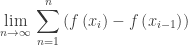
\displaystyle \underset{{n\to \infty }}{\mathop{{\lim }}}\,\sum\limits_{{n=1}}^{n}{{\left( {f\left( {{{x}_{i}}} \right)-f\left( {{{x}_{{i-1}}}} \right)} \right)}}.

Write out a few terms and you will see that is a telescoping series and its limit is \displaystyle f\left( b \right)-f\left( a \right).

The expression \displaystyle {f\left( {{{x}_{i}}} \right)-f\left( {{{x}_{{i-1}}}} \right)} resembles the right side of the Mean Value Theorem above. Since all the conditions are met, the MVT tells us that in each subinterval \displaystyle [{{x}_{{i-1}}},{{x}_{i}}] there exists a number, call it ci , such that

\displaystyle {f}'\left( {{{c}_{i}}} \right)\left( {{{x}_{i}}-{{x}_{{i-1}}}} \right)=f\left( {{{x}_{i}}} \right)-f\left( {{{x}_{{i-1}}}} \right) and therefore

\displaystyle \underset{{n\to \infty }}{\mathop{{\lim }}}\,\sum\limits_{{n=1}}^{n}{{\left( {f\left( {{{x}_{i}}} \right)-f\left( {{{x}_{{i-1}}}} \right)} \right)}}=\underset{{n\to \infty }}{\mathop{{\lim }}}\,\sum\limits_{{n=1}}^{n}{{{f}'\left( {{{c}_{i}}} \right)\left( {{{x}_{i}}-{{x}_{{i-1}}}} \right)}}=f\left( b \right)-f\left( a \right)

No one is concerned what these ci are, just that there are such numbers, that they exist. (The second limit above is then defined as the definite integral so \displaystyle \underset{{n\to \infty }}{\mathop{{\lim }}}\,\sum\limits_{{n=1}}^{n}{{{f}'\left( {{{c}_{i}}} \right)\left( {{{x}_{i}}-{{x}_{{i-1}}}} \right)}}=\int_{a}^{b}{{{f}'\left( x \right)dx=}}f\left( b \right)-f\left( a \right) – The Fundamental Theorem of Calculus.)

Other important existence theorems in calculus

The Intermediate Value Theorem

If f is continuous on the interval [a, b] and M is any number between f(a) and f(b), then there exists a number c in the open interval (a, b) such that f(c) = M.

If f is continuous on an interval and f changes sign in the interval, then there must be at least one number c in the interval such that f(c) = 0

Extreme Value Theorem

If f is continuous on the closed interval [a, b], then there exists a number c in [a, b] such that \displaystyle f\left( c \right)\ge f\left( x \right) for all x in the interval. Every function continuous on a closed interval has (i.e. there exists) a maximum value in the interval.

If f is continuous on the closed interval [a, b], then there exists a number c in [a, b] such that \displaystyle f\left( c \right)\le f\left( x \right) for all x in the interval. Every function continuous on a closed interval has (i.e. there exists) a minimum value in the interval.

Critical Points

If f is differentiable on a closed interval and \displaystyle {f}'\left( x \right) changes sign in the interval, then there exists a critical point in the interval.

Rolle’s theorem

If a function f is defined on the closed interval [a, b] and differentiable on the open interval (a, b) and f(a) = f(b), then there must exist a number c in the open interval (a, b) such that \displaystyle {f}'\left( c \right)=0.

MVT – other forms

If I drive a car continuously for 150 miles in three hours, then there is a time when my speed was exactly 50 mph.

If a function f is defined on the closed interval [a, b] and differentiable on the open interval (a, b), then there is a point on the graph of f where the tangent line is parallel to the segment between the endpoints.

Taylor’s Theorem

If f is a function with derivatives through order n + 1 on an interval I containing a, then, for each x in I , there exists a number c between x and a such that

\displaystyle f\left( x \right)=\sum\limits_{k=0}^{n}{\frac{{{f}^{\left( k \right)}}\left( a \right)}{k!}{{\left( x-a \right)}^{k}}}+\frac{{{f}^{\left( n+1 \right)}}\left( c \right)}{\left( n+1 \right)!}{{\left( x-a \right)}^{n+1}}

The number \displaystyle R=\frac{{{f}^{\left( n+1 \right)}}\left( c \right)}{\left( n+1 \right)!}{{\left( x-a \right)}^{n+1}} is called the remainder. The equation above says that if you can find the correct c the function is exactly equal to Tn(x) + R. Notice the form of the remainder is the same as the other terms, except it is evaluated at the mysterious c. The trouble is we almost never can find the c without knowing the exact value of f(x), but; if we knew that, there would be no need to approximate. However, often without knowing the exact values of c, we can still approximate the value of the remainder and thereby, know how close the polynomial Tn(x) approximates the value of f(x) for values in x in the interval, i. See Error Bounds and the Lagrange error bound.

Cogito, ergo sum

And finally, we have Descartes’ famous “theorem” Cogito, ergo sum (in Latin) or the original French, Je pense, donc je suis, translated as “I think, therefore I am” proving his own existence.


Y the FTC?

So, you’ve finally proven the Fundamental Theorem of Calculus and have written on the board:

\displaystyle \int_{a}^{b}{{{f}'\left( x \right)dx=f\left( b \right)-f\left( a \right)}}

And the students ask, “What good is that?” and “When are we ever going to use that?” Here’s your answer.

There are two very important uses of this theorem. Show them BOTH uses right away to help your students see why the FTC is so useful and important.

First, in words the theorem says that “the integral of a rate of change is the net amount of change.” So, if you are given a rate of change (as you are every year on the AP Calculus exam) and asked to find the amount of change (as you are every year on the AP Calculus exam), this is what you use, Show an example such as 2015 AB 1/BC1 that states,

“The rate at which rainwater flows into a drain pipe is modeled by the function R, where R\left( t \right)=20\sin \left( {\frac{{{{t}^{2}}}}{{35}}} \right) cubic feet per hour….

“(a) How many cubic feet of rainwater flow into the pipe during the 8-hour time interval ?”

The answer is of course, \displaystyle \int_{0}^{8}{{20\sin \left( {\frac{{{{t}^{2}}}}{{35}}} \right)dt}}. (Which they will soon learn how to evaluate.)

Second, a more immediate use is to avoid all that work you’ve been doing setting up Riemann sums and finding their limits. No more of that! Give them this integral to evaluate:

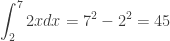
\displaystyle \int_{2}^{7}{{2xdx}}

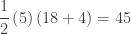
Draw the trapezoid representing the area between the graph of y=2x and the x-axis on the interval [2,7] and find its area =  \displaystyle \frac{1}{2}\left( 5 \right)\left( {18+4} \right)=45
Then ask, “Does anyone know of a function whose derivative is 2x?” Let them think for a minute and someone will say, “Yeah, it’s {{x}^{2}}”  And then show them

\displaystyle \int_{2}^{7}{{2xdx}}={{7}^{2}}-{{2}^{2}}=45

Then go for a harder one:  \displaystyle \int_{0}^{{\frac{\pi }{2}}}{{\cos \left( x \right)dx}}

“Does anyone know a function whose derivative is \cos \left( x \right)?”

“Why yes, it’s \sin \left( x \right)

So, \displaystyle \int_{0}^{{\frac{\pi }{2}}}{{\cos \left( x \right)dx}}=\sin \left( {\frac{\pi }{2}} \right)-\sin \left( 0 \right)=1-0=1

That was easy!

If you want to challenge them and review some functions of the “special angles” try this one:

\displaystyle \int_{{\frac{\pi }{6}}}^{{\frac{{4\pi }}{3}}}{{\cos \left( x \right)dx}}=\sin \left( {\frac{{4\pi }}{3}} \right)-\sin \left( {\frac{\pi }{6}} \right)=\frac{{\sqrt{3}}}{2}-\frac{1}{2}

Tie the two parts together: Look at the graph of y=\sin \left( x \right). How much does it change from 0 to \frac{\pi }{2}? How much does it change from \frac{\pi }{6} to \frac{{4\pi }}{3}?

Sum up, by looking ahead:

  1. “The function whose derivative is …” is called the antiderivative.
  2. Using antiderivatives to evaluate definite integrals is easy; the hard part is finding the antiderivatives, since they are not all as straightforward as the two examples above. So, next we need to spend a few weeks learning how to find antiderivatives.[1]
  3. Given a derivative, finding its antiderivative is also the start of solving differential equations. This, too, will soon be a concern in the course.

[1] As I’ve written before, this is where it seems logical place to teach antiderivatives. Now students have a reason to find them. Teaching antidifferentiation after differentiation, before integration, seems like an intellectual exercise. Sure, it’s fun, but now we have a need for it.


Riemann Sums – the Theory

The series of post leads up to the Fundamental theorem of Calculus (FTC). Obviously, a very important destination.

  1. Working Towards Riemann Sums
  2. Definition of the Definite Integral and the FTC – a more exact demonstration from last Friday’s post and The Fundamental Theorem of Calculus –  an older demonstration
  3. More about the FTC The derivative of a function defined by an integral – the other half of the FTC.
  4. Good Question 11 Riemann Reversed – How to find the integral, given the Riemann sum. A problem that appears on the AP Calculus exams and can be confusing for students, at first.
  5. Properties of Integrals
  6. Variation on a Theme – 2 Comparing Riemann sums
  7. Trapezoids – Ancient and Modern – some history.


Revised and updated October 22, 2018