The Derivative I

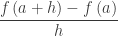
In “Local Linearity II”, my post for August 31, 2012, we developed a way of approximating the slope of a function at any point. The slope at x = a is approximated by

\displaystyle \frac{f\left( a+h \right)-f\left( a \right)}{h}

For small values of h.

The smaller the better, which suggests limits.

The limit of this expression as h approaches zero is called the derivative of f at x = a denoted by {f}'\left( a \right):

\displaystyle \ {f}'\left( a \right)=\underset{h\to 0}{\mathop{\lim }}\,\frac{f\left( a+h \right)-f\left( a \right)}{h}

Now give your students a simple function like y = x2 and give each student a different point in the interval [–4, 4] (include some fractions). Have them calculate the approximate slope and/or the derivative for their point. For each student’s value, plot on a graph the point (their a, slope at their a). Discuss the results. Guess the equation of the graph.

Of course, the result should look like the line y = 2x.  That is, the derivatives at various points, taken together, appear to be a function in their own right.

Repeat this exercise with the function y = sin(x). Guess the equation of the derivative.

We will look at this some more in the next post.

Local Linearity II

Using Local Linearity to introduce difference quotient and the derivative.

An effective way to introduce difference quotients and derivatives is to write the equation of the “line” you see when you zoom-in on a locally linear function.

First: Ask your class to use their calculator or computer grapher to graph a function, say y = sin(x), or some function they like better.

  1. Ask them to trace over to some point where the graph is “curvy.” (So they will remain on the graph, use the TRACE feature, not the moving cursor.) They do not have to go to, or even be near, the same place.
  2. Then ask them to zoom-in several times until their graph looks like a straight line (locally linear) and save the coordinates of that point as a and b (see the technology hint below).
  3. Then return to the graph and trace one or two clicks left or right to a nearby point on the graph and record the coordinates of that point as c and d.
  4. Write the equation of the line through (a, b) and (c ,d) and enter it in the graphing menu (see technology hint again).
  5. Graph the line. They should see only one “line” because the two graphs are on top of each other.
  6. Re-graph in the standard or Trig window. What do you see now? They should see their original graph with a line that appears tangent to it at the point (a, b).

Next: Discuss what you’ve done, specifically in finding the slope. The value c is a plus a little bit, that is c = a + h. (Or minus a  little bit if h is negative.) So the slope is

\displaystyle \frac{Y1(a+h)-Y1(a)}{(a+h)-a}\text{ or }\frac{f\left( x+h \right)-f\left( x \right)}{h}

and now you are ready to talk about difference quotients and their limit the derivative.

Technology Hints:

When you trace a graph on a calculator the coordinates of the point are written on the bottom of the screen as X and Y, or xc and yc. If you return to the home screen and type X [STO] A and Y [STO] B (or xc [STO] a etc.) the values will be saved to A and B. When you trace to the next point the x and y change, so return to the home screen and save them as C and D.

The line can be written directly in the equation editor in point-slope form by typing Y2 = Y1(A) + (Y1(B)-Y1(A))/(B – A)*(x – A)

Local Linearity I

Certain graphs, specifically those that are differentiable, have a property called local linearity. This means that if you zoom in (using the same zoom factor in both directions) on a point on the graph, the graph eventually appears to be a straight line whose slope if the same as the slope (derivative) of the tangent line at that point.

Now we are a little ahead of ourselves here since we haven’t mentioned tangent lines and derivatives yet. But local linearity is the graphical manifestation of differentiability. Functions that are differentiable at a point are locally linear there and functions that are locally linear are differentiable. In the next post we will see how to use the local linear idea to introduce the derivative. For now, we will look at some graphs that may or may not be locally linear. Are the graphs “smooth” everywhere?

(1)\quad f\left( x \right)=1+\sqrt{{{x}^{2}}+0.001}

\displaystyle (2)\quad g\left( x \right)={{x}^{3}}+\frac{\sqrt[3]{{{\left( x-1 \right)}^{2}}}}{7}

The first function is locally linear at (0, 1) but doesn’t look it. Zoom-in several times and you will see that it is smooth and locally linear there eventually the graph looks like a horizontal line near (0, 1). This only looks like an absolute value graph because 1+\sqrt{{{x}^{2}}+0.001}\approx 1+\sqrt{{{x}^{2}}}=1+\left| x \right|.

The second function appears locally linear at (1, 1), but is not. Zoom in a few times at you will see very strange things going on. (Hint: Use a graphing program or a calculator and enter x^3+((x – 1)^2)^(1/3)/7 as simplifying to a power of 2/3 may confuse the calculator.)

The moral is that you can never be sure just looking at a graph whether it is locally linear or not; you’re never sure if you have zoomed in enough.

Nevertheless, the local linearity concept is helpful in introducing the derivative and, when you can be sure the function is not locally linear, knowing the derivative does not exist.

Looking ahead: Take a look at the AP exam from 2005 AB 5. Here you were given a velocity graph “modeled by the piecewise- linear function defined by the graph” copied below.

Student were asked to find v ‘(4) or explain why it does not exist. It does not exist because the graph is not locally linear there.

Later they were asked if the Mean Value Theorem guaranteed a value of c in the interval [8, 20] such that v ‘(c) is equal to the average rate of change over the interval. The answer is “no”, the value does not exist because the function is not differentiable on the interval because it is not locally linear everywhere in the interval.

For Any – For Every – For All

The universal quantifier \forall  –  for any – for every – for all

Many theorems and definitions in mathematics use the phrases “for any”, “for every” or “for all.” The upside-down A is the symbol. The three phrases all mean the same thing!

For example, we have the definition “A function is increasing on an interval if, and only if, for all pairs of numbers x1 and x2 in the interval, if x1 < x2 then f(x1) < f(x2).” Whenever you have a theorem or definition with one, restating it with the other two will help students understand it better: “for all pairs of numbers,” “for any pair of numbers” and “for every pair of numbers.”

Increasing and Decreasing Functions

The symbols in the definition above tell the whole story – sure they do. As with any theorem or definition, use the Rule of Four. The definition above is the analytic part. The graphical part is the obvious – the graph goes up to the right. The numerical part is that as the x-values increase in a table, so do the y-values. The verbal part is the two preceding sentences and all the talking you’re going to have to do to explain this.

The function y=\sin \left( x \right) increases on the closed interval \left[ -\tfrac{\pi }{2},\tfrac{\pi }{2} \right] and the function decreases on the closed interval  \left[ \tfrac{\pi }{2},\tfrac{3\pi }{2} \right]. The fact that  \tfrac{\pi }{2} is in both intervals is not a problem since it is in the intervals, not at the point, that the function increases or decreases.  This is because \sin \left( \tfrac{\pi }{2} \right)  is larger than all (every, any) values in \left[ -\tfrac{\pi }{2},\tfrac{\pi }{2} \right]  , and also larger than all (any, every) of the values in \left[ \tfrac{\pi }{2},\tfrac{3\pi }{2} \right] .

“Playing” with theorems: You will soon have a theorem that says, “If the derivative of a function is positive on an interval, then the function is increasing on the interval.” Nothing in the paragraph above contradicts this, because the hypothesis says nothing about what is true if the derivative is zero. For this you have to go back to the definition. The converse of this theorem is false. Counterexample: f\left( x \right)={{x}^{3}} is increasing on any (all, every) interval containing the origin, yet f'\left( 0 \right)=0 . The AP exams do not make a big deal of this; they accept either open or closed intervals for increasing or decreasing.

The First Week

After reading my post on “The First and Second Day of School” Paul A. Foerster,  was nice enough to share  these problems from a recent presentation. They give a taste of derivatives and integrals in the first week of school and get the kids into calculus right off the bat.

The First Week of AP Calculus

Paul who recently retired after 50 (!) years of teaching, is Teacher Emeritus of Mathematics of Alamo High Heights School in San Antonio, Texas. He is the author of several textbooks including Calculus: Concepts and Applications, Second Edition, 2005, published by Kendall Hunt Publishing Company, www.kendallhunt.com (Formerly published by Key Curriculum Press).

Many years ago (almost 50) I remember teaching from his fine Trigonometry book 

Thank you, Paul!

Why Limits?

There are four important things before calculus and in beginning calculus for which we need the concept of limit.

    1. The first is continuity. Most of the time in pre-calculus mathematics and in the calculus we deal with nice continuous functions or functions that are not continuous at just a few points. Limits give us the vocabulary and the mathematics necessary to describe and deal with discontinuities of functions. Historically, the modern (delta-epsilon) definition of limit comes out of Weierstrass’ definition of continuity.
    2. Asymptotes: A vertical asymptote is the graphical feature of function at a point where its limit equals positive or negative infinity. A horizontal asymptote is the (finite) limit of a function as x approaches positive or negative infinity.

Ideally, one would hope that students have seen these phenomena and have used the terms limit and continuity informally before they study calculus. This is where the study of calculus starts. The next two items are studied in calculus and are based heavily on limit.

3. The tangent line problem. The definition of the derivative as the limit of the slope of a secant line to a graph is the first of the two basic ideas of the calculus. This single idea is the basis for all the concepts and applications of differential calculus.

4. The area problem. Using limits it is possible to find the area of a region with a curved side, even if the curve is not something simple like a semi-circle. The definite integral is defined as the limit of a Riemann sum and gives the area regions with a curved side. This then can be extended to huge number of very practical applications many having nothing to do with area.

So these are the main ways that limits are used in beginning calculus. Students need a good visual  understanding, what the graph looks like,  of the first two situations listed above and how limits describe and define them. This is also necessary later when third and fourth come up.
