Motion Problems: Same Thing, Different Context

Calculus is about things that are changing. Certainly, things that move are changing, changing their position, velocity and acceleration. Most calculus textbooks deal with things being dropped or thrown up into the air. This is called uniformly accelerated motion since the acceleration is due to gravity and is constant. While this is a good place to start, the problems are by their nature, somewhat limited. Students often know all about uniformly accelerated motion from their physics class.

The Advanced Placement exams take motion problems to a new level. AB students often encounter particles moving along the x-axis or the y-axis (i.e. on a number line) according to some function that gives the particle’s position, velocity or acceleration.  BC students often encounter particles moving around the plane with their coordinates given by parametric equations or its velocity given by a vector. Other times the information is given as a graph or even in a table of the position or velocity. The “particle” may become a car, or a rocket or even chief readers riding bicycles.

While these situations may not be all that “real”, they provide excellent ways to ask both differentiation and integration questions. but be aware that they are not covered that much in some textbooks; supplementing the text may be necessary.

The main derivative ideas are that velocity is the first derivative of the position function, acceleration is the second derivative of the position function and the first derivative of the velocity. Speed is the absolute value of velocity. (There will be more about speed in the next post.) The same techniques used to find the features of a graph can be applied to motion problems to determine things about the moving particle.

So the ideas are not new, but the vocabulary is. The table below gives the terms used with graph analysis and the corresponding terms used in motion problem.

Vocabulary: Working with motion equations (position, velocity, acceleration) you really do all the same things as with regular functions and their derivatives. Help students see that while the vocabulary is different, the concepts are the same.

Function                                Linear Motion
Value of a function at x               position at time t
First derivative                            velocity
Second derivative                       acceleration
Increasing                                   moving to the right or up
Decreasing                                 moving to the left or down
Absolute Maximum                    farthest right
Absolute Minimum                     farthest left
yʹ = 0                                         “at rest”
yʹ changes sign                          object changes direction
Increasing & cc up                     speed is increasing
Increasing & cc down                speed is decreasing
Decreasing & cc up                   speed is decreasing
Decreasing & cc down              speed is increasing
Speed                                       absolute value of velocity

Inverses Graphically and Numerically

In this final post in this series on inverses we consider the graphical and numerical concepts related to the derivative of the inverse and look at an important formula.

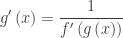
To make the notation a little less messy, let’s let g(x) = f -1(x). Then we know that f (g(x))= x. Differentiating this implicitly gives

{f}'\left( g\left( x \right) \right){g}'\left( x \right)=1
\displaystyle {g}'\left( x \right)=\frac{1}{{f}'\left( g\left( x \right) \right)}

Great formula, but one I’ve never been able to memorize and use correctly! It’s my least favorite formula, because I’m never quite sure what to substitute for what.

The graph shows a function and its inverse. It really doesn’t matter which is which, since inverse functions come in pairs: the inverse of the inverse is the original function.

Notice that the graphs are symmetric to y = x. At two points, one of which is the image of the other after reflecting over the line y = x, a tangent segment has been drawn. This segment is the hypotenuse of the “slope triangle” which is also drawn. The ratio of the vertical side of this triangle to the horizontal side is the slope (i.e. the derivative) of the tangent line.

The two triangles are congruent, so that the horizontal side of one triangle is congruent to the vertical side of the other, and vice versa. Thus the slope (the derivative) of the one tangent segment is the reciprocal of the other.

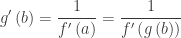
If (a, b) is a point on a function and the derivative at this point is {f}'\left( a \right), then the point (b, a) is on the function’s inverse and the derivative here is \displaystyle \frac{1}{{f}'\left( a \right)}. This is just what my least favorite formula says: if f -1 (x) = g(x), then a = g(b)  and  \displaystyle {g}'\left( b \right)=\frac{1}{{f}'\left( a \right)}=\frac{1}{{f}'\left( g\left( b \right) \right)}.
What you really need to know is:

At corresponding points on a function and its inverse, the derivatives are reciprocals of each other.

This is what my least favorite formula says.

The AP exams have a clever way of testing this. (The stem may give a few more values to throw you off, or the values may be in a table.)

Given that f\left( 2 \right)=5\text{ and }{f}'\left( 2 \right)=3 and g is the inverse of f, Find {g}'\left( 5 \right).

The solution is reasoned this way: (5, ?) is a point on g. The corresponding point on f is (?, 5) = (2, 5). The derivative of f at this point is 3, therefore the derivative at (5, 2) on g is  {g}'\left( 5 \right)=\tfrac{1}{3}.

Easy!


The Calculus of Inverses

Today we will consider computing the derivative of the inverse of a function. This is pretty standard and is in all the textbooks.

The usual suspects are the inverse trigonometric functions. So let’s start with y={{\sin }^{-1}}\left( x \right) and then rewrite this as x=\sin \left( y \right). Differentiating this gives

\displaystyle 1=\cos \left( y \right)\frac{dy}{dx}
\displaystyle \frac{dy}{dx}=\frac{1}{\cos \left( y \right)}

Since we would like this in terms of x we can proceed two ways.

The denominator is the cosine of the number whose sine is x. So using the relationship

\cos \left( y \right)=\sqrt{1-{{\sin }^{2}}\left( y \right)}=\sqrt{1-{{x}^{2}}}

we find that

\displaystyle \frac{dy}{dx}=\frac{1}{\sqrt{1-{{x}^{2}}}}.

That tends to be confusing so another method is to draw a right triangle with an acute angle of y and arrange the side so that

\displaystyle \sin \left( y \right)=\frac{x}{1}=\frac{\text{opposite}}{\text{hypotenuse}}


From this we can find all the trigonometric functions of y, specifically:

\displaystyle \cos \left( y \right)=\frac{\text{adjacent}}{\text{hypotenuse}}-\frac{\sqrt{1-{{x}^{2}}}}{1}=\sqrt{1-{{x}^{2}}} and \displaystyle \frac{dy}{dx}=\frac{1}{\sqrt{1-{{x}^{2}}}}.

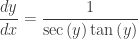
A second example: Find the derivative of y={{\sec }^{-1}}\left( x \right). The domain of this function is \left| x \right|\ge 1 and the range is [0,\tfrac{\pi }{2})\cup (\tfrac{\pi }{2},\pi ], the function is increasing on both parts of its domain; we will need to know this.
Proceeding as above we will find that

\displaystyle \frac{dy}{dx}=\frac{1}{\sec \left( y \right)\tan \left( y \right)}.

Drawing a triangle as above and arranging the side so that sec(y) = x:

Then \displaystyle \frac{dy}{dx}=\frac{1}{x\sqrt{1+{{x}^{2}}}},

But wait! It may be that x < 0, but {{\sec }^{-1}}\left( x \right) is increasing and the derivative should always be positive. So, this needs to be adjusted to

\displaystyle \frac{d}{dx}{{\sec }^{-1}}\left( x \right)=\frac{1}{\left| x \right|\sqrt{1+{{x}^{2}}}}

These can be a bit tricky.

Next: the fifth and last posting in this series will look at the graphical and numerical aspects of the derivatives of a function and its inverse.

Open or Closed?

About this time of year you find someone, hopefully one of your students, asking, “If I’m finding where a function is increasing, is the interval open or closed?”

Do you have an answer?

This is a good time to teach some things about definitions and theorems.

The place to start is to ask what it means for a function to be increasing. Here is the definition:

A function is increasing on an interval if, and only if, for all (any, every) pairs of numbers x1 < x2 in the interval, f(x1) < f(x2).

(For decreasing on an interval, the second inequality changes to f(x1) > f(x2). All of what follows applies to decreasing with obvious changes in the wording.)

  1. Notice that functions increase or decrease on intervals, not at individual points. We will come back to this in a minute.
  2. Numerically, this means that for every possible pair of points, the one with the larger x-value always produces a larger function value.
  3. Graphically, this means that as you move to the right along the graph, the graph is going up.
  4. Analytically, this means that we can prove the inequality in the definition.

For an example of this last point consider the function f(x) = x2. Let x2 = x1 + h where h > 0. Then in order for  f(x1) < f(x2) it must be true that

{{x}_{1}}^{2}<{{\left( {{x}_{1}}+h \right)}^{2}}
0<{{\left( {{x}_{1}}+h \right)}^{2}}-{{x}_{1}}^{2}
0<{{x}_{1}}^{2}+2h{{x}_{1}}+{{h}^{2}}-{{x}_{1}}^{2}
0<h\left( 2{{x}_{1}}+h \right)

This can only be true if {{x}_{1}}\ge 0, Thus, x2 is increasing only if x\ge 0.

Now, of course, we rarely, if ever, go to all that trouble. And it is even more trouble for a function that increases on several intervals.  The usual way of finding where a function is increasing is to look at its derivative.

Notice that the expression {{\left( {{x}_{1}}+h \right)}^{2}}-{{x}_{1}}^{2} looks a lot like the numerator of the original limit definition of the derivative of x2 at x = x1, namely \displaystyle {f}'\left( {{x}_{1}} \right)=\underset{h\to 0}{\mathop{\lim }}\,\frac{{{\left( {{x}_{1}}+h \right)}^{2}}-{{x}_{1}}^{2}}{h}. If h > 0, where the function is increasing the numerator is positive and the derivative is positive also. Turning this around we have a theorem that says, If {f}'\left( x \right)>0 for all x in an interval, then the function is increasing on the interval. That makes it much easier to find where a function is increasing: we simplify find where its derivative is positive.

There is only a slight problem in that the theorem does not say what happens if the derivative is zero somewhere on the interval. If that is the case, we must go back to the definition of increasing on an interval or use some other method. For example, the function x3 is increasing everywhere, even though its derivative at the origin is zero.

Let’s consider another example. The function sin(x) is increasing on the interval \left[ -\tfrac{\pi }{2},\tfrac{\pi }{2} \right] (among others) and decreasing on \left[ \tfrac{\pi }{2},\tfrac{3\pi }{2} \right]. It bothers some that \tfrac{\pi }{2} is in both intervals and that the derivative of the function is zero at x = \tfrac{\pi }{2}. This is not a problem. Sin(\tfrac{\pi }{2}) is larger than all the other values is both intervals, so by the definition, and not the theorem, the intervals are correct.

It is generally true that if a function is continuous on the closed interval [a,b] and increasing on the open interval (a,b) then it must be increasing on the closed interval [a,b] as well. (There is a proof by Lou Talman of this fact click here .)

Returning to the first point above: functions increase or decrease on intervals not at points. You do find questions in books and on tests that ask, “Is the function increasing at x = a.” The best answer is to humor them and answer depending on the value of the derivative at that point. Since the derivative is a limit as h approaches zero, the function must be defined on some interval around x = a in which h is approaching zero. So answer according to the value of the derivative on that interval.

You can find more on this here.

Case Closed.

Far Out!

A monster problem for Halloween.

A while ago I suggested you look at \displaystyle \underset{x\to \infty }{\mathop{\lim }}\,\frac{\ln \left( {{x}^{5}} \right)}{{{x}^{0.02}}} , which using the dominance idea is zero. Of course your students may try graphing or a table. Here’s the graph done by a TI-Nspire CAS. Note the scales.


This is not the way to go. Since the function is increasing near the origin, but the limit at infinity is zero there must be a maximum point where the function starts decreasing. And as the expression can never be negative once x > 1, there must be a point of inflection where the graph becomes concave up and can thereafter approach the x-axis from above as a horizontal asymptote. The maximum can be found by hand which makes for some great algebra manipulation practice:

\displaystyle \frac{d}{dx}\left( \frac{\ln \left( {{x}^{5}} \right)}{{{x}^{0.02}}} \right)=\frac{{{x}^{0.02}}\tfrac{5{{x}^{4}}}{{{x}^{5}}}-\ln \left( {{x}^{5}} \right)\left( 0.02{{x}^{-0.98}} \right)}{{{x}^{0.04}}}

\displaystyle \frac{d}{dx}\left( \frac{\ln \left( {{x}^{5}} \right)}{{{x}^{0.02}}} \right)=\frac{{{x}^{-0.98}}\left( 5-\left( 0.10 \right)\ln \left( x \right) \right)}{{{x}^{0.04}}}=\frac{50-\ln \left( x \right)}{10{{x}^{1.02}}}

Setting this equal to zero and solving gives x={{e}^{50}}\approx 5.185\times {{10}^{21}}

The second derivative is \displaystyle \frac{{{d}^{2}}}{d{{x}^{2}}}\left( \frac{\ln \left( {{x}^{5}} \right)}{{{x}^{0.02}}} \right)=\frac{-510+10.2\ln \left( x \right)}{100{{x}^{2.02}}}

and is zero when x\displaystyle {{e}^{\frac{520}{10.2}}}\approx 1.382\times {{10}^{22}}

Okay, I skipped a few steps here, but you can challenge your students with that. Since we’re really interested in the solution here more than the solving ,this is really a good place to use a CAS calculator.

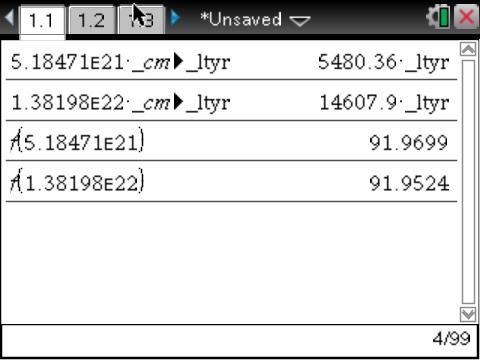
The first line in the figure above defines the function to save typing it each time. The second line finds the x-coordinate of the maximum point (how do we know this is a maximum?) and the third finds the x-coordinate of the point of inflection.  Much simpler this way!

Take a minute to consider the numbers. They are BIG! In fact, if the units on our graph paper are centimeters, then the maximum point is a little over 5,480 light-years away from the origin! The point of inflection is about 2.665 times farther at more than 14,607 light-years away!

Meanwhile the maximum value is only 91.9699 cm. That’s right centimeters, less than a meter. And the y-coordinate of the point of inflection is about 91.9524 cm. A drop of 0.0175 cm. in a horizontal distance of a little over 9,127 light-years.

Some problems are a lot less scary if done with technology.


Real “Real-life” Graph Reading

A few days ago, Paul Krugman wrote a blog about the job situation in the US.   Evan J. Romer, a mathematics teacher from Conklin, NY, used it as the basis for a great exercise on reading the graph of the derivative, the subject of my last post. He posted the questions to the AP Calculus Learning Community.  I liked them so much I have included them on my blog with Evan’s kind permission. The questions and solutions are here and on the Resources Tab above.

He used the graph below which shows the change in the number of non-farm jobs per month; in other words, the graph of a derivative of the number of people employed. The jagged graph is the data; the smooth graph is a model approximating the data.

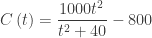
The model is \displaystyle C\left( t \right)=\frac{1000{{t}^{2}}}{{{t}^{2}}+40}-800

From this Mr. Romer developed a series of questions very similar to AP questions.  Don’t overlook the last note which discusses a “classic AP calculus mistake” made by the first person to reply to Krugman’s blog.

The first of Romer’s questions are integration questions, which you may not yet have gotten to with your class. Below is another graph of nearly the same data displayed as a bar graph. (Around February 2010 this was dubbed the “Bikini Graph” – if you look at the graph before that date you will see why.) It may be helpful in explaining the first of Romer’s questions to your class since each bar represents the change in the number of jobs for that month and leads into the concept of accumulation and the integral as the area between the graph and the axis. You can return to this when you introduce integration.

Thank You Evan.

Reading the Derivative’s Graph

A very typical calculus problem is given the equation of a function, to find information about it (extreme values, concavity, increasing, decreasing, etc., etc.). This is usually done by computing and analyzing the first derivative and the second derivative. All the textbooks show how to do this with copious examples and exercises. I have nothing to add to that. One of the “tools” of this approach is to draw a number line and mark the information about the function and the derivative on it.

A very typical AP Calculus exam problem is given the graph of the derivative of a function, but not the equation of either the derivative or the function, to find all the same information about the function. For some reason, student find this difficult even though the two-dimensional graph of the derivative gives all the same information as the number line graph and, in fact, a lot more.

Looking at the graph of the derivative in the x,y-plane it is easy to very determine the important information. Here is a summary relating the features of the graph of the derivative with the graph of the function.

Feature the function
{y}'> 0 is increasing
{y}' < 0 is decreasing
{y}' changes  – to + has a local minimum
{y}'changes + to – has a local maximum
{y}' increasing is concave up
{y}' decreasing is concave down
{y}' extreme value has a point of inflection

Here’s a typical graph of a derivative with the first derivative features marked.

Here is the same graph with the second derivative features marked.

The AP Calculus Exams also ask students to “Justify Your Answer.” The table above, with the columns switched does that. The justifications must be related to the given derivative, so a typical justification might read, “The function has a relative maximum at x-2 because its derivative changes from positive to negative at x = -2.”

Conclusion Justification
y is increasing {y}'> 0
y is decreasing {y}'< 0
y has a local minimum {y}'changes  – to +
y has a local maximum {y}'changes + to –
y is concave up {y}'increasing
y is concave down {y}'decreasing
y has a point of inflection {y}'extreme values


For notes on vertical asymptotes see

For notes on horizontal asymptotes see Other Asymptotes