Adapting 2021 AB 2

Two of nine. Continuing the series started in my last post, this post looks at the AB Calculus 2021 exam question AB 2. The series looks at each question with the aim of showing ways to use the question in with your class as is or by adapting and expanding it.  Like most of the AP Exam questions there is a lot more you can ask from the stem and a lot of other calculus you can discuss.

2021 AB 2

This is a Linear Motion Problem (Type 2) and has topics from Unit 4 of the current Course and Exam Description. Two particles are moving on the x-axis and the questions ask about their motion individually and relative to each other. The velocity and initial position are given for each particle. Parts (a), (c), and (d) are typical; (b) is the core of the problem.

The stem is:

Part (a): Students are asked to find the position of each particle at time t = 1.

Discussion and ideas for adapting this question:

  • The expected approach is to calculate for each particle the initial position plus the displacement from t = 0 to t = 1. So, for P the computation is  P\left( 1 \right)=5+\int_{0}^{1}{{\sin \left( {{{t}^{{1.5}}}} \right)}}dt and similarly for Q(1). This is a calculator allowed question and students should use their calculator to find the answer and not do it by hand.
  • A different approach is to work it as an initial value differential equation problem. This will work but takes longer than the approach suggested above.
  • In class, it is worth discussing both methods.
  • You can adapt this by using a different time.
  • Another question is to find (only) the displacement if each particle over some time interval. Displacement has been asked in other years.
  • Ask “Will the particles ever collide? If so when and justify your answer. (Answer: no)

Part (b): Students were asked to determine if the particles are moving apart or towards each other at time t = 1. This is the main question and requires a careful analysis of their motion.

Discussion and ideas for adapting this question:

  • To determine this, students need to consider the velocity of the particles and their position (from part (a)). P is to the left of Q and moving right. Q is to the right of P and moving left, therefore, the distance between them is decreasing.
  • You can practice this analysis by using different times.
  • Ask students to carefully describe the motion of one or both particles: when it is moving left and right, when it changes direction, find the local maximum and minimum positions, etc. Notice that this is really the same as analyzing the shape of a graph. The connection between the two problems will help students understand both better. See: Motion Problems: Same Thing, Different Context

Part (c): A question about speed.

Discussion and ideas for adapting this question:

  • A typical question. Students should compare the signs of the velocity and acceleration of the particle. If they are the same, the speed is increasing; if different, decreasing.
  • You may ask this of the other particle.
  • You may ask this at different times.
  • See previous posts on speed here and here.

Part (d): Students were required to find the total distanced traveled by Q on the interval [0, π].

Discussion and ideas for adapting this question:

  • Since speed is the absolute value of the velocity, integrate the absolute value of the velocity. Do this on a calculator.
  • Adapt this by using a different interval.
  • Adapt this by using the other particle.
  • Another (longer) way to approach this question is to find where the particle changes direction by finding where the velocity changes from negative to positive and/or vice versa (i.e., the local extreme values). Then find the distanced traveled on each part of the “trip,” and add or subtract. This will reinforce a lot of the concepts involved in linear motion; that is why it is worth doing. As for the exam, integrating the absolute value is the way to go. However, if this were a non-calculator question, then it would have to be done this way. Find a simpler velocity and try it both ways.
  • To integrate the absolute value by hand, it is necessary to break the interval into subintervals depending on where the velocity is positive or negative. This is the same as the approach in the bullet immediately above. This, too, is worth showing to reinforce the definition of absolute value.

2021 revised as an in-out question.

There was some unhappiness over the fact that the 2021 AB Calculus exam did not have an in-out questions (Rate and Accumulation Type 1). However, this question does have two rates going in opposite directions. So, just to be ornery, I rewrote it as an in-out questions by changing the context and units while keeping the same velocity functions. The point is that the situation tested can be reframed in other ways. Seeing the same thing in different dress may help students concentrate on the calculus involved. Here it is:

A factory processes cement at the rate of  \displaystyle {{v}_{p}}\left( t \right)=\sin \left( {{{t}^{{1.5}}}} \right) tons per hour for \displaystyle 0\le t\le \pi hours. At time t = 0 the amount on hand is P = 5 tons.

The factory ships the cement at a rate given by  \displaystyle {{v}_{Q}}\left( t \right)=\left( {t-1.8} \right){{1.25}^{t}} tons per hour for \displaystyle 0\le t\le \pi hours. At time t = 0 the amount shipped is 10 tons.

  1. Find the amount processed and the amount shipped after hour.
  2. Is the amount on hand increasing or decreasing at time t = 1? Explain your reasoning.
  3. At what rate is the rate at which the cement is being shipped changing at t = 1? Is the amount being shipped increasing or decreasing at t = 1? Explain your reasoning.
  4. Find the total amount of cement processed over the time interval \displaystyle 0\le t\le \pi .

Next week 2021 AB 3/ BC 3.

I would be happy to hear your ideas for other ways to use this questions. Please use the reply box below to share your ideas.

Adapting 2021 AB 1 / BC 1

First of nine. One of the things many successful AP Calculus teachers do is to use past AP exam questions throughout the year. Individual multiple-choice exam questions are used as the topics they test are taught; free-response questions are adapted and expanded. There are several ways to do this:

  • Assign parts of a free-response (FR) question as is as the topic it tests is taught. Later, other parts from the same stem can be assigned. Including previously assigned parts is a spiraling technique. Once students see that you are doing this, they will be more likely to keep up to date on past topics.
  • Adapting and expanding the questions is another way to use FR questions.

This summer I will be discussing how to do just that. Each week I will look at one of the released 2021 FR questions and suggest how to expand and adapt it. Each stem allows for many more questions than can be asked on any one exam. You have the luxury of asking other things based on the same stem.

This summer’s series of posts will take one question at a time discuss it and suggest additional questions or explorations that may be asked. I will not be presenting solutions. They are available on AP Community bulletin board here and here. I will link the posts to the scoring standards when they are published.


2021 AB 1 / BC 1

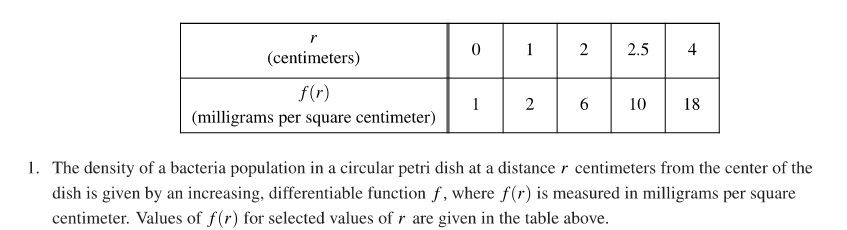
This is a Reimann sum and Table question (Type 5) and covers topics from Units 6 and 8 from the current Course and Exam Description. All four parts are fairly typical for this type of problem. There is a little twist in part (b). The context is the density of bacteria growing in a petri dish.

Density is not listed in the Course and Exam Description. It is not covered well in many textbooks. Since it is not listed you need not teach it; exam questions referencing density have enough included information so that a student who has never seen the concept will still be able to answer the question. Keep this in mind as you look at each part; help your students see past the context and look at the calculus. More information on density see these posts Density Functions, and Good Question 15 and Good Question 16.

The stem for 2021 AB 1 / BC 1 reads:

Part (a): Students were asked to estimate the value of the derivative of f at r = 2.25 and explain its meaning, including units, in the context of the problem.  The expected procedure is to find the slope between the two values closest to r =2.25. The interpretation is the increase in density as you move away from the center. The units are milligrams per square centimeter per centimeter distant from the center \frac{{mg/c{{m}^{2}}}}{{cm}}.

Discussion and ideas for adapting this question:

  • AP exams have always asked this question at a value exactly half-way between two values in the table. You may change this to some other place such as r = 3 or r = 0.8.
  • Units of the derivative are always the units of the function divided by the units of the independent variable. Be sure your students understand this.
  • The units can be correctly written as  \frac{{mg}}{{c{{m}^{3}}}}, but here is a good change to discuss what the units mean. Why does “milligrams per square centimeter per centimeter distant from the center” make more sense?
  • Ask “Is there a point in the interval [2, 2.5] where the slope of the tangent line is 8? Justify your answer.” This makes use of the Mean Value Theorem.

Part (b) : As usual in this type of problem, students are asked to write a Riemann sum based on the intervals in the table. The difference here is that the integral being approximated, \displaystyle 2\pi \int_{0}^{4}{{rf\left( r \right)}}dr, has an “extra” factor of r in it.

Discussion and ideas for adapting this question:

  • The question asked for a right Riemann sum. You can easily adapt this by asking for a left Riemann sum, a midpoint Riemann sum, and/or a Trapezoidal approximation.
  • You may ask for a Riemann sum without the “extra” factor.
  • You may find a different Riemann sum problem and include an “extra” factor in it.
  • The integral is the integral for a radial density function. See the Density blog post cited above, example 2.
  • The radial density function looks like the integral for finding volumes by the method of cylindrical shells. This is more than a coincidence. Why?

Part (c): This part asked if the answer in (b) is an overestimate or an underestimate, with an explanation. For any approximation, some idea of its accuracy is important. In BC questions on power series approximations, a numerical estimate of the error bound is a common question.

Discussion and ideas for adapting this question:

  • Ask the same question for a different Riemann sum (left, midpoint, trapezoid).
  • The error in right and left Riemann sums estimates depend on whether the function is increasing or decreasing, and therefore on the first derivative. Midpoint and Trapezoidal approximation estimates are related to the concavity and therefore to the second derivative. See: Good Question 4)
  • A visual idea helps keep all this straight. Draw sketches showing the Riemann sum rectangles or trapezoids. Whether they lie above or below the graph of the function determines whether the approximation is an overestimate or underestimate.

Part (d): Typical of the Riemann sum table question is the final part with a related question based on a function and not based on the table.

Discussion and ideas for adapting this question:

  • This is a calculator allowed question. Students should not try to do the integration by hand.
  • The question asked for the average value of the function on an interval. Other questions you could ask are find the rate of change (derivative) at a point, the total mass \int_{1}^{4}{{rf\left( r \right)}}dr (note “extra” r), the average rate of change on an interval, etc.

Next week 2021 AB 2.

I would be happy to hear your ideas for other ways to use these questions. Please use the reply box below to share your ideas.

Common Mistakes that Make Readers Pull Their Hair Out

For years, there have been various lists of the most common mistakes on the AP Calculus exams. This one was originally drawn up by the late Ben Cornelius. Larry Peterson added some comments and posted it to the AP Calculus Community bulletin board a few days ago. Both Ben and Larry are long time AP Calculus teachers, exam readers, table leaders, and question leaders. I have revised it slightly and added some thoughts of my own starting with the first one.

This is for students; so, be sure to share it with them.

“Common Mistakes that Make Readers Pull Their Hair Out.”

  1. BAD ALGEBRA. Yes, calculus students should know how to do algebra. The AP exams are calculus exams and the necessity for doing algebra is kept to a minimum. Algebraic simplification is not required. Once you find a derivative using the quotient rule, stop. Don’t take the chance of simplifying a correct answer and making an algebra mistake. Questions do not require lines and lines of algebra. If you are doing a lot of algebra, you have made a mistake; start over.
  2. BAD ARITHMETIC. There is no need to simplify arithmetic.  It won’t make the answer any more correct (even a long Riemann sum). If you get 2 + 3 or sin(π/6) stop – that’s good enough.
  3. Crossed out work. Don’t cross out your work, unless you know you can do better.
  4. Incorrect or missing units. Units are required only if specifically asked for.
  5. Go for partial credit.: If you are worried that your result in part a) is incorrect, use it anyway to finish the problem.
  6. Go for partial credit. When asked to write an integral, start with the limits and any constants of multiplication; that’s worth a point, even if you are not sure of the integrand.
  7. When using a calculator, show the mathematical set-up (e.g., the definite integral); describe what you are doing clearly in mathematical terms, not in calculator speak. Calculator work is limited to the four required functionalities: graphing, roots, numerical derivative, and numerical integration.  You will not be required to do anything else with your calculator and no question will be asked where using an additional feature would give an advantage (e.g., curve fitting). Anything else you do will not earn credit.
  8. Writing bad math. For example, “slope of the derivative.” or “6.2368 = 6.237″ or (since you know the answer should be positive) “–17.241 = 17.241″)
  9. Rounding or truncating mistakes. Remember: three or more decimal places, rounded or truncated. Do not round or truncate before the final answer (early rounding may affect the accuracy of the final answer.)
  10. Say what you mean. Don’t write f(x) = 2(1.5) + 3 if you mean f(1.5) = 2(1.5) + 3. Don’t give a Taylor series when asked for a Taylor polynomial.
  11. Pronouns need an antecedent. Name the function you are referring to. Do not say, “It is increasing because it is positive”, say “The function, f, is increasing, because the derivative of f is positive.” Refer to the function by name, especially if there is more than one function.
  12. Know the difference between increasing and positive:  f is increasing when f ’ is positive.
  13. Know the difference between local and global extrema.
  14. “Value of a function” means the y-value. Do not give an ordered pair, if only the value is asked for. Know the difference between the extreme value (y-coordinate) and the location of the extreme value (x– and y-coordinates).
  15. Write justifications and reason in complete sentences (without pronouns). You may use mathematical symbols.
  16. Make sure the equations flow correctly from one line to the next.  Do not use stream of consciousness. Do not connect equations with equal signs, unless you are sure they are equal. (e.g., 3 x+ 12 = 0 = x + 4 = –4 makes no sense). Rather work vertically:

3x + 12 = 0

x + 4 = 0

x = –4

Here is even more advice: “How, not only to Survive, but to Prevail” is the introduction I wrote for to Multiple-choice & Free-response in Preparation for the AP Calculus (AB) Examination and Multiple-choice & Free-response in Preparation for the AP Calculus (BC) Examination published by D&S Marketing Systems, Inc. More advice and information for students about to take the AP Calculus Exams.

And good luck on this year’s exams.

2021 Review Notes

About this time of year, I have been posting notes on reviewing and on the ten types of problems that usually appear on the AP Calculus Exams AB and BC. Since the types do not change, I am posting all the links below. They are only slightly revised from last year. You can also find them under “AP Exam Review” on the black navigation bar above.  

Each link provides a list of “What students should know” and links to other post and questions from past exams related to the type under consideration.

Note that the 10 Types are not the same as the 10 Units in the Fall 2020 Course and Exam Description. This is because many of the exam questions have parts from different units.

Here are the links to the various review posts:

When assigning past exams questions for review (and you should assign past exam question), keep in mind that students can find the scoring standards online. Even though the AP program forbids this and makes every effort to prevent them from being posted, they are there. Students can “research” the solution. Keep this in mind when assigning questions from past exams. Here is a suggestion Practice Exams – A Modest Proposal


Polar Equations for AP Calculus

A recent thread on the AP Calculus Community bulletin boards concerned polar equations. One teacher observed that her students do not have a very solid understanding of polar graphs when they get to calculus. I expect this is a common problem. While ideally the polar coordinate system should be a major topic in pre-calculus courses, this is sometimes not the case. Some classes may even omit the topic entirely. Getting accustomed to a new coordinate scheme and a different way of graphing is a challenge.  I remember not having that good an understanding myself when I entered college (where first-year calculus was a sophomore course). Seeing an animated version much later helped a lot. 

This blog post will discuss the basics of polar equations and their graphs. It will not be as much as students should understand, but I hope the basics discussed here will be a help. There are also some suggestions for extending the study of polar function as the end.

Instead of using the Cartesian approach of giving every point in the plane a “name” by giving its distance from the y-axis and the x-axis as an ordered pair (x,y), polar coordinates name the point differently. Polar coordinates use the ordered pair (r, θ), where r, gives the distance of the point from the pole (the origin) as a function of θ, the angle that the ray from the pole (origin) to the point makes with the polar axis, (the positive half of the x-axis).

Start with this Desmos graph. It will help if you open it and follow along with the discussion below. The equation in the example is \displaystyle r(\theta )=2+4\sin (\theta ) You may change this to explore other graphs. (Because of the way Desmos graphs, you cannot have a slider for θ; the a-slider will move the line and the point on the graph. r(a) gives the value of r(θ).

  • Notice that as the angle changes the point at varying distance from the pole traces a curve. 
  • Move the slider to π/6. Since sin(π/6) = 0.5, r(π/6) = 4. The red dot is at the point (4, π/6). Move the slider to other points to see how they work. For example, θ = π/2 gives the point (6,π/2).
  • When the slider gets to θ = 7π/6, r = 0 and the point is at the pole. After this the values of r are negative, and the point is now on the ray opposite to the ray pointing into the third and fourth quadrants. The dashed line turns red to remind you of this.
  • As we continue around, the point returns to the origin at θ = 11π/6, then values are again positive. 
  • The graph returns to its starting point when θ = 2π. Note (2,0) is the same point as (2, 2π).
  • Even though this is the graph of a function, some points may be graphed more than once and the vertical line test does not apply. 
  • If we continued around, the graph will retrace the same path. This often happens when the polar function contains trig functions with integer multiples of θ.
    • This does not usually happen if no trig functions are involved – try the spiral r = θ.
    • If you enter non-integer multiples of θ and extend the domain to large values, vastly different graphs will appear, often making nice designs. Try \displaystyle r\left( \theta \right)=2+4\sin \left( {1.3\theta } \right) for \displaystyle 0\le \theta \le 20\pi . This is an area for exploration (if you have time).

In pre-calculus courses several families of polar graphs are often studied and named. For example, there are cardioids, rose curves, spirals, limaçons, etc. The AP Exams do not refer to these names and students are not required to know the names. The exception is circles which have the following forms where R is the radius: θ=R, r = Rsin(θ) or r = Rsin(θ)

To change from polar to rectangular for use the equations x=r\cos \left( \theta  \right) and  y=r\sin \left( \theta  \right). This is simple right triangle trigonometry (draw a perpendicular from the point to the x-axis and from there to the pole). 

To change from rectangular to polar form use  r=\sqrt{{{{x}^{2}}+{{y}^{2}}}} and  \displaystyle \theta =\arctan \left( {\tfrac{y}{x}} \right)

AP Calculus Applications

There are two applications that are listed on the AP Calculus Course and Exam Description: using and interpreting the derivative of polar curves (Unit 9.7) and finding the area enclosed by a polar curve(s) (Units 9.8 and 9.9).

Since calculus is concerned with motion, AP Students should be able to analyze polar curves for how things are changing:

  • The rate of change of r away from or towards the pole is given by  \displaystyle \frac{{dr}}{{d\theta }}
  • The rate of change of the point with respect to the x-direction is given by  \displaystyle \frac{{dx}}{{d\theta }} where \displaystyle x=r\cos \left( \theta \right) from above.
  • The rate of change of the point with respect to the y-direction is given by  \displaystyle \frac{{dy}}{{d\theta }} where \displaystyle y=r\sin \left( \theta \right)from above.
  • The slope of the tangent line at a point on the curve is \displaystyle \frac{{dy}}{{dx}}=\frac{{dy/d\theta }}{{dx/d\theta }}. See 2018 BC5 (b)

Area

 \displaystyle \underset{{\Delta \theta \to 0}}{\mathop{{\lim }}}\,\sum\limits_{{i=1}}^{\infty }{{\tfrac{1}{2}}}{{r}_{i}}^{2}\Delta \theta =\tfrac{1}{2}\int_{{{{\theta }_{1}}}}^{{{{\theta }_{2}}}}{{{{r}^{2}}d\theta }}

CAUTION: In using this formula, we need to be careful that the curve does not overlap itself. In the Desmos example, the smaller loop overlaps the larger loop; integrating from 0 to 2π counts the inner loop twice. Notice how this is handled by considering the limits of integration dividing the region into non-overlapping regions: 

  • The area of the outer loop is  \displaystyle \tfrac{1}{2}\int_{{-\pi /6}}^{{7\pi /6}}{{{{{(2+4\sin (\theta ))}}^{2}}d\theta }}\approx 35.525
  • The area of the inner loop is  \displaystyle \tfrac{1}{2}\int_{{7\pi /6}}^{{11\pi /6}}{{{{{(2+4\sin (\theta ))}}^{2}}d\theta }}\approx 2.174
  • Integrating over the entire domain gives the sum of these two:  \displaystyle \tfrac{1}{2}\int_{0}^{{2\pi }}{{{{{(2+4\sin (\theta ))}}^{2}}d\theta }}=12\pi \approx 37.699. This is not the correct area of either part. 

This problem can be avoided by considering the geometry before setting up the integral: make sure the areas do not overlap. Restricting r to only non-negative values is often required by the fine print of the theorem in textbooks, but this restriction is not necessary when finding areas and makes it difficult to find, say, the area of the smaller inner loop of the example. Here is another example: 

\displaystyle r\left( \theta \right)=\cos \left( {3\theta } \right). Between 0 and \displaystyle 2\pi this curve traces the same path twice.

Infinite Sequences and Series – Unit 10

Unit 10 covers sequences and series. These are BC only topics (CED – 2019 p. 177 – 197). These topics account for about 17 – 18% of questions on the BC exam.

Topics 10.1 – 10.2

Topic 10.1: Defining Convergent and Divergent Series.

Topic 10. 2: Working with Geometric Series. Including the formula for the sum of a convergent geometric series.

Topics 10.3 – 10.9 Convergence Tests

The tests listed below are tested on the BC Calculus exam. Other methods are not tested. However, teachers may include additional methods.

Topic 10.3: The nth Term Test for Divergence.

Topic 10.4: Integral Test for Convergence. See Good Question 14

Topic 10.5: Harmonic Series and p-Series. Harmonic series and alternating harmonic series, p-series.

Topic 10.6: Comparison Tests for Convergence. Comparison test and the Limit Comparison Test

Topic 10.7: Alternating Series Test for Convergence.

Topic 10.8: Ratio Test for Convergence.

Topic 10.9: Determining Absolute and Conditional Convergence. Absolute convergence implies conditional convergence.

Topics 10.10 – 10.12 Taylor Series and Error Bounds

Topic 10.10: Alternating Series Error Bound.

Topic 10.11: Finding Taylor Polynomial Approximations of a Function.

Topic 10.12: Lagrange Error Bound.

Topics 10.13 – 10.15 Power Series

Topic 10.13: Radius and Interval of Convergence of a Power Series. The Ratio Test is used almost exclusively to find the radius of convergence. Term-by-term differentiation and integration of a power series gives a series with the same center and radius of convergence. The interval may be different at the endpoints.

Topic 10.14: Finding the Taylor and Maclaurin Series of a Function. Students should memorize the Maclaurin series for \displaystyle \frac{1}{{1-x}}, sin(x), cos(x), and ex.

Topic 10.15: Representing Functions as Power Series. Finding the power series of a function by, differentiation, integration, algebraic processes, substitution, or properties of geometric series.


Timing

The suggested time for Unit 9 is about 17 – 18 BC classes of 40 – 50-minutes, this includes time for testing etc.


Previous posts on these topics:

Before sequences

Amortization Using finite series to find your mortgage payment. (Suitable for pre-calculus as well as calculus)

A Lesson on Sequences An investigation, which could be used as early as Algebra 1, showing how irrational numbers are the limit of a sequence of approximations. Also, an introduction to the Completeness Axiom. 

Everyday Series

Convergence Tests

Reference Chart

Which Convergence Test Should I Use? Part 1 Pretty much anyone you want!

Which Convergence Test Should I Use? Part 2 Specific hints and a discussion of the usefulness of absolute convergence

Good Question 14 on the Integral Test

Sequences and Series

Graphing Taylor Polynomials Graphing calculator hints

Introducing Power Series 1

Introducing Power Series 2

Introducing Power Series 3

New Series from Old 1 substitution (Be sure to look at example 3)

New Series from Old 2 Differentiation

New Series from Old 3 Series for rational functions using long division and geometric series

Geometric Series – Far Out An instructive “mistake.”

A Curiosity An unusual Maclaurin Series

Synthetic Summer Fun Synthetic division and calculus including finding the (finite)Taylor series of a polynomial.

Error Bounds

Error Bounds Error bounds in general and the alternating Series error bound, and the Lagrange error bound

The Lagrange Highway The Lagrange error bound. 

What’s the “Best” Error Bound?

Review Notes

Type 10: Sequences and Series Questions


Parametric Equations, Polar Coordinates, and Vector-Valued Functions – Unit 9

Unit 9 includes all the topics listed in the title. These are BC only topics (CED – 2019 p. 163 – 176). These topics account for about 11 – 12% of questions on the BC exam.

Comments on Prerequisites: In BC Calculus the work with parametric, vector, and polar equations is somewhat limited. I always hoped that students had studied these topics in detail in their precalculus classes and had more precalculus knowledge and experience with them than is required for the BC exam. This will help them in calculus, so see that they are included in your precalculus classes.

Topics 9.1 – 9.3 Parametric Equations

Topic 9.1: Defining and Differentiation Parametric Equations. Finding dy/dx in terms of dy/dt and dx/dt

Topic 9.2: Second Derivatives of Parametric Equations. Finding the second derivative. See Implicit Differentiation of Parametric Equations this discusses the second derivative.

Topic 9.3: Finding Arc Lengths of Curves Given by Parametric Equations. 

Topics 9.4 – 9.6 Vector-Valued Functions and Motion in the plane

Topic 9.4 : Defining and Differentiating Vector-Valued Functions. Finding the second derivative. See this A Vector’s Derivatives which includes a note on second derivatives. 

Topic 9.5: Integrating Vector-Valued Functions

Topic 9.6: Solving Motion Problems Using Parametric and Vector-Valued Functions. Position, Velocity, acceleration, speed, total distance traveled, and displacement extended to motion in the plane. 

Topics 9.7 – 9.9 Polar Equation and Area in Polar Form.

Topic 9.7: Defining Polar Coordinate and Differentiation in Polar Form. The derivatives and their meaning.

Topic 9.8: Find the Area of a Polar Region or the Area Bounded by a Single Polar Curve

Topic 9.9: Finding the Area of the Region Bounded by Two Polar Curves. Students should know how to find the intersections of polar curves to use for the limits of integration. 


Timing

The suggested time for Unit 9 is about 10 – 11 BC classes of 40 – 50-minutes, this includes time for testing etc.


Previous posts on these topics :

Parametric Equations

Vector Valued Functions

Polar Form

