Here’s why x is so ubiquitous in mathematics.
Now one more unknown thing is known!
This TED Talk can be found here.

Here’s why x is so ubiquitous in mathematics.
Now one more unknown thing is known!
This TED Talk can be found here.
When considering functions made up of the sums, differences, products or quotients of different sorts of functions (polynomials, exponentials and logarithms), or different powers of the same sort of function we say that one function dominates the other. This means that as x approaches infinity or negative infinity, the graph will eventually look like the dominating function.
For example, consider the function 


Another example, consider a rational function (the quotient of two polynomials). If the numerator is of higher degree than the denominator, as 
Dominance works in other ways as well. Consider the graphs of 

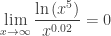
Here’s an example that pretty much has to be done using the dominance approach.
The polynomial function in the denominator, even with the very small exponent, will dominate the logarithm function. The denominator will eventually get larger than the numerator and drive the quotient towards zero. We will return to this function when we know about finding maximums and points of inflection and find where it starts decreasing. For more on this see my post Far Out!
For quite a while I’ve been writing sin(x), ln(x) and the like with parentheses instead of the usual sin x or ln x .
The main reason is that I want to emphasize that sin(x), ln(x), etc. are the same level and type of notation as f(x). The only difference is that sin(x) and ln(x) always represent the same function, while things like f(x) represent different functions from problem to problem. I hope this makes things just a little clearer to the students.
I also favor using (sin(x))² instead of sin²(x), again to make clearer just what is getting squared. Notation can be inconsistent: I don’t think I’ve ever seen ln²(x) or even f ²(x). So this helps in that regard as well.
Of course, when entering functions in calculators or computers you almost always must use the “extra” parentheses in both cases. (Except for the new Casio PRIZM which will understand sin x and ln x, but not sin²(x).)
Now we can use that spot in the notation exclusively for inverse functions, as in 

Another possible inconsistency is trying to write sin′(x) for the derivative as you do with 
Ways to find limits (summary):
 or
or  the limit may exist. Simplify by factoring, or using different trig functions. Later in the year a method called L’Hôpital’s Rule can often be used in this situation.
Infinity is not a number, but it often is used as if it were. When we say a limit is infinity, what we mean is that the function increases without bound, or there is some x-value that will make the expression larger than any number you choose. Writing things like 
DNE or Infinity? 

Take a look at this AP question 1998 AB-2: In (a) students found that 



Teachers are often concerned that the Advanced Placement Calculus tests do not test the formal definition of limit and the delta-epsilon idea. I think there are two reasons for this.
 where m is the slope of the line. Anyone can memorize that, so testing it does not provide any evidence that the student knows anything. For any other function (polynomials of higher degree, trigonometric functions, etc.) some special one-time “trick” is required, often different for each type of function. Thus, the question becomes unreasonably difficult even for one who understands the concept.
 is correct, then so is
  etc. Again no real knowledge of the definition is required – just choose the smallest delta.
Of course, the definition of limit is important. You may teach it in your class. It just will not appear on the AP Calculus exams.
Here are some notes The Definition of Limit contributed by Paul A . Foerster of San Antonio, Texas, that will help your students understand the concept.
After reading my post on “The First and Second Day of School” Paul A. Foerster, was nice enough to share these problems from a recent presentation. They give a taste of derivatives and integrals in the first week of school and get the kids into calculus right off the bat.
Paul who recently retired after 50 (!) years of teaching, is Teacher Emeritus of Mathematics of Alamo High Heights School in San Antonio, Texas. He is the author of several textbooks including Calculus: Concepts and Applications, Second Edition, 2005, published by Kendall Hunt Publishing Company, www.kendallhunt.com (Formerly published by Key Curriculum Press).
Many years ago (almost 50) I remember teaching from his fine Trigonometry book .
Thank you, Paul!
There are four important things before calculus and in beginning calculus for which we need the concept of limit.
Ideally, one would hope that students have seen these phenomena and have used the terms limit and continuity informally before they study calculus. This is where the study of calculus starts. The next two items are studied in calculus and are based heavily on limit.
3. The tangent line problem. The definition of the derivative as the limit of the slope of a secant line to a graph is the first of the two basic ideas of the calculus. This single idea is the basis for all the concepts and applications of differential calculus.
4. The area problem. Using limits it is possible to find the area of a region with a curved side, even if the curve is not something simple like a semi-circle. The definite integral is defined as the limit of a Riemann sum and gives the area regions with a curved side. This then can be extended to huge number of very practical applications many having nothing to do with area.
So these are the main ways that limits are used in beginning calculus. Students need a good visual understanding, what the graph looks like, of the first two situations listed above and how limits describe and define them. This is also necessary later when third and fourth come up.