Type 6 Questions: Differential Equations

Differential equations are tested every year. The actual solving of the differential equation is usually the main part of the problem, but it is accompanied by a related question such as a slope field or a tangent line approximation. BC students may also be asked to approximate using Euler’s Method. Large parts of the BC questions are often suitable for AB students and contribute to the AB sub-score of the BC exam.

What students should be able to do

  • Find the general solution of a differential equation using the method of separation of variables (this is the only method tested).
  • Find a particular solution using the initial condition to evaluate the constant of integration – initial value problem (IVP).
  • NEW Determine the domain restrictions on the solution of a differential equation. See this post for more on this. 
  • Understand that proposed solution of a differential equation is a function (not a number) and if it and its derivative are substituted into the given differential equation the resulting equation is true. This may be part of doing the problem even if solving the differential equation is not required (see 2002 BC 5 – parts a, b and d are suitable for AB)
  • Growth-decay problems.
  • Draw a slope field by hand.
  • Sketch a particular solution on a given slope field.
  • Interpret a slope field.
  • Multiple-choice: Given a differential equation, identify is slope field.
  • Multiple-choice: Given a slope field identify its differential equation.
  • Use the given derivative to analyze a function such as finding extreme values
  • For BC only: Use Euler’s Method to approximate a solution.
  • For BC only: use the method of partial fractions to find the antiderivative after separating the variables.
  • For BC only: understand the logistic growth model, its asymptotes, meaning, etc. The exams so far, have never asked students to actually solve a logistic equation IVP

Look at the scoring standards to learn how the solution of the differential equation is scored, and therefore, how students should present their answer. This is usually the one free-response answer with the most points riding on it. Starting in 2016 the scoring has changed slightly. The five points are now distributed this way:

  • one point for separating the variables
  • one point each for finding the antiderivatives
  • one point for including the constant of integration and using the initial condition – that is, for writing “+ C” on the paper with one of the antiderivatives and substituting the initial condition; finding the value of C is included in the “answer point.” and
  • one point for solving for y: the “answer point”, for the correct answer. This point includes all the algebra and arithmetic in the problem including solving for C..

In the past, the domain of the solution is often included on the scoring standard, but unless it is specifically asked for in the question students do not need to include it. However, the new CED lists “EK 3.5A3 Solutions to differential equations may be subject to domain restrictions.” Perhaps this will be asked in the future. For more on domain restrictions with examples see this post.

Shorter questions on this concept appear in the multiple-choice sections. As always, look over as many questions of this kind from past exams as you can find.

For some previous posts on differential equations see January 5, 2015 and for post on related subjects see November 26, 2012,  January 21, 2013 February 16, 2013


Free-response examples:

Multiple-choice examples from non-secure exams:

  • 2012 AB 23, 25
  • 2012 BC: 12, 14, 16, 23

Schedule of review postings:


Type 4 Questions: Area and Volume Problems

Given equations that define a region in the plane students are asked to find its area, the volume of the solid formed when the region is revolved around a line, and/or the region is used as a base of a solid with regular cross-sections. This standard application of the integral has appeared every year since year one (1969) on the AB exam and almost every year on the BC exam. You can be pretty sure that if a free-response question on areas and volumes does not appear, the topic will be tested on the multiple-choice section.

What students should be able to do:

  • Find the intersection(s) of the graphs and use them as limits of integration (calculator equation solving). Write the equation followed by the solution; showing work is not required. Usually no credit is earned until the solution is used in context (as a limit of integration). Students should know how to store and recall these values to save time and avoid copy errors.
  • Find the area of the region between the graph and the x-axis or between two graphs.
  • Find the volume when the region is revolved around a line, not necessarily an axis or an edge of the region, by the disk/washer method.
  • The cylindrical shell method will never be necessary for a question on the AP exams, but is eligible for full credit if properly used.
  • Find the volume of a solid with regular cross-sections whose base is the region between the curves. For an interesting variation on this idea see 2009 AB 4(b)
  • Find the equation of a vertical line that divides the region in half (area or volume). This involves setting up an integral equation where the limit is the variable for which the equation is solved.
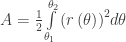
  • For BC only – find the area of a region bounded by polar curves: A=\tfrac{1}{2}\int\limits_{{{\theta }_{1}}}^{{{\theta }_{2}}}{{{\left( r\left( \theta  \right) \right)}^{2}}}d\theta
  • For BC only – Find perimeter using arc length integral

If this question appears on the calculator active section, it is expected that the definite integrals will be evaluated on a calculator. Students should write the definite integral with limits on their paper and put its value after it. It is not required to give the antiderivative and if a student gives an incorrect antiderivative they will lose credit even if the final answer is (somehow) correct.

There is a calculator program available that will give the set-up and not just the answer so recently this question has been on the no calculator allowed section. (The good news is that in this case the integrals will be easy or they will be set-up-but-do-not-integrate questions.)

Occasionally, other type questions have been included as a part of this question. See 2016 AB5/BC5 which included an average value question and a related rate question along with finding the volume.

Shorter questions on this concept appear in the multiple-choice sections. As always, look over as many questions of this kind from past exams as you can find.

For some previous posts on this subject see January 911, 2013 and “Subtract the Hole from the Whole” of December 6, 2016


Free-response questions:

  • 2014 AB 2, 2013 AB 5.
  • 2015 AB 2
  • Variations: 2009 AB 4,
  • 2016 AB5/BC5,
  • 2017 AB 1 (using a table),
  • Perimeter 2011 BC 3 and 2014 BC 5

Multiple-choice questions from non-secure exams:

  • 2008 AB 83 (Use absolute value),
  • 2012 AB 10, 92
  • 2012 BC 87, 92 (Polar area)


Revised to add perimeter question 3-16-18,

Revised March 12, 2021

An Exploration in Differential Equations

This is an exploration based on the AP Calculus question 2018 AB 6. I originally posed it for teachers last summer. This will make, I hope, a good review of many of the concepts and techniques students have learned during the year. The exploration, which will take an hour or more, includes these topics:

  • Finding the general solution of the differential equation by separating the variables
  • Checking the solution by substitution
  • Using a graphing utility to explore the solutions for all values of the constant of integration, C
  • Finding the solutions’ horizontal and vertical asymptotes
  • Finding several particular solutions
  • Finding the domains of the particular solutions
  • Finding the extreme value of all solutions in terms of C
  • Finding the second derivative (implicit differentiation)
  • Considering concavity
  • Investigating a special case or two

I also hope that in working through this exploration students will learn not so much about this particular function, but how to use the tools of algebra, calculus, and technology to fully investigate any function and to find all its foibles.

The exploration is here in a PDF file. Here are the solutions.

As always, I appreciate your feedback and comments. Please share them with me using the reply box below.


The College Board is pleased to offer a new live online event for new and experienced AP Calculus teachers on March 5th at 7:00 PM Eastern.

I will be the presenter.

The topic will be AP Calculus: How to Review for the Exam:  In this two-hour online workshop, we will investigate techniques and hints for helping students to prepare for the AP Calculus exams. Additionally, we’ll discuss the 10 type questions that appear on the AP Calculus exams, and what students need know and to be able to do for each. Finally, we’ll examine resources for exam review.

Registration for this event is $30/members and $35/non-members. You can register for the event by following this link: http://eventreg.collegeboard.org/d/xbqbjz


Differential Equations 2

More posts on differential equations

Good Question 2: 2002 BC 5 (2-17-2015) A differential equation that cannot be solved by separating the variables is investigated anyway. Most of this question is AB material.

A Family of Functions (2-21-2015) Further investigation of the general solution of the equation discussed above in Good Question 2. Most of this question is AB material.

The Logistic Equation (1-31-2017) An outline of the logistic differential equation, its solution, its graph, and what students need to know for the exam. BC Topic.

        Don’t miss this one -> An Exploration in Differential Equations  (6-8-2018) An exploration covering pretty much all of the ideas in differential equation based on 2018 AB 6.  The exploration is here and                                                          the solutions here..

Logistics Growth – Real and Simulated (1-24-2017) Examples of logistic growth and a simulation you can use in your class. BC Topic.

Review Notes

Type 6 Questions: Differential Equations (3-23-2018) What AB and BC students need to know about differential equations for the AP Calculus exams.


The College Board is pleased to offer a new live online event for new and experienced AP Calculus teachers on March 5th at 7:00 PM Eastern.

I will be the presenter.

The topic will be AP Calculus: How to Review for the Exam:  In this two-hour online workshop, we will investigate techniques and hints for helping students to prepare for the AP Calculus exams. Additionally, we’ll discuss the 10 type questions that appear on the AP Calculus exams, and what students need know and to be able to do for each. Finally, we’ll examine resources for exam review.

Registration for this event is $30/members and $35/non-members. You can register for the event by following this link: http://eventreg.collegeboard.org/d/xbqbjz


Differential Equations 1

Past posts on differential equations

Differential Equations (1-5-2015) The basics and definitions.

Domain of a Differential Equation (4-7-2017) notes and examples on finding the domain of the solution of a differential equation. (Updated thru the 2018 exam.)

Slope Fields (1-9-2015) Graphical solutions: The solution is lurking in the slope field.

Euler’s Method (1-12-2015) Numerical solutions (BC only topic)

Euler’s Method for Making Money (2-25-2015) The connection between compound growth (compound interest) and Euler’s Method.

Accumulation and Differential Equations  (2-1-2013) Solving differential equations without the “+C


Applications of Integration – Accumulation 2

Happy New Year !

A few more links to posts on accumulation.

Painting a Point (2-4-2013) Paint often and the paint accumulates.

Good Question 6: 2000 AB 4 (8-25-2015) Accumulation

Good Question 8 – or not? (1-5-2016) Accumulation

Density (1-10-2017)

Accumulation and Differential Equations  (2-1-2013) Solving differential equations without the “+C 

Review Notes: Type 1 Questions: Rate and Accumulation (3-6-2018) Review Notes


Applications of Integration – Accumulation 1

The idea that the definite integral is an “accumulator” means that integrating a rate of change over an integral gives the net amount of change over the interval.Many of the application of integration are based on this idea. Here are some past posts on this idea.

Accumulation An introductory activity to explore accumulation and the relationship between an  accumulation and derivatives

Accumulation: Need an Amount?  (1-21-2013) An important and always tested application.

AP Accumulation Questions (1-23-2013) Two good questions for teaching and learning accumulation.

Graphing with Accumulation 1 (1-25-2013) Everything you need to know about the graph of a function given its derivative can be found using integration techniques. Increasing and decreasing.

Graphing with Accumulation 2 (1-28-2013) Everything you need to know about the graph of a function given its derivative can be found using integration techniques. Concavity.


Next Tuesday is Christmas (already). There will be no post until Tuesday January 1, 2019 when I will there will be several more links to post on accumulation.

Happy Holidays, Merry Christmas, and Happy New Year.