Why Applications?

I guess the obvious answer is so you will have something to use your new knowledge of the definite integral on. This unit is a collection of the first applications. There are many more.

The whole idea is based on the fact that a definite integral is a sum. Thus, they can be used to add things. Complicated shapes can be divided into simple shapes, like rectangles, and their areas can be added.

Here are the first uses.

AVERAGE VALUE OF A FUNCTION ON AN INTERVAL

You know that to average two numbers you add them and divide the total by two. To average a larger set of numbers you add them and divide the sum by the number of numbers. Now you will learn how to average the infinite number of y-values of a function over an interval. To do it you use a definite integral.

HINT: Average value of a function, average rate of change of a function, and the mean value theorem all sound kind of the same. Furthermore, the formulas all look kind of the same. Don’t mix them up. Use their full name, not just “average,” and use the right one.

There is an interesting result found some years ago by a tenth-grade student who took AB Calculus in eighth grade and BC in ninth. He proved that Most Triangles Are Obtuse! using the average value integral.

LINEAR MOTION

This application extends your previous work on objects moving on a line. By adding, with a definite integral, you will be able to determine how far the object moves in a given time. Knowing that and where the object starts, you will be able to find its current position. BC students will also learn how to find the length of a curve in the plane.

THE AREA BETWEEN TWO CURVES

This application extends what you know about finding the area between a curve and the x-axis to finding the area between two curves.

VOLUME OF A SOLID FIGURE WITH A REGULAR CROSS-SECTION

Some solid objects, when sliced in the right way, have regular cross-section. That means, the cut surface is a square, a rectangle, a right triangle, a semi-circle and so on. Think of cutting a piece of butter from a stick of butter – each piece is a square with a little thickness, like a very small pizza box. By using an integral to add their volumes you can find the volume of the original figure. .

VOLUME OF A SOLID OF REVOLUTION – DISK METHOD

A region in the plane is revolved aroud a line resulting in a solid figure. Finding its volume is just a special case of a solid with regular cross section where the cross section is a circle. Each little piece is a disk. By adding their volumes with an integral you can calculate the volume.

VOLUME OF A SOLID OF REVOLUTION – WASHER METHOD

Some solids of revolution have holes through them. These are formed by revolving a plane figure (usually the region between two curves) around an edge or a line outside the figure. The line is often the x– or y-axis. There is a formula for doing this, but understanding what you are doing – doing two disk problems – will help you with doing this. (See Subtract the Hole from the Whole.)

One last hint: You will want to know what the solid figure looks like. In addition to the illustrations in your textbook, there are various places online where you can find pictures of the figures. You can build models of them. There is an excellent iPad app called A Little Calculus that does a good job of illustrating and animating solid figures (and lots of other calculus stuff).

Course and Exam Description Unit 8

Why Differential Equations?

Differential equations are equations that include derivatives. Their solution is not a number, but rather a function which along with its derivative(s) satisfies the equation. That is, when the function and its derivative(s) are substituted into the differential equation the result is true (an identity). You may check your solution by substituting into the differential equation.

Differential equations are used in all areas of math, science, economics, engineering, and anywhere math is used. Derivatives model the change in something. Change is often easier to model (measure and write equations for) than the function that is changing. By solving the differential equation, you find the equation that describes the situation.

If it were only that easy. Differential equations are notoriously difficult to solve. In this, your first look at them, you will study the basics and only one of the many, many methods of solution. This is just to give you a hint of what differential equations are about.

Solution involves finding antiderivatives that include a constant of integration. The solution with an unevaluated constant is called the general solution. The solution could go through any point in the plane depending on the value of the constant of integration.  

To evaluate this constant, you must know a point on the solution function. This is called an initial condition, an initial point, or a boundary condition. Once the constant is evaluated, the result is called the particular solution.

A slope field is a technique for looking at all the solutions and seeing properties of the solutions. A slope field is a series of short segments regularly spaced over the plane that have the slope indicated by the differential equation. The segments are tangent to the solution curve through the points where they are drawn. You may start at any point (the initial condition point) and sketch an approximate solution by following the slope field segments. Doing so gives you an idea of a particular solution.

You will look at exponential functions as an example of an application of a differential equation.

BC students will also learn a numerical approximation technique called Euler’s Method. This is based on the linear approximation idea repeated several times. They will also look another model for the
Logistic equation.

Course and Exam Description Unit 7

Why Antiderivatives?

Antiderivatives are needed to evaluate definite integrals.

The next thing to consider is how to find antiderivatives.

Each of the formulas you learned for finding a derivative may be reversed to find antiderivatives. For example, since \displaystyle \frac{d}{{dx}}\sin \left( x \right)=\cos \left( x \right), it follows that.\displaystyle \int{{\cos \left( x \right)dx}}=\sin \left( x \right)

I wish it were all that simple.

There are three concerns.

First, if the original function included a constant, this constant will disappear when you differentiate. Think about it: adding a constant translates the graph up or down but does not change the shape; the slope (derivative) remains the same.

This means that a function has an infinite number of antiderivatives. The good news is they are all the same except for the constant of integration.

The \displaystyle \cos \left( x \right)is the derivative of \displaystyle \sin \left( x \right)+3,\sin \left( x \right)-8,\pi +\sin \left( x \right) and all kinds of similar things.

To remind you of this you should write \displaystyle \int{{\cos \left( x \right)dx}}=\sin \left( x \right)+C where C is a constant, a number, called the constant of integration.

Next, very similar looking functions have very different antiderivatives found in very different ways. I won’t scare you with examples, you’ll see them soon enough.

Finally, there are many simple looking functions, that you can easily differentiate that do not have an antiderivative that is any function you’ve seen.

In the last parts of Unit 6, you will learn some methods integration. BC students will learn a few additional methods. You’ve only scratched the surface: there are many more, but these can wait until you get to university (or maybe Mathematica knows them – I wouldn’t be surprised).

As you learn these methods of integration you will have to decide when to use each. Learn which method is appropriate in each situation.

Course and Exam Description Unit 6.8 thru 6.14

Why the Fundamental Theorem of Calculus?

The Fundamental Theorem of Calculus is, well, fundamental. It relates the derivative and the integral.

Writing a Riemann sum with all that fancy notation is tedious. To speed things up a special notation is used to replace it. The limit of the Riemann sum for a function on an interval [a, b] is written as its definite integral:

\displaystyle \underset{{\left| {\Delta x} \right|\to 0}}{\mathop{{\lim }}}\,\sum\limits_{{i=1}}^{\infty }{{f\left( {{{x}_{i}}} \right)\Delta x}} \displaystyle =\int_{a}^{b}{{f\left( x \right)dx}}

The \displaystyle f\left( x \right) (called the integrand) is the function with no fancy notation and the dx, called differential x replaces the \displaystyle \Delta x. The a and b, called the lower and upper limit of integration respectively, show you the interval the Riemann sum was formed on (which the Riemann sum does not).

Keep in mind that behind every definite integral is a Riemann sum. Therefore, all the properties of limits apply to definite integrals. They can be added and subtracted, a constant may be factored out, and so on.

The Fundamental Theorem of Calculus, the FTC, tells you how to evaluate a definite integral (and therefore its Riemann sum): Simply evaluate the function of which \displaystyle f\left( x \right) is the derivative at the endpoints of the interval and subtract.

To keep this in mind you can write the FTC like this considering the integrand as the derivative (of something):

\displaystyle \int_{a}^{b}{{{f}'\left( x \right)dx}}=f\left( b \right)-f\left( a \right).

For example, since  \displaystyle d\sin \left( x \right)=\cos \left( x \right)dx,

\displaystyle \int_{0}^{{\pi /2}}{{\cos \left( x \right)dx=\sin }}\left( {\tfrac{\pi }{2}} \right)-\sin \left( 0 \right)=1-0=1

That’s all there is to it!

But wait! There’s more! This reveals another important idea: Since derivatives are rates of change, the FTC says that the integral of a rate of change is the net amount of change over the interval. Also called the accumulated change.

Well, okay, there is the problem of finding the function whose derivative is the integrand which is not always easy. This function is called the antiderivative of the integrand; another name is the indefinite integral. (The notation for an antiderivative or indefinite integral is the same as for a definite integral without the limits of integration). The truth is that finding the antiderivative is not as straightforward as finding the derivative. We will tackle that soon.


Course and Exam Description Unit 6.3 thru 6.7

Why Riemann Sums?

You are now ready to move into the study of integration, the other “half” of calculus. To integrate is defined as “to bring together or incorporate parts into a whole” (Dictionary.com).

The initial problem in integral calculus is to find the area of a region between the graph of a function and the x-axis with vertical sides. This is done by lining up very thin rectangles, finding their individual areas and incorporating them into a whole by adding their areas.

The way the rectangles areas are found and added is to use a Riemann sum. The width of each rectangle is a small distance along the x-axis and the length is the distance from the x-axis to the curve. As you use more rectangles over the same interval, their width decreases, and the approximation of the area becomes better.

Yes, that’s limits again. As the number of rectangles increases (\displaystyle n\to \infty ), their width decreases (\displaystyle \Delta x\to 0) and the (Riemann) sum approaches the area.

You will start by setting up some of these Riemann sums with a small number of rectangles to help you get the idea of what’s happening. (Lots of arithmetic here.)

Written in mathematical notation, a Riemann sum looks like this \displaystyle \sum\limits_{{n=1}}^{\infty }{{f\left( {{{x}_{n}}} \right)\Delta x}}. The interval on the x-axis is divided into subintervals of width \displaystyle \Delta x; these do not have to be the same, but almost always are. The \displaystyle f\left( {{{x}_{n}}} \right)  is the function’s value at some point, \displaystyle {{x}_{n}}, in each interval. So, \displaystyle f\left( {{{x}_{n}}} \right)\Delta x is the area of the rectangle for that subinterval. The sigma sign sums them up.

And the \displaystyle \underset{{\Delta x\to 0}}{\mathop{{\lim }}}\,f\left( {{{x}_{n}}} \right)\Delta x gives the area.

Most of the time the limit will not be easy to find, so you’ll avoid it! Soon you will learn a quick and efficient way to find the limits.

Riemann sums can be used in many other applications as you will soon learn.


Course and Exam Description Units 6. 1 and 6.2

Riemann Reversed

The question below appears in the new Course and Exam Description (CED) for AP Calculus, and has caused some questions since it is not something included in most textbooks and has not appeared on recent exams.

Example 1

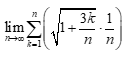
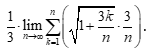
Which of the following integral expressions is equal to

There were 4 answer choices that we will consider in a minute.

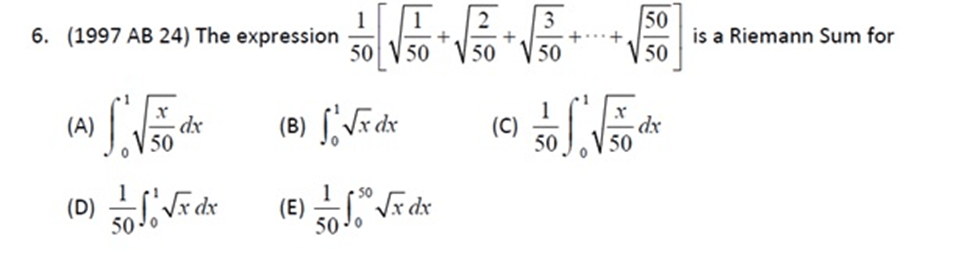
To the best of my recollection the last time a question of this type appeared on the AP Calculus exams was in 1997, when only about 7% of the students taking the exam got it correct. Considering that by random guessing about 20% should have gotten it correct, this was a difficult question. This question, the “radical 50” question is at the end of this post.

The first key to answering the question is to recognize the limit as a Riemann sum. In general, a right-side Riemann sum for the function f on the interval [a, b] with n equal subdivisions has the form:

To evaluate the limit and express it as an integral, we must identify, a, b, and f. I usually begin by looking for (b – a)/n. In this problem (b – a)/n = 1/n and from this conclude that ba = 1, so b = a + 1.

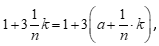
Then rewriting the radicand as

It appears that the function is

 and the limit is

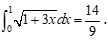
.This is the first answer choice. The choices are:

In this example, choices B, C, and D can be eliminated as soon as we determine that b = a + 1, but that is not always the case.

Let’s consider another example:

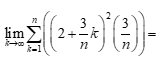
Example 2: 

As before consider (b – a)/n = 3/n  implies that b = a + 3. And the function appears to be

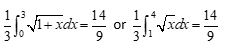
on the interval [0, 3], so the limit is

BUT

What is we take a = 2. If so, the limit is

And now one of the “problems” with this kind of question appears: the answer written as a definite integral is not unique!

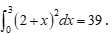
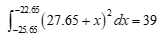
Not only are there two answers, but there are many more possible answers. These two answers are horizontal translations of each other, and many other translations are possible, such as

Returning to example 1, using something like a u-substitution, we can rewrite the original limit as . 

Now b = a + 3 and the limit could be either

You will probably have your students write Riemann sums with a small value of n when you are teaching Riemann sums leading up to the Fundamental Theorem of Calculus.  You can make up problems like this these by stopping after you get to the limit, giving your students just the limit, and have them work backwards to identify the function(s) and interval(s). You could also give them an integral and ask for the associated Riemann sum. Question writes call a question like this a reversal question, since the work is done in reverse of the usual way.

Another example appears in the 2016 “Practice Exam” available at your audit website. It is question AB 30. That question gives the definite integral and asks for the associate Riemann sum; a slightly different kind of reversal. Since this type of question appears in both the CED examples and the practice exam, chances of it appearing on future exams look good.

Critique of the problem

I’m not sure if this type of problem has any practical or real-world use. Certainly, setting up a Riemann sum is important and necessary to solve a variety of problems. After all, behind every definite integral there is a Riemann sum. But starting with a Riemann sum and finding the function and interval does not seem to me to be of practical use.

The CED references this question to MPAC 1: Reasoning with definitions and theorems, and to MPAC 5: Building notational fluency. They are appropriate, but still is the question ever done outside a test or classroom setting?

Another, bigger, problem is that the answer choices to Example 1 force the student to do the problem in a way that gets one of the answers. It is perfectly reasonable for the student to approach the problem a different way, and get another correct answer that is not among the choices. This is not good. The question could be fixed by giving the answer choices as numbers. These are the numerical values of the 4 choices:

As you can see that presents another problem.

Finally, here is the question from 1997, for you to try:

Answer B. Hint n = 50

_______________________________

Note: The original of this post was lost somehow. I’ve recreated it here. Sorry if anyone was inconvenienced. LMc May 5, 2024

Differential Equations (Type 6)

AP Questions Type 6: Differential Equations

Differential equations are tested in the free-response section of the AP exams almost every year. The actual solving of the differential equation is usually the main part of the problem accompanied by a related question such as a slope field or a tangent line approximation. BC students may also be asked to approximate using Euler’s Method. Several parts of the BC questions are often suitable for AB students and contribute to the AB sub-score of the BC exam. This topic may also appear in the multiple-choice sections of the exams. What students should be able to do
  • Find the general solution of a differential equation using the method of separation of variables (this is the only method tested).
  • Find a particular solution using the initial condition to evaluate the constant of integration – initial value problem (IVP).
  • Determine the domain restrictions on the solution of a differential equation. See this post for more on the domain of a differential equation.
  • Understand that proposed solution of a differential equation is a function (not a number) and if it and its derivative are substituted into the given differential equation the resulting equation is true. This may be part of doing the problem even if solving the differential equation is not required (see 2002 BC 5 – parts a, b and d are suitable for AB)
  • Growth-decay problems.
  • Draw a slope field by hand.
  • Sketch a particular solution on a given slope field.
  • Interpret a slope field.
  • Multiple-choice: Given a differential equation, identify is slope field.
  • Multiple-choice: Given a slope field identify its differential equation.
  • Use the given derivative to analyze a function such as finding extreme values
  • For BC only: Use Euler’s Method to approximate a solution.
  • For BC only: use the method of partial fractions to find the antiderivative after separating the variables.
  • For BC only: understand the logistic growth model, its asymptotes, meaning, etc. The exams so far, have never asked students to actually solve a logistic equation IVP
Look at the scoring standards to learn how the solution of the differential equation is scored, and therefore, how students should present their answer. This is usually the one free-response answer with the most points riding on it. Starting in 2016 the scoring has changed slightly. The five points are now distributed this way:
  • one point for separating the variables
  • one point each for finding the antiderivatives
  • one point for including the constant of integration and using the initial condition – that is, for writing “+ C” on the paper with one of the antiderivatives and substituting the initial condition; finding the value of C is included in the “answer point.” (In the older exams one point was earned for writing the +C and another point for using the initial condition.)
  • one point for solving for y: the “answer point”, for the correct answer. This point includes all the algebra and arithmetic in the problem including solving for C.
In the past, the domain of the solution was often included on the scoring standard, but unless it was specifically asked for in the question students did not need to include it. However, the CED. lists “EK 3.5A3 Solutions to differential equations may be subject to domain restrictions.” Perhaps this will be asked in the future. For more on domain restrictions with examples see this post. Shorter questions on this concept appear in the multiple-choice sections. As always, look over as many questions of this kind from past exams as you can find. For some previous posts on differential equations see January 5, 2015, and for post on related subjects see November 26, 2012, January 21, 2013, February 16, 2013 The Differential Equation question covers topics in Unit 7 of the CED.
Free-response examples:
  • 2019 There was no DE question in the free-response. You may assume the topic was tested in the multiple-choice sections.
  • 2017 AB4/BC4,
  • 2016 AB 4, BC 4, (different questions)
  • 2015 AB4/BC4,
  • 2013 BC 5
  • and a favorite Good Question 2 and Good Question 2 Continued
  • 2021 AB 6, BC 5 (b), (c)
  • 2022 AB5 – sketch solution on slope field, tangent line approximation, solve separable equation.
  • 2023 AB 3 / BC 3 – sketch solution on slope field, tangent line approximation, solve separable equation
Multiple-choice examples from non-secure exams:
  • 2012 AB 23, 25
  • 2012 BC: 12, 14, 16, 23

Previous posts on these topics for both AB and BC include:

Differential Equations  A summary of the terms and techniques of differential equations and the method of separation of variables Domain of a Differential Equation – On domain restrictions. Accumulation and Differential Equations  Slope Fields An Exploration in Differential Equations An exploration illustrating many of the ideas of differential equations. The exploration is here in PDF form and the solution is here. The ideas include: finding the general solution of the differential equation by separating the variables, checking the solution by substitution, using a graphing utility to explore the solutions for all values of the constant of integration, finding the solutions’ horizontal and vertical asymptotes, finding several particular solutions, finding the domains of the particular solutions, finding the extreme value of all solutions in terms of C, finding the second derivative (implicit differentiation), considering concavity, and investigating a special case or two.

Previous Posts on BC Only Topics

Euler’s Method Euler’s Method for Making Money The Logistic Equation  Logistic Growth – Real and Simulated


Revised 2/20/2021, March 29, May 14, 2022, June 6, 2023