Area Between Curves

Applications of Integration 1 – Area Between Curves

The first thing to keep in mind when teaching the applications of integration is Riemann sums. The thing is that when you set up and solve the majority of application problems you cannot help but develop a formula for the situation. Students think formulas are handy and go about memorizing them badly. By which I mean they forget or never learn where the various things in the formula come from. A slight change in the situation and they are lost. Behind every definite integral stands a Riemann sum; each application should be approached through its Riemann sum. If students understand that, they will make fewer mistakes with the “formula.”

As I suggested in a previous post, I believe all area problems should be treated as the area between two curves. If you build the Riemann sum rectangle between the graph and the axis and calculate its vertical side as the upper function minus the lower (or right minus left if you use horizontal rectangles) you will always get the correct integral for the area. If the upper curve is the x-axis, then the vertical sides of the Riemann sums are (0 – f(x)) and you get a positive area as you should.

If both your curves are above the x-axis, then it is tempting to explain what you are doing as subtracting the area between the lower curve and the x-axis from the area between the upper curve and the x-axis. And this is not wrong. It just does not work very smoothly when one, both or parts of either are below the x-axis. Then you go into all kinds of contortions explaining things in terms of positive and negative areas.  Why go there?

Regardless of where the two curves are relative to the x-axis, the vertical distance between them is the upper value minus the lower, f(x) – g(x). It does not matter if one or both functions are negative on all or part of the interval, the difference is positive and the area between them is

\displaystyle \underset{n\to \infty }{\mathop{\lim }}\,\sum\limits_{i=1}^{n}{\left( f\left( {{x}_{i}} \right)-g\left( {{x}_{i}} \right) \right)\Delta {{x}_{i}}}=\int_{a}^{b}{f\left( x \right)-g\left( x \right)dx}.

Furthermore, this Riemann sum rectangle is used in other applications. It is the one rotated in both the washer and shell method of finding volumes. So in area and all applications be sure your students don’t just memorize formulas, but keep their eyes on the rectangle and the Riemann sum.

Finally, if the graphs cross in the interval so that the upper and lower curves change place, you may (1) either break the problem into several pieces so that your integrands are always of the form upper minus lower, or (2) if you intend to do the computation using technology, set up the integral as
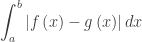
\displaystyle \int_{a}^{b}{\left| f\left( x \right)-g\left( x \right) \right|dx}.

Integration by Parts 2

Sometimes when doing an Antidifferentiation by Parts, the resulting integral is simpler than the one you started with but requires another, perhaps several more, antidifferentiations. You can do this but it can get a little complicated keeping track of everything especially with all the minus signs. There is an easier way.

Let’s consider an example: \int{{{x}^{4}}\sin \left( x \right)dx}.

Begin by making a table as shown below. After the headings:

    • In the first column leave the first cell blank and then alternate plus and minus signs down the column.
    • In the second column leave the first cell blank and then enter u and then under it list its successive derivatives.
    • In the third column enter dv in the first cell and then list its successive antiderivatives under it

Tabular 5

The antiderivative is found by multiplying across each row starting with the row with the  first plus sign and adding the products:

\int{{{x}^{4}}\sin \left( x \right)dx}=

-{{x}^{4}}\cos \left( x \right)+4{{x}^{3}}\sin \left( x \right)+12{{x}^{2}}\cos \left( x \right)-24x\sin \left( x \right)-24\cos \left( x \right)+C

Integration by Parts 1

The antidifferentiation technique known as Integration by Parts or Antidifferentiation by Parts is based on the formula for the Product Rule: d\left( uv \right)=udv+vdu.
Solve this equation for the second term on the right: udv=d\left( uv \right)-vdu.
Integrating this gives the formula \int{udv}=\int{d\left( uv \right)}-\int{vdu}. By the FTC the first term on the right can be simplified giving the formula for Integration by Parts:

\int{udv}=uv-\int{vdu}

The technique is used to find antiderivatives of expressions such as \int{x\sin \left( x \right)dx} in which there is a combination of functions that are usually of different types – here a polynomial and a trig function.

The parts of the integrand must be matched to the parts of \int{udv}. Here we make the substitutions u=x,dv=\sin \left( x \right)dx and from these we compute du=dx\text{ and }v=-\cos \left( x \right). (There is no need for the +C here; it will be included later). Making these substitutions gives


\int{x\sin \left( x \right)dx}=-x\cos \left( x \right)-\int{-\cos \left( x \right)dx}

The integral on the right is simple so we end with

\int{x\sin \left( x \right)dx}=-x\cos \left( x \right)+\sin \left( x \right)+C

As the problems get more difficult the first question students ask is which part should by u and which dv? The rules of thumb are (1) Chose u to be something that gets simpler when differentiated, and (2) chose dv to be something you can antidifferentiated or at least something that does not get more complicated when you antidifferentiate. For example, in the problem above if we were to choose u=\sin \left( x \right) and  dv=xdx the result is

\int{x\sin \left( x \right)dx}=\tfrac{{{x}^{2}}}{2}\sin \left( x \right)-\int{\tfrac{{{x}^{2}}}{2}\cos \left( x \right)dx}

This is correct, but the integral on the right is more complicated than the one we started with. When this happens, go back and start over.

For AP Calculus teachers: Note that Antidifferentiation by Parts is a BC only topic. It is something you can do in AB classes after the AP exam if you have time.

Properties of Integrals

In the last two posts we looked at activities that lead to the FTC. Today I would like to build on that activity to demonstrate some of the important properties of integrals. I am never in favor of giving students theorems or properties like these and saying, “Here they are, learn them!” Nor do I think everything has to be done up with a detailed “proof.” So here is an approach between those alternatives.

Look at the activity in the last post where we considered three functions: F1(t) = 3, F2(x) = 2t and F3(t) = 2t + 3. We built new functions that gave the area between these functions and the t-axis. We expressed these as regular looking functions and also as functions defined by definite integrals – integrals where the upper limit of integration was a variable, x. We also made tables of values for these functions. Return to these tables and consider the following properties of integrals.

      1. Integrals are additive. I hope you noticed that F3 = F1 + F2.  Look at the values in the table you made for the area functions, and you will see that \int_{a}^{x}{F1(t)\pm F2(t)dt}=\int_{a}^{x}{F1(t)dt}\pm \int_{a}^{x}{F2(t)dt}. This is important because when evaluating definite integrals this allows us to do them term by term.
      2. Constants may be factored out of the integrand and written in front: \int_{a}^{b}{k\cdot f\left( t \right)}dt=k\cdot \int_{a}^{b}{f\left( t \right)dt} . To see this make a quick table for the area between F(t) = t and compare it to the area functions for F2(t) = 2t.

      3. Previously, we restricted our domain to nonnegative numbers. Let’s change that. Make a table for the three area functions A1(x), A2(x) and A3(x) for x = -1, -2, -3, -4, and -5. Work from the functions you wrote, not from the geometry. What do you notice? There are negative and zero values!  Areas are never negative. How do you explain what’s happened?

        Write the corresponding definite integrals. Be careful, the upper limits are now less than the lower limits. Think of the Riemann sums that are behind the limits. Since x moves left, the values in the Riemann sum will be negative producing negative values for A1(x). In A2(x) both and the function values are negative, producing a positive result. Can you explain what’s going on with A3(x) which has positive, zero and negative values?

        The short answer is that if the upper and the lower limits of integration are switched then the resulting integrals are opposites of each other:\int_{a}^{b}{f\left( x \right)dx}=-\int_{b}^{a}{f\left( x \right)dx}

      4. Next use your graph and geometry to find that area between F3(t) and the t-axis between, say, x = 3 and x =  5, and then use the table value to show that \int_{0}^{3}{F3(t)dt}+\int_{3}^{5}{F3(t)dt}=\int_{0}^{5}{F3(t)dt} . Now use those numbers and the property in paragraph 3 to show that \int_{3}^{5}{F3(t)dt}+\int_{5}^{0}{F3(t)dt}=\int_{3}^{0}{F3(t)dt}.

        In general, \int_{a}^{b}{f\left( x \right)dx}+\int_{b}^{c}{f\left( x \right)dx}=\int_{a}^{c}{f\left( x \right)dx} regardless of the order of a ,b and c. The only thing that matters is that (1) the lower limit in the first integral on the left is the lower limit on the right, (2) the upper limit on the last integral on the left is the upper limit on the right, and (3) on the left the upper limit on one integral is the lower limit on the next. You can even string more integrals together as long as you follow the pattern.
      1. A final property which can be seen by comparing the graphs and the areas between them and the t-axis for F2(x) and F3(x) is this: If f\left( x \right)\le g\left( x \right) on the interval [a, b], then \int_{a}^{b}{f\left( x \right)dx}\le \int_{a}^{b}{g\left( x \right)dx}. This is sometimes called the “Racetrack Principle.” Interpreting f and g as rates and their integrals as amounts (or distances), then in the same interval, the faster horse travels farther.

Happy Holiday. My next post will be Friday December 28, 2012.

More About the FTC

In keeping with my idea from the last post of sneaking up on ideas, here is a way to sneak up on the other part of the FTC.

Consider these three functions F1(t) = 3, F2(t) = 2t and F3(t) = 2t + 3

For each of these three functions do the following:

  1. Graph each function on the interval [0, t] for t\ge 0.
  2. Let x be a value of t and let x move to the right along the t-axis starting at zero. Using area formulas, write functions, A1(x), A2(x), and A3(x), for the areas of the region between the graph and the t-axis. Make a table of values for x = 1, 2, 3, …, 10. Do not use any “calculus”; the area expressions are easy to find from geometry.  (A1(t) = 3t; A2(t) = t2; A3(t) = t2 + 3)
  3. Consider what happens as the as x moves from zero to the right.  The expressions are a function that gives the area for each x. Now write expressions for the three areas with an integral that gives the same area. The lower limit will be 0 and the upper limit will be x.
  4.  These are examples of functions defined by integrals. Each different value of x as the upper limit of integration, will give a unique value (area).
  5. Differentiate the area functions and compare them to the functions from which they came. What do you notice?

Consider the FTC where the integral has an upper limit of x. That is, a function defined by an integral. (The lower limit does not have to be zero.)

\displaystyle A\left( x \right)=\int_{a}^{x}{{f}'\left( t \right)dt}=f\left( x \right)-f\left( a \right)

What is {A}'\left( x \right)?

\displaystyle {A}'\left( x \right)=\frac{d}{dx}\int_{a}^{x}{{f}'\left( t \right)dt}=\frac{d}{dx}\left( f\left( x \right)-f\left( a \right) \right)={f}'\left( x \right)-0

or

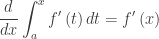
\displaystyle \frac{d}{dx}\int_{a}^{x}{{f}'\left( t \right)dt}={f}'\left( x \right)

The is the other part of the FTC which says that the derivative of a function defined by an integral is the integrand, f (x) evaluated at x.

A good way to demonstrate this to your students is to do a simple integral like

\displaystyle \int_{\pi /4}^{x}{\cos \left( t \right)dt}=\sin \left( x \right)-\tfrac{\sqrt{2}}{2},

and then differentiate to show that

\displaystyle \frac{d}{dx}\int_{\pi /4}^{x}{\cos \left( t \right)dt}=\frac{d}{dx}\left( \sin \left( x \right)-\tfrac{\sqrt{2}}{2} \right)=\cos \left( x \right)

This part of the FTC says, roughly, very roughly, that the derivative of an integral is this integrand. The other part, discussed in the last post, just as roughly, says the integral of the derivative is the antiderivative.

Keep your notes on this activity. In my next post I will use these functions to demonstrate some of the important properties of integrals.


The Fundamental Theorem of Calculus

The Fundamental Theorem of Calculus or FTC, as its name suggests, is a very important idea. It is not sufficient to present the formula and show students how to use it. Show them where it comes from.

Here is an approach to demonstrate the FTC. I try to sneak up on the result by proposing a problem and then solving it. Here is the outline.

Suppose we have a differentiable function f that goes from \left( a,f\left( a \right) \right) to \left( b,f\left( b \right) \right). What is the net change in f over this interval? Easy it’s f\left( b \right)-f\left( a \right).  No problem, but way too easy for a calculus class. So let’s try a harder way!

Partition the interval [a, b] as you would for a Riemann sum, and calculate the change in f on each subinterval. The subintervals may be the same width or not. The change in y on the general subinterval [xi-1, xi] is f\left( {{x}_{i}} \right)-f\left( {{x}_{i-1}} \right).

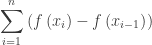
Approximate the net change over the whole interval by adding these \displaystyle \sum\limits_{i=1}^{n}{\left( f\left( {{x}_{i}} \right)-f\left( {{x}_{i-1}} \right) \right)} .
Is this a Riemann sum? No it is not! There is no \Delta x part. What to do?

The expression f\left( {{x}_{i}} \right)-f\left( {{x}_{i-1}} \right) looks familiar.
It is part of the equation for the Mean Value Theorem: \displaystyle {f}'\left( c \right)=\frac{f\left( b \right)-f\left( a \right)}{b-a} or {f}'\left( c \right)\left( b-a \right)=f\left( b \right)-f\left( a \right).
If we adapt this to the subinterval letting ci be the number guaranteed by the MVT on each subinterval  [xi-1, xi], then f\left( {{x}_{i}} \right)-f\left( {{x}_{i-1}} \right)={f}'\left( {{c}_{i}} \right)\left( {{x}_{i}}-{{x}_{i-1}} \right)

We can rewrite the sum in step 3 as \displaystyle \sum\limits_{i=1}^{n}{\left( f\left( {{x}_{i}} \right)-f\left( {{x}_{i-1}} \right) \right)}=\sum\limits_{n=1}^{n}{\left( {f}'\left( {{c}_{i}} \right)\left( {{x}_{i}}-{{x}_{i-1}} \right) \right)} .

  1. This is a Riemann sum and therefore, \displaystyle \underset{n\to \infty }{\mathop{\lim }}\,\sum\limits_{n=1}^{n}{\left( {f}'\left( {{c}_{i}} \right)\left( {{x}_{i}}-{{x}_{i-1}} \right) \right)}=\int_{a}^{b}{{f}'\left( c \right)dx} .
  2. So what is this equal to? We have already found what this limit is in step 1, so we now have:

\displaystyle \int_{a}^{b}{{f}'\left( x \right)dx}=f\left( b \right)-f\left( a \right).

This is called the FTC. And it is important.

The first thing it tells us is that the integral of a rate of change is the (net) amount of change. This will help us do a variety of problems.

The second thing it tells us is that, if we can find a function of which the integrand is the derivative (i.e. its antiderivative), then we can find the value of a definite integral by evaluating an antiderivative at the endpoints and subtracting. No more struggling with trying to find the limit of Riemann sums or graphing the function and hoping you can break it into regions with easy to find areas. All we need is an antiderivative and then one quick computation will do the trick from now on.

There is more to the FTC. This will be the subject of the next post.

The Definition of the Definite Integral

From the last post, it seems pretty obvious that as the number of rectangles in a Riemann sum increases or, what amounts to the same thing, the width of the sub-intervals decreases, the Riemann sum approaches the area of the region between a graph and the x-axis. The figures below show left-Riemann sums for the function f\left( x \right)=1+{{x}^{2}} on the interval [1, 4]. Hover and click on the figure below.

This slideshow requires JavaScript.

As the number of rectangles increases, they fill up more and more of the region. The sums increase, yet, their sum is always less than the area. They form an increasing sequence which is bounded above and therefore approaches its least upper bound (the area) as a limit.

Right-side rectangles work almost the same way. The sums form a decreasing sequence that is bounded below by the area and thus they approach the same limit.

All of the other Riemann sums must be between these two (at least for this example) and thus all approach the same limit.

This limit is called the definite integral for f on the interval [a, b], denoted by the new symbol below.

\displaystyle \underset{n\to \infty }{\mathop{\lim }}\,\sum\limits_{i=1}^{n}{f\left( x_{i}^{*} \right)\left( {{x}_{i}}-{{x}_{i-1}} \right)}=\underset{\Delta x\to 0}{\mathop{\lim }}\,\sum\limits_{i=1}^{n}{f\left( x_{i}^{*} \right)\Delta x=\int_{a}^{b}{f\left( x \right)dx}}

The notation has the advantage of being simpler to write than all the limit stuff and it shows us the interval which the limits do not. (For now consider the dx as a stand-in for \Delta x.)

The disadvantage of the notation is that, as we use it for real applications, the concept of Riemann sums often gets lost. The integrals become formulas and they get memorized but not understood.

Remember: behind every (any, all) definite integral is a Riemann sum.  As we look at applications, we should always look for the Riemann sum and how it is set up. This will tell us what the definite integral should be. We will not need to be too fussy about the subscripts and such; in fact, we will almost ignore them, but we will look carefully at the Riemann sum rectangles.