Visualizing Solid Figures 2

You have probably caught on by now that Winplot is my favorite computer graphing program. In addition to being great at drawing quick graphs, it is able to produce and rotate 3D images of, among other things, solids of rotation, and solids with regular cross-sections. In this post I will discuss how to do solids of regular cross-section and solids of rotation. In my next posts I’ll show you how to see the disks, washers, and shells.

Winplot is a free program. Click here for Winplot for PC and here for Winplot for Macs. (May 11, 2017 Note: Winplot is no longer available from its original home. The link for PCs above connect to another site where the program can be downloaded. For Macs use the PC link, but use the Winplot for Macs link for instructions and another program you will need.You can also Google Winplot and find other sites that have the program as well as many, many instructional videos.)

Solids with regular cross-sections

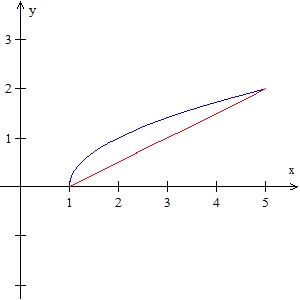
Consider the region bound by the graphs of f\left( x \right)=\sqrt{x-1} and g\left( x \right)=\tfrac{1}{2}\left( x-1 \right) from x = 1 to x = 5.

Begin by opening a Winplot 2D graphing window, graphing the curves, and adjusting the window to a good scale. Use the box where the equations are entered (Equa > 1.Explicit) check “lock interval,” and enter the “low x” and “high x” values (1 and 5 respectively) to stop the graphs where they intersect. Click “ok” to see the graphs.
Solids 2 A

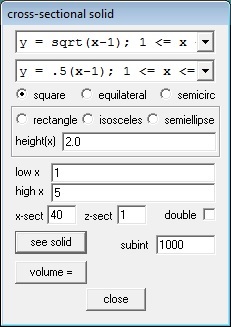
On the navigation bar, click on “Two” and then “Sections.” You should see a window like this:
Solids 2 B

The top two drop-down boxes at the top allow you to choose which curves to work with, and since we have only two they should already be selected. Then click on the cross-section shape you want – square, equilateral triangle, or semicircle. The box below that allows other shapes where the height may be set (the height(x) may be  a number or a function of x). Set the “low x” and “high x” to the left and right sides of the region. Then click “see solid” and you will see the solid in a new window.

Click on the new 3D window and then type Ctrl+A to show the axes. Rotate the image by using the 4 arrow keys, and zoom in and out with the Page Up and Page Down keys.
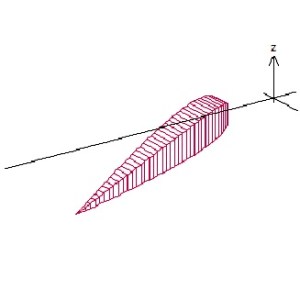
Solids 2 CNow let’s get fancy. Close the 3D window and return to the cross-section box shown above. Change the “high x” to 5@B (you may use any almost letter except x, y, or z). Then click “see solid.” Next, in the 3D Window click Anim > Individual > B. This will give you a slider. Slide the slider from 1 to 5 and you will see the solid grow and see the square cross-sections. (The video uses the “autocyc” button – use S to slow the animation, F to speed it up and Q to quit.)
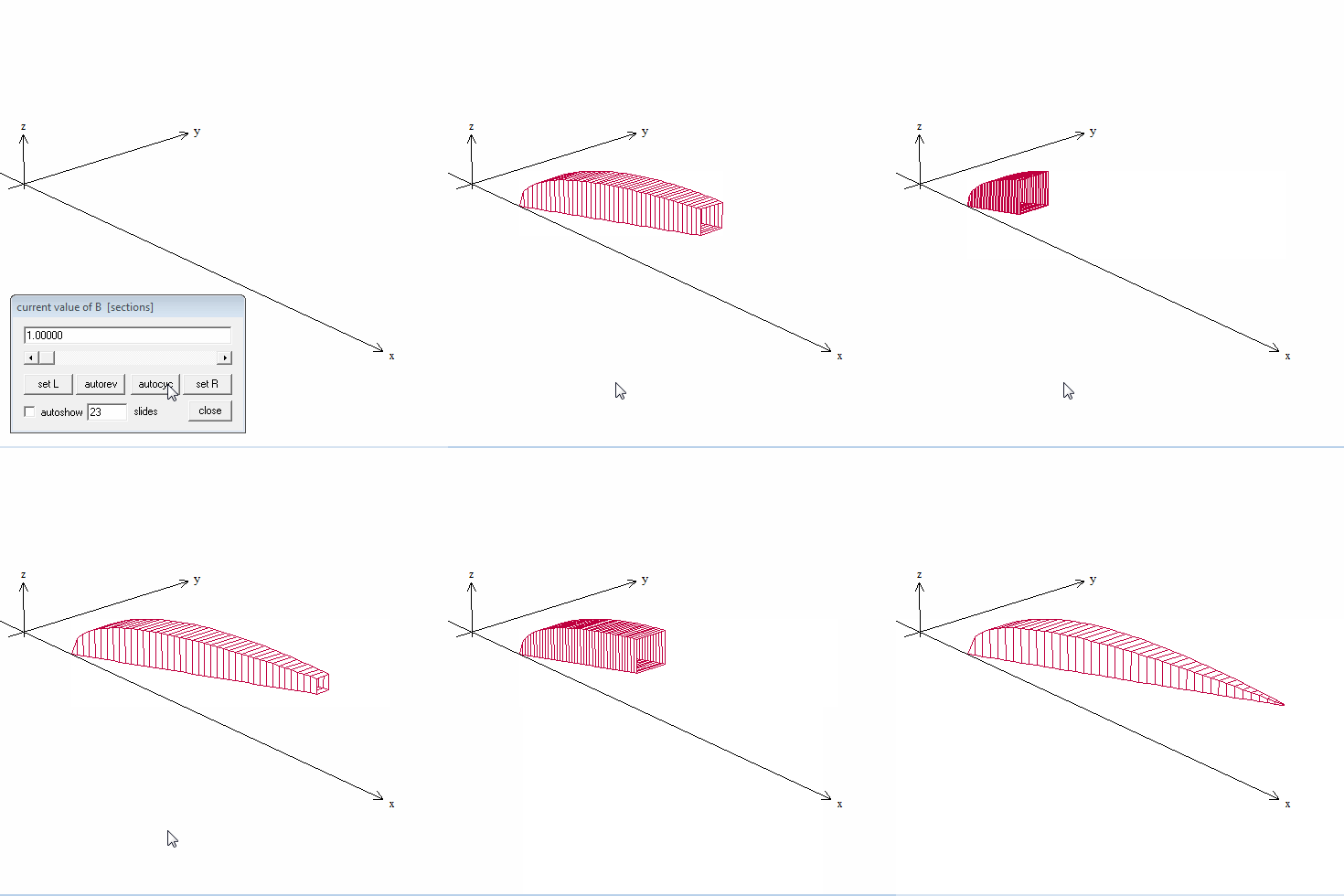
Square x-sections

Use File > Save As… to save the image. It will save with the extension .wp3 and you will lose the original 2D graphs. The animation buttons will still work when you open it again.

Solids of Revolution.

Solids of rotation are done in a similar way. We will revolve the same curves around the horizontal line y = –1.  Enter the curves as above and click on One > Revolve Surface.  Curves are revolved one at a time, so choose the first curve from the drop-down box. Choose the axis the figure is to be rotated around by entering the values for a, b, and c in ax + by = c, or clicking on one of the axis buttons.  For the “arc start” and “arc stop” values use the left and right ends of the region. The “angle start” and “angle stop” values are the default, 0 and 2pi (entered as “2pi”). Again we have made this last value 2pi@A so that we can animate the graph.

Solids 2 D

Click “see surface” to see the revolved surface.  As before, use the 4 arrow keys and the Page Up and Page Down keys to adjust the image, and Ctrl+A to show the axes.

Surfaces are revolved one at a time so return to the “surface of revolution” window and use the drop-down box to choose the next curve. Leave all the other values the same. Clicking “see surface” will graph the second curve with the first and show the solid figure. Note that the surfaces are graphed in the same color as the original 2D graphs.
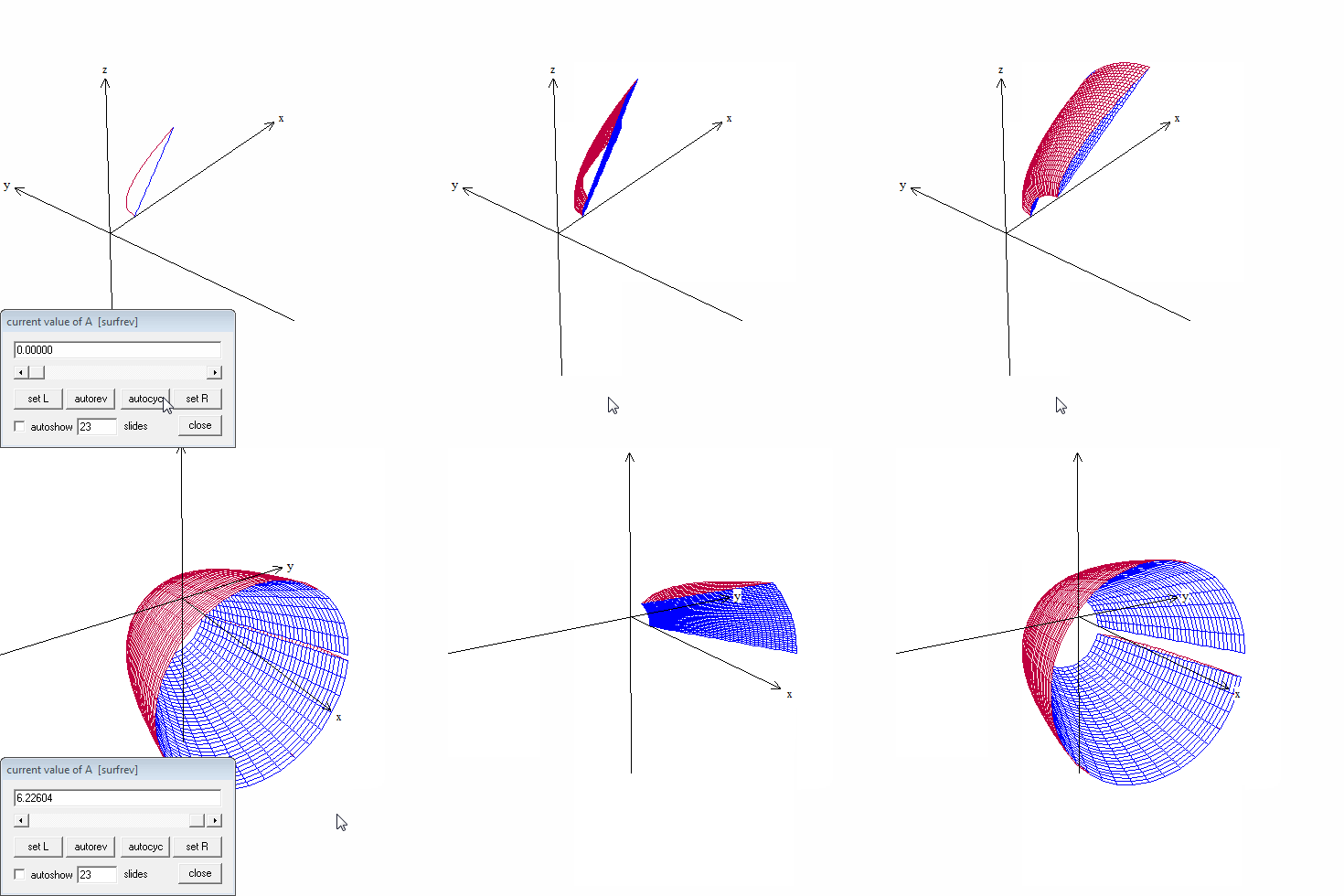
Solid rotation

Use the slider or autorev or autocyc buttons to watch the curves revolve. (Remember to type “F” to speed up the motion. “S” to slow it down, and “Q” to quit.)

The next posts will show how to see the disks, washers, and shells, and animate them along with the surfaces.
Visualizing Solid Figures 1

The shape of various solids of rotation and solids with regular cross-sections of which beginning calculus students are required to find the volume are often difficult to visualize. This post and the next two will discuss some of the ways you can help your students become familiar with these shapes. Teachers often use these as projects for students to get some hands-on familiarity with the figures. In fact, it is one of the few places where a useful project can be assigned.

 Actually, rotate a region:

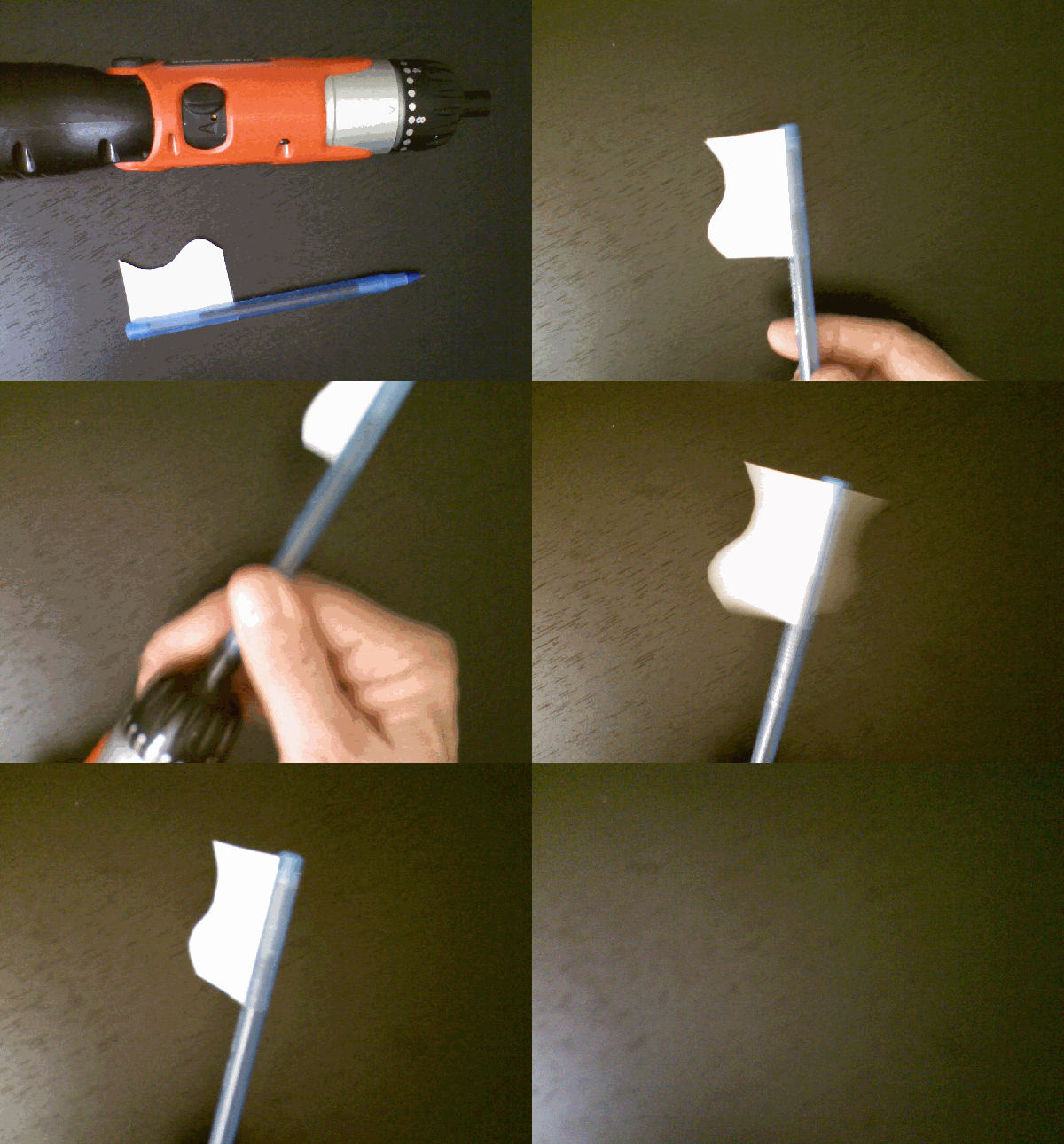
Begin by drawing the region to be revolved (from the curve to the line of rotation) on paper and cut it out. Tape the region along the line to a pencil, pen, or dowel. Roll the dowel back and forth between your hands or, as shown in the video below, with a small electric drill or screwdriver. You can get a rough idea of the shape.

Solid 4

Go to a wedding:

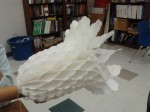
Decorations for weddings and other festive events are made from paper and fold flat. When opened you get a solid of rotation.

Measure a volume:

Take a solid fruit (like a banana), or a vegetable (like a cucumber, or carrot) and find its volume by cutting it into “coin” shaped pieces. Multiply the thickness by the area of the circular ends of each piece and then add them to find the volume.

For more of a challenge use a loaf of sliced bread (here you will need a way to calculate the area of the non-circular ends – inscribed rectangles perhaps). You could also approximate the volume of a tree trunk by measuring the circumference at regular distances along the trunk.

Build a model:

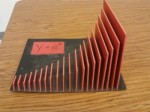
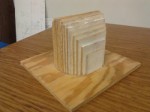
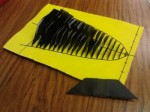
This method can be used for solids or rotation and is especially good for solids with regular cross-sections.  It is also a good project for a student or group of students.

  1. Carefully graph the region using a somewhat larger than normal scale.
  2. Draw lines at 1/8 to ¼ inch intervals across the region perpendicular to the appropriate axis.
  3. Carefully measure or calculate the length of each of these lines. Use this for the appropriate dimension for the question. For example, this may be the side of the square cross-section, or the diameter of a semi-circular section.
  4. Use the dimension to draw a series of squares, semi-circles, or whatever from cardboard, plywood, or foam board.
  5. Cut these out and assemble them on the original region you graphed to approximate the solid figure. Tape or glue them in place.
  6. Extra: Calculate the area of each piece and multiply it by the thickness (or the distance between pieces) and see how closely this comes to the calculated volume.

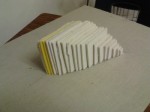
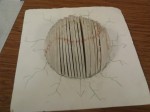
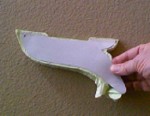
These pictures are of models made by students of Mrs. Dixie Ross at Pflugerville (Texas) High School. Students received more points if they recycled materials.Thank you Dixie!

November

November – deep into derivatives. This month’s featured posts from past Novembers are below. “Speed,” which discusses various ways to approach this topic, seems to be one of the most popular with close to 2600 hits since it was first posted in 2012. This is followed by “Open cor Closed” which discusses a question that almost always comes up at workshop and online: should the interval where a function is increasing or decreasing by open or closed. The next two most popular are “Motion Problems” one of the several posts on inverses.

When I began this blog I was posting about three times per week. I have the whole of first-year calculus to write about. I hope I’ve hit the main points. If there is anything you would like me to add or expand on, or any topic or problem you think others might be interested in please let me know; I can use some ideas.

I did get a request this week to update my Guide to AP Calculus (AB & BC) Free-response Questions. (I meant to do this, but totally forgot about it.) This guide gives suggestions on what is asked on the various common free-response questions. I’ve expanded this in my posts on reviewing for the exam (check the “Thru the Year” tab under January and February). The Guide also list the question number and individual notes on individual questions from 1998 through 2014. The Guide is on the Resource page or you can click the link at the beginning of this paragraph.

Graphing, Inverses, Linear Motion, Introducing Integration

November 2, 2012 Open or Closed?

November 5, 2012 Inverses

November 7, 2012 Writing Inverses

November 9, 2012 Writing Inverses

November 12, 2012 The Calculus of Inverses

November 14, 2012 Inverses Graphically and Numerically

November 16, 2012 Motion Problems: Same Thing, Different Context.

November 19, 2012 Speed

November 21, 2012 Derivatives of Exponential Functions

November 26, 2012 Integration Itinerary

November 18, 2012 Antidifferentiation

November 30, 2012 The Old Pump

The Marble and the Vase

A fairly common max/min problem asks the student to find the point on the parabola f\left( x \right)={{x}^{2}} that is closest to the point A\left( 0,1 \right).  The solution is not too difficult. The distance, L(x), between A and the point \left( x,{{x}^{2}} \right) on the parabola  is given by

\displaystyle L\left( x \right)=\sqrt{{{\left( x-0 \right)}^{2}}+{{\left( {{x}^{2}}-1 \right)}^{2}}}=\sqrt{{{x}^{4}}-{{x}^{2}}+1}

And the minimum distance can be found when

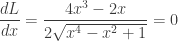
\displaystyle \frac{dL}{dx}=\frac{4{{x}^{3}}-2x}{2\sqrt{{{x}^{4}}-{{x}^{2}}+1}}=0

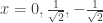
This occurs when x=0,\frac{1}{\sqrt{2}},-\frac{1}{\sqrt{2}}. The local maximum is occurs when x = 0. The (global) minimums are the other two values located symmetrically to the y-axis.

_________________________

Somewhere I saw this problem posed in terms of a marble dropped into a vase shaped like a parabola. So I think of it that way. This accounts for the title of the post. The problem is, however, basically a two-dimensional situation.

In this post I would like to expand and explore this problem. The exploration will, I hope, give students some insight and experience with extreme values, and the relationship between a graph and its derivative. I will pose a series of questions that you could give to your students to explore. I will answer the questions as I go, but you, of course, should not do that until your students have had some time to work on the questions.

Graphing technology and later Computer Algebra Systems (CAS) will come in handy.

_________________________

1. Consider a general point A\left( 0,a \right) on the y-axis. Find the x-coordinates of the closest point on the parabola in terms of a.

The distance is now given by

\displaystyle L\left( x \right)=\sqrt{{{\left( x-0 \right)}^{2}}+{{\left( {{x}^{2}}-a \right)}^{2}}}=\sqrt{{{x}^{4}}+\left( 1-2a \right){{x}^{2}}+{{a}^{2}}}

\displaystyle \frac{dL}{dx}=\frac{2{{x}^{3}}+\left( 1-2a \right)x}{\sqrt{{{x}^{4}}+2\left( 1-2a \right){{x}^{2}}+{{a}^{2}}}}

And \frac{dL}{dx}=0 when x=0,\frac{\sqrt{2\left( 2a-1 \right)}}{2},-\frac{\sqrt{2\left( 2a-1 \right)}}{2}

The (local) maximum is at x = 0. The other values are the minimums. The CAS computation is shown at the end of the post. This is easy enough to do by hand.

2. Discuss the equation {{L}^{2}}={{x}^{2}}+{{\left( x-a \right)}^{2}} in relation to this situation.

This is the equation of a circle with center at A with radius of L. At the minimum distance this circle will be tangent to the parabola.

3. What happens when a=\tfrac{1}{2} and when a<\tfrac{1}{2}?

When  a=\tfrac{1}{2}, the three zeroes are the same. The circle is tangent to the parabola at the origin and a is the minimum distance.

When a<\tfrac{1}{2}, the circle does not intersect the parabola. Notice that in this case two of the roots of \frac{dL}{dt}=0 are not Real numbers.

4. Consider the distance, L(x), from point A to the parabola. As x moves from left to right describe how this length changes. Be specific. Sketch the graph of this distance y = L(x). Where are its (local) maximum and minimum values, relative to the parabola and the circle tangent to the parabola?

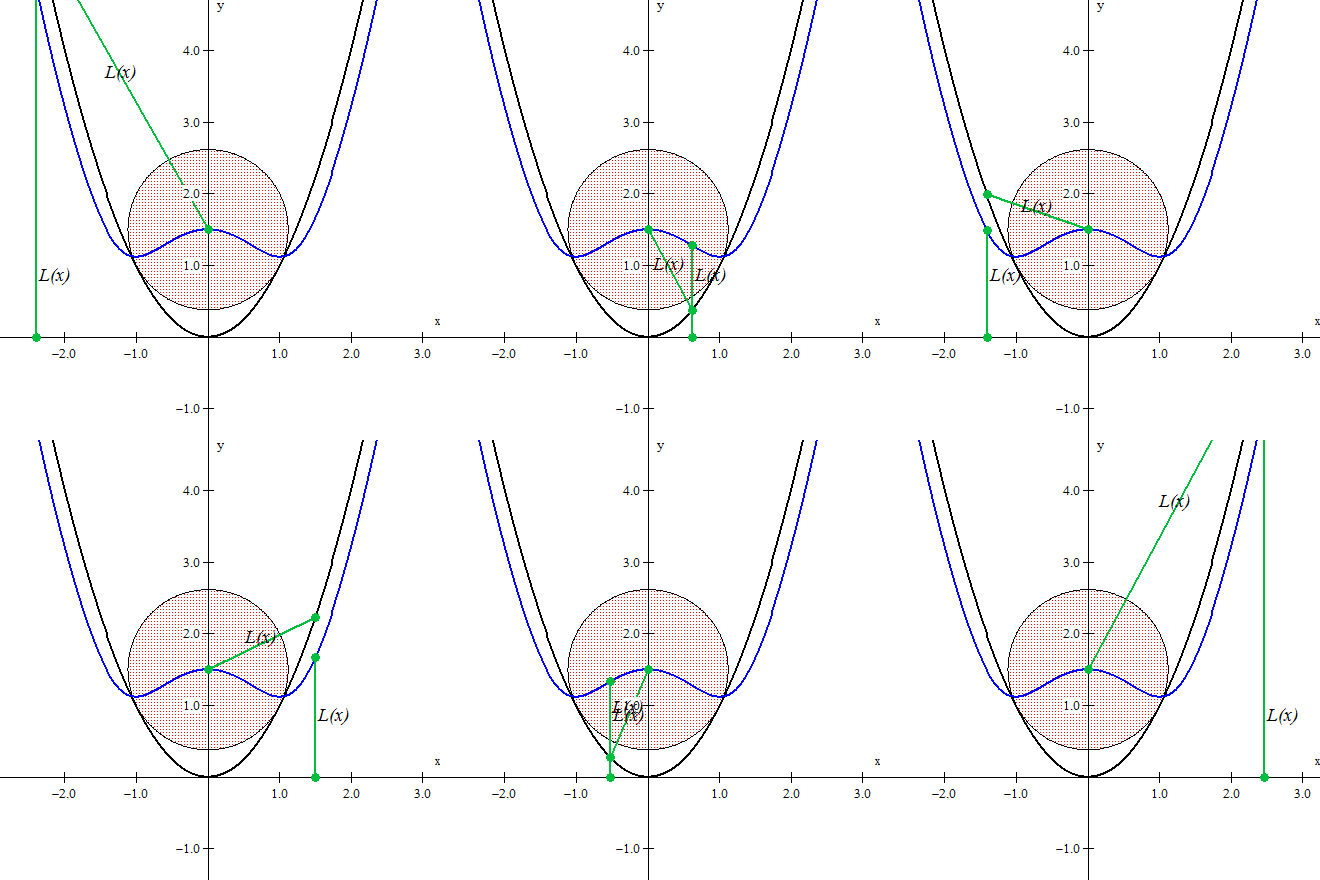
The clip below illustrates the situation. The two segments marked L(x) are congruent. The graph of y = L(x) is a“w” shape similar to but not quartic polynomial. The minimums occur directly under the points of tangency of the circle and the parabola. The local maximum is directly over the origin. Is it coincidence that the graph goes through the center of  the circle? Explain.

Vase 15. Graph y=\frac{dL}{dx}  and compare its graph with the graph of y=L(x)

vase 4

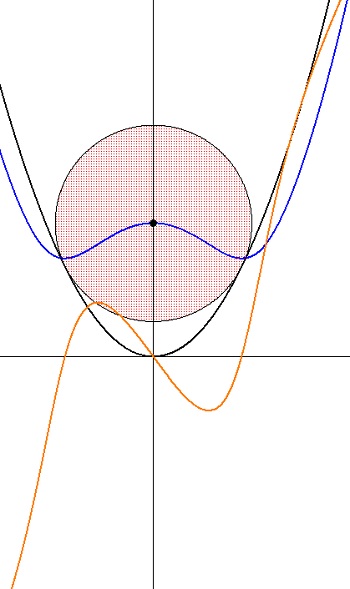
L(x) is the blue graph and and L'(x) is the orange graph.
Notice the concavity of L'(x)

6.  The graph of y=\frac{dL}{dx} appears be concave up, then down, then (after passing the origin) up, and then down again. There are three points of inflection. Find their x-coordinates in terms of a. How do these points relate to y = L(x) ? (Use a CAS to do the computation)

The points of inflection of the derivative can be found from the second derivative of the derivative (the third derivative of the L(x)). The abscissas are x=-\sqrt{a},x=0,\text{ and }\sqrt{a}. The CAS computation is shown below

Vase 2a

CAS Computation for questions 1 and 6.

Extremes without Calculus

There was an interesting question last week on the AP Calculus Community Bulletin Board. A teacher was working with polynomial functions in her pre-calculus class and the class had learned how to find the roots, and how the roots and their multiplicities affected the graph. Her question was whether there is a way to determine the number of extreme values (maximums and minimums) without using calculus.

You might want to work this yourself before reading on.

Before we go into more detail recall two facts about polynomial functions with real coefficients:

  • As a corollary to the Fundamental Theorem of Algebra, we know that a polynomial function of degree n has exactly n factors some of which may be the same. Therefore, the polynomial has exactly n roots, again not necessarily different. The multiplicity of a root is the number of times the corresponding factor appears in the factorization.
  • Between any two consecutive roots there is exactly one turning point. (You may need some calculus to justify this. If there were more than one turning point between two consecutive roots, there must be at least three of them. Then the derivative would have more zeros than the original polynomial, which of course cannot happen.

One reader suggested a method for dealing with cubics which I think generalizes to any polynomial. The method is this: Subtract the constant term from the polynomial. This translates the graph so that it will contain the origin. The translated graph is congruent to the original and therefore will have the same number of extreme values.

Red Graph: y={{x}^{3}}-4{{x}^{2}}+3x+4
Blue Graph: y={{x}^{3}}-4{{x}^{2}}+3x

Find the Real roots of the translated polynomial.  Then the number of turning points for both polynomials can be found this way (assuming, for the moment, that all the roots are Real numbers):

  1. For each distinct root, count 1
  2. For each root of even multiplicity, count 1
  3. Each root of odd multiplicity greater than one, ( 3, 5, 7, …), count 0

The number of turning points will be one less than the total.

Example P(x)=x{{\left( x-1 \right)}^{4}}{{\left( x-2 \right)}^{3}}{{\left( x-3 \right)}^{8}}, the count is 4 + 2 + 0 = 6. Turning points = 5

The reasoning goes something like this (for a polynomial with Real coefficients and constant term of zero):

  1. A linear polynomial has one root and no turning points.
  2. Each time you multiply by a different linear factor you add one root and one turning point.
  3. Each time you multiply by several of the same factor you already used to end with an even power for that factor, you add no roots, but you add one turning point (on the x-axis at the root).
  4. Each time you multiply by several of the same factor you already used to end with an odd power for that factor, you add no roots, and no turning points, since the graph will cross the axis at such a value.
  5. Then the count scheme above will then give the number of turning points.

Another approach is this: consider a polynomial with n distinct roots and (n – 1) turning points spread out along the number line. Now move two adjacent roots together (resulting in a root of multiplicity 2).  The turning point between them moves onto the x-axis. You have lost a root but not a turning point; thus, in the count item 1 decreases by one, so to compensate you increase item 2 by one to get the same total. Now move a third adjacent root to the place of the other two to get a root of multiplicity 3: this time you lose another root, and a turning point so decreasing item 1 will keep the number of turning points given by the count correct.

Did I miss anything? Yes. I did not consider translated polynomials with Complex roots. That’s because I have not (yet) figured that out.  I’m pretty sure that a unfactorable quadratic factor (i.e.  one with Complex conjugate roots) does not add any turning points to the graph, but I haven’t quite convinced myself.  Any suggestions?

October

4328070_orig

School is underway and I hope things have settled down for you. You may need a little break, so I suggest you give the Calculus Humor website a look. You‘ll find some humorous things there such as the graph at the top of this post. As the name suggests they are all based on calculus.

Use the “Thru the Year” tab at the top for links to past October posts. This month has posts on the Mean Value Theorem, finding derivatives from tables and graphs, related rate problems and graphing.

The four featured posts directly below this one are the most read from past Octobers. The leader was “Reading the Derivative’s Graph” with over 6,000 hits. This was followed by “Why Radians?” with almost 3,000 hits. The two posts on Related Rates were next with an average of about 500 each.

Power Rule Implies Chain Rule

Having developed the Product Rule d\left( uv \right)=u{v}'+{u}'v and the Power Rule \frac{d}{dx}{{x}^{n}}=n{{x}^{n-1}} for derivatives in your class, you can explore similar rules for the product of more than two functions and suddenly the Chain Rule will appear.

For three functions use the associative property of multiplication with the rule above:

d\left( uvw \right)=d\left( \left( uv \right)w \right)=u\cdot v\cdot dw+w\cdot d(uv)=u\cdot v\cdot dw+w\left( udv+vdu \right)

So expanding with a slight change in notation:

d\left( uvw \right)=uv{w}'+u{v}'w+u'vw

For four factors there is a similar result:

d\left( uvwz \right)=uvw{z}'+uv{w}'z+u{v}'wz+{u}'vwz

Exercise: Let {{f}_{i}} for i=1,2,3,...,n be functions. Write a general formula for the derivative of the product {{f}_{1}}{{f}_{2}}{{f}_{3}}\cdots {{f}_{n}} as above and in sigma notation

Answers

d\left( {{f}_{1}}{{f}_{2}}{{f}_{3}}\cdots {{f}_{n}} \right)={{f}_{1}}{{f}_{2}}{{f}_{3}}\cdots {{{f}'}_{n}}+{{f}_{1}}{{f}_{2}}{{{f}'}_{3}}\cdots {{f}_{n}}+{{f}_{1}}{{{f}'}_{2}}{{f}_{3}}\cdots {{f}_{n}}+\cdots +{{{f}'}_{1}}{{f}_{2}}{{f}_{3}}\cdots {{f}_{n}}

\displaystyle d\left( {{f}_{1}}{{f}_{2}}{{f}_{3}}\cdots {{f}_{n}} \right)=\sum\limits_{i=1}^{n}{\frac{{{f}_{1}}{{f}_{2}}{{f}_{3}}\cdots {{f}_{n}}}{{{f}_{i}}}{{{{f}'}}_{i}}}

This idea may now be used  to see the Chain Rule appear. Students may guess that d{{\left( f \right)}^{4}}=4{{\left( f \right)}^{3}}, but wait there is more to it.

Write {{\left( f \right)}^{4}}=f\cdot f\cdot f\cdot f\text{ }. Then from above

d{{\left( f \right)}^{4}}=d\left( f\cdot f\cdot f\cdot f\text{ } \right)=f\cdot f\cdot f\cdot {f}'+f\cdot f\cdot {f}'\cdot f+f\cdot {f}'\cdot f\cdot f+{f}'\cdot f\cdot f\cdot f

d{{\left( f \right)}^{4}}=4{{\left( f \right)}^{3}}{f}'\text{ }

Looks just like the power rule, but there’s that “extra” {f}'. Now you are ready to explain about the Chain Rule in the next class.