Implicit Differentiation and Inverses

Implicit differentiation of relations is done using the Chain Rule. 

Implicit Differentiation (from last Friday’s post. I discovered I never did a post on this topic before!)

Implicit differentiation of parametric equations

A Vector’s Derivative

The inverse series 

This series of posts reviews and expands what students know from pre-calculus about inverses. This leads to finding the derivative of exponential functions, ax, and the definition of e, from which comes the definition of the natural logarithm. 

Inverses Graphically and Numerically

The Range of the Inverse

The Calculus of Inverses

The Derivatives of Exponential Functions and the Definition of e  and This pair of posts shows how to find the derivative of an exponential function, how and why e is chosen to help this differentiation.

Logarithms Inverses are used to define the natural logarithm function as the inverse of ex. This follow naturally from the work on inverses. However, integration is involved and this is best saved until later. I will mention it then.


Parametric/Vector Question (Type 8 for BC only)

I have always had the impression that the AP exam assumed that parametric equations and vectors were first studied and developed in a pre-calculus course. In fact, many schools do just that. It would be nice if students knew all about these topics when they started BC calculus. Because of time considerations, this very rich topic is not fully developed in BC calculus.

That said, the parametric/vector equation questions only concern motion in a plane. I will try to address the minimum that students need to know to be successful on the BC exam. Certainly, if you can do more and include a unit in a pre-calculus course do so.

Another concern is that most calculus textbooks jump right to vectors in 3-space while the exam only tests motion in a plane and 2-dimensional vectors. (Actually, the equations and ideas are the same with an extra variable for the z-direction)

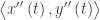
In the plane, the position of a moving object as a function of time, t, can be specified by a pair of parametric equations x=x\left( t \right)\text{ and }y=y\left( t \right) or the equivalent vector \left\langle x\left( t \right),y\left( t \right) \right\rangle . The path is the curve traced by the parametric equations or the tips of the position vector. .

The velocity of the movement in the x- and y-direction is given by the vector \left\langle {x}'\left( t \right),{y}'\left( t \right) \right\rangle . The vector sum of the components gives the direction of motion. Attached to the tip of the position vector this vector is tangent to the path pointing in the direction of motion.

The length of this vector is the speed of the moving object. \text{Speed }=\sqrt{{{\left( {x}'\left( t \right) \right)}^{2}}+{{\left( {y}'\left( t \right) \right)}^{2}}}. (Notice that this is the same as the speed of a particle moving on the number line with one less parameter: On the number line \text{Speed}=\left| v \right|=\sqrt{{{\left( {x}'\left( t \right) \right)}^{2}}}.)

The acceleration is given by the vector \left\langle {{x}'}'\left( t \right),{{y}'}'\left( t \right) \right\rangle .

What students should know how to do:

  • Vectors may be written using parentheses, ( ), or pointed brackets, \left\langle {} \right\rangle , or even \vec{i},\vec{j} form. The pointed brackets seem to be the most popular right now, but all common notations are allowed and will be recognized by readers.
  • Find the speed at time t\text{Speed }=\sqrt{{{\left( {x}'\left( t \right) \right)}^{2}}+{{\left( {y}'\left( t \right) \right)}^{2}}}
  • Use the definite integral for arc length to find the distance traveled \displaystyle \int_{a}^{b}{\sqrt{{{\left( {x}'\left( t \right) \right)}^{2}}+{{\left( {y}'\left( t \right) \right)}^{2}}}}dt. Notice that this is the integral of the speed (rate times time = distance).
  • The slope of the path is \displaystyle \frac{dy}{dx}=\frac{{y}'\left( t \right)}{{x}'\left( t \right)}. See this post for more on finding the first and second derivatives with respect to x.
  • Determine when the particle is moving left or right,
  • Determine when the particle is moving up or down,
  • Find the extreme position (farthest left, right, up, down, or distance from the origin).
  • Given the position find the velocity by differentiating; given the velocity find the acceleration by differentiating.
  • Given the acceleration and the velocity at some point find the velocity by integrating; given the velocity and the position at some point find the position by integrating. These are just initial value differential equation problems (IVP).
  • Dot product and cross product are not tested on the BC exam, nor are other aspects.

Shorter questions on these ideas appear in the multiple-choice sections. As always, look over as many questions of this kind from past exams as you can find.


Next Posts:

Friday March 31: For BC Polar Equations (Type 9)

Tuesday April 4: For BC Sequences and Series.(Type 10)


.

Good Question 9

This is a good question that leads to other good questions, both mathematical and philosophical. A few days ago this question was posted on a private Facebook page for AP Calculus Readers. The problem and illustration were photographed from an un-cited textbook.

Player 1 runs to first base [from home plate] at a speed of 20 ft/s while player 2 runs from second base to third base a speed of 15 ft/s. Let s be the distance between the two players. How fast is s changing when player 1 is 30 feet from home plate and Player 2 is 60 feet from second base. [A figure was given showing that the distance between the bases is 90 feet.]

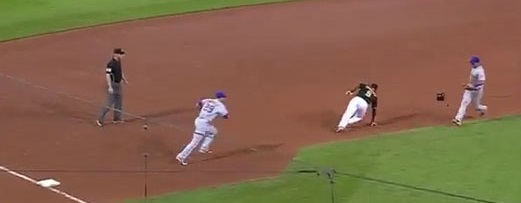
baserunners 2-8-16

Some commenters indicated some possible inconsistencies in the question, such as assuming the Player 2 is on second base when Player 1 leaves home plate. In this case the numbers don’t make sense. So, someone suggested this must be a hit-and-run situation. To which someone else replied that with a lead of that much it’s really a stolen base situation. So, the first thing to be learned here is that even writing a simple problem like this you need to take some of the real aspects into consideration. But this doesn’t change the mathematical aspects of the problem.

One of the things I noticed before I attempted to work out the solution was that Player 2 is the same distance from third base as Player 1 is from home plate. I verbalized this as “players are directly across the field from each other.” I filed this away since it didn’t seem to matter much. Wrong!

Then I worked on the problem two ways. These are shown in the appendix at the end of this post. I discovered (twice) that s’ = 0; at the moment suggested in the question the distance is not changing.

Then it hit me. Doh! – I didn’t have to do all that. So, I posted this solution (which I now notice someone beat me to):

At the time described, the players are directly across the field from each other (90 feet apart). This is the closest they come. The distance between them has been decreasing and now starts to increase. So, at this instant s is not changing (s‘ = 0).

The Philosophical Question

Then the original poster asked for someone “to post [actual] work done in calculus” and “to see some related rates.” So, I posted some “calculus” and got to thinking – the philosophical question – isn’t my first answer calculus?

I think it is. It makes use of an important calculus concept, namely that as things change, at the minimum place, the derivative is zero. Furthermore, the justification (that the distance changes from decreasing to increasing at the minimum implies the derivative is zero) is included. * Why do you need variables?

Also, this solution is approached as an extreme value (max/min) problem rather than a related rate problem. This shows a nice connection between the two types of problems.

The Related (but not related rate) Good Question

So here is another calculus question with none of the numbers we’ve grown to expect:

Two cars travel on parallel roads. The roads are w feet apart. At what rate does the distance between the cars change when the cars are w feet apart?

Notice:

  • That the cars could be travelling in the same or opposite directions.
  • Their speeds are not given.
  • You don’t know when or where they started; only that at some time they are opposite each other (w feet apart).
  • In fact, they could start opposite each other and travel in the same direction at the same speed, remaining always w feet apart.
  • One car could be standing still and the other just passes it.

But you can still answer the question.

(*Continuity and differentiability are given (or at least implied) in the original statement of the problem.)

 Appendix

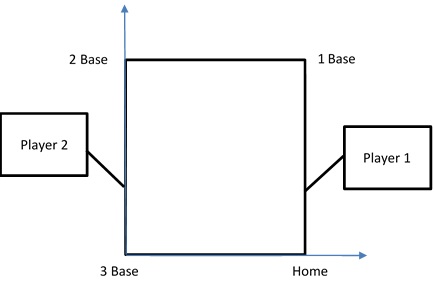
My first attempt was to set up a coordinate system with the origin at third base as shown below.

Blog 2-8-16

Then, taking the time indicated in the problem as t = 0, the position of Player 1 is (90, 30 + 20t) and the position of player 2 is (0, 30 – 15t). Then the distance between them is

s=\sqrt{{{90}^{2}}+{{\left( 30-15t-\left( 30+20t \right) \right)}^{2}}}=\sqrt{{{90}^{2}}+{{\left( -35t \right)}^{2}}}

and then

\displaystyle {s}'\left( t \right)=\frac{2\left( -35t \right)\left( -35 \right)}{2s}\text{ and }{s}'\left( 0 \right)=0

This is correct, but for some reason I was suspicious probably because zeros can hide things. So I re-stated this time taking t = 0 to be one second before the situation described in the problem. Now player 1’s position is (90, 10+20t) and player 2’s position is (0, 45-15t).


s\left( t \right)=\sqrt{{{90}^{2}}+{{\left( 45-15t-\left( 10+20t \right) \right)}^{2}}}=\sqrt{{{90}^{2}}+{{\left( 30-35t \right)}^{2}}}

\displaystyle {s}'\left( t \right)=\frac{2\left( 35-35t \right)\left( -35 \right)}{2s}\text{ and }{s}'\left( 1 \right)=0

.

____________________________________________

February 2016

As I hope you’ve noticed there is a new pull-down on the navigation bar called “Website.” For some years I’ve had a website at linmcmullin.net that lately I’ve been neglecting. I decided to close it in the next few days, and therefore, I move most of the material that is there to this new tab. The main items of interest are probably those under “Calculus”, “Winplot”, and “CAS.” If you used that website you should be able to find what you need here. If you cannot find something, then please write and I’ll try to help.

In my post entitled January 2016 are listing of post for the applications of integration for both AB and BC calculus. This month’s posts are BC topics on sequences, series, and parametric and polar equations.

Posts from past Februarys

Sequences and Series

February 9, 2015 Amortization A practical application of sequences.

February 8, 2013: Introducing Power Series 1

February 11, 2013: Introducing Power Series 2

February 13, 2013: Introducing Power Series 3

February 15, 2013 New Series from Old 1

February 18, 2013: New Series from Old 2

February 20, 2013: New Series from Old 3

February 22, 2013: Error Bounds

May 20, 2015 The Lagrange Highway

Polar, Parametric, and Vector Equations

March 15, 2013 Parametric and Vector Equations

March 18, 2013 Polar Curves

May 17, 2014 Implicit Differentiation of Parametric Equations 

A series on ROULETTES some special parametric curves (BC topic – enrichment):


January 2016

HAPPY NEW YEAR

– a few more days off and then back to school!

If you haven’t already, it is time to start integration. The posts on starting integration were listed in December since I try to stay ahead of things so you’ll have time to prepare. With that in mind here are past posts on applications of integration – area, volume, average value, improper integrals, accumulation, and some enrichment for BC classes on parametric equations. This will take AB courses well into February. The February postings will be for the BC topics on sequences and series.

The four featured post below are the most popular from this list.

Applications of integration: area, volume, average value of a function, Accumulation and functions defined by integrals.

January 2, 2013 Integration by Parts – 1

January 4, 2013 Integration by Parts – 2

January 7, 2013 Area Between Curves

 A series on visualizing solid figures:Solid rotation

January 9, 2013 Volume of Solids with Regular Cross-sections

January 11, 2013 Volumes of Revolution

January 14, 2013 Why You Never Need Cylindrical Shells

January 25, 2014 Improper Integrals and proper areas.

January 16, 2013 Average Value of a Function

February 6, 2013: Logarithms

January 19, 2013 Most Triangles are Obtuse! What is the probability that a triangle picked at random will be acute? An average value problem solved by a tenth grader.

 A series on ROULETTES some special parametric curves (BC topic – enrichment):

Accumulation – On the exams; not in many textbooks 

.

A Vector’s Derivatives

A question on the AP Calculus Community bulletin board this past Sunday inspired me to write this brief outline of what the derivatives of parametric equations mean and where they come from.

The Position Equation or Position Vector

A parametric equation gives the coordinates of points (x, y) in the plane as functions of a third variable, usually t for time. The resulting graph can be thought of as the locus of a point moving in the plane as a function of time. This is no different than giving the same two functions as a position vector, and both approaches are used. (A position vector has its “tail” at the origin and its “tip” tracing the path as it moves.)

For example, the position of a point on the flange of a railroad wheel rolling on a horizontal track (called a prolate cycloid) is given by the parametric equations

x\left( t \right)=t-1.5\sin \left( t \right)

y\left( t \right)=1-1.5\cos \left( t \right).

Or by the position vector with the same components \left\langle t-1.5\sin \left( t \right),1-1.5\cos \left( t \right) \right\rangle .

Derivatives and the Velocity Vector

The instantaneous rate of change in the y-direction is given by dy/dt, and dx/dt gives the instantaneous rate of change in the x-direction. These are the two components of the velocity vector \displaystyle \vec{v}\left( t \right)=\left\langle \frac{dx}{dt},\frac{dy}{dt} \right\rangle .

In the example, \displaystyle \vec{v}\left( t \right) =\left\langle 1-1.5\cos \left( t \right),1.5\sin \left( t \right) \right\rangle . This is a vector pointing in the direction of motion and whose length, \displaystyle \sqrt{{{\left( \frac{dx}{dt} \right)}^{2}}+{{\left( \frac{dy}{dt} \right)}^{2}}}, is the speed of the moving object.

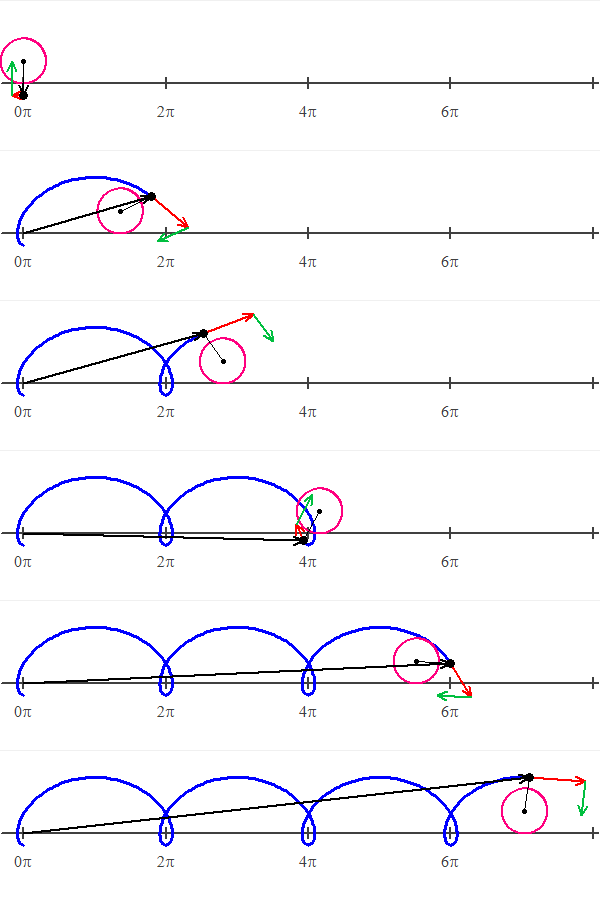
In the video below the black vector is the position vector and the red vector is the velocity vector. I’ve attached the velocity vector to the tip of the position vector. Notice how the velocitiy’s length as well as its direction changes. The velocity vector pulls the object in the direction it points and there is always tangent to the path.  This can be seen when the video pauses at the end and in the two figures at the end of this post.

Blog Cycloid 1

The slope of the tangent vector is the usual derivative dy/dx. It is found by differentiating dy/dt implicitly with respect to x. Therefore, \displaystyle \frac{dy}{dx}=\frac{dy}{dt}\cdot \frac{dt}{dx}.

There is no need to solve for t in terms of x since dt/dx is the reciprocal of dx/dt, instead of multiplying by dt/dx we can divide by dx/dt: \displaystyle \frac{dy}{dx}=\frac{dy/dt}{dx/dt}.

In the example, \displaystyle \frac{dy}{dx}=\left( 1.5\sin \left( t \right) \right)\frac{dt}{dx}=\left( 1.5\sin \left( t \right) \right)\left( \frac{1}{1-1.5\cos \left( t \right)} \right)=\frac{1.5\sin \left( t \right)}{1-1.5\cos \left( t \right)}

Second Derivatives and the Acceleration Vector

The components of the acceleration vector are just the derivatives of the components of the velocity vector

In the example, \displaystyle \vec{a}\left( t \right)=\left\langle 1.5\sin \left( t \right),1.5\cos \left( t \right) \right\rangle

The usual second derivative \displaystyle \frac{{{d}^{2}}y}{d{{x}^{2}}} is found by differentiating dy/dx, which is a function of t, implicitly with respect to x:


\displaystyle \frac{{{d}^{2}}y}{d{{x}^{2}}}=\left( \frac{d}{dt}\left( \frac{dy}{dx} \right) \right)\left( \frac{dt}{dx} \right)=\frac{\frac{d}{dt}\left( dy/dx \right)}{dx/dt}

In the example,

\displaystyle \frac{{{d}^{2}}y}{d{{x}^{2}}}=\left( \frac{d}{dt}\left( \frac{1.5\sin \left( t \right)}{1-1.5\cos \left( t \right)} \right) \right)\left( \frac{1}{1-1.5\cos \left( t \right)} \right)

\displaystyle =\frac{\left( 1-1.5\cos \left( t \right) \right)\left( 1.5\cos \left( t \right) \right)-\left( 1.5\sin \left( t \right) \right)\left( 1.5\sin \left( t \right) \right)}{{{\left( 1-1.5\cos \left( t \right) \right)}^{2}}}\cdot \frac{1}{\left( 1-1.5\cos \left( t \right) \right)}

\displaystyle =\frac{1.5\cos \left( t \right)-{{1.5}^{2}}}{{{\left( 1-1.5\cos \left( t \right) \right)}^{3}}}

The acceleration vector is the instantaneous rate of change of the velocity vector. You may think of it as pulling the velocity vector in the same way as the velocity vector pulls the moving point (the tip of the position vector). The video below shows the same situation as the first with the acceleration vectors in green attached to the tip of the velocity vector.

Blog Cycloid 2Here are two still figures so you can see the relationships. On the left is the starting position t = 0 with the y-axis removed for clarity. At this point the red velocity vector is \left\langle -0.5,0 \right\rangle indicating that the object will start by moving directly left. The green acceleration vector is \left\langle 0,1.5 \right\rangle pulling the velocity and therefore the object directly up. The second figure shows the vectors later in the first revolution. Note that the velocity vector is in the direction of motion and tangent to the path shown in blue.

Roulettes and Art – 2

Continuing with our discussion of ways to produce interesting designs with the Roulette Generator (RG) for Winplot, here are some hints on making more detailed designs using more than one function.

Hint #5: Adding more graphs to the first: You may add other graphs by selecting the roulette and/or velocity equations from the Inventory (CTRL+I) and clicking “dupl”  to duplicate the equation. Then click the duplicate and then “edit” and change the sign in front of the S in both equations. This will let you graph S and –S at the same time. This will give you two congruent graphs with the first rotated 2\pi /n from the first. (From the previous posts: if \left| R \right|=\tfrac{n}{d} then there are d dips, loops, or cusps in n full revolutions). Both graphs will have the same R value.  

You may also change the color of all the graphs.

Here is a graph with that idea. The values are in the caption.

R = -0.322, S = -0.3 (blue) and S = +0.3 (green) and their derivatives (orange and   xxx  15 Revolutions

R = -0.322, S = -0.3 (blue) and S = +0.3 (green) and their derivatives (orange and gray),
15 Revolutions

Hint #6: Plotting Density (PD) (Winplot RG only) also affects the final drawing. Graphers work by calculating a number of points and joining them with straight segments. The default plotting density is 1. Usually this results in a nice graph with smooth looking curves because the segments are very short. If your graph looks like a bunch of segments, select the equation in the Inventory, click “edit”, and increase the plotting density (to 10 or 100 or more) and the curves will no longer look like segments. Of course, you may want them to look like segments. The graph below shows how PD works. The graph on the left has a plotting density of 10. The center graph is a detail of the first with the same PD. The plot on the right is the same as the center graph but with a plotting density of 100.

Hint #7: In addition to PD, Winplot is very sensitive to image size and zooming in and out. Once you have a graph you like, experiment with zooming in and our (page-up and page-down keys) or dragging the corners of the frame. You will see a lot of different graphs.

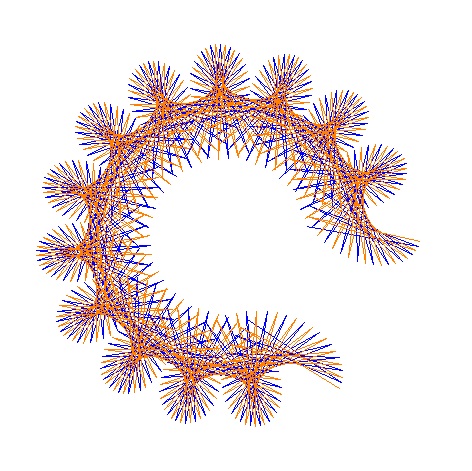
Your turn: Try making this graph below with S=\pm \tfrac{1}{3}, R = 0.00667 and slightly less than a full revolution. Make the image size (under the file tab) 12.3 x 12.3 (the units are cm.), or 465 x 465 pixels (type @ after the number to use pixels). Amazing!
R6-3a


Every slight change makes a whole new design. Start with your own values. I would like to see what you and your students come up with. When you get the perfect one, e-mail it to me as a .jpg file and I will post it. (Please include the SR, and other data.