Seeing the Chain Rule

Being a believer in the Rule of Four, I have been trying for years to find a good visual (graphical) illustration of why or how the Chain Rule for derivatives works. This very simple example is the best I could come up with.

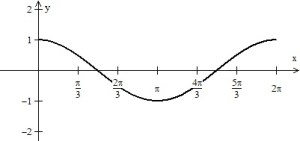
Consider the function y=\sin \left( x \right),0\le x\le 2\pi . (See figure 1. A tangent segment at \displaystyle \left( {\frac{\pi }{3},\sin \left( {\frac{\pi }{3}} \right)} \right) is drawn.) As you know, this function’s values go smoothly from 0 to 1 to 0 to –1 and back to 0. The slopes of its tangent line, its derivative, appears to go from 1 to 0 to –1 to 0 to 1 as you would expect knowing its derivative is  \frac{{dy}}{{dx}}=\cos \left( x \right). (See figure 2)

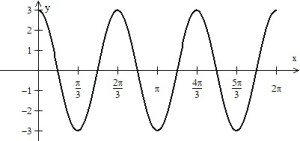
Consider the function  y=\sin \left( {3x} \right),0\le x\le 2\pi (See figure 3. A tangent line at \displaystyle \left( {\frac{\pi }{9},\sin \left( {\frac{\pi }{9}} \right)} \right)  is drawn) This takes on all the values of the sine function three times between 0 and  2\pi . It goes through the same values three times as fast and therefore, its rate of change (yeah, the derivative) should be three times as much. Compare the tangent lines in Figures 1 and 3. This agrees with the derivative found by the Chain Rule:  \frac{{dy}}{{dx}}=3\cos \left( {3x} \right). See figure 4)

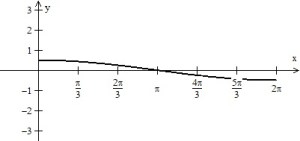
Next, consider the function y=\sin \left( {\tfrac{1}{2}x} \right),0\le x\le 2\pi (See figure 5. A tangent line at \displaystyle \left( {\frac{{2\pi }}{3},\sin \left( {\frac{{2\pi }}{3}} \right)} \right) is drawn.). This time the function is stretch and only goes through half its period. So, It goes through the same values half as fast as the original and the slope is only half as steep as the original. Compare the tangent lines in Figures 1 and 5.Therefore, the rate of change the derivative, should be only half the original’s. So,  \frac{{dy}}{{dx}}=\frac{1}{2}\cos \left( {\tfrac{1}{2}x} \right) (See figure 6)

I hope this helps your students see what’s happening with the Chain Rule, at least a little bit. I’d be happy to hear and share any ideas you have to illustrate the Chain Rule graphically.

There is a movable Desmos graph here to help illustrate all of this.


Here are links to other posts on the Chain Rule

Foreshadowing the Chain Rule

The Power Rule Implies Chain Rule

The Chain Rule

Derivative Practice – Numbers

Derivative Practice – Graphs

Experimenting with CAS – Chain Rule


2019 CED – Unit 3: Differentiation: Composite, Implicit, and Inverse Functions

Unit 3 covers the Chain Rule, differentiation techniques that follow from it, and higher order derivatives. (CED – 2019 p. 67 – 77). These topics account for about 9 – 13% of questions on the AB exam and 4 – 7% of the BC questions.

Topics 3.1 – 3.6

Topic 3.1 The Chain Rule. Students learn how to apply the Chain Rule in basic situations.

Topic 3.2 Implicit Differentiation. The Chain Rule is used to find the derivative of implicit relations.

Topic 3.3 Differentiation Inverse Functions.  The Chain Rule is used to differentiate inverse functions.

Topic 3.4 Differentiating Inverse Trigonometric Functions. Continuing the previous section, the ideas of the derivative of the inverse are applied to the inverse trigonometric functions.

Topic 3.5 Selecting Procedures for Calculating Derivatives. Students need to be able to choose which differentiation procedure should be used for any function they are given. This is where you can review (spiral) techniques from Unit 2 and practice those from this unit.

Topic 3.6 Calculating Higher Order Derivatives. Second and higher order derivatives are considered. Also, the notations for higher order derivatives are included here.


Topics 3.2, 3.4, and 3.5 will require more than one class period. You may want to do topic 3.6 before 3.5 and use 3.5 to practice all the differentiated techniques learned so far. The suggested number of 40 – 50-minute class periods is about 10 – 11 for AB and 8 – 9 for BC. This includes time for testing etc.
Posts on these topics include:

Foreshadowing the Chain Rule

The Power Rule Implies Chain Rule

The Chain Rule

           Seeing the Chain Rule

Derivative Practice – Numbers

Derivative Practice – Graphs

Experimenting with CAS – Chain Rule

Implicit Differentiation of Parametric Equations


This series of posts reviews and expands what students know from pre-calculus about inverses. This leads to finding the derivative of exponential functions, ax, and the definition of e, from which comes the definition of the natural logarithm.

Inverses Graphically and Numerically

The Range of the Inverse

The Calculus of Inverses

The Derivatives of Exponential Functions and the Definition of e and This pair of posts shows how to find the derivative of an exponential function, how and why e is chosen to help this differentiation.

Logarithms Inverses are used to define the natural logarithm function as the inverse of ex. This follow naturally from the work on inverses. However, integration is involved and this is best saved until later. I will mention it then.
Here are links to the full list of posts discussing the ten units in the 2019 Course and Exam Description.

2019 CED – Unit 1: Limits and Continuity

2019 CED – Unit 2: Differentiation: Definition and Fundamental Properties.

2019 CED – Unit 3: Differentiation: Composite , Implicit, and Inverse Functions

2019 CED – Unit 4 Contextual Applications of the Derivative  Consider teaching Unit 5 before Unit 4

2019 – CED Unit 5 Analytical Applications of Differentiation  Consider teaching Unit 5 before Unit 4

2019 – CED Unit 6 Integration and Accumulation of Change

2019 – CED Unit 7 Differential Equations  Consider teaching after Unit 8

2019 – CED Unit 8 Applications of Integration   Consider teaching after Unit 6, before Unit 7

2019 – CED Unit 9 Parametric Equations, Polar Coordinates, and Vector-Values Functions 

2019 CED Unit 10 Infinite Sequences and Series


Updated to include the series on inverses – July 7, 2020

Differentiability Implies Continuity

An important theorem concerning derivatives is this:

If a function f is differentiable at x = a, then f is continuous at x = a.

The proof begins with the identity that for all x\ne a

\displaystyle f\left( x \right)-f\left( a \right)=\left( {x-a} \right)\frac{{f\left( x \right)-f\left( a \right)}}{{x-a}}

\displaystyle \underset{{x\to a}}{\mathop{{\lim }}}\,\left( {f\left( x \right)-f\left( a \right)} \right)=\underset{{x\to a}}{\mathop{{\lim }}}\,\left( {\left( {x-a} \right)\frac{{f\left( x \right)-f\left( a \right)}}{{x-a}}} \right)=\underset{{x\to a}}{\mathop{{\lim }}}\,\left( {x-a} \right)\cdot \underset{{x\to a}}{\mathop{{\lim }}}\,\frac{{f\left( x \right)-f\left( a \right)}}{{x-a}}

\displaystyle \underset{{x\to a}}{\mathop{{\lim }}}\,\left( {f\left( x \right)-f\left( a \right)} \right)=0\cdot {f}'\left( a \right)=0

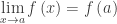
And therefore, \underset{{x\to a}}{\mathop{{\lim }}}\,f\left( x \right)=f\left( a \right)

Since both sides are finite, the function is continuous at x = a.


The converse of this theorem is false: A continuous function is not necessarily differentiable. A counterexample is the absolute value function which is continuous at the origin but not differentiable there. (The slope approaching from the left is not equal to the slope from the right.)

This is a theorem whose contrapositive is used as much as the theorem itself. The contrapositive is,

If a function is not continuous at a point, then it is not differentiable there.

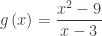
Example 1: A function such as  \displaystyle g\left( x \right)=\frac{{{{x}^{2}}-9}}{{x-3}} has a (removable) discontinuity at x = 3, but no value there.

So, in the limit definition of the derivative, \displaystyle \text{ }\!\!~\!\!\text{ }\underset{{h\to 0}}{\mathop{{\lim }}}\,\frac{{g\left( {3+h} \right)-g\left( 3 \right)}}{h} there is no value of g(3) to use, and the derivative does not exist.

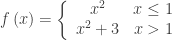
Example 2:  \displaystyle f\left( x \right)=\left\{ {\begin{array}{*{20}{c}} {{{x}^{2}}} & {x\le 1} \\ {{{x}^{2}}+3} & {x>1} \end{array}} \right.. This function has a jump discontinuity at x = 1.

Since the point (1, 1) is on the left part of the graph, if h > 0, f\left( {1+h} \right)-f\left( 1 \right)>3 and the limit  will always be a number greater than 3 divided by zero and will not exist. Therefore, even though the slopes from both side of x =1 approach the same value, namely 2, the derivative does not exist at x = 1.

This also applies to a situation like example 1 if f(3) were some value that did not fill in the hole in the graph.


On the AP Calculus exams students are often asked about the derivative of a function like those in the examples, and the lack of continuity should be an immediate clue that the derivative does not exist. See 2008 AB 6 (multiple-choice).

Just as important are questions in which the function is given as differentiable, but the student needs to know about continuity. Just remember: differentiability implies continuity. See 2013 AB 14 in which you must realize the since the function is given as differentiable at x = 1, it must be continuous there to solve the problem.


Continuity of the Derivative

A question that comes up is, if a function is differentiable is its derivative differentiable? The answer is no. While almost always the derivative is also differentiable, there is this counterexample:

\displaystyle f\left( x \right)=\left\{ {\begin{array}{*{20}{c}} {{{x}^{2}}\sin \left( {\frac{1}{x}} \right)} & {x\ne 0} \\ 0 & {x=0} \end{array}} \right.

The first line of the function has a removable oscillating discontinuity at x = 0, but since the \displaystyle {{x}^{2}} factor squeezes the function to the origin; the added condition that \displaystyle f\left( 0 \right)=0 makes the function continuous. Differentiating gives

\displaystyle {{f}^{'}}\left( x \right)={{x}^{2}}\cos \left( {\frac{1}{x}} \right)\left( {\frac{{-1}}{{{{x}^{2}}}}} \right)+2x\sin \left( {\frac{1}{x}} \right)=-\cos \left( {\frac{1}{x}} \right)+2x\sin \left( {\frac{1}{x}} \right)

And now there is no way to get around the oscillating discontinuity at x = 0.


2019 CED – Unit 2: Differentiation: Definition and Fundamental Properties.

Unit 2 contains topics rates of change, difference quotients, and the definition of the derivative (CED – 2019 p. 51 – 66). These topics account for about 10 – 12% of questions on the AB exam and 4 – 7% of the BC questions.

Topics 2.1 – 2.4: Introducing and Defining the Derivative 

Topic 2.1: Average and Instantaneous Rate of Change. The forward difference quotient is used to introduce the idea of rate of change over an interval and its limit as the length of the interval approaches zero is the instantaneous rate of change.

Topic 2.2: Defining the derivative and using derivative notation. The derivative is defined as the limit of the difference quotient from topic 1 and several new notations are introduced. The derivative is the slope of the tangent line at a point on the graph. Explain graphically, numerically, and analytically how the three representations relate to each other and the slope.

Topic 2.3 Estimating the derivative at a point.  Using tables and technology to approximate derivatives is used in this topic. The two resources in the sidebar will be helpful here.

Topic 2.4: Differentiability and Continuity. An important theorem is that differentiability implies continuity – everywhere a function is differentiable it is continuous.  Its converse is false – a function may be continuous at a point, but not differentiable there. A counterexample is the absolute value function, |x|, at x = 0.

One way that the definition of derivative is tested on recent exams which bothers some students is to ask a limit like

\displaystyle \underset{{x\to 0}}{\mathop{{\lim }}}\,\frac{{\tan \left( {\tfrac{\pi }{4}+x} \right)-\tan \left( {\tfrac{\pi }{4}} \right)}}{x}.

From the form of the limit students should realize this as the limit definition of the derivative. The h in the definition has been replaced by x. The function is tan(x) at the point where \displaystyle a=\tfrac{\pi }{4}. The limit is \displaystyle {{\sec }^{2}}\left( {\tfrac{\pi }{4}} \right)=2.

Topics 2.5 – 2.10: Differentiation Rules

The remaining topics in this chapter are the rules for calculating derivatives without using the definition. These rules should be memorized as students will be using them constantly. There will be additional rules in Unit 3 (Chain Rule, Implicit differentiation, higher order derivative) and for BC, Unit 9 (parametric and vector equations).

Topic 2.5: The Power Rule

Topic 2.6: Constant, sum, difference, and constant multiple rules

Topic 2.7: Derivatives of the cos(x), sin(x), ex, and ln(x). This is where you use the squeeze theorem.

Topic 2.8. The Product Rule

Topic 2.9: The Quotient Rule

Topic 2.10: Derivative of the other trigonometric functions

The rules can be tested directly by just asking for the derivative or its value at a point for a given function. Or they can be tested by requiring the students to use the rule of an general expression and then find the values from a table, or a graph. See 2019 AB 6(b)


The suggested number of 40 – 50 minute class periods is 13 – 14 for AB and 9 – 10  for BC. This includes time for testing etc. Topics 2.1, 2,2, and 2.3 kind of flow together, but are important enough that you should spend time on them so that students develop a good understanding of what a derivative is. Topics 2.5 thru 2.10 can be developed in 2 -3 days, but then time needs to be spent deciding which rule(s) to use and in practice using them. The sidebar resource in the CED on “Selecting Procedures for Derivative” may be helpful here.


Other post on these topics

DEFINITION OF THE DERIVATIVE

Local Linearity 1  The graphical manifestation of differentiability with pathological examples.

Local Linearity 2   Using local linearity to approximate the tangent line. A calculator exploration.

Discovering the Derivative   A graphing calculator exploration

The Derivative 1  Definition of the derivative

The Derivative 2   Calculators and difference quotients

Difference Quotients 1

Difference Quotients II

Tangents and Slopes

         Differentiability Implies Continuity

FINDING DERIVATIVES 

Why Radians?  Don’t do calculus without them

The Derivative Rules 1  Constants, sums and differences, powers.

The Derivative Rules 2  The Product rule

The Derivative Rules 3  The Quotient rule


Here are links to the full list of posts discussing the ten units in the 2019 Course and Exam Description.

2019 CED – Unit 1: Limits and Continuity

2019 CED – Unit 2: Differentiation: Definition and Fundamental Properties.

2019 CED – Unit 3: Differentiation: Composite , Implicit, and Inverse Functions

2019 CED – Unit 4 Contextual Applications of the Derivative  Consider teaching Unit 5 before Unit 4

2019 – CED Unit 5 Analytical Applications of Differentiation  Consider teaching Unit 5 before Unit 4

2019 – CED Unit 6 Integration and Accumulation of Change

2019 – CED Unit 7 Differential Equations  Consider teaching after Unit 8

2019 – CED Unit 8 Applications of Integration   Consider teaching after Unit 6, before Unit 7

2019 – CED Unit 9 Parametric Equations, Polar Coordinates, and Vector-Values Functions 

2019 CED Unit 10 Infinite Sequences and Series


Did He, or Didn’t He?

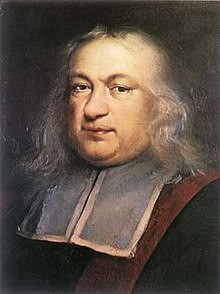
Pierre de Fermat (1607 – 1655)

Since it’s soon time to start derivatives, today we look at one way people found maximums and minimums before calculus was invented. Pierre de Fermat (1607 – 1655) was a French lawyer. His hobby, so to speak, was mathematics. He is considered one of the people who built the foundations of calculus. Along with Descartes, he did a lot of the early work on analytic geometry and did much work leading to calculus, which today we would consider calculus. Neither he nor other mathematicians of his time had the tool of limits to aid him. Derivatives were not yet invented. Nevertheless, he came awfully close to both.

Fermat was working on optimization and that required him to find the maximum or minimum values of functions. Here is how he found extreme values of polynomial functions. Even though he didn’t know limits and derivatives, maybe he used them.

Using Fermat’s method, and some modern notation and terminology, we will demonstrate has method by finding the extreme values of the function:

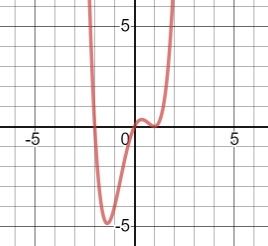
(1)          \displaystyle f\left( x \right)={{x}^{4}}-3{{x}^{2}}+2x               

Near an extreme value Fermat reasoned that a horizontal line would intersect the graph in two points, say where x = a and x = b. (There is a third intersection on this function, since there are three extreme points. The method finds all three.) He thought of this line moving up or down and the two points coming close to the extreme value. Since these two points are on the same horizontal line f(a) = f(b):

(2)          {{a}^{4}}-3{{a}^{2}}+2a={{b}^{4}}-3{{b}^{2}}+2b

After moving everything to the left side and grouping terms by their powers and factoring we have:

(3)          \displaystyle \left( {{{a}^{4}}-{{b}^{4}}} \right)-3\left( {{{a}^{2}}-{{b}^{2}}} \right)+2\left( {a-b} \right)=0

(4)          \displaystyle \left( {a-b} \right)\left( {\left( {a+b} \right)\left( {{{a}^{2}}+{{b}^{2}}} \right)-3\left( {a+b} \right)+2} \right)=0

Near where a = b, (a – b) is not zero, so we may divide by it.

(5)          \displaystyle \left( {a+b} \right)\left( {{{a}^{2}}+{{b}^{2}}} \right)-3\left( {a+b} \right)+2=0

Again, near the extreme value \displaystyle a\approx b, so, substituting  \displaystyle a=b we have

(6)          \displaystyle 2a\left( {2{{a}^{2}}} \right)-3\left( {2a} \right)+2=4{{a}^{3}}-6a+2\approx 0

Now all that remains is to solve this equation (factoring by synthetic division).

(7)          \displaystyle 4{{a}^{3}}-6a+2=2\left( {a-1} \right)\left( {2{{a}^{2}}+2a-1} \right)=0

(8)          \displaystyle a=1,a=\frac{{-1+\sqrt{3}}}{2},a=\frac{{-1-\sqrt{3}}}{2}

These are the x-coordinates of the critical points.


Now, let’s look at all the “calculus” Fermat did not do.

The left side of equations (3) and (4) are

(9)          \displaystyle f\left( a \right)-f\left( b \right)

And after dividing this by (a – b) he had in (5)

(10)         \displaystyle \frac{{f\left( a \right)-f\left( b \right)}}{{a-b}}

Then by letting a be approximately equal to b, which sounds a lot like finding a limit, he had in modern terms

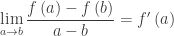
(11)         \displaystyle \underset{{a\to b}}{\mathop{{\lim }}}\,\frac{{f\left( a \right)-f\left( b \right)}}{{a-b}}={f}'\left( a \right)

Expression (6) is \displaystyle {f}'\left( a \right) – Fermat unknowingly is using the derivative! After which he set it equal to 0 and solved to find the x-coordinates of the critical points.
So, did he or didn’t he use calculus? You decide.


Optimization – Reflections


First, a new resource has been added to the resource page.  An index of all free-response questions from 1971 – 2018 listed by major topics. These were researched by by Kalpana Kanwar a teacher at Wisconsin Heights High School. Thank you Kalpana! They include precalculus topics that were tested on the exams before 1998. These may be good for your precalculus classes. (Remember that the course description underwent major changes in 1998 and some topics were dropped at that time. These include the “A” topics (precalculus), Newton’s Method, work, volume by cylindrical shells among others. Be careful, when assigning old questions; they’re good, but they may no longer be tested.) 


Optimizations problems are situations in which some item is to be made as large or small as possible. Often this is the minimum cost of producing something, or to maximize profit, or to make the largest area or volume with the least material.

While these problems are found in most of the textbooks, they almost never appear on the AP Calculus Exams. The reason for this is that the first step is to write the equation that models the situation. This step does not involve any “calculus.” If a student cannot do this or does it incorrectly, then there is no way to earn the calculus points that follow. On the exams, students are given an expression and asked to find its maximum or minimum value.

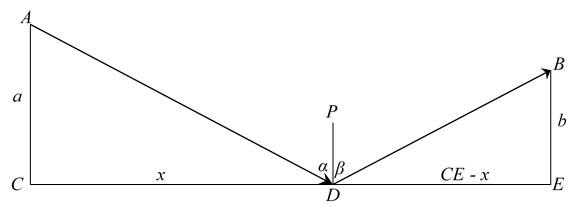
Nevertheless, the problems can be interesting and are useful in a practical sense. Reflection is one of my favorites: show that the angle of incidence equals the angle of reflection. In the figure below, light travels from a point A to point D on a reflecting surface CE and then to point B by the shortest total distance. Show that this implies that the angle α between AD and the normal to the surface is equal to the angle β between the normal and DB. The angle α is called the angle of incidence and the angle β is called the angle of reflection.

Using the lengths marked in the drawing,  \overline{{AC}},\overline{{PD}} and \overline{{BE}} are all perpendicular to  \overline{{CE}} the total distance is AD + DB. Therefore:

AD+DB=\sqrt{{{{a}^{2}}+{{x}^{2}}}}+\sqrt{{{{b}^{2}}+{{{\left( {CE-x} \right)}}^{2}}}}

To find the minimum distance find the derivative of AD + DB and set it equal to zero.

\displaystyle \frac{{2x}}{{2\sqrt{{{{a}^{2}}+{{x}^{2}}}}}}+\frac{{-2\left( {CE-x} \right)}}{{2\sqrt{{{{b}^{2}}+{{{\left( {CE-x} \right)}}^{2}}}}}}=0

Then

\displaystyle \frac{x}{{\sqrt{{{{a}^{2}}+{{x}^{2}}}}}}=\frac{{\left( {CE-x} \right)}}{{\sqrt{{{{b}^{2}}+{{{\left( {CE-x} \right)}}^{2}}}}}}

Now, we need to be clever:

\displaystyle \frac{x}{{\sqrt{{{{a}^{2}}+{{x}^{2}}}}}}=\cos \left( {ADC} \right)=\cos \left( \beta  \right) and

\displaystyle \frac{{\left( {CE-x} \right)}}{{\sqrt{{{{b}^{2}}+{{{\left( {CE-x} \right)}}^{2}}}}}}=\cos \left( {BDE} \right)=\cos \left( \alpha  \right)

And therefore, \displaystyle \alpha =\beta  QED.

See the illustration of this in Desmos here and see an easier way to do this problem.


The conic sections all have interesting reflection properties that are quite useful.

The Ellipse: A light ray leaving one focus of an ellipse is reflected by the ellipse through the other focus of the ellipse. The angle of incidence and the angle of reflection are between the segments to the foci and the normal to the ellipse.

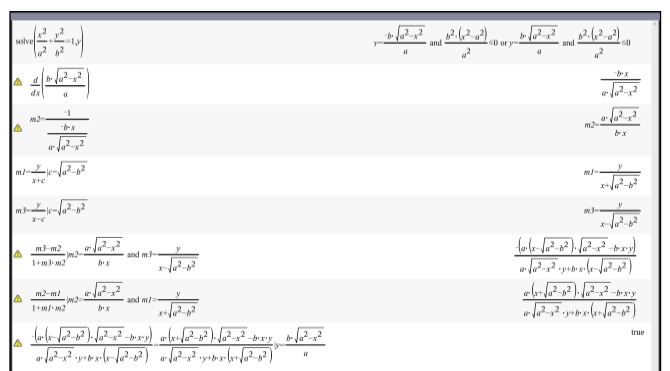
The computation is done using a Computer Algebra System (CAS) and is shown below, the line-byline explanation follows:

  • The first line starts with the ellipse \frac{{{{x}^{2}}}}{{{{a}^{2}}}}+\frac{{{{y}^{2}}}}{{{{b}^{2}}}}=1 with a > b > 0. Solving for y there are two equations, the second one is for the upper half that we will use below. The other for the lower half.
  • The second line finds the derivative of y and the third line, m2 is the slope of the normal, the opposite of the reciprocal of the derivative.
  • The fourth and fifth lines are the slopes, m1 and m3, are the slopes from the point on the ellipse to the foci. The “such that” bar, |, indicates that what follows it is substituted into the expression.
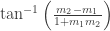
  • The next two lines compute the inverse tangent of angle rotated counterclockwise between the segments to the foci and the normal. This uses the formula from analytic geometry: {{\tan }^{{-1}}}\left( {\frac{{{{m}_{2}}-{{m}_{1}}}}{{1+{{m}_{1}}{{m}_{2}}}}} \right)
  • The last line shows that the expression from the two lines above it are equal, indicated by the “true” on the right.

An illustration using Desmos is here. Ellipses are used as reflectors in medical and dental equipment so that a relatively dim light source can be concentrated at the place where the doctor or dentist is working without “blinding” everyone in the room. There are also ceilings that reflect sound from one focus to the other without anyone elsewhere in the room hearing. These are only a few of their uses.

The hyperbola: A light ray from one focus of a hyperbola is reflected as though it came from the other focus. This is true whether the reflection is from the side nearer the focus or farther from the focus (reflection from the convex or the concave side.

The computation is like the ellipse computation with only a few sign changes. I will not reproduce it here. If you want to try use \displaystyle \frac{{{{x}^{2}}}}{{{{a}^{2}}}}-\frac{{{{y}^{2}}}}{{{{b}^{2}}}}=1 and  c=\sqrt{{{{a}^{2}}+{{b}^{2}}}}.

There is a Desmos illustration here. Use the p-slider to move the point. The left side shows the reflection from the “outside” surface; the right side shows the reflection from the “inside” surface.

Hyperbolas are used in telescopes and magnifying mirrors to enlarge the image.

The Parabola: A light ray from the focus is reflected parallel to the axis of symmetry of the parabola Or you can go the other way: light traveling parallel to the axis is reflected to the focus.

If you try to prove this on use  x=a{{y}^{2}} to avoid working with an undefined slope. The focus is at  \left( {\frac{a}{4},0} \right).

There is a Desmos illustration here

Parabolic reflectors are used in various kinds of spotlight and telescopes and for radar dishes. They are also used for satellite dishes for cable TV; you may have one at home.


Type 7 Questions: Miscellaneous

Any topic in the Course and Exam Description may be the subject of a free-response or multiple-choice question. There are topics that are not asked often enough to be classified as a type of their own. The two topics listed here have been the subject of full free-response questions or major parts of them. Other topics occasionally asked are mentioned in the question list at the end of the post.

Implicitly defined relations and implicit differentiation

These questions may ask students to find the first or second derivative of an implicitly defined relation. Often the derivative is given and students are required to show that it is correct. (This is because without the correct derivative the rest of the question cannot be done.) The follow-up is to answer questions about the function such as finding an extreme value, second derivative test, or find where the tangent is horizontal or vertical.

What students should know how to do

  • Know how to find the first derivative of an implicit relation using the product rule, quotient rule, chain rule, etc.
  • Know how to find the second derivative, including substituting for the first derivative.
  • Know how to evaluate the first and second derivative by substituting both coordinates of a given point. (Note: If all that is needed is the numerical value of the derivative then the substitution is often easier if done before solving for dy/dx or d2y/dx2, and as usual the arithmetic need not be done.)
  • Analyze the derivative to determine where the relation has horizontal and/or vertical tangents.
  • Write and work with lines tangent to the relation.
  • Find extreme values. It may also be necessary to show that the point where the derivative is zero is actually on the graph and to justify the answer.

Simpler questions about implicit differentiation my appear on the multiple-choice sections of the exam.

Related Rates

Derivatives are rates and when more than one variable is changing over time the relationships among the rates can be found by differentiating with respect to time. The time variable may not appear in the equations. These questions appear occasionally on the free-response sections; if not there, then a simpler version may appear in the multiple-choice sections. In the free-response sections they may be an entire problem, but more often appear as one or two parts of a longer question.

What students should know how to do

  • Set up and solve related rate problems.
  • Be familiar with the standard type of related rate situations, but also be able to adapt to different contexts.
  • Know how to differentiate with respect to time. That is, find dy/dt even if there is no time variable in the given equations using any of the differentiation techniques.
  • Interpret the answer in the context of the problem.
  • Unit analysis.

Shorter questions on this concept also appear in the multiple-choice sections. As always, look over as many questions of this kind from past exams as you can find.

For some previous posts on related rate see October 8, and 10, 2012 and for implicit relations see November 14, 2012.


Free response questions (many of the BC questions are suitable for AB)

  • Finding derivatives using the chain rule, the quotient rule, etc. from tables of values: 2016 AB 6 and 2015 AB 6
  • Implicit differentiation 2004 AB and 2016 BC 4
  • L’Hospital’s Rule 2016 BC 4
  • Continuity and piecewise defined functions: 2012 AB 4, 2011 AB 6 and 2014 BC 5
  • Related rate: 2014 AB4/BC4, 2016 AB5/BC5
  • Arc length (BC Topic) 2014 BC 5
  • Partial fractions (BC Topic) 2015 BC 5
  • Improper integrals (BC topic): 2017 BC 5

Multiple-choice questions from non-secure exams:

  • 2012 AB 27 (implicit differentiation), 77 (IVT), 88 (related rate)
  • 2012 BC 4 (Curve length), 7 (Implicit differentiation), 11 (continuity/differentiability), 12 (Implicit differentiation), 77 (dominance), 82 (average value), 85 (related rate) , 92 (compositions)

Schedule of review postings: