Matching Motion

Particle motion 2

Here’s a little matching quiz. In the function column there is a list of properties of functions and in the motion column are a list of terms describing the motion of a particle. The two lists are very similar. Match the terms in the function list with the corresponding terms in the Linear Motion list (some may be used more than once). The answers are below. For more on this idea see my previous post Motion Problems: Same Thing, Different Context.

Function                                               Linear Motion
1. Value of a function at x                     A. acceleration
2. First derivative                                  B. “at rest”  
3. Second derivative                             C. farthest left 
4. Function is increasing                       D. farthest right
5. Function is decreasing                      E. moving to the left or down 
6. Absolute Maximum                          F. moving to the right or up
7. Absolute Minimum                            G. object changes direction
8. y ʹ = 0                                                H. position at time t
9. y ʹ changes sign                                I. speed 
10. Increasing & concave up                J. speed is decreasing
11. Increasing & concave down           K. speed is increasing
12. Decreasing & concave up              L. velocity
13. Decreasing & concave down             
14. Absolute value of velocity      


Answers:  1. H,   2. L,   3. A,   4. F,   5. E,   6. D,   7. C,   8. B,   9. G,   10. K,   11. J,   12. J,   13. K,   14. I


Using the Derivative to Graph the Function

In my last post I showed how to use a Desmos graph to discover, by looking at the tangent line as it moved along the graph of the function, the properties of the derivative of a function. This post goes in the opposite direction. Now, instead of discovering the properties of the derivative from the graph of the function, we will use that knowledge to identify important information about the function from the graph of its derivative. We are not discovering anything here; rather we are putting our previous discoveries to use.

One of the uses of the derivative is to deduce properties of its antiderivative, i.e. the function of which it is the derivative. This is an important skill for students to be able to use. It is also a type of question that appears on every Advanced Placement Calculus exam in both the free-response sections and the multiple-choice sections. My previous post on this topic, Reading the Derivative’s Graph, is the most read post on this blog. This post expands on the concepts in that post and shows how to use the Desmos file to help students develop the skills necessary to answer this type of question.

Desmos is free. You and your students can set up their own account and save their own work there. There are also free Desmos apps for tablets and smart phones.

Click on the graph above. Here’s what you should see:

  • The first equation on the left side is f(x). This is the function whose antiderivative we will be trying to create. You may change this to any function you wish.
  • The second equation is F(x) the antiderivative of f(x). That is ‘(x) = f(x). Desmos cannot compute an antiderivative so you will need to enter it yourself. Your students need not trust you on this: have them check your equation by differentiating. Of course, at this point they will not be ready to find the analytic form of the antiderivative except for the simplest functions. This comes later in the year.
  • Note the “+C” is included and later we will manipulate this with a slider.
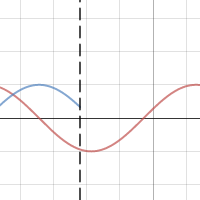
  • The antiderivative is multiplied by \frac{\sqrt{a-x}}{\sqrt{a-x}}. This is a way of controlling the “a” slider and should always be multiplied by antiderivative. This is just a syntax trick to make the graph work and is not part of the antiderivative. When x is to the left of a, (x < a) the fraction is 1 and the graph will be seen; when x is to the right of a, (x > a) the expression is undefined, and nothing will graph. As you change “a” with the slider the graph of an antiderivative will be drawn.
  • The third equation x = a graphs a dashed vertical to help you line up the corresponding points on the two graphs.
  • The next two lines are the “a” and “C” sliders. Make C = 0 for now and move the “a” slider.

At this point students should know things about the relationship between a function and its first and second derivatives. This includes the things they discovered in the previous post such as when the function is increasing the derivative is non-negative, and when the tangent line is above the graph the slope (derivative) is decreasing and the graph of the function is concave down. All of these concepts are really “if, and only if” situations. So we now consider them in reverse and deduce properties of the antiderivative from the properties of the graph of the derivative.

Using the “a” slider starting at the left side of the graph ask the students what the derivative tells them about the function in this part of the domain. Is the function increasing or decreasing? Is it concave up or down? etc.  Go slowly from left to right asking what happens next, and why (that is, how do you know? What feature of the derivative tells you this?) This is preparing them to write the justifications required on the AP exams.

Certain points on the graph of the derivative are important. The zeros of the derivative and whether the derivative changes from positive to negative, negative to positive, or neither are important. Likewise, the extreme values of the derivative point to important features of the function – points of inflection.

Once you have a complete graph of the antiderivative move the “C” slider.

  • Remind students that the derivative of a constant is zero and therefore, the C does not show up in the derivative.
  • Discuss is why changing the antiderivative does not change the derivative.
  • Ask, how many functions have the same derivative?
  • Point out is that by changing “C” the graph of an antiderivative can be made to go through any (every, all) point in the plane.

Switch to a different function and its derivative to reinforce the concepts. Yo will have to enter both the derivative and the antiderivative.Do this as often as necessary. You could also give students or groups of students the graph of a derivative (on paper) and challenge them to sketch the antiderivative.

A disclaimer: A function and its derivative should not be graphed on the same axes, because the two have different units. Nevertheless, I have done it here, and it is commonly done everywhere, to compare the graphs of a function and its derivative so that the important features of the two can be lined up and easily compared.

.


Tangents and Slopes

Using the function to learn about its derivative. 
In this post we will look at a way of helping students discover the numerical and graphical properties of the derivative and how they can be determined from the graph of the function. These ideas can be used very early, when you are first relating the function and its derivative. (In my next post we will look at the problem the other way around – using the derivative to find out about the function.)
Click on the graph below. This will take you to a graph I posted on the Desmos website (Desmos.com). This is a free and really easy to use grapher, which you and your students can use. If you sign up for your own account, you can make and save graphs for your class or use some of those that are built-in (click on the three horizontal bars at the upper left of the screen). Your students may do this as well. There are also Desmos apps for smart phones and tablets.

When you click on the graph a file called “function => derivative” should open. This is what you should see:
On the left is a list of equations. Those with a colored circle to its left are turned on; click the circle to toggle the graphs on and off. Here’s what they do:

  • f(x) is the equation of the function we will start with. Later you may change this to whatever function you are investigating. You will not have to change any of the others when you change the function. This one should be turned on.
  • g(x) is the derivative of f(x). Leave this turned off.
  • h(x) is a special function. The expression at the end, \frac{\sqrt{a-x}}{\sqrt{a-x}}, is what makes the slider work. This is a syntax trick and not part of the derivative. If x is to the right of a (i.e. x < a) the expression is equal to one and the derivative will graph. If x is to the right of a, (i.e. a < x) then the expression is undefined, and nothing will graph. Initially, turned off.
  • k(x) is the graph of a segment tangent to f at x = a. Click on the equation if you want to see how the segment is drawn by restricting the domain of x. Initially, turned on.
  • The next equation, x = a, is the equation of the dashed vertical line. This is included so that, later, we can see precisely how points on the graph are located above one another. Initially, turned off.
  • (a, f(a)) is the point of tangency. Initially, turned on.
  • The last box is the slider for the variable a. Its domain is shown at the ends. This may be changed by clicking on one end or clicking on the “gear” icon at the top of the list.

The icons at the top right of the graph let you zoom in and out or set the viewing window. You may click on the wrench icon and make other adjustments. “Projector Mode” makes the graph thicker and may help students see better when you project the graph.
Okay, you are now Desmos experts! Really, it’s that easy. The “?” at the top right has a few more instructions and you can download the user’s guide, a brief 13 pages.


Investigating the derivative
Do this before proving all the associated theorems. Let the class discover the relations between the graph of the function and its derivative. Prove them, or explain why they are so, later. You may want to spread all this over several days, perhaps dealing with where the function is increasing or decreasing and extreme values the first day and working with concavity the second.
1. Begin with just f(x), k(x), and the point (a, f(a)) turned on (click the circle to the left of the equation to toggle graphs on and off). Use the slider to move the tangent segment along the graph.
Draw the class’s attention to important things but let them formulate the observations in words. Ask your class a series of questions about what they see. Things like:

  • When the function is increasing, is the slope of the tangent segment positive or negative? When the function is decreasing, is the slope of the tangent segment positive or negative? Why?
  • What happens with the derivative when the function changes from increasing to decreasing or vice versa?
  • Notice that sometimes the tangent segment lies above the function and sometimes below. What does the function look like when the tangent is above (below)?
  • In the box for the slider delete the number and type a = 0; this moves the slider to the origin. Can you see what its slope is here? You can type in other numbers such as pi/6, or pi/2 and read the slope there. (If the slider disappears when you do this, type in a = 0 and it will come back.)
  • If you can project on a white board or are using a Smartboard, mark the points (a, slope at a) and see if you can graph the derivative.

2. Next turn on h(x) and x = a. Move the slider.

  • What are you seeing? As you move the slider the dashed vertical line moves to show you where you are. The graph of the derivative is drawn to the left of the dashed line.
  • Once again question the class about what they observe. Notice such things as on intervals where the function increases, the derivative is greater than or equal to zero, etc. Review all the things you discovered in part 1. Remember often students don’t associate things such as “the derivative is negative” with the “graph of the derivative lies below the x-axis.“
  • How does the concavity relate to the graph of the derivative?

3. Now change the starting function to something else.

  • First, just add a constant to f(x). If you really want to get fancy type f(x) = sin(x) + b. A slider for b will appear. Discuss why this transformation does not change the graph of the derivative one bit.
  • Some good examples are f(x) = cos(x), f(x) = x+2sin(x), a third- or fourth-degree polynomial (find a good example in your textbook and see below). Repeat all of steps 1 and 2 above.

Give the students a new function and see if they can sketch the (approximate) graph of the derivative themselves.


For further exploration click the graph below. This is similar to the first one; however, the function is a fourth degree polynomial with variable coefficients. Use the various sliders at the bottom to adjust the graph to an interesting shape. Make p = 0 to graph a cubic and make both p and q zero to graph a parabola. (This might make a good lesson in an advanced math or Algebra 2 class.)

A disclaimer: A function and its derivative should not be graphed on the same axes, because the two have different units. Nevertheless, I have done it here, and it is commonly done everywhere to compare the graphs of a function and its derivatives so that the important features of the two can be lined up and compared easily.

.


Discovering the Derivative

Discovering the Derivative with a Graphing Calculator

This is an outline of how to introduce the idea that the slope of the line tangent to a graph can be found, or at least approximated, by finding the slope of a line through two very close points in the graph.  It is a set of graphing calculator activities that will use graphs and numbers to lead to the symbolic form of the derivative.

You may work through the activities with your class (which is what I would do) or you could write and distribute them and let your class do them a laboratory exercise. Before starting students should know how to use their calculator to graph, to trace to points on the graph, and how to save and recall the coordinates from the graph to variables on the home screen using the graphing calculator’s store feature.

I suggest you work through these three times (or more) using different functions. I will work with y={{x}^{2}}. A good second example is y={{x}^{3}}, and a third example to use is y=\sin \left( x \right). Use simple functions, because you will want the students to see the answers without too much trouble.The procedure is the same for all.

Part 1:

  1. Begin by asking students to entery={{x}^{2}} in their calculator asY1 and graph it in a standard, square window. (Do not use the decimal window as “nice” decimals are not necessary or helpful.)

    GC Derivative 1

    Figure 1

  2. Next, have them trace over to different points on the graph (some should go left and others to the right); they should all end up at different points. Then have them zoom-in 6 or 8 times until the graph looks linear. (This is local linearity – functions that are differentiable are locally linear.)
  3. Then push TRACE to be sure the cursor is on the graph. The coordinates of the point are on the bottom of the screen. Go to the HOME screen and save the two values as a and b. Think of this first point as (a, b).
  4. Return to the graph screen and push TRACE. This should return the cursor to the first point. (If not, close is okay.) Then click to the right or to left once, or twice at most, to move to a nearby point on the graph. Return to the home screen and save the new values to c and d for the second point (c, d).
  5. On the home screen use a, b, c, and d to write the slope of the line through the two points. See figure 1. (Go around the room as they are doing this and make sure students are getting this – their slope should be approximately twice a or c.)
  6. Return to the equation screen and enter the equation of the line through the two points asY2. (See figure 2). Graph this equation with the parabola.

    Figure 2

    Figure 2

  7. Have the students record their values of a, b, c, d and m on paper (three decimal places will be enough) and also write a description of what they see on the graph and why they think this is so. (This is in case they lose the numbers on their calculator when they do another graph and also because you will need them later in the next part of the exploration.)

Repeat the same steps separately with the other two functions and record the results in the same way. Write their numbers and observations. Discuss the observations with the class.

  • Of course, the lines should look tangent to the graphs, but since they contain two points of the graph, they cannot actually be tangent.
  • Discuss how a line can be tangent to a graph. How is this different from a tangent to a circle?
  • Ask what could be done to make their line even closer to being tangent. (Use points closer together.)

Part 2:

Now you have homework to do. Collect the student’s data and combine it into a list with columns for a, c, and m. The points do not have to be in order. Leave any “wrong” points for discussion; if there are none, you might want to make one up and include it. Do this for each of the three sets of data. Make a copy for each student. Enter the numbers for a and m as lists in your emulator and make a dot-plot of the points (a, m) = (a, slope at x = a).

  1. Return the lists of points to the students and ask them to study the list and see if they can see any obvious relationship between the numbers on each line. Answers for y = x2 should be the m is approximately twice either a or c; or maybe some will see that m is approximately a + c. Answers for y = x3 will be less obvious (three times the square of a). Answers for y = sin(x) will not be obvious at all.
  2. Using the emulator, separately for each of the three sets of data, make a dot-plot of the numbers (use a square window). Ask the student to discuss what they see. See if they can find an equation of the graph of the dot-plots. Now the equation of the data set for sin(x) should be obvious. Plot their guesses on top of the points and see how close they come.

Part 3:

Now guide the class through the symbolic explanation of what they did. Ask them to explain and write in symbols specifically what they did. The idea here is for you, the teacher, to ask lots of leading questions until the class decides on the best answer.

  1. Call the first point (a, f(a)). Let h = “a little bit.” then the second is the point (a plus a little bit, f(a plus a little bit)) or (a + h, f(a + h)). Recall that h may have been negative for some students so the second point may actually be to the left of the first. Then help them come up with

\displaystyle m\approx \frac{f\left( a+h \right)-f\left( a \right)}{\left( a+h \right)-a}=\frac{f\left( a+h \right)-f\left( a \right)}{h}

Or they may prefer

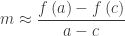
\displaystyle m\approx \frac{f\left( a \right)-f\left( c \right)}{a-c}

  1. Ask how this could be made “less approximate” and more actually equal. (Answer: smaller and smaller value of h.) Ask them to find the value of h = ac for their points. How small are they? How can you make them really small? (Find a limit.)
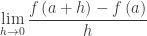
  2. Notice that h cannot be zero in these expressions. Keep hinting until someone comes up with the idea of finding

\displaystyle \underset{h\to 0}{\mathop{\lim }}\,\frac{f\left( a+h \right)-f\left( a \right)}{h}  or  \displaystyle \underset{a\to c}{\mathop{\lim }}\,\frac{f\left( a \right)-f\left( c \right)}{a-c}

  1. Next have the students calculate the limits below by actually doing the algebra. (They will not be able to handle the sin(x) at this point so save that for later.)

\displaystyle \underset{h\to 0}{\mathop{\lim }}\,\frac{{{\left( x+h \right)}^{2}}-{{\left( x \right)}^{2}}}{h}\text{ and }\underset{h\to 0}{\mathop{\lim }}\,\frac{{{\left( x+h \right)}^{3}}-{{\left( x \right)}^{3}}}{h}

  1. Compare the answers here with the earlier work and guesses, and discuss.

… And now you are ready to define the limits as the ’(a) derivative of f at x = a.

.

Good Question 5: 1998 AB2/BC2

Continuing my occasional series of some of my favorite teaching questions, today we look at the 1998 AP Calculus exam question 2. This question appeared on both the AB and BC exams. I use this problem to illustrate two very different questions that come up almost every time I lead a workshop or an AP Summer Institute. The first is if a limit is infinite, should you say “infinite” or “does not exist (DNE)”? The second is if the student solves the problems correctly, but by some other method, maybe even one not using the calculus, do they still earn full credit? In addition to discussing these two questions I’ll have a few suggestions for how to use this kind of question for teaching (maybe in other than a calculus class).

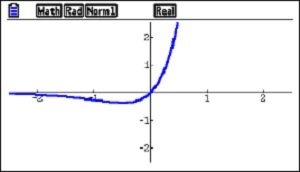
The question had the student examine the function f\left( x \right)=2x{{e}^{2x}} and, although it is easy enough to answer without, students were allowed to use their graphing calculator. A reasonable student probably looked at a graph of the function.

f\left( x \right)=2x{{e}^{2x}}

Part a: First the question asks the student to explore the end behavior of the function by finding two limits: \underset{x\to -\,\infty }{\mathop{\lim }}\,f\left( x \right) and \underset{x\to \infty }{\mathop{\lim }}\,f\left( x \right). The students should not depend on the graph here. As x\to -\infty , {{e}^{2x}}approaches zero and since the exponential function dominates the polynomial, \underset{x\to -\,\infty }{\mathop{\lim }}\,f\left( x \right)=0. In passing note that for x < 0 the function is negative and approaches zero from below. No work or explanation was required, but when teaching things like this be sure students know and can explain their answer without reference to their calculator graph.  For the second limit, since both factors increase without bound \underset{x\to \infty }{\mathop{\lim }}\,f\left( x \right)=\infty  If the student wrote \underset{x\to \infty }{\mathop{\lim }}\,f\left( x \right)=\text{DNE}, he received full credit.

Infinity is not a number, so there really is no limit in the second case; the limit DNE. But there are other ways a limit may not exist such as a jump discontinuity or an oscillating discontinuity.  DNE covers these as well as infinite limits. Saying a limit is infinite tells us more about the limit than DNE. It tells us that the function increases without bound; that eventually it becomes greater than any number.

Both answers are correct.

But we’re not done with this yet. We will come back to it before the question is done.

Part b: Students were asked to find and justify the minimum value of the function. Using the first derivative test, students proceeded by finding where the derivative is zero..

{f}'\left( x \right)=\left( 2x \right)\left( 2{{e}^{2x}} \right)+2{{e}^{2x}}=2{{e}^{2x}}\left( 2x+1 \right)=0

x=-\frac{1}{2}

f\left( -\tfrac{1}{2} \right)=2\left( -\tfrac{1}{2} \right){{e}^{2\left( -\tfrac{1}{2} \right)}}=-\frac{1}{e}\approx 0.368\text{ or }0.367

Justification: If x<-\tfrac{1}{2},\ {f}'\left( x \right)<0 and if x>-\tfrac{1}{2},\ {f}'\left( x \right)>0, therefore the absolute minimum is -\frac{1}{e} and occurs at x=-\frac{1}{2}.

All pretty straightforward

Part c: This part asked for the range of the function. Here the student must show that if he wrote DNE in part a, he knows that in fact the function grows without bound.

Putting together the answers from part a and part c, the range is f\left( x \right)\ge -\frac{1}{e}, which may also be written as \left[ -1/e,\infty\right). (The decimals could also be used here.)

Part d: asked students to consider functions given by y=bx{{e}^{bx}} where b was a non-zero number. The question required students to show that the absolute minimum value of all these functions was the same.

Most students did what was expected and preceded as in part b. The work is exactly the same as above except that all of the 2s become bs. The absolute minimum occurs at x=-\frac{1}{b} and y\left( -\tfrac{1}{b} \right)=-\frac{1}{e}.

BUT ….

Other students found a way completely without “calculus.” Can you find do that?

They realized that the given function as a horizontal expansion or compression, possibly including a reflection over the y-axis, of and therefore the range is the same for all these functions and so the minimum value must be the same. This received full credit. The rule of thumb is “don’t take off for good mathematics.”

Pretty cool!

The graphs of several cases are shown below

y=bx{{e}^{bx}}
b = -5 in blue, b = -1 in red, b = 2 in green, and b = 4 in magenta.

Teaching Suggestions

I can see using this in a pre-calculus class. The calculus (finding the minimum for b = 2 or in general) is straightforward. In a pre-calculus setting as an example of transformations it may be more useful. You could give students 6, or 8, or 10 examples with different values of b, both positive and negative.

  1. First ask students to investigate the end behavior by finding the limits as x approaches positive and negative infinity. The results will be similar. Have them write a summary considering two cases: b > 0 and b < 0.
  2. Graphing calculators have built-in operations that will find the x-coordinates or both coordinates of the minimum point of a function. Since we’re concerned with the transformation and not the calculus, let students use their graphing calculators to find the coordinates of the minimum point of each graph (as decimals). See if they can determine the x-coordinate in terms of b. They should also notice that y-coordinates will all be the same (about -0.367880).
  3. Finally, set the class to proving using their knowledge of transformation that the minimums are really all the same.

Good Question 3 1995 BC 5

A word before we look at one of my favorite AP exam questions, I put some of my presentations in a new page. Look under the “Resources” tab above, and you will see a new page named “Presentations.” There are PowerPoint slides and the accompanying handouts from some talks I’ve given in the last few years. I also use them in my workshops and AP Summer Institutes.

This continue a discussion of some of my favorite question and how to use them in class.You can find the others by entering “Good Question” in the search box on the right.

Today we look at one of my favorite AP exam questions. This one is from the 1995 BC exam; the question is also suitable for AB students. Even though it is 20 years old, it is still a good question.  1995 was the first year that graphing calculators were required on the AP Calculus exams.They were allowed, but not required for all 6 questions.

1995 BC 5

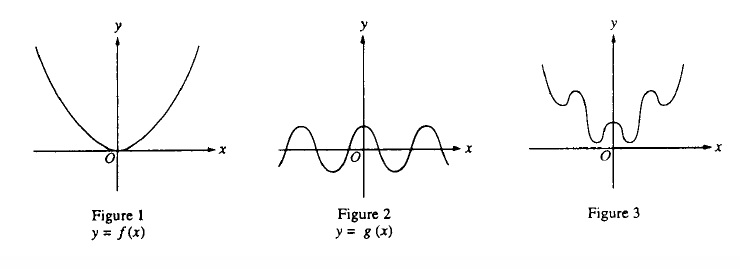
The question showed the three figures below and identified figure 1 as the graph of f\left( x \right)={{x}^{2}}  and figure 2 as the graph of g\left( x \right)=\cos \left( x \right).  The question then allowed as how one might think of the graph is figure 3 as the graph of h\left( x \right)={{x}^{2}}+\cos \left( x \right), the sum of these two functions. Not that unreasonable an assumption, but apparently not correct.

1995 BC 5

Part a: The students first were asked to sketch the graph of h\left( x \right) in a window with [–6, 6] x [–6, 40] (given this way). A box with axes was printed in the answer booklet.  This was a calculator required question and the result on a graphing calculator looks like this:


1995 BC 5

y={{x}^{2}}+\cos \left( x \right).
The window is [-6,6] x [-6, 40]

Students were expected to copy this onto the answer page. Note that the graph exits the screen below the top corners and it does not go through the origin. Both these features had to be obvious on the student’s paper to earn credit.

Part b: The second part of the question instructed students to use the second derivative of h\left( x \right) to explain why the graph does not look like figure 3.

\displaystyle \frac{dy}{dx}=2x-\sin \left( x \right)

\displaystyle \frac{{{d}^{2}}y}{d{{x}^{2}}}=2-\cos \left( x \right)

Students then had to observe that the second derivative was always positive (actually it is always greater than or equal to 1) and therefore the graph is concave up everywhere. Therefore, it cannot look like figure 3.

Part c: The last part of the question required students to prove (yes, “prove”) that the graph of y={{x}^{2}}+\cos \left( kx \right) either had no points of inflection or infinitely many points of inflection, depending on the value of the constant k.

Successful student first calculated the second derivative:
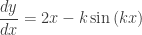
\displaystyle \frac{dy}{dx}=2x-k\sin \left( kx \right)

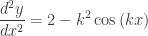
\displaystyle \frac{{{d}^{2}}y}{d{{x}^{2}}}=2-{{k}^{2}}\cos \left( kx \right)

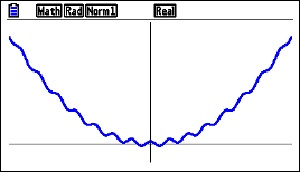
Then considering the sign of the second derivative, if {{k}^{2}}\le 2, \frac{{{d}^{2}}y}{d{{x}^{2}}}\ge 0 and there are no inflection points (the graph is always concave up). But, if {{k}^{2}}>2, then since y” is periodic and changes sign, it does so infinitely many times and there are then infinitely many inflection points. See the figure below.

k = 8

k = 8


Using this question as a class exercise

Notice how the question leads the student in the right direction. If they go along with the problem they are going in the right direction. In class, I would be inclined to make them work for it.

  1. First, I would ask the class if figure 3 is the correct graph of h\left( x \right)={{x}^{2}}+\cos \left( x \right). I would let them, individually, in groups, or as a class suggest and defend an answer. I would not even suggest, but certainly not mind, if they used a graphing calculator.
  2. Once they determined the correct answer, I would ask them to justify (or prove) their conjecture. Again, no hints; let the class struggle until they got it. I may give them a hint along the lines of what does figure 3 have or do that the correct graph does not. (Answer: figure 3 changes concavity). Sooner or later someone should decide to check out the second derivative.
  3. Then I’d ask what could be the equation for a graph that does look like figure 3. You could give hints along the line of changing the coefficients of the terms of the second derivative. There are several ways to do this and all are worth considering.
    1. Changing the coefficient of the x2 term (to a proper fraction, say, 0.02) will do the trick. If that’s what they come up with fine – it’s correct.
    2. If you want to be picky, this causes the graph to go negative and figure 3 does not do that, but I ‘d let that go and ask if changing the coefficient of the cosine term in the second derivative can be done and if so how do you do that.
    3. This may be done by simply putting a number in front of the cosine term of the original function, say h\left( x \right)={{x}^{2}}+6\cos \left( x \right), but the results really do not look like figure 3,

    4. If necessary, give them the hint y={{x}^{2}}+\cos \left( kx \right)

1995 was the first year graphing calculators were required on the AP Calculus exams. They were allowed for all questions, but most questions had no place to use them. The parametric equation question on the same test, 1995 BC 1, was also a good question that made use of the graphing capability of calculators to investigate the relative motion of two particles in the plane.   The AB Exam in 1995 only required students to copy one graph from their calculator.

Both BC questions were generally well received at the reading. I know I liked them. I was looking forward to more of the same in coming years.

I was disappointed.

There was an attempt the following year (1997 AB4/BC4), but since then nothing investigating families of functions (i.e.  like these with a parameter that affects the shape of the graph) or anything similar has appeared on the exams. I can understand not wanting to award a lot of points for just copying the graph from your calculator onto the paper, but in a case like this where the graph leads to a rich investigation of a counterintuitive situation I could get over my reluctance.

But that’s just me.

Soda Cans

A typical calculus optimization question asks you to find the dimensions of a cylindrical soda can with a fixed volume that has a minimum surface area (and therefore is cheaper to manufacture).

Let r be the radius of the cylinder and h be its height. The volume, V, is constant and V=\pi {{r}^{2}}h. The surface area including the top and bottom is given by

S=2\pi rh+2\pi {{r}^{2}}

Since \displaystyle h=\frac{V}{\pi {{r}^{2}}}, the surface area, S, can be expressed as

S=2V{{r}^{-1}}+2\pi {{r}^{2}}

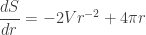
To find the value of r that will give the smallest surface area we find the derivative, set it equal to zero and solve for r:

\displaystyle \frac{dS}{dr}=-2V{{r}^{-2}}+4\pi r

This will equal zero when \displaystyle r=\sqrt[3]{\frac{V}{2\pi }} and substituting into the expression above \displaystyle h=\sqrt[3]{\frac{4V}{\pi }}.

Then \displaystyle \frac{h}{r}=\sqrt[3]{\frac{\frac{4V}{\pi }}{\frac{V}{2\pi }}}=2, so h=2r. In the optimum can the height is equal to the diameter.

The thing is that very few cans, especially beverage cans are anywhere near this “square “ shape. The closest I could find in my pantry was a tomato sauce can holding 8 oz. or 277 mL. The inside dimensions are about 65 cm. by 75cm.  Compare this to the 12 oz. soda can holding 355 mL. The usual reason given for this departure from the mathematically best shape is the taller can is easier to hold especially for children.

IMG_0442

What got me interested in this was the video below. While there is no overt calculus mentioned, there is a lot of math. There are also STEM considerations, specifically engineering. As you watch look for the math and engineering ideas that are mentioned and discuss them with your class. Here are a few:

  1. Geometry: Why a cylinder? Why not a sphere or a cube?
  2. Engineering: When cutting circles out of rectangular sheets of aluminum there is a lot of unused metal. Why is all this waste not a problem? This goes to materials engineering; steel is more difficult to recycle than aluminum.
  3. Math: Efficient packing is also a consideration. Check the calculations in the video as to the most efficient way (least empty space) to pack containers. Why do they not use the most efficient?
  4. Geometry: The (spherical) dome is a very strong shape. In what other places are domes used? Why?
  5. Engineering: How does pressurizing the cans make them stronger?
  6. Geometry and Engineering: The elongated ridges on the sides of non-pressurized steel cans strengthen the sides. How are these ridges similar to the dome or circular arch?
  7. Physics: Look for a discussion of first- and second-class leavers.
  8. Engineering: What other advantages are there to using the very thin aluminum can.

At the end of the video 6 other videos are mentioned. These are also interesting and show the same process in cartoon form and in video of the machines making cans. The links to these are here:

Rexam: http://www.youtube.com/watch?v=7dK1VV…
How It’s Made: http://www.youtube.com/watch?v=V7Y0zA…
Anim1: https://www.youtube.com/watch?v=WU_iS…
Anim2:https://www.youtube.com/watch?v=hcsDx…
Drawing: https://www.youtube.com/watch?v=DF4v-…
Redrawing: http://www.youtube.com/watch?v=iUAijp…