Calculus is always done in radian measure. Degree (a right angle is 90 degrees) and gradian measure (a right angle is 100 grads) have their uses. Outside of the calculus they may be easier to use than radians. However, they are somewhat arbitrary. Why 90 or 100 for a right angle? Why not 10 or 217?
Radians make it possible to relate a linear measure and an angle measure. A unit circle is a circle whose radius is one unit. The one-unit radius is the same as one unit along the circumference. Wrap a number line counterclockwise around a unit circle starting with zero at (1, 0). The length of the arc subtended by the central angle becomes the radian measure of the angle.
This keeps all the important numbers like the sine and cosine of the central angle, on the same scale. When you graph y = sin(x) one unit in the x-direction is the same as one unit in the y-direction. When graphing using degrees, the vertical scale must be stretched a lot to even see that the graph goes up and down. Try graphing on a calculator y = sin(x) in degree mode in a square window and you will see what I mean.
But the utility of radian measure is even more obvious in calculus. To develop the derivative of the sine function you first work with this inequality (At the request of a reader I have added an explanation of this inequality at the end of the post):

From this inequality you determine that 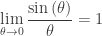
The middle term of the inequality is the area of a sector of a unit circle with central angles of  radians. If you work in degrees, this sector’s area is
  and you will find that
 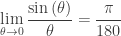 .
.
This limit is used to find the derivative of the sin(x). Thus, with x in degrees, 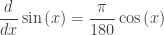 . This means that with the derivative or antiderivative of any trigonometric function that
  is there getting in the way.
Who needs that?
Do your calculus in radians.
Revision December 7, 2014: The inequality above is derived this way. Consider the unit circle shown below.
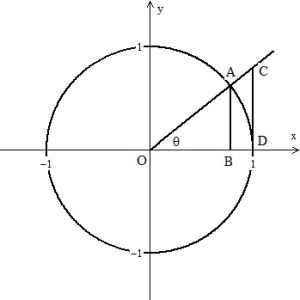
1. The central angle is and the coordinates of A are  .
.
Then the area of triangle OAB is 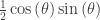
2. The area of sector  . The sector’s area is larger than the area of triangle OAB.
3. By similar triangles  .
.
Then the area of  This is larger than the area of the sector, which establishes the inequality above.
Multiply the inequality by  and take the reciprocal to obtain
 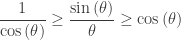 .
.
Finally, take the limit of these expression as  and the limit is established by the squeeze theorem.





![[0,\tfrac{\pi }{2})\cup (\tfrac{\pi }{2},\pi ]](https://s0.wp.com/latex.php?latex=%5B0%2C%5Ctfrac%7B%5Cpi+%7D%7B2%7D%29%5Ccup+%28%5Ctfrac%7B%5Cpi+%7D%7B2%7D%2C%5Cpi+%5D&bg=ffffff&fg=333333&s=0&c=20201002)
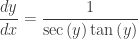
 Then
Then 


 or is undefined and then determining if there is a change of sign of the first derivative at the critical number. This may be the location of an extreme value. Compare y = x2 and y = x3 at the origin.
 or is undefined and determine if there is a sign change there. These places may be points of inflection. Compare y = x3 and y = x4 at the origin.
 .
. .
. .
. .
. , then the function is increasing on that interval.”

 Teaching Calculus