You are now ready to move into the study of integration, the other “half” of calculus. To integrate is defined as “to bring together or incorporate parts into a whole” (Dictionary.com).
The initial problem in integral calculus is to find the area of a region between the graph of a function and the x-axis with vertical sides. This is done by lining up very thin rectangles, finding their individual areas and incorporating them into a whole by adding their areas.
The way the rectangles areas are found and added is to use a Riemann sum. The width of each rectangle is a small distance along the x-axis and the length is the distance from the x-axis to the curve. As you use more rectangles over the same interval, their width decreases, and the approximation of the area becomes better.
Yes, that’s limits again. As the number of rectangles increases (), their width decreases () and the (Riemann) sum approaches the area.
You will start by setting up some of these Riemann sums with a small number of rectangles to help you get the idea of what’s happening. (Lots of arithmetic here.)
Written in mathematical notation, a Riemann sum looks like this . The interval on the x-axis is divided into subintervals of width ; these do not have to be the same, but almost always are. The is the function’s value at some point, , in each interval. So, is the area of the rectangle for that subinterval. The sigma sign sums them up.
And the gives the area.
Most of the time the limit will not be easy to find, so you’ll avoid it! Soon you will learn a quick and efficient way to find the limits.
Riemann sums can be used in many other applications as you will soon learn.
The question below appears in the new Course and Exam Description (CED) for AP Calculus, and has caused some questions since it is not something included in most textbooks and has not appeared on recent exams.
Example 1
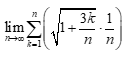
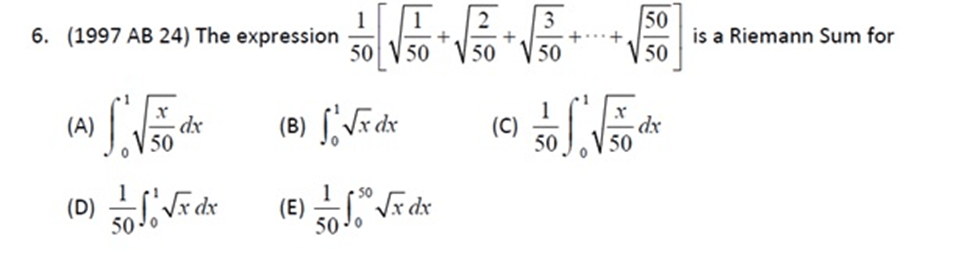
Which of the following integral expressions is equal to
There were 4 answer choices that we will consider in a minute.
To the best of my recollection the last time a question of this type appeared on the AP Calculus exams was in 1997, when only about 7% of the students taking the exam got it correct. Considering that by random guessing about 20% should have gotten it correct, this was a difficult question. This question, the “radical 50” question is at the end of this post.
The first key to answering the question is to recognize the limit as a Riemann sum. In general, a right-side Riemann sum for the function f on the interval [a, b] with n equal subdivisions has the form:
To evaluate the limit and express it as an integral, we must identify, a, b, and f. I usually begin by looking for (b – a)/n. In this problem (b – a)/n = 1/n and from this conclude that b – a = 1, so b = a + 1.
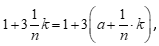
Then rewriting the radicand as
It appears that the function is
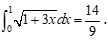
and the limit is
.This is the first answer choice. The choices are:
In this example, choices B, C, and D can be eliminated as soon as we determine that b = a + 1, but that is not always the case.
Let’s consider another example:
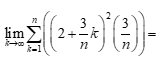
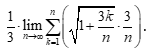
Example 2:
As before consider (b – a)/n = 3/n implies that b = a + 3. And the function appears to be
on the interval [0, 3], so the limit is
BUT
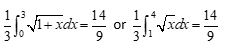
What is we take a = 2. If so, the limit is
And now one of the “problems” with this kind of question appears: the answer written as a definite integral is not unique!
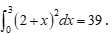
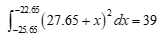
Not only are there two answers, but there are many more possible answers. These two answers are horizontal translations of each other, and many other translations are possible, such as
Returning to example 1, using something like a u-substitution, we can rewrite the original limit as .
Now b = a + 3 and the limit could be either
You will probably have your students write Riemann sums with a small value of n when you are teaching Riemann sums leading up to the Fundamental Theorem of Calculus. You can make up problems like this these by stopping after you get to the limit, giving your students just the limit, and have them work backwards to identify the function(s) and interval(s). You could also give them an integral and ask for the associated Riemann sum. Question writes call a question like this a reversal question, since the work is done in reverse of the usual way.
Another example appears in the 2016 “Practice Exam” available at your audit website. It is question AB 30. That question gives the definite integral and asks for the associate Riemann sum; a slightly different kind of reversal. Since this type of question appears in both the CED examples and the practice exam, chances of it appearing on future exams look good.
Critique of the problem
I’m not sure if this type of problem has any practical or real-world use. Certainly, setting up a Riemann sum is important and necessary to solve a variety of problems. After all, behind every definite integral there is a Riemann sum. But starting with a Riemann sum and finding the function and interval does not seem to me to be of practical use.
The CED references this question to MPAC 1: Reasoning with definitions and theorems, and to MPAC 5: Building notational fluency. They are appropriate, but still is the question ever done outside a test or classroom setting?
Another, bigger, problem is that the answer choices to Example 1 force the student to do the problem in a way that gets one of the answers. It is perfectly reasonable for the student to approach the problem a different way, and get another correct answer that is not among the choices. This is not good. The question could be fixed by giving the answer choices as numbers. These are the numerical values of the 4 choices:
As you can see that presents another problem.
Finally, here is the question from 1997, for you to try:
Answer B. Hint n = 50
_______________________________
Note: The original of this post was lost somehow. I’ve recreated it here. Sorry if anyone was inconvenienced. LMc May 5, 2024
I think that the path leading up to and including the Fundamental Theorem of Calculus (FTC) is one of the most beautiful walks in mathematics. I have written several posts about it. You will soon be ready to travel that path with your students. (I always try to post on topics shortly before most teachers will get to them, so that you have some time to consider them and work the ideas you like into your lessons.)
Here is an annotated list of some of the posts to guide you on your journey.
Working Towards Riemann Sums gives the preliminary definitions you will need to define and discuss Riemann sums.
Riemann Sums defines the several Riemann sums often used in the calculus left-side sums, right-side sums, midpoint sums and the trapezoidal sums. “The Area Under a Curve” in the iPad app A Little Calculusis a great visual display of these and shows what happens as you use more subintervals.
The Definition of the Definite Integral gives the definition of the definite integral as the limit of any Riemann sum. As with any definition, there is nothing to prove or argue about here. The thing to remember is that the limit of the Riemann sum and the definite integral are the same thing. Behind any definite integral is a Riemann sum. The advantage of the definition’s integral notation is that it shows the interval involved which the Riemann sum does not. (Any Riemann sum may be represented by many definite integrals. See Good Question 11 – Riemann Reversed.)
Foreshadowing the FTC is an example of how a definite integral may be evaluated. It is long and has a lot of notation, so you may not want to use this.
The Fundamental Theorem of Calculus is where the path leads. This post develops the FTC based on the other “big” idea of the calculus: the Mean Value Theorem. (I think the form here is preferable to the usual book notation that uses F(x) and its derivate f (x).)
Y the FTC? Tries to answer the question of what’s so important about the FTC. Example 1: The verbal interpretation of the FTC (the integral of a rate of change is the net amount of change over the interval.) will soon be used in many practical applications. While example 2 shows how the FTC allows one to evaluate a definite integral and, therefore the Riemann sum it represents, by evaluating a function whose derivative is the integrand (its antiderivative).
More About the FTC presents examples leading up to the other form of the FTC: the derivative of the integral is the integrand).
At this point you may go in the direction of learning how to find antiderivatives or working on applications. (See Integration itinerary.)
Unit 6 develops the ideas behind integration, the Fundamental Theorem of Calculus, and Accumulation. (CED – 2019 p. 109 – 128). These topics account for about 17 – 20% of questions on the AB exam and 17 – 20% of the BC questions.
Topics 6.1 – 6.4 Working up to the FTC
Topic 6.1 Exploring Accumulations of Change Accumulation is introduced through finding the area between the graph of a function and the x-axis. Positive and negative rates of change, unit analysis.
Topic 6.2 Approximating Areas with Riemann Sums Left-, right-, midpoint Riemann sums, and Trapezoidal sums, with uniform partitions are developed. Approximating with numerical methods, including use of technology are considered. Determining if the approximation is an over- or under-approximation.
Topic 6.3 Riemann Sums, Summation Notation and the Definite Integral. The definition integral is defined as the limit of a Riemann sum.
Topic 6.4 The Fundamental Theorem of Calculus (FTC) and Accumulation Functions Functions defined by definite integrals and the FTC.
Topic 6.5 Interpreting the Behavior of Accumulation Functions Involving Area Graphical, numerical, analytical, and verbal representations.
Topic 6.6 Applying Properties of Definite Integrals Using the properties to ease evaluation, evaluating by geometry and dealing with discontinuities.
Topic 6.7 The Fundamental Theorem of Calculus and Definite Integrals Antiderivatives. (Note: I suggest writing the FTC in this form because it seem more efficient then using upper case and lower case f.)
Topics 6.5 – 6.14 Techniques of Integration
Topic 6.8 Finding Antiderivatives and Indefinite Integrals: Basic Rules and Notation. Using basic differentiation formulas to find antiderivatives. Some functions do not have closed-form antiderivatives. (Note: While textbooks often consider antidifferentiation before any work with integration, this seems like the place to introduce them. After learning the FTC students have a reason to find antiderivatives. See Integration Itinerary
Topic 6.9 Integration Using Substitution The u-substitution method. Changing the limits of integration when substituting.
Topic 6.10 Integrating Functions Using Long Division and Completing the Square
Topic 6.11 Integrating Using Integration by Parts (BC ONLY)
Topic 6.12 Integrating Using Linear Partial Fractions (BC ONLY)
Topic 6.13 Evaluating Improper Integrals (BC ONLY) Showing the work requires students to show correct limit notation.
Topic 6.14 Selecting Techniques for Antidifferentiation This means practice, practice, practice.
Timing
The suggested time for Unit 6 is 18 – 20 classes for AB and 15 – 16 for BC of 40 – 50-minute class periods, this includes time for testing etc.
First of nine. One of the things many successful AP Calculus teachers do is to use past AP exam questions throughout the year. Individual multiple-choice exam questions are used as the topics they test are taught; free-response questions are adapted and expanded. There are several ways to do this:
Assign parts of a free-response (FR) question as is as the topic it tests is taught. Later, other parts from the same stem can be assigned. Including previously assigned parts is a spiraling technique. Once students see that you are doing this, they will be more likely to keep up to date on past topics.
Adapting and expanding the questions is another way to use FR questions.
This summer I will be discussing how to do just that. Each week I will look at one of the released 2021 FR questions and suggest how to expand and adapt it. Each stem allows for many more questions than can be asked on any one exam. You have the luxury of asking other things based on the same stem.
This summer’s series of posts will take one question at a time discuss it and suggest additional questions or explorations that may be asked. I will not be presenting solutions. They are available on AP Community bulletin board here and here. I will link the posts to the scoring standards when they are published.
2021 AB 1 / BC 1
This is a Reimann sum and Table question (Type 5) and covers topics from Units 6 and 8 from the current Course and Exam Description. All four parts are fairly typical for this type of problem. There is a little twist in part (b). The context is the density of bacteria growing in a petri dish.
Density is not listed in the Course and Exam Description. It is not covered well in many textbooks. Since it is not listed you need not teach it; exam questions referencing density have enough included information so that a student who has never seen the concept will still be able to answer the question. Keep this in mind as you look at each part; help your students see past the context and look at the calculus. More information on density see these posts Density Functions, and Good Question 15 and Good Question 16.
The stem for 2021 AB 1 / BC 1 reads:
Part (a): Students were asked to estimate the value of the derivative of f at r = 2.25 and explain its meaning, including units, in the context of the problem. The expected procedure is to find the slope between the two values closest to r =2.25. The interpretation is the increase in density as you move away from the center. The units are milligrams per square centimeter per centimeter distant from the center .
Discussion and ideas for adapting this question:
AP exams have always asked this question at a value exactly half-way between two values in the table. You may change this to some other place such as r = 3 or r = 0.8.
Units of the derivative are always the units of the function divided by the units of the independent variable. Be sure your students understand this.
The units can be correctly written as , but here is a good change to discuss what the units mean. Why does “milligrams per square centimeter per centimeter distant from the center” make more sense?
Ask “Is there a point in the interval [2, 2.5] where the slope of the tangent line is 8? Justify your answer.” This makes use of the Mean Value Theorem.
Part (b) : As usual in this type of problem, students are asked to write a Riemann sum based on the intervals in the table. The difference here is that the integral being approximated, , has an “extra” factor of r in it.
Discussion and ideas for adapting this question:
The question asked for a right Riemann sum. You can easily adapt this by asking for a left Riemann sum, a midpoint Riemann sum, and/or a Trapezoidal approximation.
You may ask for a Riemann sum without the “extra” factor.
You may find a different Riemann sum problem and include an “extra” factor in it.
The integral is the integral for a radial density function. See the Density blog post cited above, example 2.
The radial density function looks like the integral for finding volumes by the method of cylindrical shells. This is more than a coincidence. Why?
Part (c): This part asked if the answer in (b) is an overestimate or an underestimate, with an explanation. For any approximation, some idea of its accuracy is important. In BC questions on power series approximations, a numerical estimate of the error bound is a common question.
Discussion and ideas for adapting this question:
Ask the same question for a different Riemann sum (left, midpoint, trapezoid).
The error in right and left Riemann sums estimates depend on whether the function is increasing or decreasing, and therefore on the first derivative. Midpoint and Trapezoidal approximation estimates are related to the concavity and therefore to the second derivative. See: Good Question 4)
A visual idea helps keep all this straight. Draw sketches showing the Riemann sum rectangles or trapezoids. Whether they lie above or below the graph of the function determines whether the approximation is an overestimate or underestimate.
Part (d): Typical of the Riemann sum table question is the final part with a related question based on a function and not based on the table.
Discussion and ideas for adapting this question:
This is a calculator allowed question. Students should not try to do the integration by hand.
The question asked for the average value of the function on an interval. Other questions you could ask are find the rate of change (derivative) at a point, the total mass (note “extra” r), the average rate of change on an interval, etc.
Next week 2021 AB 2.
I would be happy to hear your ideas for other ways to use these questions. Please use the reply box below to share your ideas.
Unit 6 develops the ideas behind integration, the Fundamental Theorem of Calculus, and Accumulation. (CED – 2019 p. 109 – 128 ). These topics account for about 17 – 20% of questions on the AB exam and 17 – 20% of the BC questions.
Topics 6.1 – 6.4 Working up to the FTC
Topic 6.1 Exploring Accumulations of Change Accumulation is introduced through finding the area between the graph of a function and the x-axis. Positive and negative rates of change, unit analysis.
Topic 6.2 Approximating Areas with Riemann Sums Left-, right-, midpoint Riemann sums, and Trapezoidal sums, with uniform partitions are developed. Approximating with numerical methods, including use of technology are considered. Determining if the approximation is an over- or under-approximation.
Topic 6.3 Riemann Sums, Summation Notation and the Definite Integral. The definition integral is defined as the limit of a Riemann sum.
Topic 6.4 The Fundamental Theorem of Calculus (FTC) and Accumulation Functions Functions defined by definite integrals and the FTC.
Topic 6.5 Interpreting the Behavior of Accumulation Functions Involving Area Graphical, numerical, analytical, and verbal representations.
Topic 6.6 Applying Properties of Definite Integrals Using the properties to ease evaluation, evaluating by geometry and dealing with discontinuities.
Topic 6.7 The Fundamental Theorem of Calculus and Definite Integrals Antiderivatives. (Note: I suggest writing the FTC in this form because it seem more efficient then using upper case and lower case f.)
Topics 6.5 – 6.14 Techniques of Integration
Topic 6.8 Finding Antiderivatives and Indefinite Integrals: Basic Rules and Notation. Using basic differentiation formulas to find antiderivatives. Some functions do not have closed-form antiderivatives. (Note: While textbooks often consider antidifferentiation before any work with integration, this seems like the place to introduce them. After learning the FTC students have a reason to find antiderivatives. See Integration Itinerary
Topic 6.9 Integration Using Substitution The u-substitution method. Changing the limits of integration when substituting.
Topic 6.10 Integrating Functions Using Long Division and Completing the Square
Topic 6.11 Integrating Using Integration by Parts (BC ONLY)
Topic 6.12 Integrating Using Linear Partial Fractions (BC ONLY)
Topic 6.13 Evaluating Improper Integrals (BC ONLY) Showing the work requires students to show correct limit notation.
Topic 6.14 Selecting Techniques for Antidifferentiation This means practice, practice, practice.
Timing
The suggested time for Unit 6 is 18 – 20 classes for AB and 15 – 16 for BC of 40 – 50-minute class periods, this includes time for testing etc.
Behind every definite integral is a Riemann sums. Students need to know about Riemann sums so that they can understand definite integrals (a shorthand notation for the limit if a Riemann sun) and the Fundamental theorem of Calculus. Theses posts help prepare students for Riemann sums.








 because it seem more efficient then using upper case and lower case f.)
 does not converge.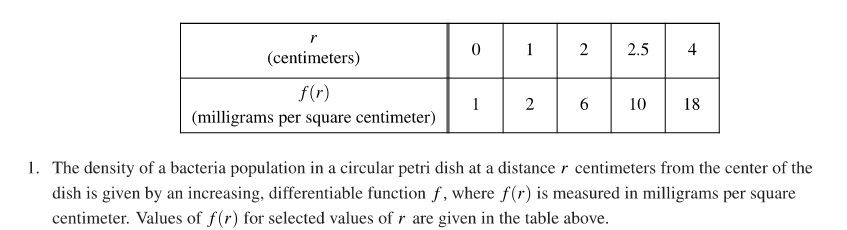
 .
. , but here is a good change to discuss what the units mean. Why does “milligrams per square centimeter per centimeter distant from the center” make more sense?
 , has an “extra” factor of r in it.
 (note “extra” r), the average rate of change on an interval, etc.
 because it seem more efficient then using upper case and lower case f.)
 does not converge.
 Teaching Calculus