Darboux’s Theorem

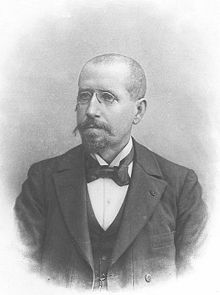
Jean Gaston Darboux 1842 - 1917

Jean Gaston Darboux
1842 – 1917

Jean Gaston Darboux was a French mathematician who lived from 1842 to 1917. Of his several important theorems the one we will consider says that the derivative of a function has the Intermediate Value Theorem property – that is, the derivative takes on all the values between the values of the derivative at the endpoints of the interval under consideration.

Darboux’s Theorem is easy to understand and prove but is not usually included in a first-year calculus course (and is not included on the AP exams). Its use is in the more detailed study of functions in a real analysis course.

You may want to use this as an enrichment topic in your calculus course, or a topic for a little deeper investigation. The ideas here are certainly within the range of what first-year calculus students should be able to follow. They relate closely to the Mean Value Theorem (MVT). I will suggest some ideas (in blue) to consider along the way.

More precisely Darboux’s theorem says that

If f is differentiable on the closed interval [a, b] and r is any number between f ’ (a) and f ’ (b), then there exists a number c in the open interval (a, b) such that ‘ (c) = r. 

Differentiable on a closed interval?

Most theorems in beginning calculus require only that the function be differentiable on an open interval. Here, obviously, we need a closed interval so that there will be values of the derivative for r to be between.

The limit definition of derivative requires a regular two-sided limit to exist; at the endpoint of an interval there is only one side. For most theorems this is enough. Here the definition of derivative must be extended to allow one-sided limits as x approaches the endpoint values from inside the interval. Also note that  if a function is differentiable on (a, b), then it is differentiable on any closed sub-interval of (a, b) that does not include a or b.

Geometric proof [1]

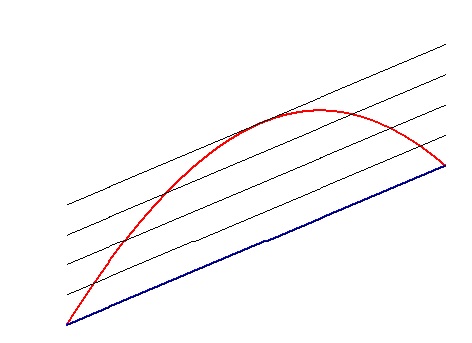
Consider the diagram below, which shows a function in blue. At each endpoint draw a line with the slope of r. Notice that these two lines have a slope less than that of the function at the left end and greater than the slope at the right end. At least one of these lines must intersect the function at an interior point of the interval.  Before reading on, see if you and your students can complete the proof from here. (Hint: What theorem does the top half of the figure remind you of?)

DarbouxOn the interval between the intersection point and the end point we can apply the Mean Value Theorem and determine the value of c where the tangent line will be parallel to the line through the endpoint. At this point ‘(c) = r. Q.E.D.

Analytic Proof [2]

Consider the function h\left( x \right)=f\left( x \right)-(f(b)+r(x-b)). Since f(x) is differentiable, it is continuous; \displaystyle f(b)+r(x-a) is also continuous and differentiable. Therefore, h(x) is continuous and differentiable on [a, b]. By the Extreme Value Theorem, there must be a point, x = c, in the open interval (a, b) where h(x) has an extreme value. At this point h’ (c) = 0.

Before reading on see if you can complete the proof from here.

\displaystyle h(x)=f(x)-(f(b)+r(x-a))

\displaystyle {h}'(x)={f}'(x)-r

\displaystyle {h}'(c)={f}'(c)-r=0

\displaystyle {f}'\left( c \right)=r

Q.E.D.

Exercise: Compare and contrast the two proofs.

  1. In the geometric proof, what does \displaystyle y=f(b)+r(x-a) represent? Where does it show up in the diagram?
  2. How do both proofs relate to the Mean Value Theorem (or Rolle’s Theorem).

The function \displaystyle h(x)=f(x)-(f(b)+r(x-a)) represents the vertical distance from f(x) to \displaystyle f(b)+r(x-a). In the diagram, this is a vertical segment connecting f(x) to  \displaystyle y=f(b)+r(x-a).This expression may be positive, negative, or zero. In the diagram, at the point(s) where the line through the right endpoint intersects the curve and at the endpoint h(x) = 0. Therefore, h(x) meets the hypotheses of Rolle’s Theorem (and the MVT), and the result follows.

The line through the right endpoint will have equation the y=f(b)+r(x-b) This makes h\left( x \right)=f\left( x \right)-\left( f(b)+r(x-b) \right). When differentiated and the result will be {f}'\left( x \right)-r the same expression as in the analytic proof.

Also, you may move this line upwards parallel to its original position and eventually it will be tangent to the graph of the function. (See my posts on MVT 1 and especially MVT 2).

Exercise:

Consider the function f(x) = sin(x)

  1. On the interval [1,3] what values of the derivative of f are guaranteed by Darboux’s Theorem? .
  2. Does Darboux’s theorem guarantee any value on the interval [0,2\pi ]? Why or why not?

Answers:

  1. f ‘(x) = cos(x). f ‘ (1) = 0.54030 and f ‘ (3) = -0.98999. So the guaranteed values are from -0.98999 to 0.54030.
  2. No. f ‘ (x) = 1 at both endpoints, so there are no values between one and one.

Another interesting aspect of Darboux’s Theorem is that there is no requirement that the derivative ‘(x) be continuous!

A common example of such a function is

\displaystyle f\left( x \right)=\left\{ \begin{matrix} {{x}^{2}}\sin \left( \frac{1}{x} \right) & x\ne 0 \\ 0 & x=0 \\ \end{matrix} \right.

With \displaystyle {f}'\left( x \right)=-\cos \left( \tfrac{1}{x} \right)+2x\sin \left( \tfrac{1}{x} \right),\,\,x\ne 0.

This function (which has appeared on the AP exams) is differentiable (and therefore continuous).There is an oscillating discontinuity at the origin. The derivative is not continuous at the origin.  Yet, every interval containing the origin as an interior point meets the conditions of Darboux’s Theorem, so the derivative while not continuous has the intermediate value property.

AP exam question 1999 AB3/BC3 part c:

Finally, what inspired this post was a recent discussion on the AP Calculus Community bulletin board about the AP exam question 1999 AB3/BC3 part c. This question gave a table of values for the rate, R, at which water was flowing out of a pipe as a differentiable function of time t. The question asked if there was a time when R’ (t) = 0. It was expected that students would use Rolle’s Theorem or the MVT. There was a discussion about using Darboux’s theorem or saying something like the derivative increased (or was positive), then decreased (was negative) so somewhere the derivative must be zero (implying that derivative had the intermediate value property). Luckily, no one tried this approach, so it was a moot point.

Take a look at the problem with your students and see if you can use Darboux’s theorem. Be sure the hypotheses are met.

Answer (try it yourself before reading on):

The function is not differentiable at the endpoints. But consider an interval like [0,3]. Using the given values in the table, by the MVT there is a time t = c where R‘(c) = 0.8/3 > 0, and there is a time t = d on the interval [21, 24] where R‘(d) = -0.6/3 < 0. The function is differentiable on the closed interval [c, d] so by Darboux’s Theorem there must exist a time when R’(t) = 0. Admittedly, this is a bit of overkill.

References:

  1. After Nitecki, Zbigniew H. Calculus Deconstructed A Second Course in First-Year Calculus, ©2009, The Mathematical Association of America, ISBN 978-0-883835-756-4, p. 221-222.
  2. After Dunham, William The Calculus Gallery Masterpieces from Newton to Lebesque, © 2005, Princeton University Press, ISBN 978-0-691-09565-3, p. 156.

Both these book are good reference books.

Updated: August 20, 2014, and October 4, 2017

Mean Numbers

Here is a problem for you and your students. The numbers are mean until you get to the end when they all become very nice and well-behaved.  

You could give this to your students individually or as a group exploration. Give each person or group a different function and/or different intervals. Choose a function that has several (3 – 5) turning points in the interval. The function should be differentiable on the open interval and continuous on the closed interval.

It is intended that the work be done on a graphing calculator; you will need to carry 6 or 7 decimal places in their work.

Here is a typical problem. A link to the solution is given at the end.

Consider the function f\left( x \right)=\sin \left( x \right) on the closed interval [1, 12].

  1. Write an equation of a line, y\left( x \right),  between the endpoints of the function. Give the decimal value of its slope and give a graph of the function and the line.
  2. Write the equation of a function h\left( x \right) that gives the vertical distance between f\left( x \right) and y\left( x \right). Since f may be both above and below y this function may have positive and negative values.
  3. Graph h and find its critical values. What are these places with respect to the graph of h?
  4. Calculate the derivative of f at the critical values of h.
  5. Interpret your result graphically.

Click here for the solution.

What’s a Mean Old Average Anyway?

Students often confuse the several concepts that have the word “average” or “mean” in their title. This may be partly because not just the names, but the formulas associated with each are very similar, but I think the main reason may be that they are keying in on the word “average” rather than the full name.

Here are the three items. We will assume that the function f is continuous on the closed interval [a, b] and differentiable on the open interval (a, b):

1.  The average rate of change of a function over the interval is simply the slope of the line from one endpoint of the graph to the other.

 \displaystyle \frac{f\left( b \right)-f\left( a \right)}{b-a}

2. The mean (or average) value theorem say that somewhere in the open interval (a, b) there is a number c such that the derivative (slope) at x = c is equal to the average rate of change over the interval.

\displaystyle {f}'\left( c \right)=\frac{f\left( b \right)-f\left( a \right)}{b-a}

3. The average value of a function is literally the average of all the y-coordinates on the interval. It is the vertical side of a rectangle whose base extends on the x-axis from x = a to x =b and whose area is the same as the area between the graph and the x-axis and the function over the same interval.

\displaystyle \frac{\int_{a}^{b}{f\left( x \right)dx}}{b-a}

Notice that when you evaluate the integral, the result looks very much like the ones above. This formula is also called the mean value theorem for integrals or the integral form of the mean value theorem. No wonder people get confused.

The three are closely related. Consider a position-velocity-acceleration situation. The average rate of change of position (#1 above) is the average value of the velocity (#3) and somewhere the velocity must equal this number (#2). Similarly, the average rate of change of velocity (#1) is the average acceleration (#3) and somewhere in the interval the acceleration (derivative of velocity) must equal this number (#2).

These ideas are tested on the AP calculus exams sometimes in the same question. See for example 2004 AB 1 parts c and d.

So, help your students concentrate on the entire name of the concepts, not just the “average” part.


Proof

When math books present a theorem, they almost always immediately present its proof. I tend to skip the proofs. I assume they are correct. I want to get on with the ideas in the text. Later I may come back and read through them. Is this a good thing to advise students to do? I don’t know.

There are reasons to read proofs. One reason is to help understand why a theorem is true, by seeing the reasoning that leads to the result. Another is to check the reasoning yourself. A third is to learn how to do proofs.

Learning to write original proofs is not usually one of the goals of a beginning calculus course. That comes later in a course with “analysis” in its title. There are many theorems that involve some one-off that rarely will be used again. I’m thinking of a proof like that of the sum of the limits is equal to the limit of the sums, where you add and subtract the same expression and this more complicated form allows you to group and factor the terms of the numerator and arrive at the result. Another example is in the Mean Value Theorem where you consider a new function that gives the vertical distance between a function and its secant line. These always bring the question, “How did you know to do that?”

If a student can accept things like that, then the proof is usually easy enough to follow. But I would never spend a lot of time making every student fight his or her way through each and every proof.

On this other hand, I would never just present a theorem and not give some explanation as to why it is true (and why it is important enough to mention). Unfortunately, I have seen teachers write the Fundamental Theorem of Calculus on the board and proceed to show how to use it to evaluate definite integrals, with no hint of why this important theorem is true. Sure kids can memorize it and use it, but it seems to me they should also have a hint as to why it is true.

Some theorems are easy to understand if explained in ways other than giving a proof. For an example of this, see my post of October 1, 2012 on the Mean Value Theorem. Almost every book will bail out on the Intermediate Value Theorem by claiming (quite rightly) that, “the proof is beyond the scope of this book,” or they give the proof in an appendix. But a simple drawing will convince you that it is true.

So my feeling is that you do not need to labor over a proof for every theorem, BUT, big BUT, you should provide a good explanation of why it is true.

This is important for all students and especially for young women. Jo Boaler writes

“As I interviewed more and more boys and girls, I noticed that the desire to know why was something that separated the girls from the boys. The girls were able to accept the method that were shown them and practice them, but they wanted to know why they worked, where they came from, and how they connected with other methods…. When they could not get access to the depth of understanding they wanted, the girls started to turn away from the subject…. Classes in which students discuss concepts, giving them access to a deep and connected understanding of math, are good for boys and girls. Boys may be willing to work in isolation on abstract rules, but such approaches do not give many students, girls or boys, access to the understanding they need. In addition, high-level work in mathematics, science and engineering is not about isolated, abstract rule following, but about collaboration and connection making.”

[Jo Boaler, What’s Math Got to Do with It? Helping Children Learn to Love Their Most Hated Subject – And Why It’s Important for America, © 2008 Penguin Group, New York. From Chapter 6]

The Mean Value Theorem II

The Rule of Four suggests that mathematics be studied from the analytical, graphical, numerical, and verbal points of view. Proof can only be done analytically – using symbols and equations. Graphs, numbers, and words aid in that, but do not by themselves prove anything.

On the other hand, numbers and especially graphs can make many of the theorems much more understandable and often can convince one of the truth of a theorem far better than the actual proof.

The Mean Value Theorem, MVT, is a good example; it can be demonstrated with a lot less trouble. See the figure above. Picture the blue line connecting the endpoints of the interval (the secant line) moving up, parallel to its original position. See the figure above. As this line moves up it intersects the graph twice, until eventually, just before it does not intersect at all, it comes to a place where it intersects exactly one. At this point it is tangent to the original graph. Since it is tangent, the slope of the line is the same as the derivative, {f}'\left( c \right), at that point.

So, the derivative is equal to the slope of the line between the endpoints. The MVT says that if its hypotheses are true, then there must be a place where the slope of the tangent line is parallel to the slope of the secant line.
But wait, there is more: at that point the instantaneous rate of change of the function is equal to the average rate of change over the interval.

This shows a real strength of looking at the graph.

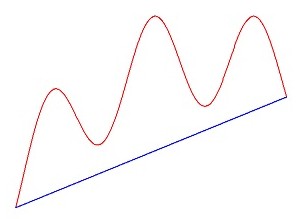
But it is only one of many possible graphs. The graph could look like this figure:

Here there are several places (5 to be exact) where the tangent line is parallel to the secant line; there could be several on one side, or several on both sides. But this is not a problem; this does not contradict the MVT, which says there is at least one.

Yet another way to show the MVT is this. Near the left end of the first graph above the slope of the tangent to the graph (the derivative) is larger than the slope of the secant line; near the right end the slope of the tangent is less than the slope of the secant. So somewhere in between, by the Intermediate Value Theorem, the slope of the tangent must equal the slope of the secant. (For the purists out there, this is from Darboux’s theorem, and requires a slightly stronger hypothesis, namely that the one-sided derivatives at a and b exist.)

Rolle’s theorem can be demonstrated with either of these approaches as well. Rolle’s Theorem is really a special case of the MVT where the slope of the secant line is zero.

In conclusion, I think that this sequence of theorems is a good place to do a little proving of theorems. On the other hand you can easily show the results other ways. In fact, the method at the beginning of this post should be shown anyway in order to give students a good picture (no pun intended) of the MVT. It will help them remember what it is all about.

The Mean Value Theorem I

The Mean Value Theorem says that if a function, f , is continuous on a closed interval [a, b] and differentiable on the open interval (a, b) then there is a number c in the open interval (a, b) such that

\displaystyle {f}'\left( c \right)=\frac{f\left( b \right)-f\left( a \right)}{b-a}.

It says a lot more than that which we will consider in the next post.

The proof, which once you know where to start, is straight forward and rests on Rolle’s theorem.

In the figure above we see the graph of f and the graph of the (secant) line, y (x), between the endpoints of f. we define a new function h(x) = f (x) – y (x), this is the vertical distance from f to y. The equation of the line is in the figure and so

\displaystyle f\left( x \right)-f\left( a \right)-\frac{f\left( b \right)-f\left( a \right)}{b-a}\left( x-a \right)=h\left( x \right)

The function h meets all the conditions of Rolle’s theorem. In particular, h (a) = h (b) = 0 since at the endpoint the two graphs intersect and the distance between them is zero. You can also verify this by substituting first x = a and then x = b into h. Therefore, by Rolle’s theorem there is a number x = c between a and b such that {h}'\left( c \right)=0. So we’ll find the derivative and substitute in x = c.

\displaystyle {f}'\left( x \right)-0-\frac{f\left( b \right)-f\left( a \right)}{b-a}={h}'\left( x \right)

\displaystyle {f}'\left( c \right)-\frac{f\left( b \right)-f\left( a \right)}{b-a}=0

\displaystyle {f}'\left( c \right)=\frac{f\left( b \right)-f\left( a \right)}{b-a}

This last equation is very important and will come back in the second act and elsewhere.

So again, we see how one theorem, Rolle’s, leads to another, the MVT.

The arc from the definition of derivative, through Fermat’s theorem and Rolle’s theorem to the MVT is, I think, a good way to demonstrate how theorems and their proofs work together. Since I would not like my students not to have any familiarity with proof and definition, I think this is a good place to show them just a little of what it’s all about.

On the other hand, we have ended up with a strange equation, which apparently has something to do with mean value, whatever that is. In the final post in this series we will discuss what this all means and how to convince your students of the truth of the MVT without all the symbol pushing that’s required in a proof.

I don’t like this proof because you must know to set up the function h at the beginning. It is “legal” to do that, but how do you know to do it? On the other hand, doing things like that is something that has to be done sometimes and students need to know this too. But we’ll see an easier way in the next post.

Rolle’s Theorem

Rolle’s theorem says that if a function is continuous on a closed interval [a, b], differentiable on the open interval (a, b) and if f (a) = f (b), then there exists a number c in the open interval (a, b) such that {f}'\left( c \right)=0.  (“There exists a number” means that there is at least one such number; there may be more than one.)

The proof has two cases:

Case I: The function is constant (all of the values of the function are the same as f (a) and f (b)). The derivative of a constant is zero so any (every, all) value(s) in the open interval qualifies as c.

Case II: If the function is not constant then it must have a maximum or minimum in the open interval (a, b) by the Extreme Value Theorem. So, by Fermat’s theorem (see this post) the derivative at that point must be zero.

So, Fermat’s theorem makes Rolle’s theorem a piece of cake.

A lemma is a theorem whose result is used in the next theorem and makes it easier to prove. So Fermat’s theorem is a lemma for Rolle’s theorem.

On the other hand, a corollary is a theorem is a result (theorem) that follows easily from the previous theorem. So, Rolle’s theorem could also be called a corollary of Fremat’s theorem.

Rolle’s theorem makes a major appearance in the MVT and then more or less disappears from the stage. When you find critical number or critical points you are using Fermat’s theorem.

I like this proof because it’s so simple. It really just comes immediately from Fermat’s theorem.

The next post: The Mean Value Theorem.