Difference Quotients II

The Symmetric Difference Quotient

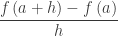
In the last post we defined the Forward Difference Quotient (FDQ) and the Backward Difference Quotient (BDQ). The average of the FDQ and the BDQ is called the Symmetric Difference Quotient (SDQ):
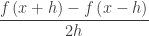
\displaystyle \frac{f\left( x+h \right)-f\left( x-h \right)}{2h}

You may be forgiven if you think this might be a better expression to use to find the derivative. It has its advantages. In fact, this is the expression used in many calculators to compute the numerical value of the derivative at a point; in calculators it is called nDeriv. Usually, it works pretty well. But if you try to find the derivative of the absolute value of x at x = 0 it will tell you the derivative is 0, which is wrong. The absolute value function is not locally linear at the origin and has no derivative there.

What went wrong?  Read the expression above. The numerator is the difference of the function values at the same distance, h, on both sides of x. Since, for the absolute value function with x = 0, these values are the same, their difference is 0. The SDQ never looks at x = 0 and doesn’t realize there is no derivative there. Thus, the limit of the SDQ is not the derivative.

This problem does not occur with the definition of derivative, since for that limit to exist the limits as h approaches zero from both sides must be equal. For the absolute value function the limit from the left is –1 and the limit from the right is +1 and therefore there is no limit and no derivative there.

Since most functions we will consider are differentiable, most of the time the SDQ and nDeriv are okay to use.

Seeing Difference Quotients Converge

This is an activity to see difference quotients graphically. Use a graphing calculator or a graphing program on a computer. One with a slider feature is better although I’ll also tell you how to use a calculator without this feature.

  1. Enter the function you want to consider as Y1 in your calculator or give it a name if you are using a computer. This is so later you can change the function without having to re-enter the next three equations.
  2. Enter the FDQ as Y2 using Y1 as the function. See Figure 1 below.
  3. Enter the BDQ as Y3 again using Y1 as the function.
  4. Enter the SDQ as Y3 again using Y1 as the function.
  5. Either set up a slider for h or go to the home screen and store a value for h. In the latter case you will have to return to the home screen and change the values.

Now graph all four functions. As you change the values of h with the slider or from the home screen, you should see three similar graphs (the difference quotients) along with the first function you entered. As h approaches zero, the three similar graphs should come together (converge) on the graph of the derivative. See Figures 2 and 3 below.

Change the first function. Some good functions to try are y = x– 4x, y = x3/3, y = sin(x) and don’t forget y = |x|. Try guessing the equation of the derivative.

Figure 2 Shows y = x3/3 in Black with the three difference quotients, h is about 2.

Figure 3 shows the same graph with h almost 0; the three difference quotients, now almost on top of each other, are closing in on the derivative.

Here is a link to a Desmos demonstration of the three difference quotients

Difference Quotients I

Difference Quotients & Definition of the Derivative

In the second posting on Local Linearity II, we saw that what we were doing, finding the slope to a nearby point, looked like this symbolically:

\displaystyle \frac{f\left( x+h \right)-f\left( x \right)}{h}

This expression is called the Forward Difference Quotient (FDQ). It kind of assumes that h > 0.

There is also the Backwards Difference Quotient (BDQ):

\displaystyle \frac{f\left( x \right)-f\left( x-h \right)}{h}=\frac{f\left( x-h \right)-f\left( x \right)}{-h}

The BDQ also kind of assumes that h > 0. If h < 0 then the FDQ becomes the BDQ and vice versa. So these are really the same thing. The limit (if it exists) as h approaches zero is the slope of the tangent line at whatever x is and this is important enough to have its own name. It is called the derivative of f at x with the notation (among others) {f}'\left( x \right) :

\displaystyle {f}'\left( x \right)=\underset{h\to 0}{\mathop{\lim }}\,\frac{f\left( x+h \right)-f\left( x \right)}{h}

Since h must approach 0 from both sides, this expression incorporates the FDQ and the BDQ in one expression.

To emphasize that h is a “change in x” this limit is often written

\displaystyle {f}'\left( x \right)=\underset{\Delta x\to 0}{\mathop{\lim }}\,\frac{f\left( x+\Delta x \right)-f\left( x \right)}{\Delta x}

The Derivative II

(In this activity I am paraphrasing and expanding the suggestions of Alan Lipp in a posting “Derivatives of Trig Functions” August 29, 2012 to the Calculus Electronic Discussion Group.)

This activity parallels the one in my last post here using technology.

    1. Enter the function you are investigating as Y1 in your calculator. Later you will change this to other functions but will not have to change the following entries.  Start with Y1 = x2.
    2. Enter

      \displaystyle Y2=\frac{Y1(x+0.0001)-Y1(x)}{0.0001}.

      This will approximate the derivative. This expression is called the forward difference quotient.

    1. Graph in a square window.
    1. Guess the equation of the graph you see for Y2, enter you guess in Y3 and graph it. If your guess is correct what should you see?
    1. Deselect Y1 and produce a table for the Y2 and Y3 graph. Do the values of Y2 look like what you guessed for Y3? If not, adjust your guess for Y3. (Hint: because Y2 is an approximation, they will be close but not exact.)
  1. Another way to check your guess is to graph Y4 = Y2/Y3. If your guess is close, Y4 should be the line y = 1. If their guess is wrong, the graph of Y4 may give a clue as to the correct answer. If the guess the derivative of x2 is x, then Y4 = 2 hinting that the correct guess is 2x.

A comment: Calculators have a built in numerical derivative function usually called nDeriv or d/dx. You may use this in step 2 above. However, entering and using the expression for the approximate derivative as above, reinforces the concept and is more transparent for the student than using some strange new built-in function.

Now repeat the exercise above with other functions. Chose functions whose derivatives are easy to guess for example, y = x3, y = x4, y = x5, etc., and  y = sin(x), and y = cos(x).

Keep a list of the results, so you can check it later.

The Derivative I

In “Local Linearity II”, my post for August 31, 2012, we developed a way of approximating the slope of a function at any point. The slope at x = a is approximated by

\displaystyle \frac{f\left( a+h \right)-f\left( a \right)}{h}

For small values of h.

The smaller the better, which suggests limits.

The limit of this expression as h approaches zero is called the derivative of f at x = a denoted by {f}'\left( a \right):

\displaystyle \ {f}'\left( a \right)=\underset{h\to 0}{\mathop{\lim }}\,\frac{f\left( a+h \right)-f\left( a \right)}{h}

Now give your students a simple function like y = x2 and give each student a different point in the interval [–4, 4] (include some fractions). Have them calculate the approximate slope and/or the derivative for their point. For each student’s value, plot on a graph the point (their a, slope at their a). Discuss the results. Guess the equation of the graph.

Of course, the result should look like the line y = 2x.  That is, the derivatives at various points, taken together, appear to be a function in their own right.

Repeat this exercise with the function y = sin(x). Guess the equation of the derivative.

We will look at this some more in the next post.

Local Linearity II

Using Local Linearity to introduce difference quotient and the derivative.

An effective way to introduce difference quotients and derivatives is to write the equation of the “line” you see when you zoom-in on a locally linear function.

First: Ask your class to use their calculator or computer grapher to graph a function, say y = sin(x), or some function they like better.

  1. Ask them to trace over to some point where the graph is “curvy.” (So they will remain on the graph, use the TRACE feature, not the moving cursor.) They do not have to go to, or even be near, the same place.
  2. Then ask them to zoom-in several times until their graph looks like a straight line (locally linear) and save the coordinates of that point as a and b (see the technology hint below).
  3. Then return to the graph and trace one or two clicks left or right to a nearby point on the graph and record the coordinates of that point as c and d.
  4. Write the equation of the line through (a, b) and (c ,d) and enter it in the graphing menu (see technology hint again).
  5. Graph the line. They should see only one “line” because the two graphs are on top of each other.
  6. Re-graph in the standard or Trig window. What do you see now? They should see their original graph with a line that appears tangent to it at the point (a, b).

Next: Discuss what you’ve done, specifically in finding the slope. The value c is a plus a little bit, that is c = a + h. (Or minus a  little bit if h is negative.) So the slope is

\displaystyle \frac{Y1(a+h)-Y1(a)}{(a+h)-a}\text{ or }\frac{f\left( x+h \right)-f\left( x \right)}{h}

and now you are ready to talk about difference quotients and their limit the derivative.

Technology Hints:

When you trace a graph on a calculator the coordinates of the point are written on the bottom of the screen as X and Y, or xc and yc. If you return to the home screen and type X [STO] A and Y [STO] B (or xc [STO] a etc.) the values will be saved to A and B. When you trace to the next point the x and y change, so return to the home screen and save them as C and D.

The line can be written directly in the equation editor in point-slope form by typing Y2 = Y1(A) + (Y1(B)-Y1(A))/(B – A)*(x – A)