When considering functions made up of the sums, differences, products or quotients of different sorts of functions (polynomials, exponentials and logarithms), or different powers of the same sort of function we say that one function dominates the other. This means that as x approaches infinity or negative infinity, the graph will eventually look like the dominating function.
- Exponentials dominate polynomials,
- Polynomials dominate logarithms,
- Among exponentials, larger bases dominate smaller,
- Among polynomials, higher powers dominate lower,
For example, consider the function  . The exponential function dominates the polynomial. As
  , the graph looks like an exponential approaching infinity; that is,
  . As
. As  the graph looks like an exponential with very small negative values (i.e. small in absolute value); so,
  .
.
Another example, consider a rational function (the quotient of two polynomials). If the numerator is of higher degree than the denominator, as  the numerator dominates, and the limit is infinite. If the denominator is of higher degree, the denominator dominates, and the limit is zero. (And if they are of the same degree, then the limit is the ratio of the leading coefficients. Dominance does not apply.)
Dominance works in other ways as well. Consider the graphs of  and
and  . In a standard graphing window, the graphs appear to intersect twice. But on the right side the exponential function is lower than the polynomial. Look farther out and farther up, the exponential dominates and will eventually lie above the polynomial (after x = 7.334).
Here’s an example that pretty much has to be done using the dominance approach.
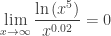
The polynomial function in the denominator, even with the very small exponent, will dominate the logarithm function. The denominator will eventually get larger than the numerator and drive the quotient towards zero. We will return to this function when we know about finding maximums and points of inflection and find where it starts decreasing. For more on this see my post Far Out!



 . The graph will show a horizontal asymptote at y = 1.
 approaches the x-axis as an asymptote, it follows that
  . (The fact that this graph crosses the x-axis many times on its trip to infinity is not a concern; the axis is still an asymptote.)
 , the functions all have a vertical asymptote of x = 0.
 near x = 3 and as
  . Relate the values and their signs to the graph. (Divide by a small number get a big number; divide by a big number, get a small number.)
 has no value at x = 2 (f(2) does not exist), but as you get closer to x = 2 the function value gets closer to 4 (
 ).
). with a gap or hole at the point (2, 4). Another example:
 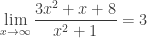 since, the graph gets closer to y = 3 as you go farther to the right. The line y = 3 is a horizontal asymptote.
 and since the fraction gets smaller as |x| gets larger, the function approaches 3 from above when x > 0 and from below when x < 0 (why?)
 or
or  the limit may exist. Simplify by factoring, or using different trig functions. Later in the year a method called L’Hôpital’s Rule can often be used in this situation.
 are common mistakes.
 does not exist, and DNE is a correct answer. However, it is a bit better to say the limit is (equals) infinity, indicating that the expression gets larger without bound as x approaches 3. Both answers will get credit on an AP exam.
  DNE since the one-sided limits (from the left and from the right) are different. Only DNE gets credit here.
 , in (b) they found the minimum value of
  is
is  and in (c) they had to state the range of the function is
  . Thus making the students show they knew that this kind of DNE is the kind where the value increases without bound.
 where m is the slope of the line. Anyone can memorize that, so testing it does not provide any evidence that the student knows anything. For any other function (polynomials of higher degree, trigonometric functions, etc.) some special one-time “trick” is required, often different for each type of function. Thus, the question becomes unreasonably difficult even for one who understands the concept.
 is correct, then so is
  etc. Again no real knowledge of the definition is required – just choose the smallest delta.
 Teaching Calculus