Mean Tables

The AP calculus exams always seem to have a multiple-choice table question in which the stem describes function in words and students are asked which of 5, now 4, tables could be a table of values for the function.  Could be because you can never be sure without other information what happens between values in the table. So, the way to solve the problem is to eliminate choices that are at odds with the description.

The question style nicely makes students relate a verbal description with the numerical information in the tables. This uses two parts of the Rule of Four.

In 2003, question AB 90 told students that a function f had a positive first derivative and a negative second derivative on the closed interval [2, 5]. There were five tables to choose from.

There is a fairly quick way to solve the problem, but I want to go a little slower and discuss the theorems that apply.

First, since the function has first and second derivatives on the interval, the function and its first derivative are continuous on the interval. This is important since, if they were not continuous, there would be no way to solve the problem.

Next, since the first derivative is positive, the function must be increasing. This allowed students to quickly eliminate three choices where the function was obviously decreasing. The remaining tables showed increasing values and thus could not be eliminated based on the first derivative.

The two remaining tables were

Table MVT

Notice that in table A the values are increasing at an increasing rate, and in table B the values are increasing at a decreasing rate. Thus, table B is the correct choice. By the end of the year that kind of reasoning is enough for students to determine the correct answer.

Students could also draw a quick graph and see that table A was concave up and B was concave down. This will give them the correct answer, but technically it is a wrong approach since, once again, there is no way to know what happens between the values; we should not just connect the points and draw a conclusion.

The correct reasoning is based on the Mean Value Theorem (MVT).

In table A, by the MVT there must be a number c1 between 2 and 3 where {f}'\left( {{c}_{1}} \right)=2 the slope between the points (2,7) and (3, 9). Also, there must be a number c2 between 3 and 4 where {f}'\left( {{c}_{2}} \right)=3 the slope between (3, 9) and (4, 12), and likewise a number c3 between 4 and 5 where {f}'\left( {{c}_{3}} \right)=4.

Then applying the MVT to these values of {f}'\left( x \right), there must be a number, say d1 between c1 and c2 where {{f}'}'\left( {{d}_{1}} \right)=\frac{3-2}{{{c}_{2}}-{{c}_{1}}}>0. Since the second derivative should be negative everywhere, table A is eliminated making the remaining table B the correct choice.

If we do a similar analysis of Table B, we find that the MVT values for the second derivative are all negative. However, we cannot be sure this is true for all values of f in table B, since we can never be sure what happens between the values in a table. But table B is the only one that could be the one described since the others clearly are not.

In this post we saw how the MVT can be used in a numerical setting. I discussed the MVT in an analytic setting on September 28, 2012 and graphically on October 1, 2012.

Intermediate Weather

I found a curious fact in a textbook today that relates to the Intermediate Value Theorem [1]. It claimed that if you draw a circle of any size on a map, there will be two diametrically opposite points on the circle at which the temperature will be the same!

This might make an interesting example when you are talking about the IVT.

The proof goes like this:

Assume the temperature varies continuously between every pair of points. Draw a circle of any radius on your map. Put a polar coordinate system on the map with the pole at the center of the circle and let theta  be the angle formed by a line through the pole and the polar axis in the usual way. Let \theta be the temperature at any point on the circle on the line that makes an angle of \theta  with the polar axis. Then consider the function, f that gives the difference in temperature between two diametrically opposite points at angles of \theta  and \theta +\pi :

f(\theta )=T(\theta )-T(\theta +\pi )

Case I:If f(0)=T(0)-T(\pi )=0 then T(0)=T(\pi ) and we have our two points.

Case II: If f(0)=T(0)-T(\pi )>0, then~T(0)>T(\pi ), indicating that as the angle increases from 0 to \pi , the temperature has a net decrease. Then, on the other half of the circle from \pi to 2\pi  the temperature must increase f(\pi )=T(\pi )-T(2\pi )=T(\pi )-T(0)<0. (Since T(0)=T(\pi )). Therefore, by the Intermediate Value Theorem there is some value \theta =c, between 0 and \pi  where f(c)=0 and T(c)=T(c+\pi )

Case III is like Case II with f(0)<0.

Without so many equations, this says that if you keep track of the temperature difference at the ends of the diameter on the way around the first half of the circle and find a net decrease in the temperature difference, then on your way around the second half of the circle (returning to the starting point) you must see a net increase. Somewhere between the decrease and the increase you must have a point where the difference is zero – the temperatures at the ends will be the same.

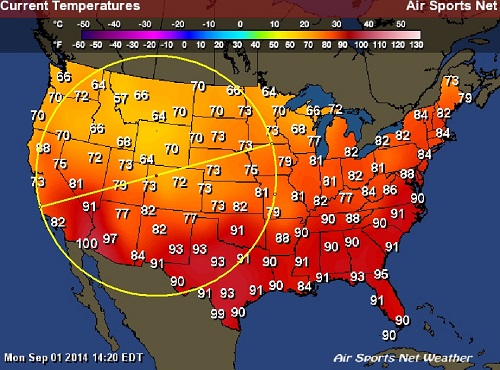
Now, I wasn’t really convinced. Yes, I believe proofs, but still…. So, I looked at a weather map [2]

Weather

Consider the circle drawn on the map. From Iowa to Canada the temperature decreases from 79 to 66. Meanwhile over in California the temperature increases from 73 near San Francisco to 82 in Los Angeles. With a little visual interpolation, the temperatures at the ends of the diameter seem to be about equal. Try it with your own weather map.

Make your own circle and space the temperatures evenly on both sides. The diameter with the same temperatures will be ¼ of the way around. Try again with unevenly spaced temperatures; you will still find a place.

This is similar to the mountain climbing problem: If you climb a mountain during certain hours one day and climb back down during the same hours the next day, then there will be a place that you pass at the same time on both days.

_______________________________

References:

[1] Calculus by Rogowski and Cannon, Second edition, Section 2.8 exercise 26

[2] Air Sports New Weather for September 1, 2014, 14:20 EDT

Revised September 3, 2014 12:50 to fix some problems with the equations appearing properly.

September

Hope you all had a nice Labor Days weekend: for some a welcome day off after the first week or two of school, for others the last day of summer and back to school this week.

The four featured post below are the most popular from the August – September period.

As you know I have organized things by months and have tried to stay ahead of you so that if you find something new and useful you will have time to incorporated into you plans. If you are just starting use the August page under the “Thru the Year” tab above. If you’ve already started then look at the September guide.

Here is a series of .gifs that my son sent me that you might like Math Gifs

FoxTrot show workRevised September 1, 2014.


Calculators

First some history and then an opinion

I remember buying my first electronic calculator in the late 1960s. It did addition, subtraction, multiplication, and division, and could remember one number. It displayed 8 digits and had a special button that displayed the next eight digits. I remember using those next eight digits never. To buy it I had to drive 40 minutes and spend $70 – expensive even today.

The square root of 743 computed using the algorithm discussed in the post. The third iteration (fourth answer) is correct to 10 digits.

The square root of 743 computed using the algorithm discussed in the post. The third iteration (fourth answer) is correct to 10 digits.

With it I learned an iterative algorithm for finding square roots: guess the root, divide the guess into the number, average the quotient and the guess, repeat using the average as the new guess.  You could do it all without writing anything down. (See the illustration on a modern calculator – accurate to 8 decimals in only 3 iterations (fourth answer), but then I could find the next 8 with the special button.)

Since then, I’ve had lots of calculators of all sorts.

Graphing calculators hit the general market around 1989 or 1990. This was the same time as the “reform calculus” movement. The College Board announced that the AP calculus exams would require graphing calculators in 1995 – five years to get the country ready.

The College Board held intensive training immediately following the reading. These were the TICAP conferences (Technology Intensive Calculus for Advanced Placement). Half the readers were invited for the first year and the other half for the second, then more for the third year.

Casio, Hewlett-Packard, Texas Instruments all gave participants calculators to use take home. Sharpe lent them calculators (and we haven’t heard of Sharpe since). Sample lessons were taught using Hewlett-Packard CAS calculators and then the same lesson was taught using TI-81s. The HP computer algebra system calculators, with far more features but using the far more complicated reverse Polish notation entry system, lost in the completion to the simpler to use, but less sophisticated TI-81s.

The teachers were not all happy. A friend of mine, due to retire in 2-3 years gave up his AP calculus classes early so he would not need to learn the calculators. Others embraced technology. The AP program forced the graphing calculator into high schools where they were used to improve learning and instruction. Yet even today not all high schools have embraced technology.

The calculator makers, especially Texas Instruments, provided print materials, software, workshops and conferences that helped teachers learn how to use graphing calculators in their classes at all levels.

Technology, as a way to teach, learn, and most importantly, do mathematics, caught on big time. And that was and is a good thing.

I think graphing calculators are very quickly becoming obsolete and should be phased out.

Technology has bypassed graphing calculators. Tablet computers, PCs, Macs, iPads, and the like, even smart phones, can do everything graphing calculators can do. They are more versatile. The larger screens are easier to see and can show more information without crowding.

The initial investment may be more than for a graphing calculator, but once purchased the apps are relatively cheap. There are many free apps that not only do computations and graphing, but CAS operations as well. Interactive geometry and statistics apps are also available.

These, along with online textbooks and internet access, put everything students need to learn math literally at their fingertips. Graphs and other results can be easily copied and printed, or pasted into note-taking apps.

One disadvantage is the initial cost for the hardware (but of course many students already have the hardware). The other disadvantage is the ability to communicate and find help both in the room and around the world during tests. Photographing the questions for later use by others is another concern.  I think (hope) it is just a matter of time before this problem can be overcome perhaps with an app that allows access only to the apps the teachers allow for tests.

Technology, like time, marches on.

Darboux’s Theorem

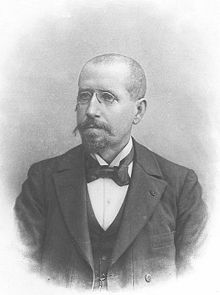
Jean Gaston Darboux 1842 - 1917

Jean Gaston Darboux
1842 – 1917

Jean Gaston Darboux was a French mathematician who lived from 1842 to 1917. Of his several important theorems the one we will consider says that the derivative of a function has the Intermediate Value Theorem property – that is, the derivative takes on all the values between the values of the derivative at the endpoints of the interval under consideration.

Darboux’s Theorem is easy to understand and prove but is not usually included in a first-year calculus course (and is not included on the AP exams). Its use is in the more detailed study of functions in a real analysis course.

You may want to use this as an enrichment topic in your calculus course, or a topic for a little deeper investigation. The ideas here are certainly within the range of what first-year calculus students should be able to follow. They relate closely to the Mean Value Theorem (MVT). I will suggest some ideas (in blue) to consider along the way.

More precisely Darboux’s theorem says that

If f is differentiable on the closed interval [a, b] and r is any number between f ’ (a) and f ’ (b), then there exists a number c in the open interval (a, b) such that ‘ (c) = r. 

Differentiable on a closed interval?

Most theorems in beginning calculus require only that the function be differentiable on an open interval. Here, obviously, we need a closed interval so that there will be values of the derivative for r to be between.

The limit definition of derivative requires a regular two-sided limit to exist; at the endpoint of an interval there is only one side. For most theorems this is enough. Here the definition of derivative must be extended to allow one-sided limits as x approaches the endpoint values from inside the interval. Also note that  if a function is differentiable on (a, b), then it is differentiable on any closed sub-interval of (a, b) that does not include a or b.

Geometric proof [1]

Consider the diagram below, which shows a function in blue. At each endpoint draw a line with the slope of r. Notice that these two lines have a slope less than that of the function at the left end and greater than the slope at the right end. At least one of these lines must intersect the function at an interior point of the interval.  Before reading on, see if you and your students can complete the proof from here. (Hint: What theorem does the top half of the figure remind you of?)

DarbouxOn the interval between the intersection point and the end point we can apply the Mean Value Theorem and determine the value of c where the tangent line will be parallel to the line through the endpoint. At this point ‘(c) = r. Q.E.D.

Analytic Proof [2]

Consider the function h\left( x \right)=f\left( x \right)-(f(b)+r(x-b)). Since f(x) is differentiable, it is continuous; \displaystyle f(b)+r(x-a) is also continuous and differentiable. Therefore, h(x) is continuous and differentiable on [a, b]. By the Extreme Value Theorem, there must be a point, x = c, in the open interval (a, b) where h(x) has an extreme value. At this point h’ (c) = 0.

Before reading on see if you can complete the proof from here.

\displaystyle h(x)=f(x)-(f(b)+r(x-a))

\displaystyle {h}'(x)={f}'(x)-r

\displaystyle {h}'(c)={f}'(c)-r=0

\displaystyle {f}'\left( c \right)=r

Q.E.D.

Exercise: Compare and contrast the two proofs.

  1. In the geometric proof, what does \displaystyle y=f(b)+r(x-a) represent? Where does it show up in the diagram?
  2. How do both proofs relate to the Mean Value Theorem (or Rolle’s Theorem).

The function \displaystyle h(x)=f(x)-(f(b)+r(x-a)) represents the vertical distance from f(x) to \displaystyle f(b)+r(x-a). In the diagram, this is a vertical segment connecting f(x) to  \displaystyle y=f(b)+r(x-a).This expression may be positive, negative, or zero. In the diagram, at the point(s) where the line through the right endpoint intersects the curve and at the endpoint h(x) = 0. Therefore, h(x) meets the hypotheses of Rolle’s Theorem (and the MVT), and the result follows.

The line through the right endpoint will have equation the y=f(b)+r(x-b) This makes h\left( x \right)=f\left( x \right)-\left( f(b)+r(x-b) \right). When differentiated and the result will be {f}'\left( x \right)-r the same expression as in the analytic proof.

Also, you may move this line upwards parallel to its original position and eventually it will be tangent to the graph of the function. (See my posts on MVT 1 and especially MVT 2).

Exercise:

Consider the function f(x) = sin(x)

  1. On the interval [1,3] what values of the derivative of f are guaranteed by Darboux’s Theorem? .
  2. Does Darboux’s theorem guarantee any value on the interval [0,2\pi ]? Why or why not?

Answers:

  1. f ‘(x) = cos(x). f ‘ (1) = 0.54030 and f ‘ (3) = -0.98999. So the guaranteed values are from -0.98999 to 0.54030.
  2. No. f ‘ (x) = 1 at both endpoints, so there are no values between one and one.

Another interesting aspect of Darboux’s Theorem is that there is no requirement that the derivative ‘(x) be continuous!

A common example of such a function is

\displaystyle f\left( x \right)=\left\{ \begin{matrix} {{x}^{2}}\sin \left( \frac{1}{x} \right) & x\ne 0 \\ 0 & x=0 \\ \end{matrix} \right.

With \displaystyle {f}'\left( x \right)=-\cos \left( \tfrac{1}{x} \right)+2x\sin \left( \tfrac{1}{x} \right),\,\,x\ne 0.

This function (which has appeared on the AP exams) is differentiable (and therefore continuous).There is an oscillating discontinuity at the origin. The derivative is not continuous at the origin.  Yet, every interval containing the origin as an interior point meets the conditions of Darboux’s Theorem, so the derivative while not continuous has the intermediate value property.

AP exam question 1999 AB3/BC3 part c:

Finally, what inspired this post was a recent discussion on the AP Calculus Community bulletin board about the AP exam question 1999 AB3/BC3 part c. This question gave a table of values for the rate, R, at which water was flowing out of a pipe as a differentiable function of time t. The question asked if there was a time when R’ (t) = 0. It was expected that students would use Rolle’s Theorem or the MVT. There was a discussion about using Darboux’s theorem or saying something like the derivative increased (or was positive), then decreased (was negative) so somewhere the derivative must be zero (implying that derivative had the intermediate value property). Luckily, no one tried this approach, so it was a moot point.

Take a look at the problem with your students and see if you can use Darboux’s theorem. Be sure the hypotheses are met.

Answer (try it yourself before reading on):

The function is not differentiable at the endpoints. But consider an interval like [0,3]. Using the given values in the table, by the MVT there is a time t = c where R‘(c) = 0.8/3 > 0, and there is a time t = d on the interval [21, 24] where R‘(d) = -0.6/3 < 0. The function is differentiable on the closed interval [c, d] so by Darboux’s Theorem there must exist a time when R’(t) = 0. Admittedly, this is a bit of overkill.

References:

  1. After Nitecki, Zbigniew H. Calculus Deconstructed A Second Course in First-Year Calculus, ©2009, The Mathematical Association of America, ISBN 978-0-883835-756-4, p. 221-222.
  2. After Dunham, William The Calculus Gallery Masterpieces from Newton to Lebesque, © 2005, Princeton University Press, ISBN 978-0-691-09565-3, p. 156.

Both these book are good reference books.

Updated: August 20, 2014, and October 4, 2017

Pacing for AP Calculus

Some thoughts on pacing and planning your year’s work for AP Calculus AB or BC.  The ideas are my own and are only suggestions for you to consider.

Almost all textbooks provide an AP pacing guide among their ancillary material. You can consult the guide for your book for specific suggestions for the number of days on each topic or section.

Keep a copy of the latest Course and Exam Description handy. Changes in the exam are announced in this book; to keep up to date be sure you always read the following year’s edition which is available at AP Central shortly after the exam is given in May. The book contains the “Topical Outline” for the AB and BC courses. The topics listed here are what may be tested on the exams. What is not listed will not be tested. For example, calculating volumes by the method of Cylindrical Shells is not listed; any volume problem on the exam can be done by other methods. This does not mean you may not or should not teach the topics that are not listed if you believe your students will benefit from them. If you wish to teach them you may still do so. Students may use these methods on the exam; they will not be penalized for correct mathematics. Many teachers teach these topics in the time after the exam.

PLANNING YOUR YEAR

Get out your school calendar. The AP Calculus exams are usually given during the first week in May; the exact date will be at AP Central.

  • Count back about 2 school weeks from the exam date (don’t count your spring break week). Allow an extra week if you are prone to many snow days. This time will be used for review. (This brings you to a week or so into April.)
  • Count back two more weeks. I’ll discuss what this should time should be used for later. (Mid-march) This is when you should aim to be done the material and ready to begin review. Finishing by the beginning of March is even better.
  • Count the number of weeks between the beginning of school and the week above. (About 26 – 27 weeks if your start just after Labor Day; 28-30 weeks if you start in mid-August). This is the number of week you have to teach the material. Don’t panic: the AB course is taught typically in college in 30 – 35 classes in one semester. You do have time, but by the same token, you still need to stick with the calendar and keep you students on it as well.
  • Take half of this number and find the middle week of the year. This is sometime in early to mid-December. To allow equal time for derivatives and integrals, this is when you should finish derivatives and start integration. Don’t delay starting integration beyond the first class of the New Year.
  • Now plan your work so that you can do it in the time allowed. You all want your students to do well. It is not unknown for teachers to spend a few extra days now and then to give extra work on derivative. But this time adds up. Remember half the exam is integration; you need to cover that too. Don’t get behind.
  • If you are in an area where there are closings due to weather or other reasons, plan for them. You usually get some short warning that snow is coming. Be ready on short notice to post an assignment, a video to watch, or some other useful work on your website. If it looks like several days off, tell the students you will post the assignment daily and make them responsible for finding them and doing them.

Look over past exams. Learn what is tested and how it is tested and plan your time accordingly. Here are some hints as to where you can shave some time.

STARTING THE YEAR

  • Summer assignments: Personally, I do not see the use in summer assignments. What is their purpose? To keep the material fresh in the kids’ minds, I suppose. But the good students will do it right away and then forget anyway over the summer, and the others, will forget “everything” over the summer and try the assignment at the end of the summer and get nowhere.
  • If you want to keep their minds on mathematics over the summer, assign a good book to read. Maybe they will spread that out over the summer. Reading suggestion: Is God a Mathematician? by Mario Livio.
  • Ideally, limits and continuity should be taught in pre-calculus. Work with your pre-calculus teachers and help them arrange their curriculum so that the things students need to know coming into calculus are taught in pre-calculus. This is one of the things vertical teaming can accomplish. (Incidentally, be sure they do not start learning about derivatives and the slope of tangent lines in pre-calculus as some textbooks do; the time is better spent elsewhere.) Remember the delta-epsilon definition is not tested and is optional.
  • DO NOT begin the year with a week or two (or even a day or two) of review of mathematics up to calculus. It won’t help. Later in the year when you get to one of those topics students “should” know, they will have forgotten it all over again. So instead of a week or two (or more) of review at the beginning of the year, plan 10 – 15 minutes of review when these topics come up during the year. (You’ll have to do this anyway.)
  • If the first chapter of your textbook is review, as most are, skip this chapter. Make your first night’s assignment to read this chapter and ask about anything they don’t remember. This chapter can be used for reference when necessary later in the year.
  • Do begin the year with derivatives (or limits and continuity if students have not studied this before). The very fact that this is new will help get and retain the students’ interest.

DERIVATIVES

Here are some places you may shave a few days off while teaching derivatives:

  • Computing derivatives is important. Product rule, Quotient rule, Chain rule are all tested on the exam. But look at some past exams: the questions are not that complicated. It is rare to find “monster” problems involving all three rules together along with radicals and trig functions. Sure, give one or two of those, but the basics are what are tested. Furthermore, you can and should include these all thru the year, so students stay in practice.
  • Optimization problems: Building a cheaper box or fencing in the largest field with a given amount of fence are great problems. They do not appear on the AP exams (at least not since 1982). They do not appear because the hard part is writing the model (the equation); if a student misses this they cannot earn anymore points in the problem. If these problems were on the exam, missing the equation means the student could not go on and cost the student all 9 points on a free-response question. Finding maximums and minimum, which require the same calculus thinking and techniques, are tested in other ways. On the multiple-choice section, optimization questions, if any, are of the easiest sort. The model may even be given, and there will  be no more than one such question. Spend only a day or two on the modeling.
  • Related Rate problems: These questions do appear on the exams. A multiple-choice question on related rates may appear. As with any multiple-choice question it cannot be too difficult. Every few years a related rate question shows as part of a free-response question. You cannot cut this out completely, but you can shave some time off here if you are short of time.
  • Practice the differentiation skills, and later the antidifferentiation skills, and the concepts associated with derivatives by including them on all your tests. Make all tests cumulative from the beginning of the year; just a random question or two will keep them on their toes.
  • Look for and assign differentiation problems based on graphs and tables of values in addition to the usual analytic (equation) questions. Use your textbook; however, some textbooks are rather thin on questions with tables and graphs in the stem. Use released exams or a review book for sources.

INTEGRALS

  • As with derivatives, the finding of antiderivatives is important, but the antiderivatives, definite and indefinite integrals are not very difficult. There are no trig substitution integrals, and nothing too monstrous. Integration by Parts is only on the BC exam.  Give students lots of practice spread over the second half of the year.
  • Trapezoidal Rule is not really tested on the exams. Students do not need to know the formula or the error bound formula for the Trapezoidal Rule. Questions do ask for a “trapezoidal approximation.” Like the left-, right; and midpoint-Riemann sums approximations, these questions can be answered by actually drawing a small number of trapezoids and computing their areas. This should be done from equations, graphs and tables. This tests the concept and often the graphical interpretation, not the mindless use of a formula. Error analysis is tested based on whether the approximating rectangles or trapezoids lie above or below the graph. Simpson’s Rule is not tested.
  • Look for and assign integration problems based on graphs and tables of values in addition to the usual analytic (equation) questions. Use your textbook, released exams or a review book for sources.

THOSE TWO WEEKS BEFORE THE REVIEW STARTS

The free-response and the multiple-choice sections of the exam contain some questions very similar to questions that are in textbooks and in contiguous sections of the textbook. These include:

The free-response and the multiple-choice sections contain some questions that are very different from questions that are in textbooks. This is because these questions are on topics from different parts of the year (limit, differentiation and integration concepts in the same question), and these questions are just not asked in the same way in textbooks. These include:

  • Rate/accumulation questions
  • Graph Analysis Differentiation and integration questions about a function given the graph of its derivative and functions defined by integrals
  • Motion on a line (AB), or motion in a plane (BC – parametric and vector equations)
  • Polar Equations (BC only)
  • Questions, both differentiation and integration, given a table of values.
  • Overlapping topics in the same question such as a particle motion question based on a graph or table stem, or a question about an important theorem based on value in a table.

The topics in this latter list pull the entire year’s work together. At first students find this disconcerting since they have rarely seen questions like these; so be sure they do see them before the test. Use these two weeks to pull these topics together and get your students thinking more broadly. This will lead naturally into the full-scale review; in fact, some of this work may profitably spill over into the review time.  Spend 2 – 3 days on each type using actual AP questions for each so the students can see the different variations on the same idea, and the different ways the same idea can be tested. (This is preferable starting the review with one complete free-response exam with 6 different type questions to do. However, later in the review you should do this.)

Another way to approach these problems is to include parts of them throughout the year as the students learn the topics tested in each part. Released multiple-choice problems can be used for this purpose as well.

THE REVIEW TIME

Once the students are familiar with the style of questions, give them a mock exam. For the multiple-choice questions use one of the released exams or one of the genuine-fake exams in a good review book. Give the free-response questions from a recent year. If possible, give the mock exam under the same conditions and timing as the exam. This can be done on a Saturday. If you cannot get 3.25 hours in a row, then give the parts with their proper timing during class periods. Grade the exam according to the standards which are available at AP Central.  Teach them some good test taking strategies.

Spend a fair amount of time doing multiple-choice questions. The released exams from 1998, 2003 and 2008, 2012 and 2013 (and soon 2014) are available. You can also use questions from a good review book (AB or BC). Pay attention to the style and wording, as well as the concepts tested.

Make your calendar up in advance and stick to it. You won’t help the students by getting behind; in college they will have to go a lot faster than in high school. Help them get used to it.

I hope this helps you get started and keep a proper pace through the year.


Revised and updated June 6, 2021

August – Vacation or Lesson Planning?

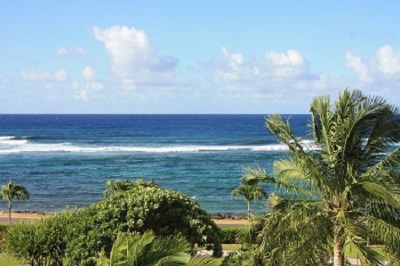
Kauai - The next land in that direction is Antarctica

Kauai – The next land in that direction is Antarctica

Well, duh, vacation of course.  I’m on vacation right now – you can write blog posts ahead of time and post them later on schedule.  So I hope you are all enjoying some vacation too. After 10 months in Hawai’i I need a vacation (I really was working there.)

But, later this month school will be starting for a lot of you, and the others won’t be far behind.

As I hope you’ve noticed, I made some changes to the blog in the last month. The “Thru the Year” tab at the top of the page has been changed to a pull down menu so you can get to each month quicker. Here you will find a list of my past blogs on various calculus topics arranged more or less in the order most folks follow. These are listed a few weeks before you will get to the topic so you can have some time to think them over. They are not a time line.

The “August” entries include some notes on the first days of school and then on limits.

The “Posts by Topic” and the “Archives” in the right side bar have also been change to drop downs to take up a little less space and make it more convenient. Here you can go directly to the topic you are interested in.


A new page has been added to the top navigation bar called “Videos.” A few years ago I made a series of video lessons on AP Calculus topics. I had forgotten about them until a reader wrote me a few weeks ago saying she used them last year to “flip” her class, and said it went well. There are many, many video lessons available on the web at YouTube, Vimeo, and similar sites, probably better than mine. Mine are at Vimeo.com, but now you can access them directly from the blog. There are study sheets available with most of them.

I have never flipped a class. If you have good or poor experience with flipping I would like to hear from you. You could even be a guest blogger. Please e-mail me at lnmcmullin@aol.com or use the Comment box at the end of any post.

The other use for the videos is for reviewing, for students who are going to miss a few days, and for snow  or other weather day assignments.


In the coming year I hope to add posts that I hope will be useful. I’ll try to fill in any gaps (such as differential equations, which I notice I have only one post on).

As always I like to hear from you with comments, suggestions, questions, corrections, and especially ideas for posts – things you would like me to write about.. Again, please e-mail me at lnmcmullin@aol.com or use the Comment box at the end of any post.

But mostly this month – relax.

Next post: Pacing for AP Calculus