Y the FTC?

So, you’ve finally proven the Fundamental Theorem of Calculus and have written on the board:
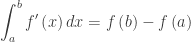
\displaystyle \int_{a}^{b}{{{f}'\left( x \right)dx=f\left( b \right)-f\left( a \right)}}

And the students ask, “What good is that?” and “When are we ever going to use that?” Here’s your answer.

There are two very important uses of this theorem. Show them BOTH uses right away to help your students see why the FTC is so useful and important.

First, in words the theorem says that “the integral of a rate of change is the net amount of change.” So, if you are given a rate of change (as you are every year on the AP Calculus exam) and asked to find the amount of change (as you are every year on the AP Calculus exam), this is what you use, Show an example such as 2015 AB 1/BC1 that states,

“The rate at which rainwater flows into a drain pipe is modeled by the function R, where R\left( t \right)=20\sin \left( {\frac{{{{t}^{2}}}}{{35}}} \right) cubic feet per hour….

“(a) How many cubic feet of rainwater flow into the pipe during the 8-hour time interval ?”

The answer is of course, \displaystyle \int_{0}^{8}{{20\sin \left( {\frac{{{{t}^{2}}}}{{35}}} \right)dt}}. (Which they will soon learn how to evaluate.)

Second, a more immediate use is to avoid all that work you’ve been doing setting up Riemann sums and finding their limits. No more of that! Give them this integral to evaluate:

\displaystyle \int_{2}^{7}{{2xdx}}

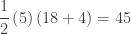
Draw the trapezoid representing the area between the graph of y=2x and the x-axis on the interval [2,7] and find its area =  \displaystyle \frac{1}{2}\left( 5 \right)\left( {18+4} \right)=45

Then ask, “Does anyone know of a function whose derivative is 2x?” Let them think for a minute and someone will say, “Yeah, it’s {{x}^{2}}”  And then show them

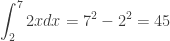
\displaystyle \int_{2}^{7}{{2xdx}}={{7}^{2}}-{{2}^{2}}=45

Then go for a harder one:  \displaystyle \int_{0}^{{\frac{\pi }{2}}}{{\cos \left( x \right)dx}}

“Does anyone know a function whose derivative is \cos \left( x \right)?”

“Why yes, it’s \sin \left( x \right)

So, \displaystyle \int_{0}^{{\frac{\pi }{2}}}{{\cos \left( x \right)dx}}=\sin \left( {\frac{\pi }{2}} \right)-\sin \left( 0 \right)=1-0=1

That was easy!

If you want to challenge them and review some functions of the “special angles” try this one:

\displaystyle \int_{{\frac{\pi }{6}}}^{{\frac{{4\pi }}{3}}}{{\cos \left( x \right)dx}}=\sin \left( {\frac{{4\pi }}{3}} \right)-\sin \left( {\frac{\pi }{6}} \right)=\frac{{\sqrt{3}}}{2}-\frac{1}{2}

Tie the two parts together: Look at the graph of y=\sin \left( x \right). How much does it change from 0 to \frac{\pi }{2}? How much does it change from \frac{\pi }{6} to \frac{{4\pi }}{3}?

Sum up, by looking ahead:

  1. “The function whose derivative is …” is called the antiderivative.
  2. Using antiderivatives to evaluate definite integrals is easy; the hard part is finding the antiderivatives, since they are not all as straightforward as the two examples above. So, next we need to spend a few weeks learning how to find antiderivatives.[1]
  3. Given a derivative, finding its antiderivative is also the start of solving differential equations. This, too, will soon be a concern in the course.

[1] As I’ve written before, this is where it seems logical place to teach antiderivatives. Now students have a reason to find them. Teaching antidifferentiation after differentiation, before integration, seems like an intellectual exercise. Sure, it’s fun, but now we have a need for it.



Integration

Integration – DON’T PANIC

As I’ve mentioned before, I try to stay a few weeks ahead of where I figure you are in the curriculum. So here. early in November, I start with integration. You probably don’t start integration until after Thanksgiving in early December. That’s about the midpoint of the year. Don’t wait too much longer. True, your kids are not differentiation experts (yet); there will be plenty of differentiation work while your teaching and learning integration. Spending too much time on differentiation will give you less time for integration and there is as much integration on the test as differentiation.

The first thing to decide is when to teach antidifferentiation (finding the function whose derivative you are given). Many books do this at the end of the last differentiation chapter or the first thing in the first integration chapter. Some teachers, myself included, prefer to wait until after presenting the Fundamental Theorem of Calculus (FTC). Still others wait until after teaching all the applications. The reasons  for this are discussed in more detail in the first post below, Integration Itinerary.

Integration itinerary – a discussion of when to teach antidifferentiation.

The following posts are on different antidifferentiation techniques.

Antidifferentiation u-substitution

Why Muss with the “+C”?

Good Question 12 – Parts with a Constant?

Arbitrary Ranges  Integrating inverse trigonometric functions.

Integration by Parts I (BC only)

Good Question 12 – Parts with a Constant  How come you don’t need the “+C”?

The next three posts discuss the tabular method in more detail. This is used when integration by parts must be used more than once. If memory serves, using integration by parts twice on the same function has never shown up on the AP exams. Just sayin’.

Integration by Parts II (BC only) The Tabular method.

Parts and More Parts   (BC only) More on the tabular method and on reduction formulas

Modified Tabular Integration  (BC only) With this you don’t need to make a table; it’s quicker than the tabular method and just as easy.


Revised and updated November 4, 2018

Applications of Integration, part 3: Accumulation

Integration, at its basic level, is addition. A definite integral is a sum (a Riemann sum). When you add things you get an amount of whatever you are adding: you accumulate. Here are some previous posts on this important idea that often shows up on the AP Calculus exams (usually the first free-response question!)

Accumulation: Need an Amount?

Good Question 6 – 2000 AB 4  One of my favorite questions

Painting a Point

Real “Real Life” Graph Reading

Jobs, Jobs, Jobs  are real life accumulation problem based on a graph

Graphing with Accumulation 1 Increasing and decreasing.

Graphing with Accumulation 2 Concavity

Accumulation and Differential Equations   Differential equations will be considered next week, but this idea relates to integration.

Good Question 8 – or Not?

Rate and Accumulation Questions (Type 1)


Good Question 13

Let’s end the year with this problem that I came across a while ago in a review book:

Integrate \int{x\sqrt{x+1}dx}

It was a multiple-choice question and had four choices for the answer. The author intended it to be done with a u-substitution but being a bit rusty I tried integration by parts. I got the correct answer, but it was not among the choices. So I thought it would make a good challenge to work on over the holidays.

    1. Find the antiderivative using a u-substitution.
    2. Find the antiderivative using integration by parts.
    3. Find the antiderivative using a different u-substitution.
    4. Find the antiderivative by adding zero in a convenient form.

Your answers for 1, 3, and 4 should be the same, but look different from your answer to 2. The difference is NOT due to the constant of integration which is the same for all four answers. Show that the two forms are the same by

  1. “Simplifying” your answer to 2 and get a third form of the answer.
  2. “Simplifying” your answer to 1, 3, 4 and get that third form again.

Give it a try before reading on. The solutions are below the picture.


Method 1: u-substitution

Integrate \int{x\sqrt{x+1}dx}

u=x+1,x=u-1,dx=du

\int{x\sqrt{x+1}dx=}\int{\left( u-1 \right)\sqrt{u}}du=\int{{{u}^{3/2}}-{{u}^{1/2}}}du=\tfrac{5}{2}{{u}^{5/2}}-\tfrac{3}{2}{{u}^{3/2}}

\tfrac{2}{5}{{\left( x+1 \right)}^{5/2}}-\tfrac{2}{3}{{\left( x+1 \right)}^{3/2}}+C

Method 2: By Parts

Integrate \int{x\sqrt{x+1}dx}

u=x,du=dx

dv=\sqrt{x+1}dx,v=\tfrac{2}{3}{{\left( x+1 \right)}^{3/2}}

\int{x\sqrt{x+1}dx}=\tfrac{2}{3}x{{\left( x+1 \right)}^{3/2}}-\int{\tfrac{2}{3}{{\left( x+1 \right)}^{3/2}}dx}=

\tfrac{2}{3}x{{\left( x+1 \right)}^{3/2}}-\tfrac{4}{15}{{\left( x+1 \right)}^{5/2}}+C

Method 3: A different u-substitution

Integrate \int{x\sqrt{x+1}dx}

u=\sqrt{x+1},x={{u}^{2}}-1,

du=\tfrac{1}{2}{{\left( x+1 \right)}^{-1/2}}dx,dx=2udu

2{{\int{\left( {{u}^{2}}-1 \right){{u}^{2}}}}^{{}}}du=2\int{{{u}^{4}}-{{u}^{2}}}du=\tfrac{2}{5}{{u}^{5}}-\tfrac{2}{3}{{u}^{3}}=

\tfrac{2}{5}{{\left( x+1 \right)}^{5/2}}-\tfrac{2}{3}{{\left( x+1 \right)}^{3/2}}+C

This gives the same answer as Method 1.

Method 4: Add zero in a convenient form.

Integrate \int{x\sqrt{x+1}dx}

\int{x\sqrt{x+1}}dx=\int{x\sqrt{x+1}+\sqrt{x+1}-\sqrt{x+1} dx=}

\int{\left( x+1 \right)\sqrt{x+1}-\sqrt{x+1}}dx=

\int{{{\left( x+1 \right)}^{3/2}}-{{\left( x+1 \right)}^{1/2}}dx}=

\tfrac{2}{5}{{\left( x+1 \right)}^{5/2}}-\tfrac{2}{3}{{\left( x+1 \right)}^{3/2}}+C

This, also, gives the same answer as Methods 1 and 3.

So, by a vote of three to one Method 2 must be wrong. Yes, no, maybe?

No, all four answers are the same. Often when you get two forms for the same antiderivative, the problem is with the constant of integration. That is not the case here. We can show that the answers are the same by factoring out a common factor of {{\left( x+1 \right)}^{3/2}}. (Factoring the term with the lowest fractional exponent often is the key to simplifying expressions of this kind.)


Simplify the answer for Method 2:

\tfrac{2}{3}x{{\left( x+1 \right)}^{3/2}}-\tfrac{4}{15}{{\left( x+1 \right)}^{5/2}}+C=

\tfrac{2}{3}{{\left( x+1 \right)}^{3/2}}\left( x-\tfrac{2}{5}\left( x+1 \right) \right)+C=

\displaystyle \tfrac{2}{3}{{\left( x+1 \right)}^{3/2}}\left( \frac{5x-2x-2}{5} \right)+C=

\tfrac{2}{15}{{\left( x+1 \right)}^{3/2}}\left( 3x-2 \right)+C

Simplify the answer for Methods 1, 3, and 4:

\tfrac{2}{5}{{\left( x+1 \right)}^{5/2}}-\tfrac{2}{3}{{\left( x+1 \right)}^{3/2}}+C=

\tfrac{2}{15}{{\left( x+1 \right)}^{3/2}}\left( 3\left( x+1 \right)-5 \right)+C=

\tfrac{2}{15}{{\left( x+1 \right)}^{3/2}}\left( 3x-2 \right)+C

So, same answer and same constant.

Is this a good question? No and yes.

As a multiple-choice question, no, this is not a good question. It is reasonable that a student may use the method of integration by parts. His or her answer is not among the choices, but they have done nothing wrong. Obviously, you cannot include both answers, since then there will be two correct choices. Moral: writing a multiple-choice question is not as simple as it seems.

From another point of view, yes, this is a good question, but not for multiple-choice. You can use it in your class to widen your students’ perspective. Give the class a hint on where to start. Even better, ask the class to suggest methods; if necessary, suggest methods until you have all four (… maybe there is even a fifth). Assign one-quarter of your class to do the problem by each method. Then have them compare their results. Finally, have them do the simplification to show that the answers are the same.

My next post will be after the holidays.

Happy Holidays to Everyone!


.

Starting Integration

Behind every definite integral is a Riemann sums. Students need to know about Riemann sums so that they can understand definite integrals (a shorthand notation for the limit if a Riemann sun) and the Fundamental theorem of Calculus. Theses posts help prepare students for Riemann sums.

  1. The Old Pump Where I start Integration
  2. Flying into Integrationland Continues the investigation in the Old Pump – the airplane problem
  3. Working Towards Riemann Sums
  4. Definition of the Definite Integral and the FTC – a more exact demonstration from last Friday’s post and The Fundamental Theorem of Calculus –  an older demonstration
  5. More about the FTC The derivative of a function defined by an integral – the other half of the FTC.
  6. Good Question 11 Riemann Reversed – How to find the integral, given the Riemann sum
  7. Properties of Integrals
  8. Variation on a Theme – 2 Comparing Riemann sums
  9. Trapezoids – Ancient and Modern – some history


Antidifferentiation

We now turn to integration. The first thing to decide is when to teach antidifferentiation. Many books do this at the end of the last differentiation chapter or the first thing in the first integration chapter. Some teachers, myself included, prefer to wait until after presenting the Fundamental Theorem of Calculus. Still others wait until after teaching all the applications. The reasons  for this are discussed in more detail in the first post below, Integration Itinerary.

If you teach this later, come back and look at it then.

Integration itinerary – a discussion of when to teach antidifferentiation.

The following posts are on different antidifferentiation techniques.

Antidifferentiation u-substitution

Why Muss with the “+C”?

Good Question 12 – Parts with a Constant?

Integration by Parts I (BC only)

Integration by Parts II (BC only)

Parts and More Parts   (BC only) More on the tabular method and on reduction formulas

Modified Tabular Integration  (BC only) With this you don’t need to make a table.


Good Question 12 – Parts with a Constant?

partsSomeone asked me about this a while ago and I thought I would share it with you. It may be a good question to get your students thinking about; see if they can give a definitive answer that will, of course, include a justification.

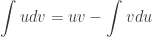
Integration by Parts is summarized in the equation

\displaystyle \int_{{}}^{{}}{udv}=uv-\int_{{}}^{{}}{vdu}

To use the equation, you choose part of a given integral (left side) to be u and part to be dv, both functions of x. Then you differentiate u and integrate dv and use them on the right side to obtain a simpler integral that you can integrate.

The question is this: When you integrate dv, should you, can you, have a constant of integration, the “+ ” that you insist upon in other integration problems? Why don’t you use it here? Or can you?

Scroll down for my answer.

Answer: Let’s see what happens if we use a constant. Assume that \displaystyle \int_{{}}^{{}}{dv}=v+C. Then

\displaystyle \int_{{}}^{{}}{udv}=u\cdot \left( v+C \right)-\int_{{}}^{{}}{\left( v+C \right)du}

\displaystyle =uv+Cu-\left( \int_{{}}^{{}}{vdu}+\int_{{}}^{{}}{Cdu} \right)

\displaystyle =uv+Cu-\int_{{}}^{{}}{vdu}-Cu

\displaystyle =uv-\int_{{}}^{{}}{vdu}

So, you may use a constant if you want, but it will always add out of the expression.


For more on integration by parts see here for the basic idea, here for the tabular method, here for a quicker way than the tabular method, and here for more on the tabular method and reduction formulas.