Applications of Integration – Accumulation 2

Happy New Year !

A few more links to posts on accumulation.

Painting a Point (2-4-2013) Paint often and the paint accumulates.

Good Question 6: 2000 AB 4 (8-25-2015) Accumulation

Good Question 8 – or not? (1-5-2016) Accumulation

Density (1-10-2017)

Accumulation and Differential Equations  (2-1-2013) Solving differential equations without the “+C 

Review Notes: Type 1 Questions: Rate and Accumulation (3-6-2018) Review Notes


Applications of Integration – Accumulation 1

The idea that the definite integral is an “accumulator” means that integrating a rate of change over an integral gives the net amount of change over the interval.Many of the application of integration are based on this idea. Here are some past posts on this idea.

Accumulation An introductory activity to explore accumulation and the relationship between an  accumulation and derivatives

Accumulation: Need an Amount?  (1-21-2013) An important and always tested application.

AP Accumulation Questions (1-23-2013) Two good questions for teaching and learning accumulation.

Graphing with Accumulation 1 (1-25-2013) Everything you need to know about the graph of a function given its derivative can be found using integration techniques. Increasing and decreasing.

Graphing with Accumulation 2 (1-28-2013) Everything you need to know about the graph of a function given its derivative can be found using integration techniques. Concavity.


Next Tuesday is Christmas (already). There will be no post until Tuesday January 1, 2019 when I will there will be several more links to post on accumulation.

Happy Holidays, Merry Christmas, and Happy New Year.


Good Question 18: 2018 BC 2(b)

In this post we look at another part of the AP Calculus BC exam. Good Question 15 discussed the unusual units in 2018 BC 2(a). In this post we look at 2018 BC 2(b) where units help us find the correct integral to answer the question.

How do you answer a question of a type you’ve never seen before? I expect that’s what many of the students taking the 2018 AP Calculus exam were asking when they got to BC 5. If you’ve never done a density question how do you handle this one? 

The question concerns density. Density gives you how much of something exists in a certain length, area, or volume.  Density questions have appeared on the exam now and then, most recently 2008 AB 92 (which really isn’t recent, but then there are a lot of questions we never see). I have a blog post about the density here with several examples. In that post the alternate solution to example 3 explained how I used a unit analysis to find the answer; I used a similar approach here.

2018 BC 2 (b)

The stem of the question tells us that at a depth of meters, 0 < h < 30, the number of plankton in a cubic meter of sea water is modeled by p\left( h \right)=0.2{{h}^{2}}{{e}^{{-0.0025{{h}^{2}}}}} million cells per cubic meter. Part (b) asks for the number of million of plankton in a column of water whose horizontal cross sections have a constant area of 3 square meters.

If the density were constant, then it is just a matter of multiplying the volume of the column times the constant density. Alas, the density is not constant; it varies with the depth. What to do?

Since an amount is asked for, you usually look around for a rate to integrate. Density is a kind of rate: the units are millions of cells per cubic meter. You need to integrate something concerning the density so that you end up with millions of cells; something that will “cancel” the cubic meters.

Consider a horizontal slice thru the column at depth h meters. While I’m not sure plankton is a good topping for pizza, you could picture this as a rather large pizza box whose sides are \sqrt{3} meters long and whose height is  \Delta h meters. This box has a volume of 3 \Delta h cubic meters. For small values of \Delta h the number of million plankton in the box is nearly constant, so at depth hi , there are p(hi) million plankton per cubic meter or {3p\left( {{{h}_{i}}} \right)\Delta h} million plankton in the box.

Notice how the units of the individual quantities combine to assure you the final quantity has the correct units:

\displaystyle (3\text{ square meters)}\cdot \left( {p\left( {{{h}_{i}}} \right)\text{ }\frac{{\text{million plankton}}}{{\text{cubic meters}}}} \right)\left( {\Delta h\text{ meters}} \right)=3p\left( {{{h}_{i}}} \right)\Delta h\text{ million plankton}

Now to find the amount in the column of water we can add up a stack of “pizza boxes.” The sum is \sum\limits_{{i=1}}^{n}{{3p\left( {{{h}_{i}}} \right)\Delta h}}. Now, if we take thinner boxes by letting \Delta h\to 0, we are looking at a Riemann sum. And calculus gives us the answer.

\displaystyle \underset{{n\to \infty }}{\mathop{{\lim }}}\,\sum\limits_{{i=1}}^{n}{{3p\left( {{{h}_{i}}} \right)\Delta h}}=\int_{0}^{{30}}{{3p\left( h \right)dh}}\approx 1,675 million plankton in the column of water (rounded to the nearest million as directed in the question.)


Previous Good Questions can be found under the “Thru the Year” tab on the black navigation bar at the top of the page, or here.


Renumbered 3-14-24 Was Question 16.

Posts on Differential Equations – 2

More posts on differential equations

Good Question 2 (2002 BC 5) and A Family of Function (Good Question 2 continued) – one of my all-time favorite AP exam questions. Parts a, c, and d are suitable for AB students. Part b is a Euler’s method question. Part d is an example of a question where the second derivative test is the only approach possible.

Accumulation and Differential Equations  and Why Muss with the “+C”?

Euler’s method for Making Money an application

The Logistic Equation  – a BC only topic

Logistic Growth – Real and Simulated  – a BC only topic

Logarithms  Defining logarithms with a differential equation


Applications of Integration, part 3: Accumulation

Integration, at its basic level, is addition. A definite integral is a sum (a Riemann sum). When you add things you get an amount of whatever you are adding: you accumulate. Here are some previous posts on this important idea that often shows up on the AP Calculus exams (usually the first free-response question!)

Accumulation: Need an Amount?

Good Question 6 – 2000 AB 4  One of my favorite questions

Painting a Point

Real “Real Life” Graph Reading

Jobs, Jobs, Jobs  are real life accumulation problem based on a graph

Graphing with Accumulation 1 Increasing and decreasing.

Graphing with Accumulation 2 Concavity

Accumulation and Differential Equations   Differential equations will be considered next week, but this idea relates to integration.

Good Question 8 – or Not?

Rate and Accumulation Questions (Type 1)


Rate and Accumulation Questions (Type 1)

The Free-response Questions

The free-response questions fall into 10 general categories or types. The multiple-choice questions fall largely into the same categories plus some straight-forward questions asking students to find limits, derivatives, and integrals. Often two or more type are combined into one question. The types are the following.

  1. Rate and Accumulation
  2. Linear motion
  3. Graph Analysis
  4. Area / Volume
  5. Table and Riemann sum
  6. Differential Equation (and slope fields)
  7. Others (implicit differentiation, related rates, theorems, et. al.)
  8. Parametric Equations (BC only)
  9. Polar Equations (BC only)
  10. Sequences and Series (BC only)

My numbering has changed over the years. This numbering follows this index where each type is referenced to free-response and multiple-choice questions of the same type.

I will discuss each type individually over the next few weeks starting today with Type 1.


AP Type Questions 1: Rate and Accumulation

These questions are often in context with a lot of words describing a situation in which some things are changing. There are usually two rates acting in opposite ways. Students are asked about the change that the rates produce over some time interval either separately or together.

The rates are often fairly complicated functions. If they are on the calculator allowed section, students should store the functions in the equation editor of their calculator and use their calculator to do any integration or differentiation that may be necessary.

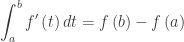
The main idea is that integral of a rate of change over the time interval [a, b] is the net amount of change

\displaystyle \int_{a}^{b}{{f}'\left( t \right)dt}=f\left( b \right)-f\left( a \right)

If the question asks for an amount, look around for a rate to integrate.

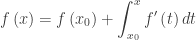
The final (accumulated) amount is the initial amount plus the accumulated change:

\displaystyle f\left( x \right)=f\left( {{x}_{0}} \right)+\int_{{{x}_{0}}}^{x}{{f}'\left( t \right)}\,dt,

where {{x}_{0}} is the initial time, and  f\left( {{x}_{0}} \right) is the initial amount. Since this is one of the main interpretations of the definite integral the concept may come up in a variety of situations.

What students should be able to do:

  • Be ready to read and apply; often these problems contain a lot of writing which needs to be carefully read.
  • Recognize that rate = derivative.
  • Recognize a rate from the units given without the words “rate” or “derivative.”
  • Find the change in an amount by integrating the rate. The integral of a rate of change gives the amount of change (FTC):

\displaystyle \int_{a}^{b}{{f}'\left( t \right)dt}=f\left( b \right)-f\left( a \right).

  • Find the final amount by adding the initial amount to the amount found by integrating the rate. If x={{x}_{0}} is the initial time, and f\left( {{x}_{0}} \right)  is the initial amount, then final accumulated amount is

\displaystyle f\left( x \right)=f\left( {{x}_{0}} \right)+\int_{{{x}_{0}}}^{x}{{f}'\left( t \right)}\,dt,

  • Understand the question. It is often not necessary to as much computation as it seems at first.
  • Use FTC to differentiate a function defined by an integral.
  • Explain the meaning of a derivative or its value in terms of the context of the problem.
  • Explain the meaning of a definite integral or its value in terms of the context of the problem. The explanation should contain (1) what it represents, (2) its units, and (3) how the limits of integration apply in context.
  • Store functions in their calculator recall them to do computations on their calculator.
  • If the rates are given in a table, be ready to approximate an integral using a Riemann sum or by trapezoids.
  • Do a max/min or increasing/decreasing analysis.

Shorter questions on this concept appear in the multiple-choice sections. As always, look over as many questions of this kind from past exams as you can find.


For some previous posts on this subject see January 2123, 2013. This post is revised from the post of March 1, 2013


Next Posts:

Tuesday March 7: Type 2 Linear Motion

Friday March 10: Type 3: Graph Analysis


Good Question 7 – 2009 AB 3

Another in my occasional series on Good Questions to teach from. This is the Mighty Cable Company question from the 2009 AB Calculus exam, number 3

This question presented students with a different situation than had been seen before. It is a pretty standard “in-out” question, except that what was going in and out was money. Students were told that the Mighty Cable Company sold its cable for $120 per meter. They were also told that the cost of the cable varied with its distance from the starting end of the cable. Specifically, the cost of producing a portion of the cable x meters from the end is 6\sqrt{x} dollars per meter. Profit was defined as the difference between the money the company received for selling the cable minus the cost of producing the cable.  Steel Wire Rope 3

Students had a great deal of trouble answering this question. (The mean was 1.92 out of a possible 9 points. Fully, 36.9% of students earned no point; only 0.02% earned all 9 points.) This was probably because they had difficulty in interpreting the question and translating it into the proper mathematical terms and symbols. Since economic problems are not often seen on AP Calculus exams, students needed to be able to use the clues in the stem:

  • The $120 per meter is a rate. This should be deduced from the units: dollars per meter.
  • The cost of producing the portion of cable x meters from one end cable is also a rate for the same reason. In economics this is called the marginal cost; the students did not need to know this term.
  • The profit is an amount that is a function of x, the length of the cable.

Part (a): Students were required to find the profit from the sale of a 25-meter cable. This is an amount. As always, when asked for an amount, integrate a rate. In this case integrate the difference between the rate at which the cable sells and the cost of producing it.

\displaystyle P(25)=\int_{0}^{25}{\left( 120-6\sqrt{x} \right)dx}=\$2500

or

\displaystyle P(25)=120(25)-\int_{0}^{25}{6\sqrt{x}\ dx}=\$2500

Part (b): Students were asked to explain the meaning of \displaystyle \int_{25}^{30}{6\sqrt{x}dx} in the context of the problem. Since the answer is probably not immediately obvious, here is the reasoning involved.

This is the integral of a rate and therefore, gives the amount (of money) needed to manufacture the cable. This can be found by a unit analysis of the integrand: \displaystyle \frac{\text{dollars}}{\text{meter}}\cdot \text{meters}=\text{dollars} .

Let C be the cost of production, so \displaystyle \frac{dC}{dx}=6\sqrt{x}, and therefore, \displaystyle \int_{25}^{30}{6\sqrt{x}dx}=C\left( 30 \right)-C\left( 25 \right) by the Fundamental Theorem of Calculus (FTC).

Therefore, \displaystyle \int_{25}^{30}{6\sqrt{x}dx} is the difference in dollars between the cost of producing a cable 30 meters long, C(30), and the cost of producing a cable 25 meters long, C(25). (Another acceptable is that the integral is the cost in dollars of producing the last 5 meters of a 30 meter cable.)

Part (c): Students were asked to write an expression involving an integral that represents the profit on the sale of a cable k meters long.

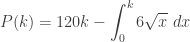
Part (a) serves as a hint for this part of the question. Here the students should write the same expression as they wrote in (a) with the 25 replaced by k.
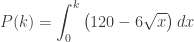
\displaystyle P(k)=\int_{0}^{k}{\left( 120-6\sqrt{x} \right)dx}

or

\displaystyle P(k)=120k-\int_{0}^{k}{6\sqrt{x}\ dx}

Part d: Students were required to find the maximum profit that can be earned by the sale of one cable and to justify their answer. Here they need to find when the rate of change of the profit (the marginal profit) changes from positive to negative.

Using the FTC to differentiate either of the answers in part (c) or by starting fresh from the given information:
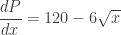
\displaystyle \frac{dP}{dx}=120-6\sqrt{x}

\displaystyle \frac{dP}{dx}=0 when x = 400 and P(400)= $16,000.

Justification: The maximum profit on the sale of one cable is $16,000 for a cable 400 meters long. For 0<x<400,{P} '(x)>0 and for x>400,{P} '(x)<0 therefore, the maximum profit occurs at x = 400. (The First Derivative Test).


Once students are familiar with in-out questions, this is a good question to challenge them with. The actual calculus is not that difficult or unusual but concentrating on the translation of the unfamiliar context into symbols and calculus ideas is different. Show them how to read the hints in the problem such as the units.


Steel cable or steel wire rope as it is called also has some interesting geometry in its construction. You can find many good illustrations of this, such as the ones below, by Googling “steel wire rope.”

This slideshow requires JavaScript.