In this final post in this series on inverses we consider the graphical and numerical concepts related to the derivative of the inverse and look at an important formula.
To make the notation a little less messy, let’s let g(x) = f -1(x). Then we know that f (g(x))= x. Differentiating this implicitly gives

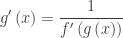
Great formula, but one I’ve never been able to memorize and use correctly! It’s my least favorite formula, because I’m never quite sure what to substitute for what.

The graph shows a function and its inverse. It really doesn’t matter which is which, since inverse functions come in pairs: the inverse of the inverse is the original function.
Notice that the graphs are symmetric to y = x. At two points, one of which is the image of the other after reflecting over the line y = x, a tangent segment has been drawn. This segment is the hypotenuse of the “slope triangle” which is also drawn. The ratio of the vertical side of this triangle to the horizontal side is the slope (i.e. the derivative) of the tangent line.
The two triangles are congruent, so that the horizontal side of one triangle is congruent to the vertical side of the other, and vice versa. Thus the slope (the derivative) of the one tangent segment is the reciprocal of the other.
If (a, b) is a point on a function and the derivative at this point is 

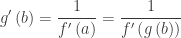
What you really need to know is:
At corresponding points on a function and its inverse, the derivatives are reciprocals of each other.
This is what my least favorite formula says.
The AP exams have a clever way of testing this. (The stem may give a few more values to throw you off, or the values may be in a table.)
Given that 

The solution is reasoned this way: (5, ?) is a point on g. The corresponding point on f is (?, 5) = (2, 5). The derivative of f at this point is 3, therefore the derivative at (5, 2) on g is 
Easy!
 and then rewrite this as
  . Differentiating this gives


 .
.

 and
and  . The domain of this function is
  and the range is
 ![[0,\tfrac{\pi }{2})\cup (\tfrac{\pi }{2},\pi ]](https://s0.wp.com/latex.php?latex=%5B0%2C%5Ctfrac%7B%5Cpi+%7D%7B2%7D%29%5Ccup+%28%5Ctfrac%7B%5Cpi+%7D%7B2%7D%2C%5Cpi+%5D&bg=ffffff&fg=333333&s=0&c=20201002) , the function is increasing on both parts of its domain; we will need to know this.
, the function is increasing on both parts of its domain; we will need to know this.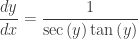 .
.
 ,
, is increasing and the derivative should always be positive. So, this needs to be adjusted to
 where it is understood that this represents a non-negative number. This is why
  . So that if a = –4,
  .
. , these are the output values of the sin(x); the range is restricted to
  . Because the signs of the trig functions are different outside of the first quadrant and in order to make as many of the inverses as possible continuous, each inverse trig function has a different range. You will find these in your textbook. They are built into calculators and computers. This can be a little confusing for students, but there is not much that can be done about that.
 and we think we have solved the problem. We have not. While I can write



 , Thus, x2 is increasing only if
  .
. looks a lot like the numerator of the original limit definition of the derivative of x2 at x = x1, namely
  . If h > 0, where the function is increasing the numerator is positive and the derivative is positive also. Turning this around we have a theorem that says, If
  for all x in an interval, then the function is increasing on the interval. That makes it much easier to find where a function is increasing: we simplify find where its derivative is positive.
![\left[ -\tfrac{\pi }{2},\tfrac{\pi }{2} \right]](https://s0.wp.com/latex.php?latex=%5Cleft%5B+-%5Ctfrac%7B%5Cpi+%7D%7B2%7D%2C%5Ctfrac%7B%5Cpi+%7D%7B2%7D+%5Cright%5D&bg=ffffff&fg=333333&s=0&c=20201002) (among others) and decreasing on
(among others) and decreasing on ![\left[ \tfrac{\pi }{2},\tfrac{3\pi }{2} \right]](https://s0.wp.com/latex.php?latex=%5Cleft%5B+%5Ctfrac%7B%5Cpi+%7D%7B2%7D%2C%5Ctfrac%7B3%5Cpi+%7D%7B2%7D+%5Cright%5D&bg=ffffff&fg=333333&s=0&c=20201002) . It bothers some that
. It bothers some that  is in both intervals and that the derivative of the function is zero at x =
  , which using the dominance idea is zero. Of course your students may try graphing or a table. Here’s the graph done by a TI-Nspire CAS. Note the scales.