Socrative

As you may know I have un-retired this year and gone back to high school teaching; I’m filling in for a friend who is on sabbatical. It turns out that this takes a lot of time and so I’ve been writing very little and perhaps neglecting my blog. Today I would like to share a website that I’ve been using this year with both my BC calculus students and my eighth grade Algebra 1 students. It is called Socrative; the URL is www.socrative.com.

The website is similar to a “clicker.” It can be used with a computer, a smart phone, an iPad or other tablet – anything that can connect to the internet. The first time teachers join they get a “room number” that remains theirs from then on. The teacher, working on the teacher side of the site, then prepares quizzes or tests. When the students sign in, they need enter only the teacher’s “room number” and they are ready to go. The teacher starts the quiz, and the students see the questions and answer them on their device. The results are instantly shown on the teacher’s screen.

The questions can be multiple-choice with two (for true-false question) to five choices. Questions may also be open-ended allowing students to enter longer answers. The teacher can supply the correct answer and / or an explanation. Instead of prepared work there is also the option of single-question activities. This is what I use most often. I present the question on the board and the students answer one question at a time on their device.

The results appear on the teacher’s screen which I project for the class. Multiple-choice results are displayed as a bar graph for each choice. Short answers display whatever the student wrote. This allows students to see other forms of the correct answers and spot common mistakes. (Be aware that some students may enter an answer of 2/3 as a forty-place decimal, but that’s not really so bad.)

You have the option to allow the students’ names to appear with their answer. I don’t do that too often. When I do I explain that making fun of someone who made a mistake is a form of bullying and rather they should help whoever got it wrong instead of making fun of them.

Projecting the answers allows the teacher to have immediate feedback – formative assessment. If there are a lot of wrong answers, then you know you have to work more on that concept; if the answers are all or almost all correct you can go on to the next idea.

I used it quite well with eighth grade students in Algebra 1 with all the evaluating of expressions, simplifying, and equation solving in that course and next semester for factoring. I used it recently with my BC calculus classes when we were learning how to write justification for free-response questions. Having a variety of correct and almost correct justifications made for a good discussion and a good class.

Both seniors and eighth graders like doing this and, especially the eighth graders ask to do it daily (which I don’t do).

One of the features I like is that there is a running count of how many students are signed and also how many have answered each question. It helps the teacher know everyone is involved. No one can be daydreaming, doing something else, or playing games on their iPad.

A report with each student’s name and answers can be downloaded at the end of the activity as an e-mail or spreadsheet.

Images, including math symbols, can be included in questions as .gif, .jpg or .png flies, but they are pixellated and appear after the question text (i.e. not as inline equations) and there is no way for students to draw graphs. The website does not work well using Chrome on my PC but is fine in Firefox and Internet Explorer. It works on iPad browsers such as Chrome and Safari. There are also free apps available for smart phones, iPads and tablets.
The Math Book

Ants can count.

I did not know that.

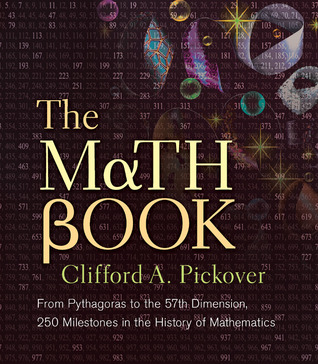
I found this interesting fact in a book I bought recently called The Math Book by Clifford A. Pickover. The book is similar to a coffee table book in that it is nicely made with high quality paper and illustrations, although its size is about the same as a regular book. It consists of 250 entries one page in length with a color illustration on the facing page.

The Math BookThe topics cover the whole range of mathematics and mathematicians.

The entries are dated by year from c.150 million B.C. (Ant Odometer) to 2007. Most of the years are from the current era of course. Each entry discusses the important mathematics discovered or developed in that year or a mathematician active in that time.

Some entries are devoted to curiosities such as Aristotle’s Wheel Paradox (c.320 B.C.) or the Birthday Paradox (1939). Numerous mathematicians and their work are discussed. Games with mathematical features such as Go (548 BC), Mastermind (1970) and Awari (2002) make interesting entries. Unsolved and recently solved problems like the Riemann Hypothesis (1859) and the Four-Color Theorem (1852) are included. Mathematical inventions like the slide rule, (1621) and the Curta Calculator (1948) among others are discussed.

Every page seems to have new ideas many of which I have never heard of (which doesn’t prove a whole lot). Do you know about Johnson’s Theorem (1916) or Voderberg Tilings (1936)?

As the author points out, one page is not enough space to go deeply into each topic, but that is not the purpose of this book. Each essay includes reference to other related topics in the book.  For those who want to know more or want their students to dig a little deeper, there are notes, references and further readings for every topic the end of the book.

Each entry is fascinating, informative and fun.

How am I going to use this in my classes? I thought that each day I would have a student pick a date and then read the entry closest to that date. My goal will be simply to give the class a hint of the breadth of mathematics, the people who made mathematics, and the wide range of things mathematical.

The Math Book, by Clifford A. Pickover, © 2009, Sterling Publishing, New York, NY. ISBN 978-1-4027-5796-9 (hardcover), ISBN 978-1-4027-8829-1 (Paperback)

Difficult Problems and Why We Like Them

Item 1:

Audrey Weeks writes a really great set of animations for calculus teachers and students called Calculus in Motion. The animations run on Geometer’s Sketchpad and are very easy to use, but difficult to program. But Audrey is an expert.  She is very busy each year at this time doing animations of the recent AP calculus exam questions. I proofread the animations as she finishes each one and now and then make some suggestions.

The particular solution to the differential equation question BC 5 on this year’s exam is a function with a vertical asymptote.  The animation allows the user to move the initial condition around. This moves the asymptote(s); in some cases there is no asymptote. Her graph showed the function on both sides of the asymptote with the note that the domain was x > –1.  I pointed out that the graph should only exist on one side of the asymptote at x = –1.  She wrote back that “I agree, and I had tried, but couldn’t find any way to do that.”  

Then the next day she sent the next version with only the correct part of the graph showing, and its changing restricted domain stated as the initial condition changed.

See the figure below with no graph to the left of the asymptote x = –1

cim

She wrote:

“Now, will anyone appreciate the additional 5 hours of work to make that happen, …?  Doesn’t matter … it makes ME happy.”

Item 2:

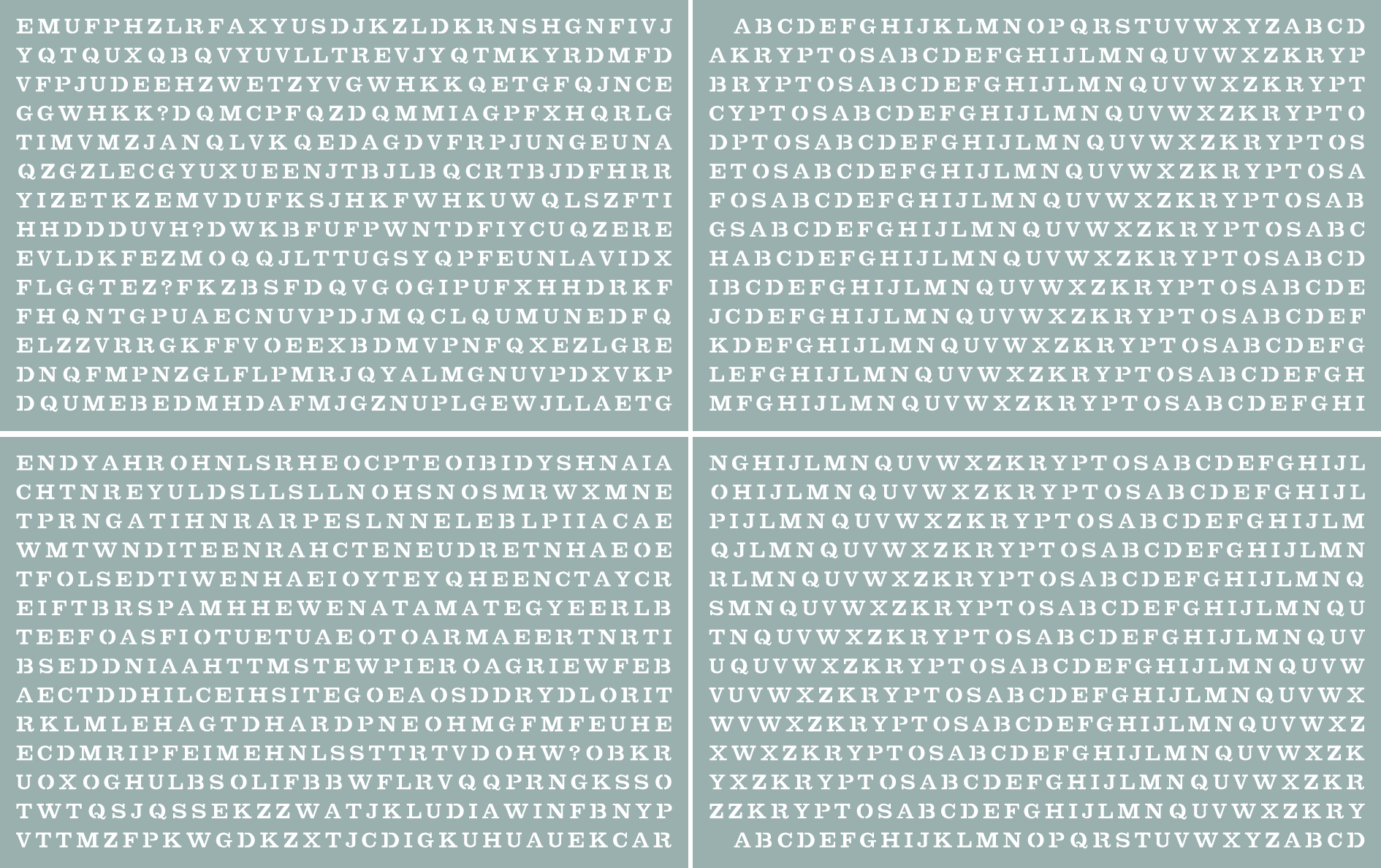
Kryptos is a sculpture by artist Jim Sanborn that stands on the campus of the Central Intelligence Agency (CIA) Headquarters in Langley,  VA.  The sculpture contains four coded messages.

Kryptos

In a recent article Wired.com recounts how David Stein, a CIA employee who is not a cryptographer, got interested in the cipher and spent 400 hours over 8 years trying to break it. He succeeded in deciphering three of the four messages in 1998. He did the deciphering with pencil-and-paper in his spare time.

The CIA would not allow him to make his results public at the time.  (Later, Jim Gillogly, a computer scientist, cracked the same 3 messages using a computer and, not being employed by the CIA, published his results.)  The CIA recently declassified Stein work.

The Wired article recounts the story when (quoting Stein), “I was I was hit by that sweetly ecstatic, rare experience that I have heard described as a ‘moment of clarity.’ All the doubts and speculations about the thousands of possible alternate paths simply melted away, and I clearly saw the one correct course laid out in front of me.”  Stein’s full article is included in the Wired article (photocopied, slightly redacted, and missing the figures and charts). The solution is here. To this day no one has deciphered the fourth message.

Stein’s account concludes with this remark:

When confronted with a puzzle or problem, we sometimes can lose sight of the fact that we have issued a challenge to ourselves–not to our tools. And before we automatically reach for our computers, we sometimes need to remember that we already possess the most essential and powerful problem-solving tool within our own minds.

In other words, he did it because it made him happy.

Photo by Jim Sanborn – Wikipedia

Update (November 21, 2014) The sculptor of Kryptos has provide a second clue to the fourth panel of the sculptor. The full story is here. The full enciphered text is below. The source (N.Y. Times November 21, 2014) with the known deciphering and the clues is here.

kryptos-945

Summer Reading

I like to read and I read a lot. I often have a novel going. Lately since I’ve been writing this Blog, I’ve been reading other blogs. I’ve listed a few in the right-side column but here are two that might interest you. (Since deleted)

Wired Magazine

Wired magazine  has a lot of interesting articles on science and technology. They also publish a collection of Science Blogs. If you are interested in what’s going on in science this may be the place to start. Samuel Arbesman writes the math blog entitled Social Dimensions that is more focused on things mathematical. Wired also has the latest in math news like their piece on the “Unknown Mathematician Proves Elusive Property of Prime Numbers”

 dy/dan

Another of my favorites is a blog called dy/dan  by Dan Meyer who always has interesting ideas and interesting problems to discuss from all levels of teaching mathematics. The blog has lessons on lots of topics.

Dan recently posted the video below. It is a talk by Uri Theisman entitled “Keeping Our Eyes on the Prize” concerning equity, race and the opportunity to learn. Dr. Theisman is from the Charles A. Dana Center at the University of Texas at Austin. He is a recognized authority on education. The talk was given at the NCTM meeting April 19, 2103. It runs about 50 minutes and is certainly worth the time. Anyone interested in equity and the opportunity to learn will find this interesting.  Here is Dr. Theisman’s own summary:

There are two factors that shape inequality in this country and educational achievement inequality. The big one is poverty. But a really big one is an opportunity to learn. As citizens, we need to work on poverty and income inequality or our democracy is threatened. As mathematics educators … we need to work on opportunity to learn. It cannot be that the accident of where a child lives or the particulars of their birth determine their mathematics education.

Uri Treisman’s “Keeping Our Eyes on the Prize” – NCTM 2013 from Dan Meyer on Vimeo.

Is God a Mathematician?

Finally, if you are looking for an actual book to read, I recommend again Is God a Mathematician? by Mario Livio. I written about this book before here.

The Opposite of Negative

Next year, for the first time in 15 years, I am going to be teaching high school full-time. While I have enjoyed writing and working primarily with teachers for the last 15 years, I’m looking forward to “going back to the classroom” as they say. It looks like I’ll be teaching BC calculus and Algebra 1 – two of my favorite classes. I’m very positive about that.

With that in mind I have been thinking of some of the things I want to be sure I get right in the Algebra 1 classes to get the kids off to a good start. So a few of my blogs in the coming year may be on Algebra 1 topics with the view of having students do things right from the start and not having to relearn things when they get to calculus.

So here is the first thing I want to be sure to work on: the m-dash also known as the minus sign.

According to Wikipedia:

The minus sign () has three main uses in mathematics:

  1. The subtraction operator: A binary operator to indicate the operation of subtraction, as in 5 − 3 = 2. Subtraction is the inverse of addition.
  2. Directly in front of a number and when it is not a subtraction operator it means a negative number. For instance −5 is negative 5.
  3. unary operator that acts as an instruction to replace the operand by its opposite. For example, if x is 3, then −x is −3, but if x is −3, then −x is 3. Similarly, −(−2) is equal to 2.

Using the same symbol understandably can confuse beginning math students. I am not going to invent new symbols so I will just have to be careful with what I say and let the kids say. And I have to say it right , if I expect them to.

When used between two numbers or two expressions with variables the symbol means subtraction. That’s pretty easy to spot and understand in context.  But when used alone in front of something the minus sign means different things.

The m-dash may always be read “opposite.” So “–a” is read “the opposite of a” and not “negative a.”  Likewise, –5 is read “the opposite of five.”

There is only one instance where the m-dash may be read “negative.” When it is used in front of a number it indicates a negative number so      “–5” is also correctly read “negative five.” This is the only time the m-dash should be read “negative.”  Things like “–a” should always be read “the opposite of a” and never read “negative a.”

There was a time when the folks who write math books tried to make the distinction by using a slightly raised dash to indicate negative number so negative 3 was written  “3.” This has carried over into calculators where the key marked “(–)” is used for “negative” and “opposite.” and is printed on the screen as a shorter and slightly raised dash. The subtraction key is only used for subtraction.

Oh, if it were only that simple. What do you do with –(–5)? Not really a problem the “opposite of the opposite of 5” and the “opposite of negative 5” are both 5.

I’ll know I’ve succeeded when everyone can get 100% on this little True-False quiz:

  1. The opposite of a number is a negative.
  2. x < 0
  3. x > 0
  4. | x | = x
  5. |– x |= x

Answers are in my next post.


Revised 10-27-2018

What’s a Mean Old Average Anyway?

Students often confuse the several concepts that have the word “average” or “mean” in their title. This may be partly because not just the names, but the formulas associated with each are very similar, but I think the main reason may be that they are keying in on the word “average” rather than the full name.

Here are the three items. We will assume that the function f is continuous on the closed interval [a, b] and differentiable on the open interval (a, b):

1.  The average rate of change of a function over the interval is simply the slope of the line from one endpoint of the graph to the other.

 \displaystyle \frac{f\left( b \right)-f\left( a \right)}{b-a}

2. The mean (or average) value theorem say that somewhere in the open interval (a, b) there is a number c such that the derivative (slope) at x = c is equal to the average rate of change over the interval.

\displaystyle {f}'\left( c \right)=\frac{f\left( b \right)-f\left( a \right)}{b-a}

3. The average value of a function is literally the average of all the y-coordinates on the interval. It is the vertical side of a rectangle whose base extends on the x-axis from x = a to x =b and whose area is the same as the area between the graph and the x-axis and the function over the same interval.

\displaystyle \frac{\int_{a}^{b}{f\left( x \right)dx}}{b-a}

Notice that when you evaluate the integral, the result looks very much like the ones above. This formula is also called the mean value theorem for integrals or the integral form of the mean value theorem. No wonder people get confused.

The three are closely related. Consider a position-velocity-acceleration situation. The average rate of change of position (#1 above) is the average value of the velocity (#3) and somewhere the velocity must equal this number (#2). Similarly, the average rate of change of velocity (#1) is the average acceleration (#3) and somewhere in the interval the acceleration (derivative of velocity) must equal this number (#2).

These ideas are tested on the AP calculus exams sometimes in the same question. See for example 2004 AB 1 parts c and d.

So, help your students concentrate on the entire name of the concepts, not just the “average” part.


Proof

When math books present a theorem, they almost always immediately present its proof. I tend to skip the proofs. I assume they are correct. I want to get on with the ideas in the text. Later I may come back and read through them. Is this a good thing to advise students to do? I don’t know.

There are reasons to read proofs. One reason is to help understand why a theorem is true, by seeing the reasoning that leads to the result. Another is to check the reasoning yourself. A third is to learn how to do proofs.

Learning to write original proofs is not usually one of the goals of a beginning calculus course. That comes later in a course with “analysis” in its title. There are many theorems that involve some one-off that rarely will be used again. I’m thinking of a proof like that of the sum of the limits is equal to the limit of the sums, where you add and subtract the same expression and this more complicated form allows you to group and factor the terms of the numerator and arrive at the result. Another example is in the Mean Value Theorem where you consider a new function that gives the vertical distance between a function and its secant line. These always bring the question, “How did you know to do that?”

If a student can accept things like that, then the proof is usually easy enough to follow. But I would never spend a lot of time making every student fight his or her way through each and every proof.

On this other hand, I would never just present a theorem and not give some explanation as to why it is true (and why it is important enough to mention). Unfortunately, I have seen teachers write the Fundamental Theorem of Calculus on the board and proceed to show how to use it to evaluate definite integrals, with no hint of why this important theorem is true. Sure kids can memorize it and use it, but it seems to me they should also have a hint as to why it is true.

Some theorems are easy to understand if explained in ways other than giving a proof. For an example of this, see my post of October 1, 2012 on the Mean Value Theorem. Almost every book will bail out on the Intermediate Value Theorem by claiming (quite rightly) that, “the proof is beyond the scope of this book,” or they give the proof in an appendix. But a simple drawing will convince you that it is true.

So my feeling is that you do not need to labor over a proof for every theorem, BUT, big BUT, you should provide a good explanation of why it is true.

This is important for all students and especially for young women. Jo Boaler writes

“As I interviewed more and more boys and girls, I noticed that the desire to know why was something that separated the girls from the boys. The girls were able to accept the method that were shown them and practice them, but they wanted to know why they worked, where they came from, and how they connected with other methods…. When they could not get access to the depth of understanding they wanted, the girls started to turn away from the subject…. Classes in which students discuss concepts, giving them access to a deep and connected understanding of math, are good for boys and girls. Boys may be willing to work in isolation on abstract rules, but such approaches do not give many students, girls or boys, access to the understanding they need. In addition, high-level work in mathematics, science and engineering is not about isolated, abstract rule following, but about collaboration and connection making.”

[Jo Boaler, What’s Math Got to Do with It? Helping Children Learn to Love Their Most Hated Subject – And Why It’s Important for America, © 2008 Penguin Group, New York. From Chapter 6]