Polar Curves (Type 9 for BC only)

Ideally, as with parametric and vector functions, polar curves should be introduced and covered thoroughly in a pre-calculus course. Questions on the BC exams have been concerned with calculus ideas related to polar curves. Students have not been asked to know the names of the various curves (rose, curves, limaçons, etc.). The graphs are usually given in the stem of the problem, but students should know how to graph polar curves on their calculator, and the simplest by hand.

What students should know how to do:

  • Calculate the coordinates of a point on the graph,
  • Find the intersection of two graphs (to use as limits of integration).
  • Find the area enclosed by a graph or graphs: Area =\displaystyle A=\tfrac{1}{2}\int_{{{\theta }_{1}}}^{{{\theta }_{2}}}{(r(}θ\displaystyle ){{)}^{2}}dθ
  • Use the formulas x\left( \theta  \right)\text{ }=~r\left( \theta  \right)\text{cos}\left( \theta  \right)~~\text{and}~y\left( \theta  \right)\text{ }=~r(\theta )\text{sin}\left( \theta  \right)~  to convert from polar to parametric form,
  • Calculate \displaystyle \frac{dy}{d\theta } and \displaystyle \frac{dx}{d\theta } (Hint: use the product rule on the equations in the previous bullet).
  • Discuss the motion of a particle moving on the graph by discussing the meaning of \displaystyle \frac{dr}{d\theta } (motion towards or away from the pole), \displaystyle \frac{dy}{d\theta } (motion in the vertical direction) or \displaystyle \frac{dx}{d\theta } (motion in the horizontal direction).
  • Find the slope at a point on the graph, \displaystyle \frac{dy}{dx}=\frac{dy/d\theta }{dx/d\theta }.

This topic appears only occasionally on the free-response section of the exam instead of the Parametric/vector motion question. The most recent on the released exams were in 2007,  2013, 2014, and 2017. If the topic is not on the free-response then 1, or maybe 2 questions, probably finding area, can be expected on the multiple-choice section.

Shorter questions on these ideas appear in the multiple-choice sections. As always, look over as many questions of this kind from past exams as you can find.


Next post:

Tuesday April 4: For BC Sequences and Series.

Friday April 7, 2017 The Domain of the solution of a differential equation.


.

February 2016

As I hope you’ve noticed there is a new pull-down on the navigation bar called “Website.” For some years I’ve had a website at linmcmullin.net that lately I’ve been neglecting. I decided to close it in the next few days, and therefore, I move most of the material that is there to this new tab. The main items of interest are probably those under “Calculus”, “Winplot”, and “CAS.” If you used that website you should be able to find what you need here. If you cannot find something, then please write and I’ll try to help.

In my post entitled January 2016 are listing of post for the applications of integration for both AB and BC calculus. This month’s posts are BC topics on sequences, series, and parametric and polar equations.

Posts from past Februarys

Sequences and Series

February 9, 2015 Amortization A practical application of sequences.

February 8, 2013: Introducing Power Series 1

February 11, 2013: Introducing Power Series 2

February 13, 2013: Introducing Power Series 3

February 15, 2013 New Series from Old 1

February 18, 2013: New Series from Old 2

February 20, 2013: New Series from Old 3

February 22, 2013: Error Bounds

May 20, 2015 The Lagrange Highway

Polar, Parametric, and Vector Equations

March 15, 2013 Parametric and Vector Equations

March 18, 2013 Polar Curves

May 17, 2014 Implicit Differentiation of Parametric Equations 

A series on ROULETTES some special parametric curves (BC topic – enrichment):


Limaçons

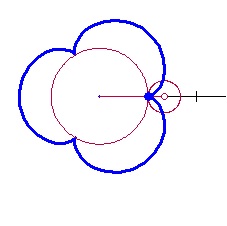
When I first started getting interested in roulettes I began in polar form graphing limaçons. Without going into as much detail as with the roulettes, I offer just one today.

I found this Winplot illustration instructive as to how polar graphs are formed and just how the graphs work and relate to rectangular form graphs of the same functions. So this could be used as a first example, or an investigation of its own.

For my example we will consider the limaçon, or a cardioid with an inner loop, given below (using t for the usual theta, since the LaTex translator doesn’t seem to be able to handle thetas).

r\left( t \right)=1.4-2\sin \left( t \right)

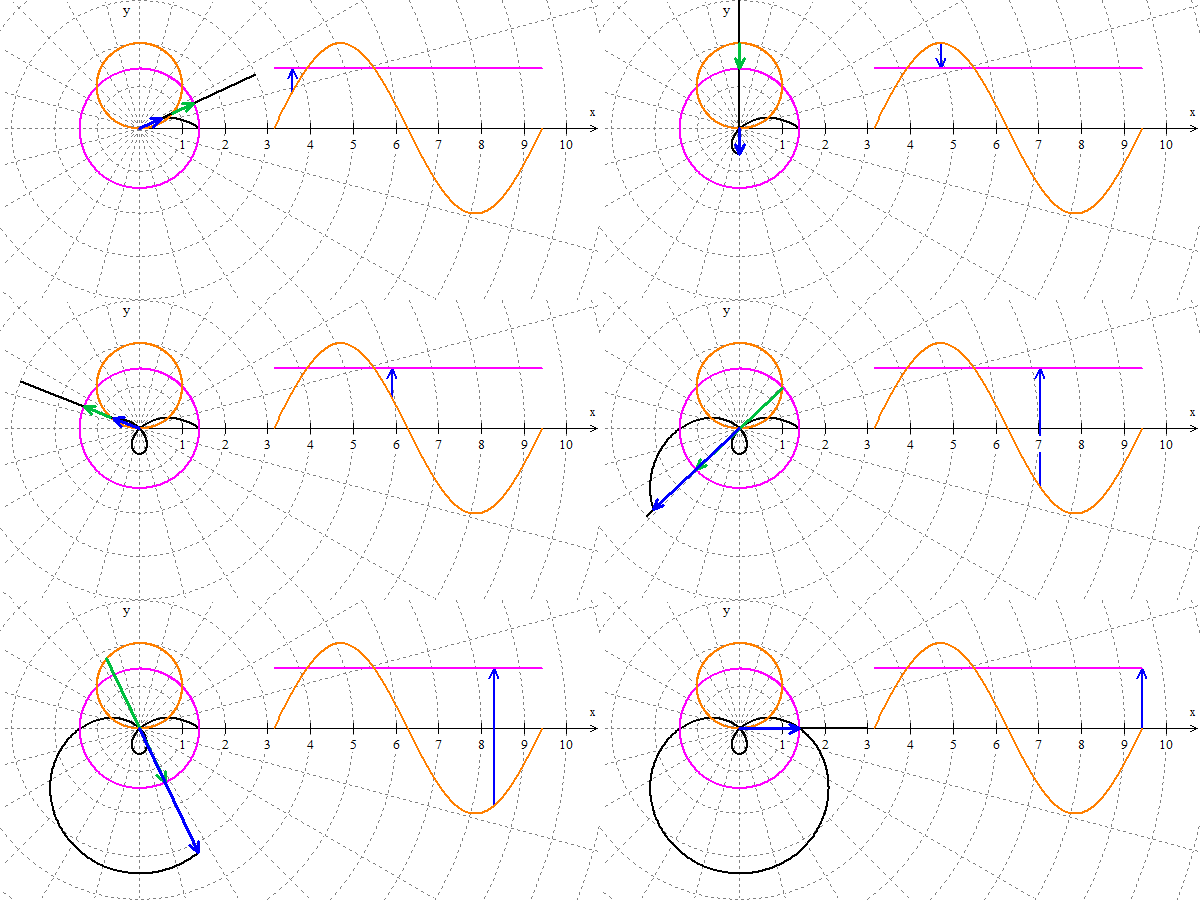
In polar form {{r}_{1}}\left( t \right)=1.4 is a circle with center at the pole and radius of 1.4.This is shown in light blue in the figures.

The polar curve {{r}_{2}}\left( t \right)=2\sin \left( t \right) is a circle with center at \left( 1,\tfrac{\pi }{2} \right) and radius of 1. This is shown in orange in the figures below.

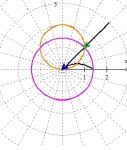
The graph in the example isr\left( t \right)={{r}_{2}}\left( t \right)-{{r}_{1}}\left( t \right)  the directed distance (length of the vector) from {{r}_{1}}\left( t \right) to {{r}_{2}}\left( t \right) and is shown by the green arrow in figures 1, 3, and 4.

The blue arrow is congruent to the green with its tail at the pole; its point traces the limaçon shown in black. (Click to enlarge.)

  •  In figure 1, the distance is positive and both arrows point in the same direction along the rotating ray.
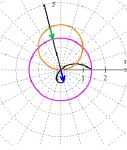
  • In figure 2, the two circles intersect and the distance between them is zero. The limaçon goes through the origin.
  • In figure 3, the curves have changed position and the directed distance is negative. The blue arrow points in the negative direction opposite to the rotating ray drawing the inner loop.
  • In figure 4, the arrows return to pointing in the same direction, but are longer due to the fact that the distance runs from the orange circle to the far side of  the light blue circle forming the bottom outside loop

In the clip below the limaçon is drawn as the black ray rotates from 0 to 2\pi  radians. Watch how the green and blue arrows (always the same length, but not the same direction), work to draw the limaçon.

On the right side of the clip are the two functions graphed in rectangular form. The blue arrow on the right is the same length as the blue arrow on the left and gives the directed distance from {{r}_{1}}\left( t \right)  to {{r}_{2}}\left( t \right). This form is probably more familiar to students and may help them see the relationships.

A limaçon being graphed.

A limaçon being graphed.

This form is probably more familiar to students and may help them see the relationships. The Winplot file may be downloaded here. If you or your students what to investigate further, click on the Winplot graph and then CTRL+SHIFT+N to see the notes; they will also tell you how to change the A, B, and R sliders to change the curves.

Roulettes and Calculus

Roulettes – 5: Calculus Considerations.

In the first post of this series Roulette Generators (RG) are explained. Here are the files for Winplot or Geometer’s Sketchpad. Use them to quickly see the graphs of these curves by adjusting one or two parameters.

While writing this series of posts I was intrigued by the cusps that appear in some of the curves. In Cartesian coordinates you think of a cusp as a place where the curves is continuous, but the derivative is undefined, and the tangent line is vertical. Cusps on the curves we have been considering are different.

The equations of the curves formed by a point attached to a circle rolling around a fixed circle in the form we have been using are:

x\left( t \right)=(1+R)\cos \left( t \right)-S\cos \left( \tfrac{1}{R}t+t \right)

y\left( t \right)=\left( 1+R \right)\sin \left( t \right)-S\sin \left( \tfrac{1}{R}t+t \right)

For example, let’s consider the case with R=S=\tfrac{1}{3}


Epicycloid with R = S = 1/3

Epicycloid with R = S = 1/3

The equations become

x\left( t \right)=\frac{4}{3}\cos \left( t \right)-\frac{1}{3}\cos \left( 4t \right)

y\left( t \right)=\frac{4}{3}\sin \left( t \right)-\frac{1}{3}\sin \left( 4t \right)

The derivative is

\displaystyle \frac{dy}{dx}=\frac{dy/dt}{dx/dt}=\frac{\cos \left( t \right)-\cos (4t)}{-\sin \left( t \right)+\sin (4t)}

The cusps are evenly spaced one-third of the way around the circle and appear at t=0,\tfrac{2\pi }{3},\tfrac{4\pi }{3}. At the cusps dy/dx is an indeterminate form of the type 0/0. (Note that at t=\tfrac{2\pi }{3}\cos \left( 4t \right)=\cos \left( \tfrac{8\pi }{3} \right)=\cos \left( \tfrac{2\pi }{3} \right) and likewise for the sine.) Since derivatives are limits, we can apply L’Hôpital’s Rule and find that at t=\tfrac{2\pi }{3}

\displaystyle \frac{dy}{dx}=\underset{t\to \tfrac{2\pi }{3}}{\mathop{\lim }}\,\frac{-\sin \left( t \right)+4\sin \left( 4t \right)}{-\cos \left( t \right)+4\cos \left( 4t \right)}=\underset{t\to \tfrac{2\pi }{3}}{\mathop{\lim }}\,\frac{3\sin \left( t \right)}{3\cos \left( t \right)}=\tan \left( \tfrac{2\pi }{3} \right)=-\sqrt{3}

This is, I hope, exactly what we should expect. As the curve enters and leaves the cusp it is tangent to the line from the cusp to the origin. (The same thing happens at the other two cusps.)  At the cusps the moving circle has completed a full revolution and thus, the line from its center to the center of the fixed circle goes through the cusp and has a slope of tan(t).

The cusps will appear where the same t makes dy/dt = 0 and dx/dt =0 simultaneously.

The parametric derivative is defined at the cusp and is the slope of the line from the cusp to the origin. Now I may get an argument on that, but that’s the way it seems to me.

A look at the graph of the derivative in parametric form may help us to see what is going on. In the next figure R=S=\tfrac{1}{3} with the graph of the curve is in blue. The velocity vector is shown twice (arrows). The first is attached to the moving point and shows the direction and its length shows the speed of the movement. The second shows the velocity vector as a position vector (tail at the origin). The orange graph is the path of the velocity vector’s tip – the parametric graph of the velocity. Note that these vectors are the same (i.e. they have the same direction and magnitude)

The video shows the curve moving through the cusp at. Notice that as the graph passes through the cusp the velocity vector changes from pointing down to the right, to the zero vector, to pointing up to the left. The change is continuous and smooth.
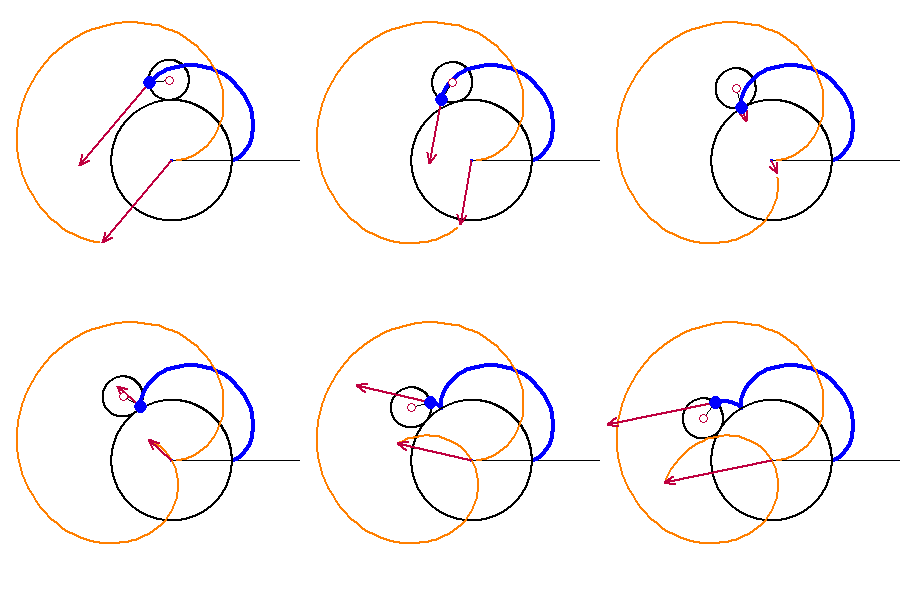
Velocity near a cusp.

Velocity near a cusp.

Here is the whole curve being drawn with its velocity and the velocity vectors.
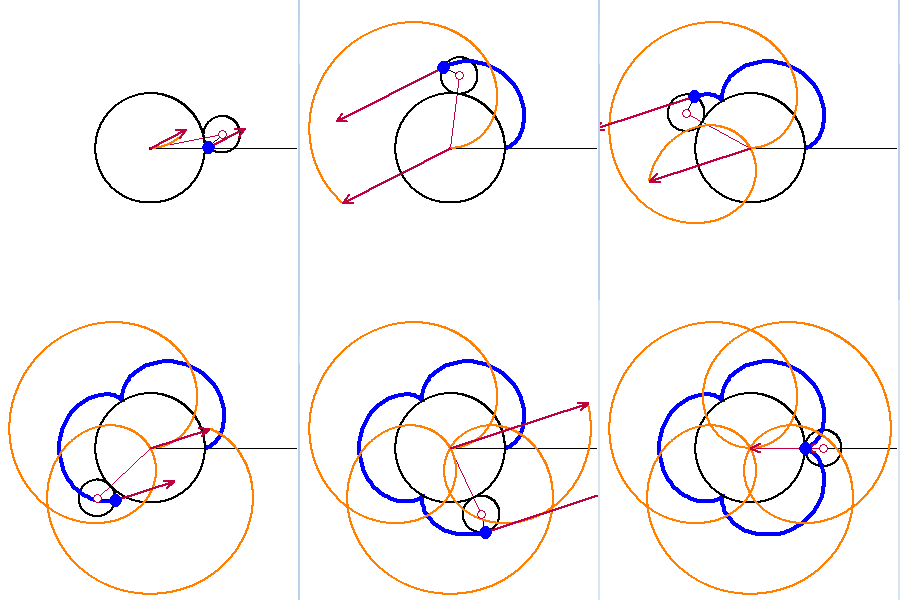
Epicycloid with velocity vectors

Epicycloid with velocity vectors

(If you are using the Winplot file you graph the velocity this way. Open the inventory with CTRL+I, scroll down to the bottom and select, one at a time, the last three lines marked “hidden”, and then click on “Graph.”). The Geometer’s Sketchpad version has a button to show the derivative’s graph and the velocity vectors.

The general equation of the derivative (velocity vector) is

\displaystyle {x}'\left( t \right)=-\left( 1+R \right)\sin \left( t \right)+S\left( \tfrac{1}{R}+1 \right)\sin \left( \tfrac{1}{R}t+t \right)

\displaystyle {y}'\left( t \right)=\left( 1+R \right)\cos \left( t \right)-S\left( \tfrac{1}{R}+1 \right)\cos \left( \tfrac{1}{R}t+t \right)

Notice that the derivative has to same form as a roulette.

Finally, I have to mention how much seeing the graphs in motion have helped me understand, not just the derivatives, but all of the curves in this series and the ones to come. To experiment, to ask “what if … ?” questions, and just to play is what technology should be used for in the classroom. See what your students can find using the RGs.

Exploration and Challenge:

Consider the epitrochoid x\left( t \right)=\frac{2}{3}\cos \left( t \right)+\frac{1}{3}\cos \left( 2t \right),y\left( t \right)=\frac{2}{3}\sin \left( t \right)-\frac{1}{3}\sin \left( 2t \right).

  1. Find its derivative as a parametric equation and graph it with a graphing program or calculator. (Straight forward)
  2. Are the graph of the derivative and the graph of the rose curve given in polar form by r\left( t \right)=\frac{4}{3}\sin \left( 3t \right) the same? Justify your answer.  (Warning: The graphs certainly look the same. I have not been able to do show they are  the same (which certainly doesn’t prove anything), so they may not be the same.) Please post your answer using the “Leave a Reply” box at the end of this post.

Next: Roulette Art.


Polar Curves

AP Type Questions 9

Polar Curves for BC only.

Ideally, as with parametric and vector functions, polar curves should be introduced and covered thoroughly in a precalculus course. Questions on the BC exams have been concerned with calculus ideas. Students have not been asked to know the names of the various curves (rose, curves, limaçons, etc.). The graphs are usually given in the stem of the problem, but students should know how to graph polar curves on their calculator.

What students should know how to do

  • Find the intersection of two graphs (to use as limits of integration).
  • Find the area enclosed by a graph or graphs using the formula \displaystyle A=\tfrac{1}{2}\int_{{{\theta }_{1}}}^{{{\theta }_{2}}}{(r(}θ\displaystyle ){{)}^{2}}dθ
  • Use the formulas x(θ) = r(θ)cos(θ)  and y(θ) = r(θ)sin(θ) to
    • convert from polar to rectangular form,
    • calculate the coordinates of a point on the graph, and
    • calculate \frac{dy}{d\theta } and \frac{dx}{d\theta } (Hint: use the product rule).
    • Discuss the motion of a particle moving on the graph by discussing the meaning of \frac{dr}{d\theta } (motion towards or away from the pole), \frac{dy}{d\theta } (motion in the vertical direction) or \frac{dx}{d\theta } (motion in the horizontal direction).
    • Find the slope at a point on the graph, \frac{dy}{dx}=\frac{dy/d\theta }{dx/d\theta }.

This topic appears only occasionally on the free-response section of the exam. The most recent were 2007 and 2013. If the topic is not on the free-response then 1, or maybe 2 questions, probably finding area, can be expected on the multiple-choice section.