2019 CED Unit 4: Contextual Applications of the Derivative

Unit 4 covers rates of change in motion problems and other contexts, related rate problems, linear approximation and L’Hospital’s Rule. (CED – 2019 p. 82 – 90). These topics account for about 10 – 15% of questions on the AB exam and 6 – 9% of the BC questions.

Topics 4.1 – 4.6

Topic 4.1 Interpreting the Meaning of the Derivative in Context Students learn the meaning of the derivative in situations involving rates of change.

Topic 4.2 Linear Motion The connections between position, velocity, speed, and acceleration. This topic may work  better after the graphing problems in Unit 5, since many of the ideas are the same. See Motion Problems: Same Thing, Different Context

Topic 4.3 Rates of Change in Contexts Other Than Motion Other applications

Topic 4.4 Introduction to Related Rates Using the Chain Rule

Topic 4.5 Solving Related Rate Problems

Topic 4.6 Approximating Values of a Function Using Local Linearity and Linearization The tangent line approximation

Topic 4.7 Using L’Hospital’s Rule for Determining Limits of Indeterminate Forms. Indeterminate Forms of the type \displaystyle \tfrac{0}{0} and \displaystyle \tfrac{\infty }{\infty }. (Other forms may be included, but only these two are tested on the AP exams.)

Topic 4.1 and 4.3 are included in the other topics, topic 4.2 may take a few days, Topics 4.4 – 4.5 are challenging for many students and may take 4 – 5 classes, 4.6 and 4.7 two classes each. The suggested time is 10 -11 classes for AB and 6 -7 for BC. of 40 – 50-minute class periods, this includes time for testing etc.


Posts on these topics include:

Motion Problems 

Motion Problems: Same Thing, Different Context

Speed

A Note on Speed

Related Rates

Related Rate Problems I

Related Rate Problems II

Good Question 9 – Related rates

Linear Approximation

Local Linearity 1

Local Linearity 2 

L’Hospital’s Rule

Locally Linear L’Hôpital  

L’Hôpital Rules the Graph  

Determining the Indeterminate

Determining the Indeterminate 2


Here are links to the full list of posts discussing the ten units in the 2019 Course and Exam Description.

2019 CED – Unit 1: Limits and Continuity

2019 CED – Unit 2: Differentiation: Definition and Fundamental Properties.

2019 CED – Unit 3: Differentiation: Composite , Implicit, and Inverse Functions

2019 CED – Unit 4 Contextual Applications of the Derivative  Consider teaching Unit 5 before Unit 4

2019 – CED Unit 5 Analytical Applications of Differentiation  Consider teaching Unit 5 before Unit 4

2019 – CED Unit 6 Integration and Accumulation of Change

2019 – CED Unit 7 Differential Equations  Consider teaching after Unit 8

2019 – CED Unit 8 Applications of Integration   Consider teaching after Unit 6, before Unit 7

2019 – CED Unit 9 Parametric Equations, Polar Coordinates, and Vector-Values Functions 

2019 CED Unit 10 Infinite Sequences and Series


Limit of Composite Functions

Recently, a number of questions about the limit of composite functions have been discussed on the AP Calculus Community bulletin board and also on the AP Calc TEACHERS – AB/BC Facebook page. The theorem that we would like to apply in these cases is this:

If f is continuous at b and \underset{{x\to a}}{\mathop{{\lim }}}\,g\left( x \right)=b, then \underset{{x\to a}}{\mathop{{\lim }}}\,f\left( {g\left( x \right)} \right)=f\left( b \right).

That is, \underset{{x\to a}}{\mathop{{\lim }}}\,f\left( {g\left( x \right)} \right)=f\left( {\underset{{x\to a}}{\mathop{{\lim }}}\,g\left( x \right)} \right)

The problem is that in the examples one or the other of the hypotheses (continuity or the existence of  \underset{{x\to a}}{\mathop{{\lim }}}\,g\left( x \right)) is not met. Therefore, the theorem cannot be used. This does not mean that the limits necessarily do not exist, rather that we need to find some other way of determining them. We need a workaround. Let’s look at some.

Example 1: The first example is from the 2016 BC International exam, question 88. Students were given the graph at the right and asked to find  \displaystyle \underset{{x\to 0}}{\mathop{{\lim }}}\,f\left( {1-{{x}^{2}}} \right).

At first glance it appears that as x approaches zero,  \left( {1-{{x}^{2}}} \right) approaches 1 and the limit does not exist since f is not continuous at 1, so the theorem cannot be used. However, on closer examination, we see that \left( {1-{{x}^{2}}} \right) is always less than 1, so \left( {1-{{x}^{2}}} \right) is approaching 1 from the left (or from below). Therefore, as f approaches 1 from the left \displaystyle \underset{{x\to 0}}{\mathop{{\lim }}}\,f\left( {1-{{x}^{2}}} \right)=\underset{{x\to {{1}^{-}}}}{\mathop{{\lim }}}\,f\left( x \right)=3

Another approach is to try to write the equation of f. Although we cannot be certain, it appears that: f\left( x \right)={{x}^{2}}+2,x<1.

Then,  f\left( {1-{{x}^{2}}} \right)={{\left( {1-{{x}^{2}}} \right)}^{2}}+2={{x}^{4}}-2{{x}^{2}}+3,x<1. In this form the limit is obviously 3.

Example 2: The second example is also based on a graph. Given the graph of a function f, shown at the left, what is  \displaystyle \underset{{x\to 0}}{\mathop{{\lim }}}\,f\left( {f\left( x \right)} \right) ?

\underset{{x\to 0}}{\mathop{{\lim }}}\,f\left( x \right)=2. Since f is not continuous at 2, the theorem cannot be used. But, notice that as x approaches 0 from both sides, the limit 2 is approached from the left (from below). So we need to find the value of f as its argument approaches  {{2}^{-}}. From the graph, this value is zero; So, \underset{{x\to 0}}{\mathop{{\lim }}}\,f\left( {f\left( x \right)} \right)=0


To clarify this a little more, let’s look at a similar problem suggested by Sondra Edwards on the Facebook site: Consider this similar function:

Now as we approach 0 from both sides  \underset{{x\to 0}}{\mathop{{\lim }}}\,f\left( x \right)=2 approached from both sides. But now f(2) does not exist (DNE). (This is the “outside” f, which is not continuous here.) This time, the limiting value, 2, is approached from both sides. Therefore, \underset{{x\to 0}}{\mathop{{\lim }}}\,f\left( {f\left( x \right)} \right) DNE. There is no way to work around the discontinuity.

For a similar question see here


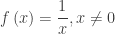
Example 3: If \displaystyle f\left( x \right)=\frac{1}{x},x\ne 0, what is \displaystyle \underset{{x\to 0}}{\mathop{{\lim }}}\,f\left( {f\left( {x)} \right)} \right) ?

Here again, the theorem cannot be used, since the “inside” function has no limit as x approaches 0. But, this function is its own inverse, so \displaystyle f\left( {f\left( {x)} \right)} \right)=x, and \displaystyle \underset{{x\to 0}}{\mathop{{\lim }}}\,f\left( {f\left( x \right)} \right)=\underset{{x\to 0}}{\mathop{{\lim }}}\,x=0


Infinite Musings

Students get confused about infinity, \infty , because they think of it as a number, because \infty used like a number. Even though they know there is no largest number, they think of infinity as the largest number.

In studying limits, the starting point of calculus, infinite limits come up early on. We tell them \displaystyle \underset{{x\to 0}}{\mathop{{\lim }}}\,\frac{1}{{{{x}^{2}}}}=\infty . But what we really mean, and what this symbol means, is that by taking x close enough to 0, \displaystyle\frac{1}{{{{x}^{2}}}} eventually becomes larger that any number they choose, no matter how large.

So, instead why don’t we just say \displaystyle \underset{{x\to 0}}{\mathop{{\lim }}}\,\frac{1}{{{{x}^{2}}}}>M where M is any real number? (And as I always suggest when you see the word “any” replace it with “every” and “all.”

    • \displaystyle \underset{{x\to 0}}{\mathop{{\lim }}}\,\frac{1}{{{{x}^{2}}}}>M where M is any real number
    • \displaystyle \underset{{x\to 0}}{\mathop{{\lim }}}\,\frac{1}{{{{x}^{2}}}}>M where M represents every real number
    • \displaystyle\underset{{x\to 0}}{\mathop{{\lim }}}\,\frac{1}{{{{x}^{2}}}}>M where M is all real numbers

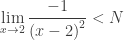
Likewise, \displaystyle \underset{{x\to 2}}{\mathop{{\lim }}}\,\frac{{-1}}{{{{{\left( {x-2} \right)}}^{2}}}}<N where N is any number, instead of saying the limit is -\infty .

Infinity, \infty , is really defined by this idea; it’s what “infinity” means.

Consider, \displaystyle \underset{{x\to 0}}{\mathop{{\lim }}}\,\frac{1}{x} . Here, you cannot say the expression is larger than any number (because of the negative values approaching zero from the left), so obviously there is no limit, the limit does not exist, DNE, and using \infty is wrong).

To answer my own question, we don’t do this because we’d have to change all the calculus books, and that’s not going to happen. So, don’t do it. Maybe you can start with this and then quickly switch over to the shorthand version  \infty .

For more on using \infty and DNE see the post Finding Limits and Good Question 5


.


2019 CED Unit 1 – Limits and Continuity

This is the first of a series of blog posts that I plan to write over the next few months, staying a little ahead of where you are so you can use anything you find useful in your planning. Look for this series every 2 – 4 weeks.

Unit 1 contains topics on Limits and Continuity. (CED – 2019 p. 36 – 50). These topics account for about 10 – 12% of questions on the AB exam and 4 – 7% of the BC questions.

Logically, limits come before continuity since limit is used to define continuity. Practically and historically, continuity comes first. Newton and Leibnitz did not have the concept of limit the way we use it today. It was in the early 1800’s that the epsilon-delta definition of limit was first given by Bolzano (whose work was overlooked) and then by Cauchy and Weierstrass. But their formulation did not use the word “limit”, rather the use was part of their definition of continuity. Only later was it pulled out as a separate concept and then returned to the definition of continuity as a previously defined term.

Students should have plenty of experience in their math courses before calculus with functions that are and are not continuous. They should know the names of the types of discontinuities – jump, removable, infinite, etc. As you go through this unit, you may want to quickly review these terms and concepts as they come up.

(As a general technique, rather than starting the year with a week or three of review – which the students need but will immediately forget again – be ready to review topics as they come up during the year as they are needed – you will have to do that anyway. See Getting Started #2)

Topics 1.1 – 1.9: Limits

Topic 1.1: Suggests an introduction to calculus to give students a hint of what’s coming. See Getting Started #3

Topic 21.: Proper notation and multiple-representations of limits.

There is an exclusion statement noting that the delta-epsilon definition of limit is not tested on the exams, but you may include it if you wish. The epsilon-delta definition is not tested probably because it is too difficult to write good questions. Specifically, (1) the relationship for a linear function is always  \delta =\frac{\varepsilon }{{\left| m \right|}}  where m is the slope and is too complicated to compute for other functions, and (2) for a multiple-choice question the smallest answer must be correct. (Why?)

Topic 1.3: One-sided limits.

Topic 1.4: Estimating limits numerically and from tables.

Topic 1.5: Algebraic properties of limits.

Topic 1.6: Simplifying expressions to find their limits. This can and should be done along with learning the other concepts and procedures in this unit.

Topic 1.7: Selecting the proper procedure for finding a limit. The first step is always to substitute the value into the limit. If this comes out to be number than that is the limit. If not, then some manipulation may be required. This can and should be done along with learning the other concepts and procedures in this unit.

Topic 1.8: The Squeeze Theorem is mainly used to determine \underset{{x\to 0}}{\mathop{{\lim }}}\,\frac{{\sin \left( x \right)}}{x}=1 which in turn is used in finding the derivative of the sin(x). (See Why Radians?) Most of the other examples seem made up just for exercises and tests. (See 2019 AB 6(d)). Thus, important, but not too important.

Topic 1.9: Connecting multiple-representations of limit. This can and should be done along with learning the other concepts and procedures in this unit. Dominance, Topic 15, may be included here as well (EK LIM-2.D.5)

Topics 1.10 – 1.16 Continuity

Topic 1.10: Here you can review the different types of discontinuities with examples and graphs.

Topic 1.11: The definition of continuity. The EK statement does not seem to use the three-hypotheses definition. However, for the limit to exist and for f(c) to exist, they must be real numbers (i.e. not infinite). This is tested often on the exams, so students should have practice with verifying that (all three parts of) the hypothesis are met and including this in their answers.

Topic 1.12: Continuity on an interval and which Elementary Functions are continuous for all real numbers.

Topic 1.13: Removable discontinuities and handing piecewise – defined functions

Topic 1.14: Vertical asymptotes and unbounded functions. Here be sure to explain the difference between limits “equal to infinity” and limits that do not exist (DNE). See Good Question 5: 1998 AB2/BC2.

Topic 1.15: Limits at infinity, or end behavior of a function. Horizontal asymptotes are the graphical manifestation of limits at infinity or negative infinity. Dominance is included here as well (EK LIM-2.D.5)

Topic 1.16: The Intermediate Value Theorem (IVT) is a major and important result of a function being continuous. This is perhaps the first Existence Theorem students encounter, so be sure to stop and explain what an existence theorem is.


The suggested number of 40 – 50 minute class periods is 22 – 23 for AB and 13 – 14 for BC. This includes time for testing etc. If time seems to be a problem you can probably combine topics 3 – 5, topics 6 -7, topics 11 – 12. Topics 6, 7, and 9 are used with all the limit work.


There are three other important limits that will be coming in later Units:

The definition of the derivative in Unit 2, topics 1 and 2

L’Hospital’s Rule in Unit 4, topic 7

The definition of the definite integral in Unit 6, topic 3.

Posts on Continuity

CONTINUITY To help understand limits it is a good idea to look at functions that are not continuous. Historically and practically, continuity should come before limits. On the other hand, the definition of continuity requires knowing about limits. So, I list continuity first. The modern definition of limit was part of Weierstrass’ definition of continuity.

Continuity (8-13-2012)

Continuity (8-21-2013) The definition of continuity.

Continuous Fun (10-13-2015) A fuller discussion of continuity and its definition

Right Answer – Wrong Question (9-4-2013) Is a function continuous even if it has a vertical asymptote?

Asymptotes (8-15-2012) The graphical manifestation of certain limits

Fun with Continuity (8-17-2012) the Diriclet function

Far Out! (10-31-2012) When the graph and dominance “disagree” From the Good Question series

Posts on Limits

Why Limits? (8-1-2012)

Deltas and Epsilons (8-3-2012) Why this topic is not tested on the AP Calculus Exams.

Finding Limits (8-4-2012) How to…

Limit of Composite Functions

Dominance (8-8-2012) See limits at infinity

Determining the Indeterminate (12-6-2015) Investigating an indeterminate form from a differential equation. From the Good Question series.

Locally Linear L’Hôpital (5-31-2013) Demonstrating L’Hôpital’s Rule (a/k/a L’Hospital’s Rule)

L’Hôpital’s Rules the Graph (6-5-2013)


Here are links to the full list of posts discussing the ten units in the 2019 Course and Exam Description.

2019 CED – Unit 1: Limits and Continuity

2019 CED – Unit 2: Differentiation: Definition and Fundamental Properties.

2019 CED – Unit 3: Differentiation: Composite , Implicit, and Inverse Functions

2019 CED – Unit 4 Contextual Applications of the Derivative  Consider teaching Unit 5 before Unit 4

2019 – CED Unit 5 Analytical Applications of Differentiation  Consider teaching Unit 5 before Unit 4

2019 – CED Unit 6 Integration and Accumulation of Change

2019 – CED Unit 7 Differential Equations  Consider teaching after Unit 8

2019 – CED Unit 8 Applications of Integration   Consider teaching after Unit 6, before Unit 7

2019 – CED Unit 9 Parametric Equations, Polar Coordinates, and Vector-Values Functions 

2019 CED Unit 10 Infinite Sequences and Series


An Exploration in Differential Equations

This is an exploration based on the AP Calculus question 2018 AB 6. I originally posed it for teachers last summer. This will make, I hope, a good review of many of the concepts and techniques students have learned during the year. The exploration, which will take an hour or more, includes these topics:

  • Finding the general solution of the differential equation by separating the variables
  • Checking the solution by substitution
  • Using a graphing utility to explore the solutions for all values of the constant of integration, C
  • Finding the solutions’ horizontal and vertical asymptotes
  • Finding several particular solutions
  • Finding the domains of the particular solutions
  • Finding the extreme value of all solutions in terms of C
  • Finding the second derivative (implicit differentiation)
  • Considering concavity
  • Investigating a special case or two

I also hope that in working through this exploration students will learn not so much about this particular function, but how to use the tools of algebra, calculus, and technology to fully investigate any function and to find all its foibles.

The exploration is here in a PDF file. Here are the solutions.

As always, I appreciate your feedback and comments. Please share them with me using the reply box below.


The College Board is pleased to offer a new live online event for new and experienced AP Calculus teachers on March 5th at 7:00 PM Eastern.

I will be the presenter.

The topic will be AP Calculus: How to Review for the Exam:  In this two-hour online workshop, we will investigate techniques and hints for helping students to prepare for the AP Calculus exams. Additionally, we’ll discuss the 10 type questions that appear on the AP Calculus exams, and what students need know and to be able to do for each. Finally, we’ll examine resources for exam review.

Registration for this event is $30/members and $35/non-members. You can register for the event by following this link: http://eventreg.collegeboard.org/d/xbqbjz


L’Hospital’s Rule

Another application of the derivative

L’Hospital’s Rule 

Locally Linear L’Hospital’s Demonstration of the proof

L’Hospital Rules the Graph

Good Question An AP Exam question that can be used to delve deeper into L’Hospital’s Rule (2008 AB 6)

Guillaume de l’Hospital
1661 – 1704


Revised from a post of November 7, 2017


There will be two extra posts this week! Check tomorrow for some suggestions on “Teaching Concavity” and on Friday for “Foreshadowing the MVT.”

I made a major update to last Friday’s post On Scaling. It includes a suggestion from a reader of  this blog with a Desmos graph that will calculate the Kennedy scale scores for you.


Continuity

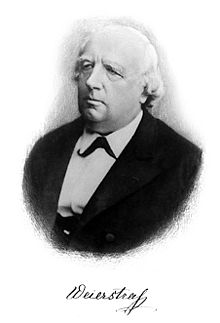
Karl Weierstrass (1815 – 1897) was the mathematician who (finally) formalized the definition of continuity. Included in that definition was the epsilon-delta definition of limit. This definition has been pulled out, so to speak, and now is usually presented on its own. So, which came first – continuity or limit? The ideas and situations that required continuity could only be formalized with the concept of limit. So, looking at functions that are or are not continuous helps us understand what limits are and why we first need them.

In the ideal world, students would have plenty of work with continuous and not continuous functions before starting the calculus. The vocabulary and notation, if not the formal definitions, would be used as early as possible. Then when students got to calculus, they would know the ideas and be ready to formalize the ideas.

The Intermediate Value Theorem (IVT) is an important property of continuous functions.

Using the definition of continuity to show that a function is or is not continuous at a point is a common question of the AP exams, as is the IVT.

Continuity The definition of continuity.

Continuity Should continuity come before limits?

From One Side or the Other One-sided limits and one-sided differentiability

How to Tell Your Asymptote from a Hole in the Graph  From the technology series. Showing holes and asymptotes on a graphing calculator.

Fun with Continuity Defined everywhere and continuous nowhere. Continuous only at a single point.

Theorems The Intermediate Value Theorem (IVT) and suggestions on teaching theorems.

Intermediate Weather  Using the IVT

Right Answer – Wrong Question Continuity or continuity “on its domain”?


Revised from a post of August 22, 2017