A Note on Speed

A quick note on speed.

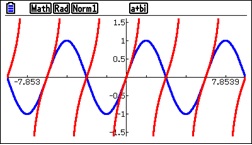
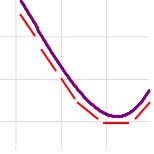
The idea of differentiating speed to determine where it is increasing or decreasing is perfectly reasonable.

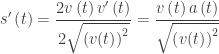
\displaystyle \text{Speed}=s(t)=\left| {v\left( t \right)} \right|=\sqrt{{{{{\left( {v(t)} \right)}}^{2}}}}. Then,

\displaystyle {s}'\left( t \right)=\frac{{2v\left( t \right){v}'\left( t \right)}}{{2\sqrt{{{{{\left( {v(t)} \right)}}^{2}}}}}}=\frac{{v\left( t \right)a\left( t \right)}}{{\sqrt{{{{{\left( {v(t)} \right)}}^{2}}}}}}

Since the denominator is positive, \displaystyle {s}'\left( t \right)>0 and speed is increasing when \displaystyle v\left( t \right) and \displaystyle a\left( t \right) have the same sign, and \displaystyle {s}'\left( t \right)<0 and speed is decreasing when they have different signs.

As a practical matter, this is the “long way.” It requires you to calculate the sign of the velocity and acceleration and some other stuff. So, the traditional way, without the other stuff, is faster. On the other hand, it carries over nicely to higher dimensions where the velocity and acceleration vectors do not have signs, per se. 

See also a previous post on Speed here.

(This occurred to me in the shower this morning; I don’t think I ever realized it before – TMI.)

Units

I had a question from a reader recently asking about how to determine the units for derivatives and integrals.
Derivatives: The units of the derivative are the units of dy divided by the units of dx, or the units of the dependent variable (f(x) or y) divided by the units of the independent variable (x). The reason for this comes from the definition of the derivative:

\displaystyle {f}'\left( x \right)=\underset{{\Delta x\to 0}}{\mathop{{\lim }}}\,\frac{{f\left( {x+\Delta x} \right)-f\left( x \right)}}{{\Delta x}}

In the quotient the numerator has the units of f and in the denominator the has the same units as x.

Definite Integrals: The units of a definite integral are the units of the integrand f(x) multiplied by the units of dx. This comes directly from the definition of a definite integral:

\displaystyle \int_{a}^{b}{{f\left( x \right)dx}}=\underset{{n\to \infty }}{\mathop{{\lim }}}\,\sum\limits_{{i=1}}^{n}{{f\left( {{{x}_{i}}^{*}} \right)\frac{{b-a}}{n}}}

The factor (ba) has the same units a x, the independent variable, and the f(x) has whatever units it has. From the Riemann sum we can see that since these factors are multiplied, that product is the units of the definite integral.

The integrand is the derivative of its antiderivative (by the FTC) and so its units are often derivative units (miles per hour, furlongs per fortnight, etc.). When multiplied by (ba)/n its units “cancel” the units of the denominator of f(x) and the result is the units of the numerator of f(x).  This is not always the case*, therefore, multiplying the units is safest.


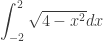
*The definite integral \displaystyle \int_{{-2}}^{2}{{\sqrt{{4-{{x}^{2}}}}dx}} gives the area of a semi-circle of radius 2 feet. The units of the radical are feet and represent the vertical distance from the x-axis to a point in the semi-circle; the dx is the horizontal side of the Riemann sum rectangles also in feet. Both are measured in the same linear units and the area is their product: feet times feet or square feet.



Other Derivative Applications

Some final applications of derivatives

L’Hospital’s Rule 

Locally Linear L’Hospital’s Demonstration of the proof

L’Hospital Rules the Graph

Good Question An AP Exam question that can be used to delve deeper into L’Hospital’s Rule (2008 AB 6)

Related Rate problems

Related Rates Problems 1 

 Related Rate Problems II

Good Question 9  Baseball and Related Rates

Painting a Point  Mostly integration, but with a Related Rate tie-in.


The Mean Value Theorem

Another application of the derivative is the Mean Value Theorem (MVT). This theorem is very important. One of its most important uses is in proving the Fundamental Theorem of Calculus (FTC), which comes a little later in the year. Here are some previous post on the MVT:

Fermat’s Penultimate Theorem   A lemma for Rolle’s Theorem: Any function extreme value(s) on an open interval must occur where the derivative is zero or undefined.

Rolle’s Theorem   A lemma for the MVT: On an interval if a function is continuous on a closed interval [a, b] and differentiable on the open interval (a, b) and f(a) = f(b), there must exist a number in the open interval (a, b) where ‘(c) = 0.

Mean Value Theorem I   Proof

Mean Value Theorem II   Graphical Considerations

Darboux’s Theorem   The Intermediate Value Theorem for derivatives.

Mean Tables


Extreme Values and Linear Motion

Two more applications of differentiation are finding extreme values and the analysis of linear motion.

Extreme Values

The Marble and the Vase

Extremes without Calculus

A Standard Problem

Far Out!

Linear Motion – Motion on a Line 

Type 2 Problems

Motion Problems: Same Thing, Different Context

The Ubiquitous Particle Motion Problem  – a PowerPoint Presentation and its Handout

Brian Leonard’s Particle Motion Game Velocity Game  and answers Velocity game Answers

Matching Motion – an activity

Speed


Derivative Applications – Graphing

Graphing and the analysis of graphs given (1) the equation, (2) a graph, or (3) a table of values of a function and its derivative(s) makes up the largest group of questions on the AP exams. Most of the other applications of the derivative depend on understanding the relationship between a function and its derivatives.

Here is a list of posts on these topics. Since this list is rather long and the topic takes more than a week to (un)cover, I will leave it as the lede post for the next two weeks.

Tangents and Slopes

Concepts Related to Graphs

The Shapes of a Graph 

Open or Closed?  Concerning intervals on which a function increases or decreases.

Extreme Values

Concavity

Joining the Pieces of a Graph

Using the Derivative to Graph the Function

Real “Real life” Graph Reading

Comparing the Graph of a Function and its Derivative  Activities on comparing the graphs using Desmos.

Writing on the AP Calculus Exams   Justifying features of the graph of a function is a major point-earner on the AP Exams.

Reading the Derivative’s Graph Summary and my most read post!


Implicit Differentiation and Inverses

Implicit differentiation of relations is done using the Chain Rule. 

Implicit Differentiation (from last Friday’s post. I discovered I never did a post on this topic before!)

Implicit differentiation of parametric equations

A Vector’s Derivative

The inverse series 

This series of posts reviews and expands what students know from pre-calculus about inverses. This leads to finding the derivative of exponential functions, ax, and the definition of e, from which comes the definition of the natural logarithm. 

Inverses Graphically and Numerically

The Range of the Inverse

The Calculus of Inverses

The Derivatives of Exponential Functions and the Definition of e  and This pair of posts shows how to find the derivative of an exponential function, how and why e is chosen to help this differentiation.

Logarithms Inverses are used to define the natural logarithm function as the inverse of ex. This follow naturally from the work on inverses. However, integration is involved and this is best saved until later. I will mention it then.