Math vs. the “Real World”

There is a difference between mathematics and the “real world”: In the real world you are allowed to do whatever you want, as long as there is no law against doing it; in mathematics, you cannot do something unless there is a law that says you may.

A question that comes up often on the AP Calculus Community bulletin board concerns the divergence of the improper integral \displaystyle \int_{{-1}}^{1}{{\frac{1}{x}dx}}.

There are several mistakes students make when computing this integral.

First, they may not realize this is an improper integral and compute incorrectly:

\displaystyle \int_{{-1}}^{1}{{\frac{1}{x}dx}}=\ln \left| 1 \right|-\ln \left| {-1} \right|=0-0=0

Since the laws concerning improper integrals do not allow this, you may not do it.

Or, they might think that it does converge to zero by the symmetry of the graph. There is no law (theorem) that permits calculating limits based on the appearance of a graph.
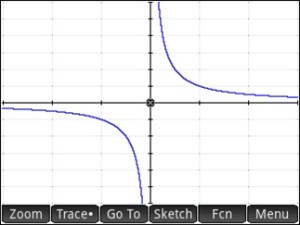
Finally, and most often, they may start out following the rules but go astray. The law says you must find deal with the discontinuity at x = 0 by using one-sided limits:

\displaystyle \int_{{-1}}^{1}{{\frac{1}{x}dx}}=\underset{{a\to 0-}}{\mathop{{\lim }}}\,\int_{{-1}}^{a}{{\frac{1}{x}dx}}+\underset{{b\to 0+}}{\mathop{{\lim }}}\,\int_{b}^{1}{{\frac{1}{x}dx}}

=\underset{{a\to 0-}}{\mathop{{\lim }}}\,\left( {\ln \left| a \right|-\ln \left| 1 \right|} \right)+\underset{{b\to 0+}}{\mathop{{\lim }}}\,\left( {\ln \left| 1 \right|-\ln \left| b \right|} \right)

=\left( {-\infty -0} \right)+\left( {0-(-\infty )} \right)=\infty -(\infty )=0

The mistake is subtler here. It is correct to say that  =\underset{{a\to 0-}}{\mathop{{\lim }}}\,\ln \left| a \right|=-\infty , but what that really means is that the limit does not exist (DNE). Then in the last line above you cannot say

(does not exist) – (does not exist) = 0.

You cannot subtract something that does not exist from something else that does not exist. As soon as you see that one of the limits does not exist, the entire limit does not exist. (That’s the law.) There is no algebra/calculus theorem that permits the addition of two divergent integrals, therefore, it is not correct to add them.

Students need help in understanding this. Here are three ways to think about it.

  1. Infinity is not a number. When you say the integrals equal infinity and negative infinity, you must stop. Just because it looks like something minus the same thing is zero, you cannot do this, because you’re not working with numbers. In fact, the integrals do not exist, so you cannot add them – there’s nothing to add.
  2. “Infinity” is a short, and correct, way of expressing the limits as you approach zero for this function from the right or left. But, you must remember that infinity is a shorthand for DNE, not for some really large number and its opposite.
  3. Infinity minus infinity (\infty -\infty ) is an indeterminate form. Some indeterminate forms of this type converge, if you can find some additional algebra/calculus to do on them (such as L’Hospital’s Rule in some cases). For this example, such algebra/calculus does not exist (no pun intended)

So, in conclusion \displaystyle \int_{{-1}}^{1}{{\frac{1}{x}dx}} does not converge!


This question was discussed recently on the AP Calculus bulletin board. The two items below were included and may help your students understand what’s going on with infinity. The are by Stu Schwartz.

Thank You Stu!



Introducing Power Series

The posts for the next several weeks will be on topics tested only on the BC Calculus exams. Continuing with some posts on introducing power series (the Taylor and Maclaurin series)

Introducing Power Series 1 Two examples to lead off with.

Introducing Power Series 2 Looking at the graph of a power series foreshadows the idea of the interval of convergence.

Introducing Power Series 3 The Taylor Approximating Polynomial with examples of using a series to approximate.

Graphing Taylor Polynomials Graphing calculator hints.


Units

I had a question from a reader recently asking about how to determine the units for derivatives and integrals.

Derivatives: The units of the derivative are the units of dy divided by the units of dx, or the units of the dependent variable (f(x) or y) divided by the units of the independent variable (x). The reason for this comes from the definition of the derivative:

\displaystyle {f}'\left( x \right)=\underset{{\Delta x\to 0}}{\mathop{{\lim }}}\,\frac{{f\left( {x+\Delta x} \right)-f\left( x \right)}}{{\Delta x}}

In the quotient the numerator has the units of f and in the denominator the has the same units as x.

Definite Integrals: The units of a definite integral are the units of the integrand f(x) multiplied by the units of dx. This comes directly from the definition of a definite integral:

\displaystyle \int_{a}^{b}{{f\left( x \right)dx}}=\underset{{n\to \infty }}{\mathop{{\lim }}}\,\sum\limits_{{i=1}}^{n}{{f\left( {{{x}_{i}}^{*}} \right)\frac{{b-a}}{n}}}

The factor (ba) has the same units a x, the independent variable, and the f(x) has whatever units it has. From the Riemann sum we can see that since these factors are multiplied, that product is the units of the definite integral.

The integrand is the derivative of its antiderivative (by the FTC) and so its units are often derivative units (miles per hour, furlongs per fortnight, etc.). When multiplied by (ba)/n its units “cancel” the units of the denominator of f(x) and the result is the units of the numerator of f(x).  This is not always the case*, therefore, multiplying the units is safest.


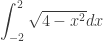
*The definite integral \displaystyle \int_{{-2}}^{2}{{\sqrt{{4-{{x}^{2}}}}dx}} gives the area of a semi-circle of radius 2 feet. The units of the radical are feet and represent the vertical distance from the x-axis to a point in the semi-circle; the dx is the horizontal side of the Riemann sum rectangles also in feet. Both are measured in the same linear units and the area is their product: feet times feet or square feet.


Infinite Series

The posts for the next several weeks will be on topics tested only on the BC Calculus exams. The first few weeks will be past posts on sequences and series. That will be followed, in February, by a discussion of Parametric and Vector functions, and Polar equation.

We begin with series.

Comparison Test Chart A table summarizing the convergence test required for the AP Calculus BC exam, their hypotheses and Conclusions (Updated 2-1-18)

What Conversion Test Should I Use? Part 1

What Conversion Test Should I Use? Part 2

Good Question 14 A riff on the Integral Test

Everyday series   decimals and roots

Amortization Calculating your mortgage payment – a practical and useful example of finite series


Revised 2-26-2018


Posts on Differential Equations – 2

More posts on differential equations

Good Question 2 (2002 BC 5) and A Family of Function (Good Question 2 continued) – one of my all-time favorite AP exam questions. Parts a, c, and d are suitable for AB students. Part b is a Euler’s method question. Part d is an example of a question where the second derivative test is the only approach possible.

Accumulation and Differential Equations  and Why Muss with the “+C”?

Euler’s method for Making Money an application

The Logistic Equation  – a BC only topic

Logistic Growth – Real and Simulated  – a BC only topic

Logarithms  Defining logarithms with a differential equation


Posts on Differential Equations – 1

Next in line are differential equations. Here are links to some past posts on differential equations

Differential Equations Outline of basic ideas for AB and BC calculus

Slope Fields

Euler’s Method – a BC only topic

Domain of a Differential Equation mentioned on the new Course and Exam Description

Good Question 6  2000 AB 4

Additional post on differential equations next week.


Applications of Integration, part 3: Accumulation

Integration, at its basic level, is addition. A definite integral is a sum (a Riemann sum). When you add things you get an amount of whatever you are adding: you accumulate. Here are some previous posts on this important idea that often shows up on the AP Calculus exams (usually the first free-response question!)

Accumulation: Need an Amount?

Good Question 6 – 2000 AB 4  One of my favorite questions

Painting a Point

Real “Real Life” Graph Reading

Jobs, Jobs, Jobs  are real life accumulation problem based on a graph

Graphing with Accumulation 1 Increasing and decreasing.

Graphing with Accumulation 2 Concavity

Accumulation and Differential Equations   Differential equations will be considered next week, but this idea relates to integration.

Good Question 8 – or Not?

Rate and Accumulation Questions (Type 1)