Sequences and Series (Type 10)

AP Questions Type 10:  Sequences and Series (BC Only)

The last BC question on the exams usually concerns sequences and series. The question may ask students to write a Taylor or Maclaurin series and to answer questions about it and its interval of convergence, or about a related series found by differentiating or integrating. The topics may appear in other free-response questions and in multiple-choice questions. Questions about the convergence of sequences may appear as multiple-choice questions. With about 8 multiple-choice questions and a full free-response question this is one of the largest topics on the BC exams.

Convergence tests for series appear on both sections of the BC Calculus exam. In the multiple-choice section, students may be asked to say if a sequence or series converges or which of several series converge.

The Ratio test is used most often to determine the radius of convergence and the other tests to determine the exact interval of convergence by checking the convergence at the end points. Click here for a convergence test chart students should be familiar with; this list is also on the resource page.

Students should be familiar with and able to write several terms and the general term of a Taylor or Maclaurin series. They may do this by finding the derivatives and constructing the coefficients from them, or they may produce the series by manipulating a known or given series. They may do this by substituting into a series, differentiating it, or integrating it.

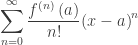
The general form of a Taylor series is \displaystyle \sum\limits_{n=0}^{\infty }{\frac{{{f}^{\left( n \right)}}\left( a \right)}{n!}{{\left( x-a \right)}^{n}}}; if a = 0, the series is called a Maclaurin series.
What Students Should be Able to Do 

  • Use the various convergence tests to determine if a series converges. The test to be used is rarely given so students need to know when to use each of the common tests. For a summary of the tests click: Convergence test chart.  and the posts “What Convergence Test Should I use?” Part 1 and Part 2
  • Understand absolute and conditional convergence. If the series of the absolute values of the terms of a series converges, then the original series is said to absolutely convergent (or converges absolutely). If a series is absolutely convergent, then it is convergent. If the series of absolute values diverges, then the original series may or may not converge; if it converges it is said to be conditionally convergent.
  • Write the terms of a Taylor or Maclaurin series by calculating the derivatives and constructing the coefficients of each term.
  • Distinguish between the Taylor series for a function and the function. DO NOT say that the Taylor polynomial is equal to the function (this will lose a point); say it is approximately equal.
  • Determine a specific coefficient without writing all the previous coefficients.
  • Write a series by substituting into a known series, by differentiating or integrating a known series, or by some other algebraic manipulation of a series.
  • Know (from memory) the Maclaurin series for sin(x), cos(x), ex and \displaystyle \tfrac{1}{1-x} and be able to find other series by substituting into one of these.
  • Find the radius and interval of convergence. This is usually done by using the Ratio test to find the radius and then checking the endpoints.
  • Be familiar with geometric series, its radius of convergence, and be able to find the number to which it converges, \displaystyle {{S}_{\infty }}=\frac{{{a}_{1}}}{1-r}. Re-writing a rational expression as the sum of a geometric series and then writing the series has appeared on the exam.
  • Be familiar with the harmonic and alternating harmonic series. These are often useful series for comparison.
  • Use a few terms of a series to approximate the value of the function at a point in the interval of convergence.
  • Determine the error bound for a convergent series (Alternating Series Error Bound and Lagrange error bound). See my posts on Error Bounds and the Lagrange Highway
  • Use the coefficients (the derivatives) to determine information about the function (e.g. extreme values).

This list is quite long, but only a few of these items can be asked in any given year. The series question on the free-response section is usually quite straightforward. Topics and convergence test may appear on the multiple-choice section. As I have suggested before, look at and work as many past exam questions to get an idea of what is asked and the difficulty of the questions. Click on Power Series in the “Posts by Topic” list on the right side of the screen to see previous posts on Power Series or any other topic you are interested in.

Free-response questions:

  • 2004 BC 6 (An alternate approach, not tried by anyone, is to start with \displaystyle \sin \left( {5x+\tfrac{\pi }{4}} \right)=\sin (5x)\cos \left( {\tfrac{\pi }{4}} \right)+\cos (5x)\sin \left( {\tfrac{\pi }{4}} \right))
  • 2011 BC 6 (Lagrange error bound)
  • 2016 BC 6
  • 2017 BC 6
  • 2019 BC 6

Multiple-choice questions from non-secure exams:

  • 2008 BC 4, 12, 16, 20, 23, 79, 82, 84
  • 2012 BC 5, 9, 13, 17, 22, 27, 79, 90,

These question come from Unit 10 of the  2019 CED.


Revised March 12, 2021


Polar Equation Questions (Type 9)

AP  Questions Type 9:  Polar Equations (BC Only)

Ideally, as with parametric and vector functions, polar curves should be introduced and covered thoroughly in a pre-calculus course. Questions on the BC exams have been concerned only with calculus ideas related to polar curves. Students have not been asked to know the names of the various curves (rose curves, limaçons, etc.). The graphs are usually given in the stem of the problem; students are expected to be able to determine which is which if more than one is given. Students should know how to graph polar curves on their calculator, and the simplest by hand. Intersection(s) of two graph may be given or easy to find.

What students should know how to do:

  • Calculate the coordinates of a point on the graph,
  • Find the intersection of two graphs (to use as limits of integration).
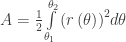
  • Find the area enclosed by a graph or graphs: Area =\displaystyle A=\tfrac{1}{2}\int_{{{\theta }_{1}}}^{{{\theta }_{2}}}{(r(}θ\displaystyle ){{)}^{2}}dθ
  • Use the formulas x\left( \theta  \right)\text{ }=~r\left( \theta  \right)\text{cos}\left( \theta  \right)~~\text{and}~y\left( \theta  \right)\text{ }=~r(\theta )\text{sin}\left( \theta  \right)~  to convert from polar to parametric form,
  • Calculate \displaystyle \frac{dy}{d\theta } and \displaystyle \frac{dx}{d\theta } (Hint: use the product rule on the equations in the previous bullet).
  • Discuss the motion of a particle moving on the graph by discussing the meaning of \displaystyle \frac{dr}{d\theta } (motion towards or away from the pole), \displaystyle \frac{dy}{d\theta } (motion in the vertical direction), and/or \displaystyle \frac{dx}{d\theta } (motion in the horizontal direction).
  • Find the slope at a point on the graph, \displaystyle \frac{dy}{dx}=\frac{dy/d\theta }{dx/d\theta }.

When this topic appears on the free-response section of the exam there is no Parametric/vector motion question and vice versa. When not on the free-response section there are one or more multiple-choice questions on polar equations.

Free-response questions:

  • 2013 BC 2
  • 2014 BC 2
  • 2017 BC 2
  • 2018 BC 5
  • 2019 AB 2

Multiple-choice questions from non-secure exams:

  • 2008 BC 26
  • 2012 BC 26, 91

Other posts on Polar Equations

Polar Basics

Polar Equations for AP Calculus

Extreme Polar Conditions

Polar Equations (Review 2018)


Revised March 12, 2021


This question typically covers topics from Unit 9 of the 2019 CED .


Schedule of future posts for reviewing for the 2019 Exams

Exams for AP Calculus are Tuesday May 5, 2020 at 08:00 local time

NOTE: The type number I’ve assigned to each type DO NOT correspond to the 2019 CED Unit numbers. Many AP Exam questions have parts from different Units. The CED Unit numbers will be referenced in each post.

Tuesday February 25 – AP Exam Review 2020 
Friday, February 28 – Reviewing Resources 2020
Tuesday March 3, 2020: Rate and accumulation questions (Type 1) 
Friday March 6, 2020: Linear motion problems (Type 2) 
Tuesday March 10, 2020: Graph analysis problems (Type 3)
Friday March 13, 2020: Area and volume problems (Type 4)
Tuesday March 17, 2020: Table and Riemann sum questions (Type 5)
Friday March 20, 2020: Differential equation questions (Type 6)
Tuesday March 24, 2020: Other questions (Type 7)
Friday March 27, 2020: Parametric and vector questions (Type 8) BC topic
Tuesday March 31, 2020: Polar equations questions (Type 9) BC Topic
Friday April 3, 2020: Sequences and Series questions (Type 10) BC Topic


Parametric and Vector Equations (Type 8)

AP  Questions Type 8: Parametric and Vector Equations (BC Only)

The parametric/vector equation questions only concern motion in a plane. Other topics, such as dot product and cross product, are not tested.

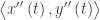
In the plane, the position of a moving object as a function of time, t, can be specified by a pair of parametric equations x=x\left( t \right)\text{ and }y=y\left( t \right) or the equivalent vector \left\langle x\left( t \right),y\left( t \right) \right\rangle . The path is the curve traced by the parametric equations or the tips of the position vector. .

The velocity of the movement in the x- and y-direction is given by the vector \left\langle {x}'\left( t \right),{y}'\left( t \right) \right\rangle . The vector sum of the components gives the direction of motion. Attached to the tip of the position vector this vector is tangent to the path pointing in the direction of motion.

The length of this vector is the speed of the moving object. \text{Speed }=\sqrt{{{\left( {x}'\left( t \right) \right)}^{2}}+{{\left( {y}'\left( t \right) \right)}^{2}}}. (Notice that this is the same as the speed of a particle moving on the number line with one less parameter: On the number line \text{Speed}=\left| v \right|=\sqrt{{{\left( {x}'\left( t \right) \right)}^{2}}}.)

The acceleration is given by the vector \left\langle {{x}'}'\left( t \right),{{y}'}'\left( t \right) \right\rangle .

What students should know how to do:

  • Vectors may be written using parentheses, ( ), or pointed brackets, \left\langle {} \right\rangle , or even \vec{i},\vec{j} form. The pointed brackets seem to be the most popular right now, but all common notations are allowed and will be recognized by readers.
  • Find the speed at time t\text{Speed }=\sqrt{{{\left( {x}'\left( t \right) \right)}^{2}}+{{\left( {y}'\left( t \right) \right)}^{2}}}
  • Use the definite integral for arc length to find the distance traveled \displaystyle \int_{a}^{b}{\sqrt{{{\left( {x}'\left( t \right) \right)}^{2}}+{{\left( {y}'\left( t \right) \right)}^{2}}}}dt. Notice that this is the integral of the speed (rate times time = distance).
  • The slope of the path is \displaystyle \frac{dy}{dx}=\frac{{y}'\left( t \right)}{{x}'\left( t \right)}. See this post for more on finding the first and second derivatives with respect to x.
  • Determine when the particle is moving left or right,
  • Determine when the particle is moving up or down,
  • Find the extreme position (farthest left, right, up, down, or distance from the origin).
  • Given the position find the velocity by differentiating;
  • Given the velocity find the acceleration by differentiating.
  • Given the acceleration and the velocity at some point find the velocity by integrating.
  • Given the velocity and the position at some point find the position by integrating. These are just initial value differential equation problems (IVP).
  • Dot product and cross product are not tested on the BC exam, nor are other aspects.

When this topic appears on the free-response section of the exam there is no polar equation free-response question and vice versa. When not on the free-response section there are one or more multiple-choice questions on parametric equations.


Free-response questions:

  • 2012 BC 2
  • 2016 BC 2

Multiple-choice questions from non-secure exams

  • 2003 BC 4, 7, 17, 84
  • 2008 BC 1, 5, 28
  • 2012 BC 2

This question typically covers topics from Unit 9 of the 2019 CED .


Revised March 12, 2021

Other Problems (Type 7)

AP  Questions Type 7: Other topics 

Any topic in the Course and Exam Description may be the subject of a free-response or multiple-choice question. The topics discussed here are not asked often enough to be classified as a type of their own. The topics listed here have been the subject of full free-response questions or major parts of them. Other topics occasionally asked are mentioned in the question list at the end of the post.

Implicitly defined relations and implicit differentiation

These questions may ask students to find the first or second derivative of an implicitly defined relation. Often the derivative is given and students are required to show that it is correct. (This is because without the correct derivative the rest of the question cannot be done.) The follow-up is to answer questions about the function such as finding an extreme value, second derivative test, or find where the tangent is horizontal or vertical.

What students should know how to do

  • Know how to find the first derivative of an implicit relation using the product rule, quotient rule, chain rule, etc.
  • Know how to find the second derivative, including substituting for the first derivative.
  • Know how to evaluate the first and second derivative by substituting both coordinates of a given point. (Note: If all that is needed is the numerical value of the derivative then the substitution is often easier if done before solving for dy/dx or d2y/dx2, and as usual the arithmetic need not be done.)
  • Analyze the derivative to determine where the relation has horizontal and/or vertical tangents.
  • Write and work with lines tangent to the relation.
  • Find extreme values. It may also be necessary to show that the point where the derivative is zero is actually on the graph and to justify the answer.

Simpler questions about implicit differentiation my appear on the multiple-choice sections of the exam.

Example:

Implicit Differentiation,

Good Question 17

2004 AB 4

2016 BC 4

2012 AB 27 (implicit differentiation), Multiple-choice

BC classes see Implicit differentiation of parametric equations,  A Vector’s Derivative

Related Rates 

Derivatives are rates and when more than one variable is changing over time the relationships among the rates can be found by differentiating with respect to time. The time variable may not appear in the equations. These questions appear occasionally on the free-response sections; if not there, then a simpler version may appear in the multiple-choice sections. In the free-response sections they may be an entire problem, but more often appear as one or two parts of a longer question.

What students should know how to do

  • Set up and solve related rate problems.
  • Be familiar with the standard type of related rate situations, but also be able to adapt to different contexts.
  • Know how to differentiate with respect to time. That is, find dy/dt even if there is no time variable in the given equations using any of the differentiation techniques.
  • Interpret the answer in the context of the problem.
  • Unit analysis.

Shorter questions on this concept also appear in the multiple-choice sections. As always, look over as many questions of this kind from past exams as you can find.

For some previous posts on related rate see  Related Rate Problems I and Related Rate Problems II.

Examples

 2014 AB4/BC4,

2016 AB5/BC5

2019 AB 4 Related Rate

2019 AB 6

Good Question 9


Family of Functions

A “family of functions” are defined by an equation with a parameter (sort of an extra variable). Changing the parameter gives a different but similar curve. Questions should be answered in general, that is, in terms of the parameter not some specific value of the parameter. These questions appeared on some exams long ago, may be making a comeback.

Examples:

1995 BC 5

1996 AB4/BC4

Good Question 5: 1998 AB2/BC2

2019 BC 5


Other Topics

Free response questions (many of the BC questions are suitable for AB)

  • Finding derivatives using the chain rule, the quotient rule, etc. from tables of values: 2016 AB 6 and 2015 AB 6
  • L’Hospital’s Rule 2016 BC 4, 2019 AB 3 (Don’t be fooled), 2019 AB 4(c)
  • Continuity and piecewise defined functions: 2012 AB 4, 2011 AB 6 and 2014 BC 5
  • Arc length (BC Topic) 2014 BC 5
  • Partial fractions (BC Topic) 2015 BC 5
  • Improper integrals (BC topic): 2017 BC 5

Multiple-choice questions from non-secure exams:

  • 2012 AB 27 (implicit differentiation), 77 (IVT), 88 (related rate)
  • 2012 BC 4 (Curve length), 7 (Implicit differentiation), 11 (continuity/differentiability), 12 (Implicit differentiation), 77 (dominance), 82 (average value), 85 (related rate) , 92 (compositions)

These question may come from any of the Units in the  2019 CED.


Revised March 12, 2021


Differential Equations (Type 6)

AP  Questions Type 6: Differential Equations

Differential equations are tested almost every year. The actual solving of the differential equation is usually the main part of the problem, but it is accompanied by a related question such as a slope field or a tangent line approximation. BC students may also be asked to approximate using Euler’s Method. Large parts of the BC questions are often suitable for AB students and contribute to the AB sub-score of the BC exam. What students should be able to do

  • Find the general solution of a differential equation using the method of separation of variables (this is the only method tested).
  • Find a particular solution using the initial condition to evaluate the constant of integration – initial value problem (IVP).
  • NEW Determine the domain restrictions on the solution of a differential equation. See this post for more on this. 
  • Understand that proposed solution of a differential equation is a function (not a number) and if it and its derivative are substituted into the given differential equation the resulting equation is true. This may be part of doing the problem even if solving the differential equation is not required (see 2002 BC 5 – parts a, b and d are suitable for AB)
  • Growth-decay problems.
  • Draw a slope field by hand.
  • Sketch a particular solution on a given slope field.
  • Interpret a slope field.
  • Multiple-choice: Given a differential equation, identify is slope field.
  • Multiple-choice: Given a slope field identify its differential equation.
  • Use the given derivative to analyze a function such as finding extreme values
  • For BC only: Use Euler’s Method to approximate a solution.
  • For BC only: use the method of partial fractions to find the antiderivative after separating the variables.
  • For BC only: understand the logistic growth model, its asymptotes, meaning, etc. The exams so far, have never asked students to actually solve a logistic equation IVP

Look at the scoring standards to learn how the solution of the differential equation is scored, and therefore, how students should present their answer. This is usually the one free-response answer with the most points riding on it. Starting in 2016 the scoring has changed slightly. The five points are now distributed this way:

  • one point for separating the variables
  • one point each for finding the antiderivatives
  • one point for including the constant of integration and using the initial condition – that is, for writing “+ C” on the paper with one of the antiderivatives and substituting the initial condition; finding the value of C is included in the “answer point.” and
  • one point for solving for y: the “answer point”, for the correct answer. This point includes all the algebra and arithmetic in the problem including solving for C..

In the past, the domain of the solution is often included on the scoring standard, but unless it is specifically asked for in the question students do not need to include it. However, the 9 CED. lists “EK 3.5A3 Solutions to differential equations may be subject to domain restrictions.” Perhaps this will be asked in the future. For more on domain restrictions with examples see this post. Shorter questions on this concept appear in the multiple-choice sections. As always, look over as many questions of this kind from past exams as you can find. For some previous posts on differential equations see January 5, 2015 and for post on related subjects see November 26, 2012,  January 21, 2013 February 16, 2013 The Differential Equation question covers topics in Unit 7 of the 2019 CED.


Free-response examples:

  • 2019 There was no DE question in the free-response. You may assume the topic was tested in the multiple-choice sections.
  • 2017 AB4/BC4,
  • 2016 AB 4, BC 4, (different questions)
  • 2015 AB4/BC4,
  • 2013 BC 5
  • and a favorite  Good Question 2 and Good Question 2 Continued

Multiple-choice examples from non-secure exams:

  • 2012 AB 23, 25
  • 2012 BC: 12, 14, 16, 23

Previous posts on these topics for both AB and BC include:

Differential Equations  A summary of the terms and techniques of differential equation and the method of separation of variables

Domain of a Differential Equation – On domain restrictions.

Accumulation and Differential Equations 

Slope Fields

An Exploration in Differential Equations An exploration illustrating many of the ideas of differential equations. The exploration is here in PDF form and the solution is here. The ideas include: finding the general solution of the differential equation by separating the variables, checking the solution by substitution, using a graphing utility to explore the solutions for all values of the constant of integration, finding the solutions’ horizontal and vertical asymptotes, finding several particular solutions, finding the domains of the particular solutions, finding the extreme value of all solutions in terms of C, finding the second derivative (implicit differentiation), considering concavity, and investigating a special case or two.

Previous Posts on BC Only Topics

Euler’s Method

Euler’s Method for Making Money

The Logistic Equation 

Logistic Growth – Real and Simulated


Revised 2/20/2021


Riemann Sum & Table Problems (Type 5)

AP  Questions Type 5: Riemann Sum & Table Problems

Tables may be used to test a variety of ideas in calculus including analysis of functions, accumulation, theory and theorems, and position-velocity-acceleration, among others. Numbers and working with numbers is part of the Rule of Four and table problems are one way this is tested. This question often includes an equation in a  latter part of the problem that refers to the same situation.

 What students should be able to do:

  • Find the average rate of change over an interval
  • Approximate the derivative using a difference quotient. Use the two values closest to the number at which you are approximating.  This amounts to finding the slope or rate of change. Show the quotient even if you can do the arithmetic in your head and even if  the denominator is 1.
  • Use a left-, right-, or midpoint- Riemann sums or a trapezoidal approximation to approximate the value of a definite integral using values in the table (typically with uneven subintervals). The Trapezoidal Rule, per se, is not required; it is expected that students will add the areas of a small number of trapezoids without reference to a formula.
  • Average value, average rate of change, Rolle’s theorem, the Mean Value Theorem and the Intermediate Value Theorem. (See 2007 AB 3 – four simple parts that could be multiple-choice questions; the mean on this question was 0.96 out of a possible 9.)
  • These questions are usually presented in some context and answers should be in that context. The context may be something growing (changing over time) or linear motion.
  • Use the table to find a value based on the Mean Value Theorem (2018 AB 4(b)) or Intermediate Value Theorem.
  • One of the parts of this question asks a related question based on a function given by an equation.
  • Unit analysis.

Do’s and Don’ts

Do: Remember that you do not know what happens between the values in the table unless some other information is given. For example, do not assume that the largest number in the table is the maximum value of the function, or that the function is decreasing between two values just because a value is less than the preceding value.

Do: Show what you are doing even if you can do it in your head. If you’re finding a slope, show the quotient even if the denominator is 1.

Do Not do arithmetic: A long expression consisting entirely of numbers such as you get when doing a Riemann sum, does not need to be simplified in any way. If you a simplify correct answer incorrectly, you will lose credit.

Do Not leave expression such as R(3) – pull its numerical value from the table.

Do Not: Find a regression equation and then use that to answer parts of the question. While regression is perfectly good mathematics, regression equations are not one of the four things students may do with their calculator. Regression gives only an approximation of our function. The exam is testing whether students can work with numbers.


This question typically covers topics from Unit 6 of the 2019 CED but may include topics from Units 2, 3, and 4 as well.


Free-response examples:

  • 2007 AB 3 (4 simple parts on various theorems, yet the mean score was 0.96 out of 9),
  • 2017 AB 1/BC 1, and AB 6,
  • 2016 AB 1/BC 1
  • 2018 AB 4

Multiple-choice questions from non-secure exams:

  • 2012 AB 8, 86, 91
  • 2012 BC 8, 81, 86  (81 and 86 are the same on both the AB and BC exams)


Revised March 12, 2021


Area and Volume Problems (Type 4)

AP Type Questions 4: Area and Volume

Given equations that define a region in the plane students are asked to find its area, the volume of the solid formed when the region is revolved around a line, and/or the region is used as a base of a solid with regular cross-sections. This standard application of the integral has appeared every year since year one (1969) on the AB exam and almost every year on the BC exam. You can be pretty sure that if a free-response question on areas and volumes does not appear, the topic will be tested on the multiple-choice section.

What students should be able to do:

  • Find the intersection(s) of the graphs and use them as limits of integration (calculator equation solving). Write the equation followed by the solution; showing work is not required. Usually no credit is earned until the solution is used in context (as a limit of integration). Students should know how to store and recall these values to save time and avoid copy errors.
  • Find the area of the region between the graph and the x-axis or between two graphs.
  • Find the volume when the region is revolved around a line, not necessarily an axis or an edge of the region, by the disk/washer method. See “Subtract the Hole from the Whole”
  • The cylindrical shell method will never be necessary for a question on the AP exams, but is eligible for full credit if properly used.
  • Find the volume of a solid with regular cross-sections whose base is the region between the curves. For an interesting variation on this idea see 2009 AB 4(b)
  • Find the equation of a vertical line that divides the region in half (area or volume). This involves setting up an integral equation where the limit is the variable for which the equation is solved.
  • For BC only – find the area of a region bounded by polar curves: A=\tfrac{1}{2}\int\limits_{{{\theta }_{1}}}^{{{\theta }_{2}}}{{{\left( r\left( \theta  \right) \right)}^{2}}}d\theta
  • For BC only – Find perimeter using arc length integral

If this question appears on the calculator active section, it is expected that the definite integrals will be evaluated on a calculator. Students should write the definite integral with limits on their paper and put its value after it. It is not required to give the antiderivative and if a student gives an incorrect antiderivative they will lose credit even if the final answer is (somehow) correct.

There is a calculator program available that will give the set-up and not just the answer so recently this question has been on the no calculator allowed section. (The good news is that in this case the integrals will be easy or they will be set-up-but-do-not-integrate questions.)

Occasionally, other type questions have been included as a part of this question. See 2016 AB5/BC5 which included an average value question and a related rate question along with finding the volume.

Shorter questions on this concept appear in the multiple-choice sections. As always, look over as many questions of this kind from past exams as you can find.

For some previous posts on this subject see January 911, 2013 and “Subtract the Hole from the Whole” of December 6, 2016.


The Area and Volume question covers topics from Unit 6 of the 2019 CED .


Free-response questions:

  • Variations: 2009 AB 4, Don’t overlook this one, especially part (b)
  • 2016 AB5/BC5,
  • 2017 AB 1 (using a table),
  • 2018 AB 5 – average rate of change, L’Hospital’s Rule
  • 2019 AB 5
  • Perimeter parametric curves 2011 BC 3 and 2014 BC 5
  • Area in polar form 2017 BC 5, 2018 BC 5, 20129 BC 2

Multiple-choice questions from non-secure exams:

  • 2008 AB 83 (Use absolute value),
  • 2012 AB 10, 92
  • 2012 BC 87, 92 (Polar area)


Revised March 12, 2012