Why You Never Need Cylindrical Shells

Don’t get me wrong; finding volumes of solids of rotation by the method of cylindrical shells is a great method. It’s just that you can always work around it; you don’t ever need to use it. The work-around is often longer and involves more work, but it is interesting mathematically. So here’s an example of how to do it.

The region bounded by the graph of y={{x}^{3}}+x+1, and the lines y = 1 and x = 2, is revolved around the y-axis. What is the volume of the resulting solid?

Supposedly this volume must be found by the shell method. Using the washer method the volume is set up as the integral of the area of the outside circle with constant radius of 2, minus the area of the inside circle of radius x, times the “thickness” of a slice. This “thickness” is in the y-direction and so is dy. The dy also determines the limits of integration.
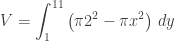
\displaystyle V=\int_{1}^{11}{\left( \pi {{2}^{2}}-\pi {{x}^{2}} \right)\,dy}

Since the integral contains a dy the usual way is to change the x to a function of y, which in this case involves solving a cubic polynomial. In this case that is very difficult to find x as a function of y and with a different function that may even be impossible. But do we really have to do that? In fact, what is required is to have only one variable and the variable may be x! So we find dy in terms of x and dx and substitute into the expression above. We also change the limits of integration to the corresponding x-values.


dy=\left( 3{{x}^{2}}+1 \right)dx
\displaystyle V=\int_{0}^{2}{\left( \pi {{2}^{2}}-\pi {{x}^{2}} \right)\,\left( 3{{x}^{2}}+1 \right)dx}
\displaystyle V=\pi \int_{0}^{2}{\left( 4+11{{x}^{2}}-3{{x}^{4}}\, \right)dx}

This integral is easy to evaluate and will give the same value, \tfrac{272}{15}\pi, as the shell integral.

To use this idea, the function must either be one-to-one on the interval or the solid must be broken into sections that are one-to-one. This may make the problem longer. Most problems that you want to do by shells are easier by shells. The point is that washers (or disks) may always be used; not that the washer approach is the easiest way.

Volumes of Revolution

Applications of Integration 3 – Volumes of Rotation

In our last post we discussed volumes of figures with regular cross sections. Many common figures can be analyzed as some region rotated around a line, possibly one of its edges. For example, the region between the x-axis and the segment with equation y=\frac{r}{h}x from x = 0 to
x = h when rotated around the x-axis generates a cone with height h and a base with a radius of r. This has regular cross-sections which are circles for any value of x between 0 and h. Their areas are. So based on the idea in my previous post the volume is the integral of the cross-section area times the thickness:

\displaystyle \underset{n\to \infty }{\mathop{\lim }}\,\sum\limits_{i=1}^{n}{\pi {{\left( \tfrac{r}{h}{{x}_{i}} \right)}^{2}}\Delta {{x}_{i}}}=\int_{0}^{h}{\pi {{\left( \tfrac{r}{h}x \right)}^{2}}}dx=\tfrac{1}{3}\pi {{r}^{2}}h

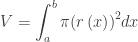
Since circular cross-sections are very common (at least in calculus books) this is often treated as a separate topic with its own ideas and formulas. It really is not. It’s the basic idea applied to figures with circular sections; the cross-section area as a function of x is \pi {{\left( r(x) \right)}^{2}}; the thickness is \Delta x

\displaystyle V=\int_{a}^{b}{\pi {{\left( r\left( x \right) \right)}^{2}}dx}.

If the figure has a hole through it one subtracts the inside volume (radius = r\left( x \right) ) from the outside volume (radius = R\left( x \right)). This may be done with two integrals or combined into one.

\displaystyle \int_{a}^{b}{\pi {{\left( R\left( x \right) \right)}^{2}}dx}-\int_{a}^{b}{\pi {{\left( r\left( x \right) \right)}^{2}}}dx=\int_{a}^{b}{\pi {{\left( R\left( x \right) \right)}^{2}}-\pi {{\left( r\left( x \right) \right)}^{2}}dx}

Looking at the last integral we see that this is the same as treating the cross-section as an annulus (aka a “washer”). The \pi is often factored out in front of the integral sign to make things look neater; I suggest you leave it where it is to remind students that they are subtracting the areas of two circles.

To help students see what the figures look like you can do several things. You can cut the region out of light cardboard and tape it to the end of a pencil. Then rotate the pencil quickly to see the volume. Another way is to use a good graphing program, such as Winplot, which will let you see a three-dimensional figure being formed. One of my favorites is to use paper wedding bells that start flat and then open into a three-dimensional figure.

Volume of Solids with Regular Cross-sections

Applications of Integration 2 – Solids with Regular Cross-sections

In Vino Veritas. And not only truth, but the start of an important application of the calculus. After Johannes Kepler’s (1571–1630) first wife died he decided to marry again. Naturally, he bought wine for the festivities. There was some disagreement with the wine merchant concerning how he calculated the volume of the barrel of wine. This led Kepler, a mathematician, to study the problem of finding the volume of barrels. The barrels, then as now, had circular cross sections of different diameters. His idea was to consider the wine as a stack of thin cylinders (with height of as we would say today). He then calculated the volume of each cylinder and added them together to find the volume of the barrel. There is a nice animation of the idea and more information on Kepler here.

The basic problem is this: you have a solid object whose volume you need to compute. If you can slice the object perpendicular to the axis in such a way that you get regular cross sections (i.e. similar figures) whose area you can compute, then by multiplying the area times the thickness and adding the results, you can have the volume. This kind of addition is done nicely by integration, since the volume of the slices form a Riemann sum.

You need to set up a coordinate system so that you can slice the figure into thin slices (whose width is ) and express the cross-section’s dimensions as a function of x and then the area as A(x). The result always looks like this where A(x) is the area of the cross-section:

\displaystyle \underset{n\to 0}{\mathop{\lim }}\,\sum\limits_{i=1}^{n}{A\left( {{x}_{i}} \right)\Delta {{x}_{i}}}=\int_{a}^{b}{A\left( x \right)dx}

Think of this as the integral of the cross-section area times the thickness

Since you are probably not allowed to have wine in your calculus class, you may want to illustrate the idea some way other than using a wine barrel. Think of a loaf of sliced bread, or a deck of cards. Find some object that the students can measure and calculate the volume, such as a tree trunk, a statue, or a Coke-Cola bottle.

Another interesting exercise is to develop (prove) the formulas for volumes that students have known and used without proof since grade school: a cone, a pyramid, a sphere, the frustum of a cone.

Area Between Curves

Applications of Integration 1 – Area Between Curves

The first thing to keep in mind when teaching the applications of integration is Riemann sums. The thing is that when you set up and solve the majority of application problems you cannot help but develop a formula for the situation. Students think formulas are handy and go about memorizing them badly. By which I mean they forget or never learn where the various things in the formula come from. A slight change in the situation and they are lost. Behind every definite integral stands a Riemann sum; each application should be approached through its Riemann sum. If students understand that, they will make fewer mistakes with the “formula.”

As I suggested in a previous post, I believe all area problems should be treated as the area between two curves. If you build the Riemann sum rectangle between the graph and the axis and calculate its vertical side as the upper function minus the lower (or right minus left if you use horizontal rectangles) you will always get the correct integral for the area. If the upper curve is the x-axis, then the vertical sides of the Riemann sums are (0 – f(x)) and you get a positive area as you should.

If both your curves are above the x-axis, then it is tempting to explain what you are doing as subtracting the area between the lower curve and the x-axis from the area between the upper curve and the x-axis. And this is not wrong. It just does not work very smoothly when one, both or parts of either are below the x-axis. Then you go into all kinds of contortions explaining things in terms of positive and negative areas.  Why go there?

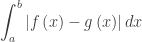
Regardless of where the two curves are relative to the x-axis, the vertical distance between them is the upper value minus the lower, f(x) – g(x). It does not matter if one or both functions are negative on all or part of the interval, the difference is positive and the area between them is

\displaystyle \underset{n\to \infty }{\mathop{\lim }}\,\sum\limits_{i=1}^{n}{\left( f\left( {{x}_{i}} \right)-g\left( {{x}_{i}} \right) \right)\Delta {{x}_{i}}}=\int_{a}^{b}{f\left( x \right)-g\left( x \right)dx}.

Furthermore, this Riemann sum rectangle is used in other applications. It is the one rotated in both the washer and shell method of finding volumes. So in area and all applications be sure your students don’t just memorize formulas, but keep their eyes on the rectangle and the Riemann sum.

Finally, if the graphs cross in the interval so that the upper and lower curves change place, you may (1) either break the problem into several pieces so that your integrands are always of the form upper minus lower, or (2) if you intend to do the computation using technology, set up the integral as

\displaystyle \int_{a}^{b}{\left| f\left( x \right)-g\left( x \right) \right|dx}.

Integration by Parts 2

Sometimes when doing an Antidifferentiation by Parts, the resulting integral is simpler than the one you started with but requires another, perhaps several more, antidifferentiations. You can do this but it can get a little complicated keeping track of everything especially with all the minus signs. There is an easier way.

Let’s consider an example: \int{{{x}^{4}}\sin \left( x \right)dx}.

Begin by making a table as shown below. After the headings:

    • In the first column leave the first cell blank and then alternate plus and minus signs down the column.
    • In the second column leave the first cell blank and then enter u and then under it list its successive derivatives.
    • In the third column enter dv in the first cell and then list its successive antiderivatives under it

Tabular 5

The antiderivative is found by multiplying across each row starting with the row with the  first plus sign and adding the products:

\int{{{x}^{4}}\sin \left( x \right)dx}=

-{{x}^{4}}\cos \left( x \right)+4{{x}^{3}}\sin \left( x \right)+12{{x}^{2}}\cos \left( x \right)-24x\sin \left( x \right)-24\cos \left( x \right)+C

Integration by Parts 1

The antidifferentiation technique known as Integration by Parts or Antidifferentiation by Parts is based on the formula for the Product Rule: d\left( uv \right)=udv+vdu.
Solve this equation for the second term on the right: udv=d\left( uv \right)-vdu.
Integrating this gives the formula \int{udv}=\int{d\left( uv \right)}-\int{vdu}. By the FTC the first term on the right can be simplified giving the formula for Integration by Parts:

\int{udv}=uv-\int{vdu}

The technique is used to find antiderivatives of expressions such as \int{x\sin \left( x \right)dx} in which there is a combination of functions that are usually of different types – here a polynomial and a trig function.

The parts of the integrand must be matched to the parts of \int{udv}. Here we make the substitutions u=x,dv=\sin \left( x \right)dx and from these we compute du=dx\text{ and }v=-\cos \left( x \right). (There is no need for the +C here; it will be included later). Making these substitutions gives


\int{x\sin \left( x \right)dx}=-x\cos \left( x \right)-\int{-\cos \left( x \right)dx}

The integral on the right is simple so we end with

\int{x\sin \left( x \right)dx}=-x\cos \left( x \right)+\sin \left( x \right)+C

As the problems get more difficult the first question students ask is which part should by u and which dv? The rules of thumb are (1) Chose u to be something that gets simpler when differentiated, and (2) chose dv to be something you can antidifferentiated or at least something that does not get more complicated when you antidifferentiate. For example, in the problem above if we were to choose u=\sin \left( x \right) and  dv=xdx the result is

\int{x\sin \left( x \right)dx}=\tfrac{{{x}^{2}}}{2}\sin \left( x \right)-\int{\tfrac{{{x}^{2}}}{2}\cos \left( x \right)dx}

This is correct, but the integral on the right is more complicated than the one we started with. When this happens, go back and start over.

For AP Calculus teachers: Note that Antidifferentiation by Parts is a BC only topic. It is something you can do in AB classes after the AP exam if you have time.