Area & Volume (Type 4)

Given equations that define a region in the plane students are asked to find its area and the volume of the solid formed when the region is revolved around a line or used as a base of a solid with regular cross-sections. This standard application of the integral has appeared every year since 1969 on the AB exam and all but one year on the BC exam.

What students should be able to do:

  • Find the intersection(s) of the graphs and use them as limits of integration (calculator equation solving). Write the equation followed by the solution; showing work is not required. Usually no credit is earned until the solution is used in context (as a limit of integration). Students should know how to store and recall these values to save time and avoid copy errors.
  • Find the area of the region between the graph and the x-axis or between two graphs.
  • Find the volume when the region is revolved around a line, not necessarily an axis or an edge of the region, by the disk/washer method.
  • The cylindrical shell method will never be necessary for a question on the AP exams, but is eligible for full credit if properly used.
  • Find the volume of a solid with regular cross-sections whose base is the region between the curves. For an interesting variation on this idea see 2009 AB 4(b)
  • Find the equation of a vertical line that divides the region in half (area or volume). This involves setting up and solving an integral equation where the limit is the variable for which the equation is solved.
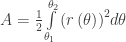
  • For BC only – find the area of a region bounded by polar curves: A=\tfrac{1}{2}\int\limits_{{{\theta }_{1}}}^{{{\theta }_{2}}}{{{\left( r\left( \theta  \right) \right)}^{2}}}d\theta
If this question appears on the calculator active section, it is expected that the definite integrals will be evaluated on a calculator. Students should write the definite integral with limits on their paper and put its value after it.  It is not required to give the antiderivative and if a student gives an incorrect antiderivative they will lose credit even if the final answer is (somehow) correct.

There is a calculator program available that will give the set-up and not just the answer so recently this question has been on the no calculator allowed section. (The good news is that in this case the integrals will be easy or they will be set-up-but-do-not-integrate questions.)

Occasionally, other type questions have been included as a part of this question. See 2016 AB5/BC5 which included an average value question and a related rate question along with finding the volume.

Shorter questions on this concept appear in the multiple-choice sections. As always, look over as many questions of this kind from past exams as you can find.

For some previous posts on this subject see January 911, 2013


Next Posts:

Friday March 17: Table and Riemann sums (Type 5)

Tuesday Match 21: Differential Equations (Type 6)

Friday March 24: Others (Type 7: related rates, implicit differentiation, etc.)

Tuesday March 28: for BC Parametric Equation (Type 8)


Subtract the Hole from the Whole.

Sometimes I think textbooks are too rigorous. Behind every Riemann sum is a definite integral. So, authors routinely show how to solve an application of integration problem by developing the method starting from the Riemann sum and proceeding to an integral that give the result that is summarized in a “formula.” There is nothing wrong with that except that often the formula is all the students remember and are lost when faced with a similar situation that the formula does not handle. .

The volume of solid figure problems are developed from the idea that if a solid figure has a regular cross-section (that is, when cut perpendicular to a line, each face is similar – in the technical sense – to all the others). They are all squares, or equilateral triangles, or whatever. The last shape considered is usually a “washer”, that is, an annulus or two concentric circles. This is formed by revolving the region between two curves around a line. Authors develop a formula for such volumes: \displaystyle \pi \int_{a}^{b}{{{\left( R\left( x \right) \right)}^{2}}-{{\left( r\left( x \right) \right)}^{2}}dx}.

Now there is nothing wrong with that, but I like to give the students their chance to show off. They can usually figure out the answer without Riemann sums. Here is my suggestion. After students have had some practice with circular cross-sections (“Disk” method”) I give them a series of three volumes to find.

Example 1: The curve f\left( x \right)=\sin \left( \pi x \right) on the interval [0, ½] is revolved around the x-axis to form a solid figure. Find the volume of this figure. washers-1
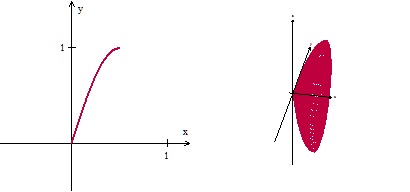
Solution: \displaystyle V=\int_{0}^{1}{\pi {{\left( \sin \left( \pi x \right) \right)}^{2}}dx}=\frac{\pi }{4}

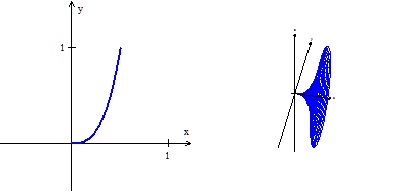
Example 2: The curve g\left( x \right)=8{{x}^{3}} on the interval [0, ½] is revolved around the x-axis to form a solid figure. Find the volume of this figure.   washers-2

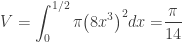
Solution: \displaystyle V=\int_{0}^{1/2}{\pi {{\left( 8{{x}^{3}} \right)}^{2}}dx=}\frac{\pi }{14}

These they find easy. Then, leaving the first two examples in plain view, I give them:

Example 3: The region in the first quadrant between the graphs of f\left( x \right)=\sin \left( \pi x \right) and g\left( x \right)=8{{x}^{3}} is revolved around the x-axis. Find the volume of the resulting figure.washers-3

A little thinking and (rarely) a hint and they have it. \displaystyle V=\frac{\pi }{4}-\frac{\pi }{14}

What did they do? Easy, they subtracted the hole from the whole. We discuss this and why they think it is correct. We try one or two others. And now they are set to do any “washer” method problem without another formula to memorize.


Extensions:

1. In symbols, when rotation around a horizontal line, if R(x) is the distance from the curve farthest from the line of rotation and r(x) the distance from the closer curve to the line of rotation the result can be summarized in the formula

\displaystyle V = \int_{a}^{b}{\pi {{\left( R\left( x \right) \right)}^{2}}dx}-\int_{a}^{b}{\pi {{\left( r\left( x \right) \right)}^{2}}dx}.

         Notice, that I like to keep the \pi  inside the integral sign so that each integrand looks like the formula for the area of a circle. What the students need to know is to subtract the volume hole from the outside volume. With that                idea and the disk method they can do any volume by washers problem.

2. You should show the students how this equation above can be rearranged into the formula in their books,

\displaystyle V = \pi \int_{a}^{b}{{{\left( R\left( x \right) \right)}^{2}}-{{\left( r\left( x \right) \right)}^{2}}dx}.

This is so that they understand that the formulas are the same, and not think you’ve forgotten to tell them something important. It is also a good exercise in working with the notation. (see MPAC 5 – Notational fluency)

3. Next discuss what {{\left( \pi R\left( x \right) \right)}^{2}}-\pi {{\left( r\left( x \right) \right)}^{2}} is the area of and how it relates to this problem. See if the students can understand what the textbook is doing; what shape the book is using.. Discuss the Riemann sum approach. (MPAC 1 Reasoning with definitions and theorems, and MPAC 5 Notational fluency)

4. With the idea of subtracting the “hole” try a problem like this. Example 4: The region in the first quadrant between x-axis and the graphs of f\left( x \right)=\sqrt{x} and g\left( x \right)=\sqrt{2x-4} is revolved around the x-axis. Find the volume of the resulting figure. washers-4

Solution:\displaystyle V=\int_{0}^{4}{\pi {{\left( \sqrt{x} \right)}^{2}}dx}-\int_{2}^{4}{\pi {{\left( \sqrt{2x-4} \right)}^{2}}dx}=4\pi

(Notice the limits of integration.)

Traditionally, this is done by the method of cylindrical shells, but you don’t need that. You could divide the region into two parts with a vertical line at x = 2 and use disks on the left and washers on the right, but you don’t need to do that either. Just subtract the hole from the whole.

.

Visualizing Solid Figures 1

The shape of various solids of rotation and solids with regular cross-sections of which beginning calculus students are required to find the volume are often difficult to visualize. This post and the next two will discuss some of the ways you can help your students become familiar with these shapes. Teachers often use these as projects for students to get some hands-on familiarity with the figures. In fact, it is one of the few places where a useful project can be assigned.

 Actually, rotate a region:

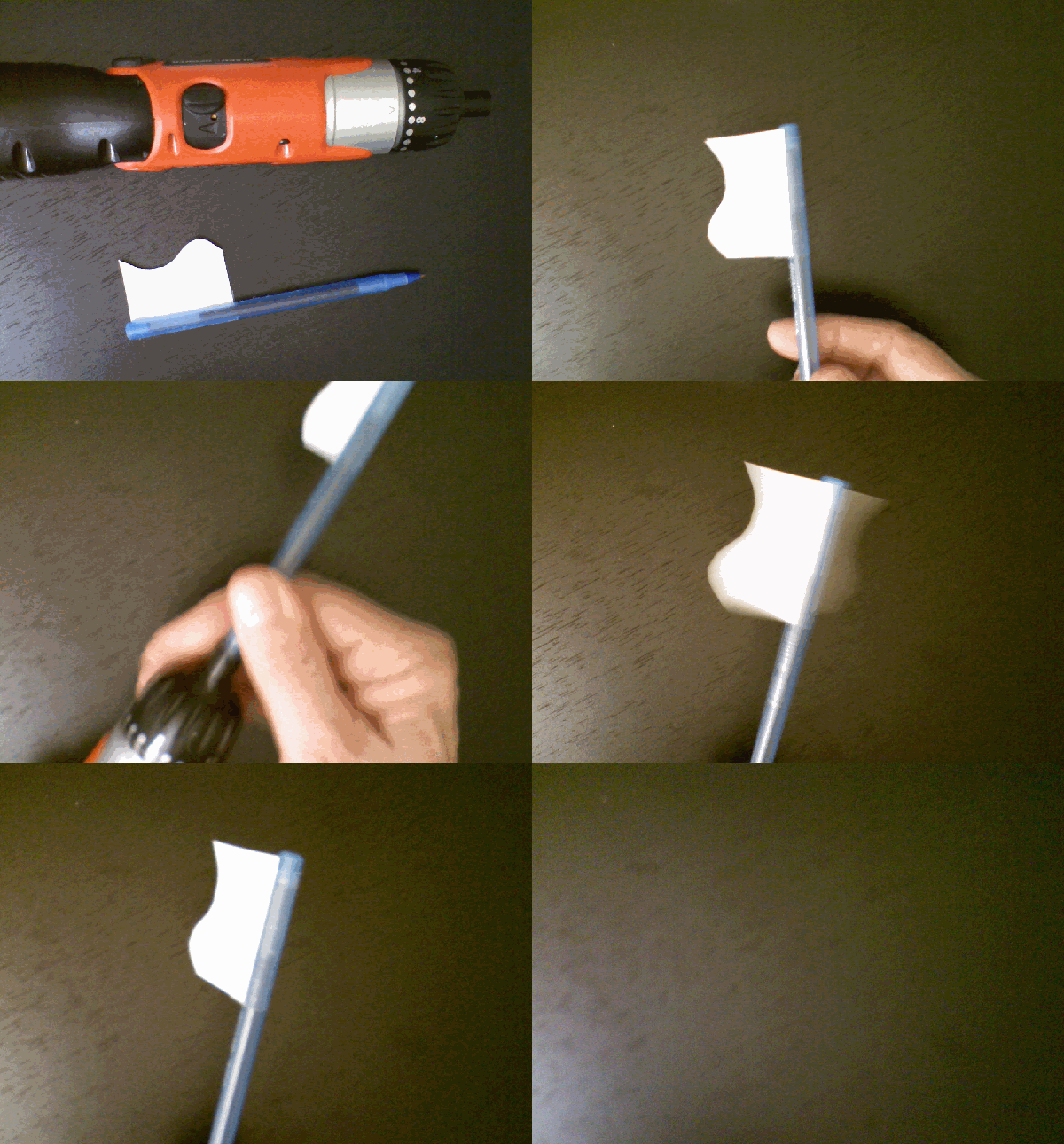
Begin by drawing the region to be revolved (from the curve to the line of rotation) on paper and cut it out. Tape the region along the line to a pencil, pen, or dowel. Roll the dowel back and forth between your hands or, as shown in the video below, with a small electric drill or screwdriver. You can get a rough idea of the shape.

Solid 4

Go to a wedding:

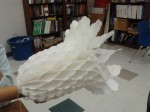
Decorations for weddings and other festive events are made from paper and fold flat. When opened you get a solid of rotation.

Measure a volume:

Take a solid fruit (like a banana), or a vegetable (like a cucumber, or carrot) and find its volume by cutting it into “coin” shaped pieces. Multiply the thickness by the area of the circular ends of each piece and then add them to find the volume.

For more of a challenge use a loaf of sliced bread (here you will need a way to calculate the area of the non-circular ends – inscribed rectangles perhaps). You could also approximate the volume of a tree trunk by measuring the circumference at regular distances along the trunk.

Build a model:

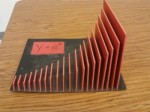
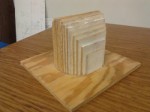
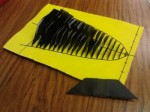
This method can be used for solids or rotation and is especially good for solids with regular cross-sections.  It is also a good project for a student or group of students.

  1. Carefully graph the region using a somewhat larger than normal scale.
  2. Draw lines at 1/8 to ¼ inch intervals across the region perpendicular to the appropriate axis.
  3. Carefully measure or calculate the length of each of these lines. Use this for the appropriate dimension for the question. For example, this may be the side of the square cross-section, or the diameter of a semi-circular section.
  4. Use the dimension to draw a series of squares, semi-circles, or whatever from cardboard, plywood, or foam board.
  5. Cut these out and assemble them on the original region you graphed to approximate the solid figure. Tape or glue them in place.
  6. Extra: Calculate the area of each piece and multiply it by the thickness (or the distance between pieces) and see how closely this comes to the calculated volume.

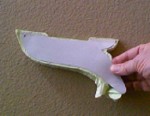
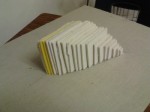
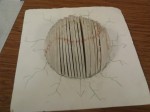
These pictures are of models made by students of Mrs. Dixie Ross at Pflugerville (Texas) High School. Students received more points if they recycled materials.Thank you Dixie!