Why Applications?

I guess the obvious answer is so you will have something to use your new knowledge of the definite integral on. This unit is a collection of the first applications. There are many more.

The whole idea is based on the fact that a definite integral is a sum. Thus, they can be used to add things. Complicated shapes can be divided into simple shapes, like rectangles, and their areas can be added.

Here are the first uses.

AVERAGE VALUE OF A FUNCTION ON AN INTERVAL

You know that to average two numbers you add them and divide the total by two. To average a larger set of numbers you add them and divide the sum by the number of numbers. Now you will learn how to average the infinite number of y-values of a function over an interval. To do it you use a definite integral.

HINT: Average value of a function, average rate of change of a function, and the mean value theorem all sound kind of the same. Furthermore, the formulas all look kind of the same. Don’t mix them up. Use their full name, not just “average,” and use the right one.

There is an interesting result found some years ago by a tenth-grade student who took AB Calculus in eighth grade and BC in ninth. He proved that Most Triangles Are Obtuse! using the average value integral.

LINEAR MOTION

This application extends your previous work on objects moving on a line. By adding, with a definite integral, you will be able to determine how far the object moves in a given time. Knowing that and where the object starts, you will be able to find its current position. BC students will also learn how to find the length of a curve in the plane.

THE AREA BETWEEN TWO CURVES

This application extends what you know about finding the area between a curve and the x-axis to finding the area between two curves.

VOLUME OF A SOLID FIGURE WITH A REGULAR CROSS-SECTION

Some solid objects, when sliced in the right way, have regular cross-section. That means, the cut surface is a square, a rectangle, a right triangle, a semi-circle and so on. Think of cutting a piece of butter from a stick of butter – each piece is a square with a little thickness, like a very small pizza box. By using an integral to add their volumes you can find the volume of the original figure. .

VOLUME OF A SOLID OF REVOLUTION – DISK METHOD

A region in the plane is revolved aroud a line resulting in a solid figure. Finding its volume is just a special case of a solid with regular cross section where the cross section is a circle. Each little piece is a disk. By adding their volumes with an integral you can calculate the volume.

VOLUME OF A SOLID OF REVOLUTION – WASHER METHOD

Some solids of revolution have holes through them. These are formed by revolving a plane figure (usually the region between two curves) around an edge or a line outside the figure. The line is often the x– or y-axis. There is a formula for doing this, but understanding what you are doing – doing two disk problems – will help you with doing this. (See Subtract the Hole from the Whole.)

One last hint: You will want to know what the solid figure looks like. In addition to the illustrations in your textbook, there are various places online where you can find pictures of the figures. You can build models of them. There is an excellent iPad app called A Little Calculus that does a good job of illustrating and animating solid figures (and lots of other calculus stuff).

Course and Exam Description Unit 8
Area and Volume Problems (Type 4)

AP Type Questions 4: Area and Volume

Given equations that define a region in the plane students are asked to find its area, the volume of the solid formed when the region is revolved around a line, and/or the region is used as a base of a solid with regular cross-sections. This standard application of the integral has appeared every year since year one (1969) on the AB exam and almost every year on the BC exam. You can be fairly sure that if a free-response question on areas and volumes does not appear, the topic will be tested on the multiple-choice section.

What students should be able to do:

  • Find the intersection(s) of the graphs and use them as limits of integration (calculator equation solving). Write the equation followed by the solution; showing work is not required. Usually, no credit is earned until the solution is used in context (e.g., as a limit of integration). Students should know how to store and recall these values to save time and avoid copy errors.
  • Find the area of the region between the graph and the x-axis or between two graphs.
  • Find the volume when the region is revolved around a line, not necessarily an axis or an edge of the region, by the disk/washer method. See “Subtract the Hole from the Whole”
  • The cylindrical shell method will never be necessary for a question on the AP exams but is eligible for full credit if properly used.
  • Find the volume of a solid with regular cross-sections whose base is the region between the curves. For an interesting variation on this idea see 2009 AB 4(b)
  • Find the equation of a vertical line that divides the region in half (area or volume). This involves setting up an integral equation where the limit is the variable for which the equation is solved.
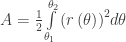
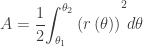
  • For BC only – find the area of a region bounded by polar curves: \displaystyle A=\frac{1}{2}{{\int_{{{{\theta }_{1}}}}^{{{{\theta }_{2}}}}{{\left( {r\left( \theta \right)} \right)}}}^{2}}d\theta
  • For BC only – Find perimeter using arc length integral

If this question appears on the calculator active section, it is expected that the definite integrals will be evaluated on a calculator. Students should write the definite integral with limits on their paper and put its value after it. It is not required to give the antiderivative and if a student gives an incorrect antiderivative, they will lose credit even if the final answer is (somehow) correct.

There is a calculator program available that will give the set-up and not just the answer so recently this question has been on the no calculator allowed section. (The good news is that in this case the integrals will be easy, or they will be set-up-but-do-not-integrate questions.)

Occasionally, other type questions have been included as a part of this question. See 2016 AB5/BC5 which included an average value question and a related rate question along with finding the volume.

Shorter questions on this concept appear in the multiple-choice sections. As always, look over as many questions of this kind from past exams as you can find.

For some previous posts on this subject see January 911, 2013 and “Subtract the Hole from the Whole” of December 6, 2016.


The Area and Volume question covers topics from Unit 6 of the CED .


Free-response questions:

  • Variations: 2009 AB 4, Don’t overlook this one, especially part (b)
  • 2016 AB5/BC5,
  • 2017 AB 1 (using a table),
  • 2018 AB 5 – average rate of change, L’Hospital’s Rule
  • 2019 AB 5
  • Perimeter parametric curves 2011 BC 3 and 2014 BC 5
  • Area in polar form 2017 BC 5, 2018 BC 5, 20129 BC 2
  • 2021 AB 3/ BC 3
  • 2022 AB2 – area, volume, inc/dec analysis, and related rate.
  • 2023 BC 5 – Area, Improper integral, Integration by Parts (No area problem on 2023 AB exam)

Multiple-choice questions from non-secure exams:

  • 2008 AB 83 (Use absolute value),
  • 2012 AB 10, 92
  • 2012 BC 87, 92 (Polar area)

Updated March 12, 2012, March 22, 2022, May 4, 2023, June 4, 2023


Area and Volume Problems (Type 4)

AP Type Questions 4: Area and Volume

Given equations that define a region in the plane students are asked to find its area, the volume of the solid formed when the region is revolved around a line, and/or the region is used as a base of a solid with regular cross-sections. This standard application of the integral has appeared every year since year one (1969) on the AB exam and almost every year on the BC exam. You can be pretty sure that if a free-response question on areas and volumes does not appear, the topic will be tested on the multiple-choice section.

What students should be able to do:

  • Find the intersection(s) of the graphs and use them as limits of integration (calculator equation solving). Write the equation followed by the solution; showing work is not required. Usually no credit is earned until the solution is used in context (as a limit of integration). Students should know how to store and recall these values to save time and avoid copy errors.
  • Find the area of the region between the graph and the x-axis or between two graphs.
  • Find the volume when the region is revolved around a line, not necessarily an axis or an edge of the region, by the disk/washer method. See “Subtract the Hole from the Whole”
  • The cylindrical shell method will never be necessary for a question on the AP exams, but is eligible for full credit if properly used.
  • Find the volume of a solid with regular cross-sections whose base is the region between the curves. For an interesting variation on this idea see 2009 AB 4(b)
  • Find the equation of a vertical line that divides the region in half (area or volume). This involves setting up an integral equation where the limit is the variable for which the equation is solved.
  • For BC only – find the area of a region bounded by polar curves: A=\tfrac{1}{2}\int\limits_{{{\theta }_{1}}}^{{{\theta }_{2}}}{{{\left( r\left( \theta  \right) \right)}^{2}}}d\theta
  • For BC only – Find perimeter using arc length integral

If this question appears on the calculator active section, it is expected that the definite integrals will be evaluated on a calculator. Students should write the definite integral with limits on their paper and put its value after it. It is not required to give the antiderivative and if a student gives an incorrect antiderivative they will lose credit even if the final answer is (somehow) correct.

There is a calculator program available that will give the set-up and not just the answer so recently this question has been on the no calculator allowed section. (The good news is that in this case the integrals will be easy or they will be set-up-but-do-not-integrate questions.)

Occasionally, other type questions have been included as a part of this question. See 2016 AB5/BC5 which included an average value question and a related rate question along with finding the volume.

Shorter questions on this concept appear in the multiple-choice sections. As always, look over as many questions of this kind from past exams as you can find.

For some previous posts on this subject see January 911, 2013 and “Subtract the Hole from the Whole” of December 6, 2016.


The Area and Volume question covers topics from Unit 6 of the 2019 CED .


Free-response questions:

  • Variations: 2009 AB 4, Don’t overlook this one, especially part (b)
  • 2016 AB5/BC5,
  • 2017 AB 1 (using a table),
  • 2018 AB 5 – average rate of change, L’Hospital’s Rule
  • 2019 AB 5
  • Perimeter parametric curves 2011 BC 3 and 2014 BC 5
  • Area in polar form 2017 BC 5, 2018 BC 5, 20129 BC 2

Multiple-choice questions from non-secure exams:

  • 2008 AB 83 (Use absolute value),
  • 2012 AB 10, 92
  • 2012 BC 87, 92 (Polar area)


Revised March 12, 2012


Type 4 Questions: Area and Volume Problems

Given equations that define a region in the plane students are asked to find its area, the volume of the solid formed when the region is revolved around a line, and/or the region is used as a base of a solid with regular cross-sections. This standard application of the integral has appeared every year since year one (1969) on the AB exam and almost every year on the BC exam. You can be pretty sure that if a free-response question on areas and volumes does not appear, the topic will be tested on the multiple-choice section.

What students should be able to do:

  • Find the intersection(s) of the graphs and use them as limits of integration (calculator equation solving). Write the equation followed by the solution; showing work is not required. Usually no credit is earned until the solution is used in context (as a limit of integration). Students should know how to store and recall these values to save time and avoid copy errors.
  • Find the area of the region between the graph and the x-axis or between two graphs.
  • Find the volume when the region is revolved around a line, not necessarily an axis or an edge of the region, by the disk/washer method.
  • The cylindrical shell method will never be necessary for a question on the AP exams, but is eligible for full credit if properly used.
  • Find the volume of a solid with regular cross-sections whose base is the region between the curves. For an interesting variation on this idea see 2009 AB 4(b)
  • Find the equation of a vertical line that divides the region in half (area or volume). This involves setting up an integral equation where the limit is the variable for which the equation is solved.
  • For BC only – find the area of a region bounded by polar curves: A=\tfrac{1}{2}\int\limits_{{{\theta }_{1}}}^{{{\theta }_{2}}}{{{\left( r\left( \theta  \right) \right)}^{2}}}d\theta
  • For BC only – Find perimeter using arc length integral

If this question appears on the calculator active section, it is expected that the definite integrals will be evaluated on a calculator. Students should write the definite integral with limits on their paper and put its value after it. It is not required to give the antiderivative and if a student gives an incorrect antiderivative they will lose credit even if the final answer is (somehow) correct.

There is a calculator program available that will give the set-up and not just the answer so recently this question has been on the no calculator allowed section. (The good news is that in this case the integrals will be easy or they will be set-up-but-do-not-integrate questions.)

Occasionally, other type questions have been included as a part of this question. See 2016 AB5/BC5 which included an average value question and a related rate question along with finding the volume.

Shorter questions on this concept appear in the multiple-choice sections. As always, look over as many questions of this kind from past exams as you can find.

For some previous posts on this subject see January 911, 2013 and “Subtract the Hole from the Whole” of December 6, 2016


Free-response questions:

  • 2014 AB 2, 2013 AB 5.
  • 2015 AB 2
  • Variations: 2009 AB 4,
  • 2016 AB5/BC5,
  • 2017 AB 1 (using a table),
  • Perimeter 2011 BC 3 and 2014 BC 5

Multiple-choice questions from non-secure exams:

  • 2008 AB 83 (Use absolute value),
  • 2012 AB 10, 92
  • 2012 BC 87, 92 (Polar area)


Revised to add perimeter question 3-16-18,

Revised March 12, 2021

Applications of Integration – Volume

One of the major applications of integration is to find the volumes of various solid figures.

Volume of Solids with Regular Cross-sections  This is where to start with volume problems. After all, solids of revolution are just a special case of solids with regular cross-sections.

Volumes of Revolution

Subtract the Hole from the Whole and Does Simplifying Make Things Simpler?

Visualizing Solid Figures

Why you Never Need Cylindrical Shells

Painting a Point


Revised and update October 22, 2018

Applications of integrals, part 2: Volume problems

One of the major applications of integration is to find the volumes of various solid figures.

Volume of Solids with Regular Cross-sections  This is where to start with volume problems. After all, solids of revolution are just a special case of solids with regular cross-sections.

Volumes of Revolution

Subtract the Hole from the Whole and Does Simplifying Make Things Simpler?

Visualizing Solid Figures

Area and Volume (Type 4)  also Area and Volume Question review notes.

Why you Never Need Cylindrical Shells

Painting a Point


Area & Volume (Type 4)

Given equations that define a region in the plane students are asked to find its area and the volume of the solid formed when the region is revolved around a line or used as a base of a solid with regular cross-sections. This standard application of the integral has appeared every year since 1969 on the AB exam and all but one year on the BC exam.

What students should be able to do:

  • Find the intersection(s) of the graphs and use them as limits of integration (calculator equation solving). Write the equation followed by the solution; showing work is not required. Usually no credit is earned until the solution is used in context (as a limit of integration). Students should know how to store and recall these values to save time and avoid copy errors.
  • Find the area of the region between the graph and the x-axis or between two graphs.
  • Find the volume when the region is revolved around a line, not necessarily an axis or an edge of the region, by the disk/washer method.
  • The cylindrical shell method will never be necessary for a question on the AP exams, but is eligible for full credit if properly used.
  • Find the volume of a solid with regular cross-sections whose base is the region between the curves. For an interesting variation on this idea see 2009 AB 4(b)
  • Find the equation of a vertical line that divides the region in half (area or volume). This involves setting up and solving an integral equation where the limit is the variable for which the equation is solved.
  • For BC only – find the area of a region bounded by polar curves: A=\tfrac{1}{2}\int\limits_{{{\theta }_{1}}}^{{{\theta }_{2}}}{{{\left( r\left( \theta  \right) \right)}^{2}}}d\theta

If this question appears on the calculator active section, it is expected that the definite integrals will be evaluated on a calculator. Students should write the definite integral with limits on their paper and put its value after it.  It is not required to give the antiderivative and if a student gives an incorrect antiderivative they will lose credit even if the final answer is (somehow) correct.

There is a calculator program available that will give the set-up and not just the answer so recently this question has been on the no calculator allowed section. (The good news is that in this case the integrals will be easy or they will be set-up-but-do-not-integrate questions.)

Occasionally, other type questions have been included as a part of this question. See 2016 AB5/BC5 which included an average value question and a related rate question along with finding the volume.

Shorter questions on this concept appear in the multiple-choice sections. As always, look over as many questions of this kind from past exams as you can find.

For some previous posts on this subject see January 911, 2013


Next Posts:

Friday March 17: Table and Riemann sums (Type 5)

Tuesday Match 21: Differential Equations (Type 6)

Friday March 24: Others (Type 7: related rates, implicit differentiation, etc.)

Tuesday March 28: for BC Parametric Equation (Type 8)