Type 8: Parametric and Vector Questions

The parametric/vector equation questions only concern motion in a plane.

In the plane, the position of a moving object as a function of time, t, can be specified by a pair of parametric equations x=x\left( t \right)\text{ and }y=y\left( t \right) or the equivalent vector \left\langle x\left( t \right),y\left( t \right) \right\rangle . The path is the curve traced by the parametric equations or the tips of the position vector. .

The velocity of the movement in the x- and y-direction is given by the vector \left\langle {x}'\left( t \right),{y}'\left( t \right) \right\rangle . The vector sum of the components gives the direction of motion. Attached to the tip of the position vector this vector is tangent to the path pointing in the direction of motion.

The length of this vector is the speed of the moving object. \text{Speed }=\sqrt{{{\left( {x}'\left( t \right) \right)}^{2}}+{{\left( {y}'\left( t \right) \right)}^{2}}}. (Notice that this is the same as the speed of a particle moving on the number line with one less parameter: On the number line \text{Speed}=\left| v \right|=\sqrt{{{\left( {x}'\left( t \right) \right)}^{2}}}.)

The acceleration is given by the vector \left\langle {{x}'}'\left( t \right),{{y}'}'\left( t \right) \right\rangle .

What students should know how to do:

  • Vectors may be written using parentheses, ( ), or pointed brackets, \left\langle {} \right\rangle , or even \vec{i},\vec{j} form. The pointed brackets seem to be the most popular right now, but all common notations are allowed and will be recognized by readers.
  • Find the speed at time t\text{Speed }=\sqrt{{{\left( {x}'\left( t \right) \right)}^{2}}+{{\left( {y}'\left( t \right) \right)}^{2}}}
  • Use the definite integral for arc length to find the distance traveled \displaystyle \int_{a}^{b}{\sqrt{{{\left( {x}'\left( t \right) \right)}^{2}}+{{\left( {y}'\left( t \right) \right)}^{2}}}}dt. Notice that this is the integral of the speed (rate times time = distance).
  • The slope of the path is \displaystyle \frac{dy}{dx}=\frac{{y}'\left( t \right)}{{x}'\left( t \right)}. See this post for more on finding the first and second derivatives with respect to x.
  • Determine when the particle is moving left or right,
  • Determine when the particle is moving up or down,
  • Find the extreme position (farthest left, right, up, down, or distance from the origin).
  • Given the position find the velocity by differentiating; given the velocity find the acceleration by differentiating.
  • Given the acceleration and the velocity at some point find the velocity by integrating; given the velocity and the position at some point find the position by integrating. These are just initial value differential equation problems (IVP).
  • Dot product and cross product are not tested on the BC exam, nor are other aspects.

When this topic appears on the free-response section of the exam there is no polar equation question and vice versa. When not on the free-response section there are one or more multiple-choice questions on parametric equations.


Free-response questions:

  • 2012 BC 2
  • 2016 BC 2

Multiple-choice questions from non-secure exams

  • 2003 BC 4, 7, 17, 84
  • 2008 BC 1, 5, 28
  • 2012 BC 2


Parametric Equations and Vectors

In BC calculus the only application parametric equations and vectors is motion in a plane. Polar equations concern area and the meaning of derivatives. See the review notes for more detail and an outline of the topics. (only 3 items here)

Motion Problems: Same Thing Different Context (11-16-2012)

Implicit Differentiation of Parametric Equations (5-17-2014)

A Vector’s Derivative (1-14-2015)

Review Notes 

Type 8: Parametric and Vector Equations (3-30-2018) Review Notes

Type 9: Polar Equation Questions (4-3-2018) Review Notes

Roulettes 

This is a series of posts that could be used when teaching polar form and curves defined by vectors (or parametric equations). They might be used as a project. Hopefully, the equations that produce the graphs will help students understand these topics. Don’t let the names put you off. Except for one post, there is no calculus here.

Rolling Circles  (6-24-2014)

Epicycloids (6-27-2014)

Epitrochoids (7-1-2014) The most common of these are the cycloids.

Hypocycloids and Hypotrochoids  (7-7-2014)

Roulettes and Calculus  (7-11-2014)

Roulettes and Art – 1  (7-17-2014)

Roulettes and Art – 2 (7-23-2014)

Limaçons (7-28-2014)


The College Board is pleased to offer a new live online event for new and experienced AP Calculus teachers on March 5th at 7:00 PM Eastern.

I will be the presenter.

The topic will be AP Calculus: How to Review for the Exam:  In this two-hour online workshop, we will investigate techniques and hints for helping students to prepare for the AP Calculus exams. Additionally, we’ll discuss the 10 type questions that appear on the AP Calculus exams, and what students need know and to be able to do for each. Finally, we’ll examine resources for exam review.

Registration for this event is $30/members and $35/non-members. You can register for the event by following this link: http://eventreg.collegeboard.org/d/xbqbjz


Parametric and Vector Equations

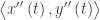
In the plane, the position of a moving object as a function of time, t, can be specified by a pair of parametric equations x=x\left( t \right)\text{ and }y=y\left( t \right) or the equivalent vector \left\langle x\left( t \right),y\left( t \right) \right\rangle . The path is the curve traced by the parametric equations or the tips of the position vector. .

The velocity of the movement in the x- and y-direction is given by the vector \left\langle {x}'\left( t \right),{y}'\left( t \right) \right\rangle . The vector sum of the components gives the direction of motion. Attached to the tip of the position vector this vector is tangent to the path pointing in the direction of motion.

The length of this vector is the speed of the moving object. \text{Speed }=\sqrt{{{\left( {x}'\left( t \right) \right)}^{2}}+{{\left( {y}'\left( t \right) \right)}^{2}}}. (Notice that this is the same as the speed of a particle moving on the number line with one less parameter: On the number line \text{Speed}=\left| v \right|=\sqrt{{{\left( {x}'\left( t \right) \right)}^{2}}}.)

The acceleration is given by the vector \left\langle {{x}'}'\left( t \right),{{y}'}'\left( t \right) \right\rangle .
What students should know how to do:

  • Vectors may be written using parentheses, ( ), or pointed brackets, \left\langle {} \right\rangle , or even \vec{i},\vec{j} form. The pointed brackets seem to be the most popular right now, but all common notations are allowed and will be recognized by readers.
  • Find the speed at time t\text{Speed }=\sqrt{{{\left( {x}'\left( t \right) \right)}^{2}}+{{\left( {y}'\left( t \right) \right)}^{2}}}
  • Use the definite integral for arc length to find the distance traveled \displaystyle \int_{a}^{b}{\sqrt{{{\left( {x}'\left( t \right) \right)}^{2}}+{{\left( {y}'\left( t \right) \right)}^{2}}}}dt. Notice that this is the integral of the speed (rate times time = distance).
  • The slope of the path is \displaystyle \frac{dy}{dx}=\frac{{y}'\left( t \right)}{{x}'\left( t \right)}. See this post for more on finding the first and second derivatives with respect to x.
  • Determine when the particle is moving left or right,
  • Determine when the particle is moving up or down,
  • Find the extreme position (farthest left, right, up, down, or distance from the origin).
  • Given the position find the velocity by differentiating; given the velocity find the acceleration by differentiating.
  • Given the acceleration and the velocity at some point find the velocity by integrating; given the velocity and the position at some point find the position by integrating. These are just initial value differential equation problems (IVP).
  • Dot product and cross product are not tested on the BC exam, nor are other aspects.


Here are two past post on this topic:

Implicit Differentiation of Parametric Equation

A Vector’s Derivatives


Roulettes and Art – 2

Continuing with our discussion of ways to produce interesting designs with the Roulette Generator (RG) for Winplot, here are some hints on making more detailed designs using more than one function.

Hint #5: Adding more graphs to the first: You may add other graphs by selecting the roulette and/or velocity equations from the Inventory (CTRL+I) and clicking “dupl”  to duplicate the equation. Then click the duplicate and then “edit” and change the sign in front of the S in both equations. This will let you graph S and –S at the same time. This will give you two congruent graphs with the first rotated 2\pi /n from the first. (From the previous posts: if \left| R \right|=\tfrac{n}{d} then there are d dips, loops, or cusps in n full revolutions). Both graphs will have the same R value.  

You may also change the color of all the graphs.

Here is a graph with that idea. The values are in the caption.

R = -0.322, S = -0.3 (blue) and S = +0.3 (green) and their derivatives (orange and   xxx  15 Revolutions

R = -0.322, S = -0.3 (blue) and S = +0.3 (green) and their derivatives (orange and gray),
15 Revolutions

Hint #6: Plotting Density (PD) (Winplot RG only) also affects the final drawing. Graphers work by calculating a number of points and joining them with straight segments. The default plotting density is 1. Usually this results in a nice graph with smooth looking curves because the segments are very short. If your graph looks like a bunch of segments, select the equation in the Inventory, click “edit”, and increase the plotting density (to 10 or 100 or more) and the curves will no longer look like segments. Of course, you may want them to look like segments. The graph below shows how PD works. The graph on the left has a plotting density of 10. The center graph is a detail of the first with the same PD. The plot on the right is the same as the center graph but with a plotting density of 100.

Hint #7: In addition to PD, Winplot is very sensitive to image size and zooming in and out. Once you have a graph you like, experiment with zooming in and our (page-up and page-down keys) or dragging the corners of the frame. You will see a lot of different graphs.

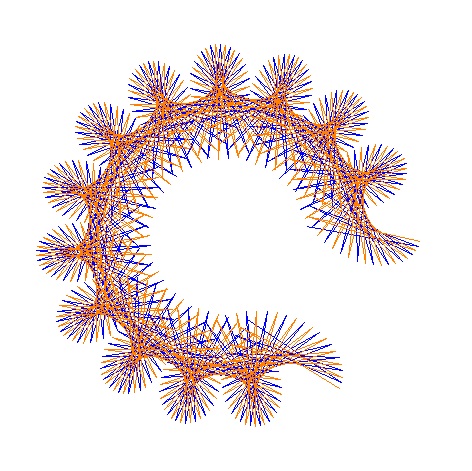
Your turn: Try making this graph below with S=\pm \tfrac{1}{3}, R = 0.00667 and slightly less than a full revolution. Make the image size (under the file tab) 12.3 x 12.3 (the units are cm.), or 465 x 465 pixels (type @ after the number to use pixels). Amazing!
R6-3a


Every slight change makes a whole new design. Start with your own values. I would like to see what you and your students come up with. When you get the perfect one, e-mail it to me as a .jpg file and I will post it. (Please include the SR, and other data.

Implicit Differentiation of Parametric Equations

I’ve never liked memorizing formulas. I would rather know where they came from or be able to tie it to something I already know. One of my least favorite formulas to remember and explain was the formula for the second derivative of a curve given in parametric form. No longer.

If y=y\left( t \right) and, x=x\left( t \right) then the tradition formula gives

\displaystyle \frac{d}{dx}y\left( t \right)=\frac{dy/dt}{dx/dt}, and

\displaystyle \frac{{{d}^{2}}y}{d{{x}^{2}}}=\frac{\frac{d}{dt}\left( \frac{dy}{dx} \right)}{\frac{dx}{dt}}

It is that last part, where you divide by \displaystyle \frac{dx}{dt}, that bothers me. Where did the \displaystyle \frac{dx}{dt} come from?

Then it occurred to me that dividing by \displaystyle \frac{dx}{dt} is the same as multiplying by \displaystyle \frac{dt}{dx}

It’s just implicit differentiation!

Since \displaystyle \frac{dy}{dx} is a function of t you must begin by differentiating the first derivative with respect to t. Then treating this as a typical Chain Rule situation and multiplying by \displaystyle \frac{dt}{dx} gives the second derivative. (There is a technical requirement here that given x=x\left( t \right), then t={{x}^{-1}}\left( x \right) exists.)

In fact, if you look at a proof of the formula for the first derivative, that’s what happens there as well:

\displaystyle \frac{d}{dx}y\left( t \right)=\frac{dy}{dt}\cdot \frac{dt}{dx}=\frac{dy/dt}{dx/dt}

The reason you to do it this way is that since x is given as a function of t, it may be difficult to solve for t so you can find dt/dx in terms of x. But you don’t have to; just divide by dx/dt which you already know.

Here is an example for both derivatives.

Suppose that x={{t}^{3}}-3 and y=\ln \left( t \right)

Then \displaystyle \frac{dy}{dt}=\frac{1}{t}, and \displaystyle \frac{dx}{dt}=3{{t}^{2}} and \displaystyle \frac{dt}{dx}=\frac{1}{3{{t}^{2}}}.

Then \displaystyle \frac{dy}{dx}=\frac{1}{t}\cdot \frac{dt}{dx}=\frac{1}{t}\cdot \frac{1}{3{{t}^{2}}}=\frac{1}{3{{t}^{3}}}=\frac{1}{3}{{t}^{-3}}

And \displaystyle \frac{{{d}^{2}}y}{d{{x}^{2}}}=\left( \frac{d}{dt}\left( \frac{dy}{dx} \right) \right)\cdot \frac{dt}{dx}=\left( -{{t}^{-4}} \right)\cdot \frac{dt}{dx}=\left( -{{t}^{-4}} \right)\left( \frac{1}{3{{t}^{2}}} \right)=-\frac{1}{3{{t}^{6}}}

Yes, it’s the same thing as using the traditional formula, but now I’ll never have to worry about forgetting the formula or being unsure how to explain why you do it this way.

Revised: Correction to last equation 5/18/2014

Revised:  2/8/2016
