Implicit Differentiation

I discovered in doing next week’s post that I apparently never wrote about implicit differentiation. So here goes – an extra post this week!

Implicit Differentiation

The technique of implicit differentiation allows you to find slopes of relations given by equations that are not written as functions or may even be impossible to write as functions.

Example 1: A good way to start investigating this idea is to give your class the equation of a circle, say {{x}^{2}}+{{y}^{2}}=25 and ask them to find the slope of the tangent line (the derivative) where x = 3. No hints, just let them try.

Most students will hit upon solving for y and then differentiating:

y=\pm \sqrt{{25-{{x}^{2}}}}

\displaystyle \frac{{dy}}{{dx}}=\frac{{-2x}}{{\pm 2\sqrt{{25-{{x}^{2}}}}}}=\frac{{-x}}{{\pm \sqrt{{25-{{x}^{2}}}}}}

There are two points where x = 3: (3, 4) and (3, –4) at the first point the slope is – ¾ and at the second ¾.

Then show them another way – implicit differentiation.

To use this technique, assume that y is a function of x, but do not bother to find that function. Then using the chain rule on any terms containing a y. For{{x}^{2}}+{{y}^{2}}=25 , we have

\displaystyle 2x+2y\frac{{dy}}{{dx}}=0

Then solve for the derivative

\displaystyle \frac{{dy}}{{dx}}=-\frac{x}{y}

We see that this is the same as we found the first time, since y=\pm \sqrt{{25-{{x}^{2}}}}! There is a slight advantage here: we can now find the slopes from the coordinates without solving or dealing with the plus/minus sign. *

Example 2: Now let’s consider a more difficult example. Find the derivative of {{x}^{2}}+4{{y}^{2}}=7+3xy. To solve for y here is possible but somewhat difficult (Hint: use the quadratic formula). We can continue writing {y}' for dy/dx.

2x+8y{y}'=0+3x{y}'+3y

Note that the last term on the right is differentiated using the product rule.  Since this happens fairly often, students need to be reminded of it.

Now solving for {y}'gives

\displaystyle {y}'=\frac{{3y-2x}}{{8y-3x}}

Then we can find the derivatives at specific points by substituting the coordinates of the point. At the point (3,2) on the curve, the slope is \displaystyle {y}'=\frac{{3\left( 2 \right)-2\left( 3 \right)}}{{8\left( 2 \right)-3\left( 3 \right)}}=\frac{0}{7}=0

Note: the derivative of an implicit relation usually involves both the x and y coordinates.

Second Derivatives

This idea can be repeated to find second and higher derivatives.

Example 1 continued: In the first example with \displaystyle \frac{{dy}}{{dx}}=\frac{{-x}}{y}  we differentiate using the quotient rule:

\displaystyle  {{y}'}'=\frac{{y(-1)-(-x){y}'}}{{{{y}^{2}}}}

The second derivative is a function, not just of x and y, but also of {y}'. We can replace it with the first derivative and simplify.

\displaystyle  {{y}'}'=\frac{{-y+x\left( {\frac{{-x}}{y}} \right)}}{{{{y}^{2}}}}=\frac{{-{{y}^{2}}-{{x}^{2}}}}{{{{y}^{3}}}}=-\frac{{25}}{{{{y}^{3}}}}

(This might be a good time to do a quick review of simplifying complex fractions; they occur often in implicit differentiation problems.)

To find the value of the second derivative at a given point we can substitute into either of the two expressions above. At (3, –4) where the derivative has been previously found to be ¾ we have \displaystyle  {{y}'}'=\frac{{y(-1)-(-x){y}'}}{{{{y}^{2}}}}=\frac{{\left( {-4} \right)\left( {-1} \right)-\left( {-3} \right)\left( {\frac{3}{{-4}}} \right)}}{{{{{\left( {-4} \right)}}^{2}}}}=-\frac{{-16-9}}{{-48}}=\frac{{25}}{{48}}

Or we can use the second form

\displaystyle {{y}'}'=-\frac{{25}}{{{{y}^{3}}}}=-\frac{{25}}{{{{{\left( {-4} \right)}}^{3}}}}=\frac{{25}}{{48}}

Example 2 continued: The second example was taken from an AB Calculus exam (2004 AB 4). The first part gave the first derivative and asked students to show that it was correct. This was done (instead of just asking the students to find the first derivative) so that students would be sure to have the correct derivative to use later in the question.

The second part asked students to show that the tangent line is horizontal at the point where x = 3. This included finding the coordinates of the point, (3, 2) and showing that it is on the curve.

The third part of the question asked students to determine whether the point from part (b) was a relative maximum, a relative minimum or neither, and to justify their answer. Since there is no way to determine how the sign of the first derivative changes at the point the First Derivative Test cannot be used. Likewise, the Candidates’ Test (a/k/a the closed interval test) cannot be used without solving for y, and determining the domain of each part. That leaves the Second Derivative Test as the easiest choice.

\displaystyle {y}'=\frac{{3y-2x}}{{8y-3x}}  at (3,2) \displaystyle {y}'=\frac{{3\left( 2 \right)-2\left( 3 \right)}}{{8\left( 2 \right)-3\left( 3 \right)}}=0

\displaystyle {{y}'}'=\frac{{\left( {8y-3x} \right)\left( {3{y}'-2} \right)-\left( {3y-2x} \right)\left( {8{y}'-3} \right)}}{{{{{\left( {8y-3x} \right)}}^{2}}}}

Substituting the values into this without doing the algebra to remove the first derivative gives

\displaystyle \begin{array}{l}{{y}'}'=\frac{{\left( {8\left( 2 \right)-3\left( 3 \right)} \right)\left( {0-2} \right)-\left( {3\left( 2 \right)-2\left( 3 \right)} \right)\left( {8\left( 0 \right)-3} \right)}}{{{{{\left( {8\left( 2 \right)-3\left( 3 \right)} \right)}}^{2}}}}=\frac{{\left( {16-9} \right)\left( {-2} \right)-0}}{{{{{\left( {16-9} \right)}}^{2}}}}=-\frac{2}{7}\\\end{array}

So, the point (3, 2) is a relative maximum.

The graph of the relation, an ellipse is shown below.


* Incidentally, there is another clever way of doing example 1: The radius to any point on a circle centered at the origin has a slope of y/x.  Since tangents to circles are perpendicular to the radii drawn to the point of tangency, the slope of the tangent must be –x/y.


Other Topics (Type 7)

Any topic in the Course and Exam Description may be the subject of a free-response question. The two topics listed here have been the subject of full free-response questions or major parts of them.

Implicitly defined relations and implicit differentiation

These questions may ask students to find the first or second derivative of an implicitly defined relation. Often the derivative is given and students are required to show that it is correct. (This is because without the correct derivative the rest of the question cannot be done.) The follow-up is to answer questions about the function such as finding an extreme value, second derivative test, or find where the tangent is horizontal or vertical.

What students should know how to do

  • Know how to find the first derivative of an implicit relation using the product rule, quotient rule, the chain rule, etc.
  • Know how to find the second derivative, including substituting for the first derivative.
  • Know how to evaluate the first and second derivative by substituting both coordinates of a given point. (Note: If all that is needed is the numerical value of the derivative then the substitution is often easier if done before solving for dy/dx or d2y/dx2 and as usual the arithmetic need not be done.)
  • Analyze the derivative to determine where the relation has horizontal and/or vertical tangents.
  • Write and work with lines tangent to the relation.
  • Find extreme values. It may also be necessary to show that the point where the derivative is zero is actually on the graph and to justify the answer.

Simpler questions about implicit differentiation my appear on the multiple-choice sections of the exam.

Related Rates

Derivatives are rates and when more than one variable is changing over time the relationships among the rates can be found by differentiating with respect to time. The time variable may not appear in the equations. These questions appear occasionally on the free-response sections; if not there, then a simpler version may appear in the multiple-choice sections. In the free-response sections they may be an entire problem, but more often appear as one or two parts of a longer question.

What students should know how to do

  • Set up and solve related rate problems.
  • Be familiar with the standard type of related rate situations, but also be able to adapt to different contexts.
  • Know how to differentiate with respect to time, that is find dy/dt even if there is no time variable in the given equations. using any of the differentiation techniques.
  • Interpret the answer in the context of the problem.
  • Unit analysis.

Shorter questions on both these concepts appear in the multiple-choice sections. As always, look over as many questions of this kind from past exams as you can find.

For some previous posts on related rate see October 8, and 10, 2012 and for implicit relations see November 14, 2012


Next Posts:

Friday March 31: For BC Polar Equations (Type 9)

Tuesday April 4: For BC Sequences and Series.

Friday April 7, 2017 The Domain of the solution of a differential equation.

Determining the Indeterminate 2

The other day someone asked me a question about the implicit relation {{x}^{3}}-{{y}^{2}}+{{x}^{2}}=0. They had been asked to find where the tangent line to this relation is vertical. They began by finding the derivative using implicit differentiation:

3{{x}^{2}}-2y\frac{dy}{dx}+2x=0

\displaystyle \frac{dy}{dx}=\frac{3{{x}^{2}}+2x}{2y}

The derivative will be undefined when its denominator is zero. Substituting y = 0 this into the original equation gives {{x}^{3}}-0+{{x}^{2}}=0. This is true when x = –1 or when x = 0. They reasoned that there will be a vertical tangent when x = –1 (correct) and when x = 0 (not so much). They quite wisely looked at the graph.

relation 1

{{x}^{3}}-{{y}^{2}}+{{x}^{2}}=0

The graph appears to run from the first quadrant, through the origin into the third quadrant, up to the second quadrant with a vertical tangent at x = –1, and then through the origin again and down into the fourth quadrant. It looks like a string looped over itself.

What’s going on at the origin? Where is the vertical tangent at the origin?

The short answer is that vertical tangents occur when the denominator of the derivative is zero and the numerator is not zero.  When x = 0 and y = 0 the derivative is an indeterminate form 0/0.

In this kind of situation an indeterminate form does not mean that the expression is infinite, rather it means that some other way must be used to find its value. L’Hôpital’s Rule comes to mind, but the expression you get results in another 0/0 form and is no help (try it!).

My thought was to solve for y and see if that helps:

y=\pm \sqrt{{{x}^{3}}+{{x}^{2}}}

The graph consists of two parts symmetric to the x-axis, in the same way a circle consists of two symmetric parts above and below the x-axis. The figure below shows the top half.

y=+\sqrt{{{x}^{3}}+{{x}^{2}}}

So, the graph does not run from the first quadrant to the third; rather, at the origin it “bounces” up into the second quadrant. The lower half is congruent and is the reflection of this graph in the x-axis.

So, what happens at the origin and why?

The derivative of the top half is \displaystyle \frac{dy}{dx}=\frac{3{{x}^{2}}+2x}{2\sqrt{{{x}^{3}}+{{x}^{2}}}}. Notice that this is the same as the implicit derivative above. Now a little simplifying; okay a lot of simplifying – who says simplifying isn’t that big a deal?

\displaystyle \frac{dy}{dx}=\frac{x\left( 3x+2 \right)}{2\sqrt{{{x}^{2}}\left( x+1 \right)}}=\frac{x\left( 3x+2 \right)}{2\left| x \right|\sqrt{x+1}}=\left\{ \begin{matrix} \frac{3x+2}{2\sqrt{x+1}} & x>0 \\ -\frac{3x+2}{2\sqrt{x+1}} & x<0 \\ \end{matrix} \right.

Now we see what’s happening. As x approaches zero from the right, the derivative approaches +1, and as x approaches zero from the left, the derivative approaches –1.  This agrees with the graph. Since the derivative approaches different values from each side, the derivative does not exist at the origin – this is not the same as being infinite.  (For the lower half, the signs of the derivative are reversed, due to the opposite sign of the denominator.)

The tangent lines at the origin are x = 1 on the right, and x = –1 on the left, hardly vertical.

What have we learned?

  1. Indeterminate forms do not necessarily indicate an infinite value. An indeterminate form must be investigated further to see what you can learn about a function, relation, or graph.
  2. Sometimes simplifying, or at least changing the form of an expression, is helpful and therefore necessary.

Extension: Using a graphing utility that allows sliders (Winplot, GeoGebra, Desmos, etc)  enter A{{x}^{3}}-B{{y}^{2}}+C{{x}^{2}}=0 and explore the effects of the parameters on the graph.

_________________________

The Man Who Tried to Redeem the World with Logic

WALTER PITTS (1923-1969): Walter Pitts’ life passed from homeless runaway, to MIT neuroscience pioneer, to withdrawn alcoholic. (Estate of Francis Bello / Science Source)

WALTER PITTS (1923-1969): Walter Pitts’ life passed from homeless runaway, to MIT neuroscience pioneer, to withdrawn alcoholic. (Estate of Francis Bello / Science Source)

I ran across this article that you might find interesting. It is about Walter Pitts one of the twentieth century’s most important mathematicians we, or at least I, have never heard of.  It is from the February 5, 2015 of the science magazine Nautilus


Good Question 2: 2002 BC 5

This is the second in my occasional series on good questions, good from the point of view of teaching about the concepts involved. This one is about differential equations and slope fields. The question is from the 2002 BC calculus exam. Question 5. while a BC question, all but part b are suitable for AB classes.

2002 BC 5

The stem presented the differential equation \displaystyle \frac{dy}{dx}=2y-4x. Now the only kind of differential equation that AP calculus students are expected to be able to solve are those that can be separated. This one cannot be separated, so some other things must be happening.
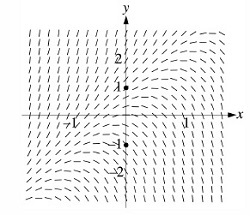
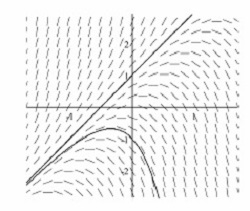

Part a concerns slope fields. Often on the slope field questions students are asked to draw a slope field of a dozen or so points. While drawing a slope field by hand is an excellent way to help students learn what a slope fields is, in “real life” slope fields are rarely drawn by hand. The real use of slope fields is to investigate the properties of a differential equation that perhaps you cannot solve. It allows you to see something about the solutions. And that is what happens in this question.

In the first part of the question students were asked to sketch the solutions that contained the points (0, 1) and (0, –1). These points were marked on the graph. The solutions are easy enough to draw.

But the question did not stop there, as we shall see, using the slope field could help in other parts of the question.

Part c: Taking these out of order, we will return to part b in a moment. Part c told students that there was a number b for which y = 2x + b is a solution to the differential equation. Students were required to find the value of b and (of course) justify their answer.

There are two approaches. Since y = 2x + b is a solution, we can substitute it into the differential equation and solve for b. Since for this solution dy/dx = 2 we have

2=2\left( 2x+b \right)-4x

2=4x+2b-4x

1=b

So b = 1 and the solution serves as the justification.

The other method, I’m happy to report, had some students using the slope field. They noticed that the solution through the point (0, 1) is, or certainly appears to be, the line y = 2x + 1. So students guessed that b  = 1 and then checked their guess by substituting y = 2x + 1 into the differential equation:

2=2\left( 2x+1 \right)-4x

2=4x+2=4x

2=2

The solution checks and the check serves as the justification.

I like the second solution much better, because it uses the slope field as slope field are intended to be used.

Incidentally, this part was included because readers noticed in previous years that many students did not understand that the solution to a differential equation could be substituted into the differential equation to obtain a true equation as was necessary using either method for part b.

There is yet another approach. Since the solution is given as linear the second derivative must by 0. So

\displaystyle \frac{{{d}^{2}}y}{d{{x}^{2}}}=2\frac{dy}{dx}-4=2\left( 2y-4x \right)-4

2\left( 2y-4x \right)-4=0

4y-8x-4=0

4y=8x+4

y=2x+1

And again b = 1

Returning to part b.

Part b asked students to do an Euler’s method approximation of f(0.2) with two equal steps  of the solution of the differential equation through (0, 1). The computation looks like this:

f\left( 0.1 \right)\approx 1+\left( 2\left( 1 \right)-4\left( 0 \right) \right)\left( 0.1 \right)=1.2

f\left( 0.2 \right)\approx 1.2+\left( 2\left( 1.2 \right)-4\left( 0.1 \right) \right)\left( 0.1 \right)=1.4

So far so good. But this is is about the solution through the point (0, 1). Again referring to the slope field, there is no reason to approximate (except that students were specifically told to do so). Substituting into y = 2x + 1, f(0.2) = 1.4 exactly!

Part d: In the last part of the question students were asked to consider a solution of the differential,  g, that satisfied the initial condition g(0) = 0, a solution containing the origin. Students were asked to determine if g(x) had a local extreme at the origin and, if so, to tell what kind (maximum or minimum), and to justify their answer.

Looking again at the slope field it certainly appears that there is a maximum at the origin, and since substituting (0, 0) into the differential equation gives dy/dx = 2(0) – 4(0) = 0, it appears there could be an extreme there. So now how do we determine and justify if this is a maximum or minimum? We cannot use the Candidates’ Test (Closed Interval Test) since we do not have a closed interval, nor can we easily determine if there are any other points nearby where the derivative is zero (there are). Therefore, the First Derivative Test does not help. That leaves the Second Derivative Test.

To use the Second Derivative Test we must use implicit differentiation. (Notice that two unexpected topics now appear extending the scope of the question in a new direction).

\displaystyle \frac{{{d}^{2}}y}{d{{x}^{2}}}=2\frac{dy}{dx}-4

At the origin dy/dx = 0 as we already determined, so

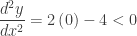
\displaystyle \frac{{{d}^{2}}y}{d{{x}^{2}}}=2\left( 0 \right)-4<0

Therefore, since at x = 0, the first derivative is zero and the second derivative is negative the function g(x) has a maximum value at (0, 0) by the Second Derivative Test .

More: Can we solve the differential equation? Yes. The solution has two parts. First we solve the homogeneous differential equation \frac{dy}{dx}=2y, ignoring the –4x for the moment. This is easily solved by separating the variables y=C{{e}^{2x}}, which can be checked by substituting.

Because the differential equation contains x and y and ask ourselves what kind of function might produce a derivative of 2y – 4x? Then we assume there is a solution of the form y = Ax + B where A and B are to be determined and proceed as follows.

\displaystyle \frac{dy}{dx}=2y-4x

A=2\left( Ax+B \right)-4x=\left( 2A-4 \right)x+2B

Equating the coefficients of the like terms we get the system of equations:

A=2B

0=2A-4

A=2\text{ and }B=1

Putting the two parts together the solution is y=C{{e}^{2x}}+2x+1. This may be checked by substituting. Notice that when C = 0 the particular solution is y = 2x + 1, the line through the point (0, 1).


(Extra: It is not unreasonable to think that instead of y = Ax + B we should assume that the solution might be of the form y = Ax2 + Bx + C. Substitute this into the differential equation and show why this is not the case; i.e. show that A = 0, B = 2 and C = 1 giving the same solution as just found.)

Using a graphing program like Winplot, we can consider all the solutions. Below the slope field is graphed using a slider for C to animate the different solutions. The video below shows this with the animation pausing briefly at the two solutions from part a. Notice the maximum point as the graphs pass through the origin.

Slope field

But wait! There’s more!

The next post will take this question further – Look for it soon.

Update June 27, 2015. Third solution to part c added.

A Vector’s Derivatives

A question on the AP Calculus Community bulletin board this past Sunday inspired me to write this brief outline of what the derivatives of parametric equations mean and where they come from.

The Position Equation or Position Vector

A parametric equation gives the coordinates of points (x, y) in the plane as functions of a third variable, usually t for time. The resulting graph can be thought of as the locus of a point moving in the plane as a function of time. This is no different than giving the same two functions as a position vector, and both approaches are used. (A position vector has its “tail” at the origin and its “tip” tracing the path as it moves.)

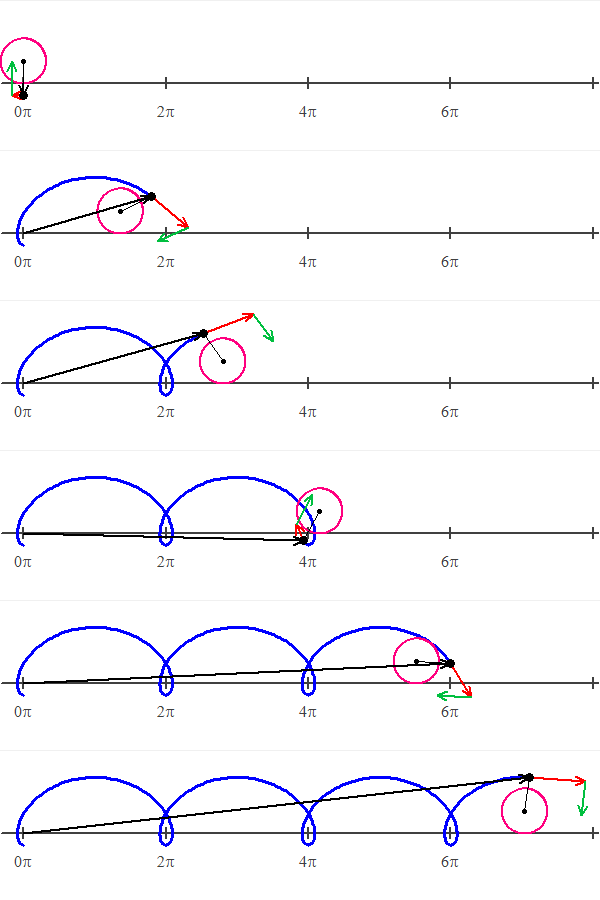
For example, the position of a point on the flange of a railroad wheel rolling on a horizontal track (called a prolate cycloid) is given by the parametric equations

x\left( t \right)=t-1.5\sin \left( t \right)

y\left( t \right)=1-1.5\cos \left( t \right).

Or by the position vector with the same components \left\langle t-1.5\sin \left( t \right),1-1.5\cos \left( t \right) \right\rangle .

Derivatives and the Velocity Vector

The instantaneous rate of change in the y-direction is given by dy/dt, and dx/dt gives the instantaneous rate of change in the x-direction. These are the two components of the velocity vector \displaystyle \vec{v}\left( t \right)=\left\langle \frac{dx}{dt},\frac{dy}{dt} \right\rangle .

In the example, \displaystyle \vec{v}\left( t \right) =\left\langle 1-1.5\cos \left( t \right),1.5\sin \left( t \right) \right\rangle . This is a vector pointing in the direction of motion and whose length, \displaystyle \sqrt{{{\left( \frac{dx}{dt} \right)}^{2}}+{{\left( \frac{dy}{dt} \right)}^{2}}}, is the speed of the moving object.

In the video below the black vector is the position vector and the red vector is the velocity vector. I’ve attached the velocity vector to the tip of the position vector. Notice how the velocitiy’s length as well as its direction changes. The velocity vector pulls the object in the direction it points and there is always tangent to the path.  This can be seen when the video pauses at the end and in the two figures at the end of this post.

Blog Cycloid 1

The slope of the tangent vector is the usual derivative dy/dx. It is found by differentiating dy/dt implicitly with respect to x. Therefore, \displaystyle \frac{dy}{dx}=\frac{dy}{dt}\cdot \frac{dt}{dx}.

There is no need to solve for t in terms of x since dt/dx is the reciprocal of dx/dt, instead of multiplying by dt/dx we can divide by dx/dt: \displaystyle \frac{dy}{dx}=\frac{dy/dt}{dx/dt}.

In the example, \displaystyle \frac{dy}{dx}=\left( 1.5\sin \left( t \right) \right)\frac{dt}{dx}=\left( 1.5\sin \left( t \right) \right)\left( \frac{1}{1-1.5\cos \left( t \right)} \right)=\frac{1.5\sin \left( t \right)}{1-1.5\cos \left( t \right)}

Second Derivatives and the Acceleration Vector

The components of the acceleration vector are just the derivatives of the components of the velocity vector

In the example, \displaystyle \vec{a}\left( t \right)=\left\langle 1.5\sin \left( t \right),1.5\cos \left( t \right) \right\rangle

The usual second derivative \displaystyle \frac{{{d}^{2}}y}{d{{x}^{2}}} is found by differentiating dy/dx, which is a function of t, implicitly with respect to x:


\displaystyle \frac{{{d}^{2}}y}{d{{x}^{2}}}=\left( \frac{d}{dt}\left( \frac{dy}{dx} \right) \right)\left( \frac{dt}{dx} \right)=\frac{\frac{d}{dt}\left( dy/dx \right)}{dx/dt}

In the example,

\displaystyle \frac{{{d}^{2}}y}{d{{x}^{2}}}=\left( \frac{d}{dt}\left( \frac{1.5\sin \left( t \right)}{1-1.5\cos \left( t \right)} \right) \right)\left( \frac{1}{1-1.5\cos \left( t \right)} \right)

\displaystyle =\frac{\left( 1-1.5\cos \left( t \right) \right)\left( 1.5\cos \left( t \right) \right)-\left( 1.5\sin \left( t \right) \right)\left( 1.5\sin \left( t \right) \right)}{{{\left( 1-1.5\cos \left( t \right) \right)}^{2}}}\cdot \frac{1}{\left( 1-1.5\cos \left( t \right) \right)}

\displaystyle =\frac{1.5\cos \left( t \right)-{{1.5}^{2}}}{{{\left( 1-1.5\cos \left( t \right) \right)}^{3}}}

The acceleration vector is the instantaneous rate of change of the velocity vector. You may think of it as pulling the velocity vector in the same way as the velocity vector pulls the moving point (the tip of the position vector). The video below shows the same situation as the first with the acceleration vectors in green attached to the tip of the velocity vector.

Blog Cycloid 2Here are two still figures so you can see the relationships. On the left is the starting position t = 0 with the y-axis removed for clarity. At this point the red velocity vector is \left\langle -0.5,0 \right\rangle indicating that the object will start by moving directly left. The green acceleration vector is \left\langle 0,1.5 \right\rangle pulling the velocity and therefore the object directly up. The second figure shows the vectors later in the first revolution. Note that the velocity vector is in the direction of motion and tangent to the path shown in blue.

Implicit Differentiation of Parametric Equations

I’ve never liked memorizing formulas. I would rather know where they came from or be able to tie it to something I already know. One of my least favorite formulas to remember and explain was the formula for the second derivative of a curve given in parametric form. No longer.

If y=y\left( t \right) and, x=x\left( t \right) then the tradition formula gives

\displaystyle \frac{d}{dx}y\left( t \right)=\frac{dy/dt}{dx/dt}, and

\displaystyle \frac{{{d}^{2}}y}{d{{x}^{2}}}=\frac{\frac{d}{dt}\left( \frac{dy}{dx} \right)}{\frac{dx}{dt}}

It is that last part, where you divide by \displaystyle \frac{dx}{dt}, that bothers me. Where did the \displaystyle \frac{dx}{dt} come from?

Then it occurred to me that dividing by \displaystyle \frac{dx}{dt} is the same as multiplying by \displaystyle \frac{dt}{dx}

It’s just implicit differentiation!

Since \displaystyle \frac{dy}{dx} is a function of t you must begin by differentiating the first derivative with respect to t. Then treating this as a typical Chain Rule situation and multiplying by \displaystyle \frac{dt}{dx} gives the second derivative. (There is a technical requirement here that given x=x\left( t \right), then t={{x}^{-1}}\left( x \right) exists.)

In fact, if you look at a proof of the formula for the first derivative, that’s what happens there as well:

\displaystyle \frac{d}{dx}y\left( t \right)=\frac{dy}{dt}\cdot \frac{dt}{dx}=\frac{dy/dt}{dx/dt}

The reason you to do it this way is that since x is given as a function of t, it may be difficult to solve for t so you can find dt/dx in terms of x. But you don’t have to; just divide by dx/dt which you already know.

Here is an example for both derivatives.

Suppose that x={{t}^{3}}-3 and y=\ln \left( t \right)

Then \displaystyle \frac{dy}{dt}=\frac{1}{t}, and \displaystyle \frac{dx}{dt}=3{{t}^{2}} and \displaystyle \frac{dt}{dx}=\frac{1}{3{{t}^{2}}}.

Then \displaystyle \frac{dy}{dx}=\frac{1}{t}\cdot \frac{dt}{dx}=\frac{1}{t}\cdot \frac{1}{3{{t}^{2}}}=\frac{1}{3{{t}^{3}}}=\frac{1}{3}{{t}^{-3}}

And \displaystyle \frac{{{d}^{2}}y}{d{{x}^{2}}}=\left( \frac{d}{dt}\left( \frac{dy}{dx} \right) \right)\cdot \frac{dt}{dx}=\left( -{{t}^{-4}} \right)\cdot \frac{dt}{dx}=\left( -{{t}^{-4}} \right)\left( \frac{1}{3{{t}^{2}}} \right)=-\frac{1}{3{{t}^{6}}}

Yes, it’s the same thing as using the traditional formula, but now I’ll never have to worry about forgetting the formula or being unsure how to explain why you do it this way.

Revised: Correction to last equation 5/18/2014

Revised:  2/8/2016

Implicit Relations & Related Rates

AP Type Questions 7

Implicitly defined relations and implicit differentiation

These questions may ask students to find the first or second derivative of an implicitly defined relation. Often the derivative is given and students are required to show that it is correct. (This is because without the correct derivative the rest of the question cannot be done.) The follow-up is to answer questions about the function such as finding an extreme value, second derivative test, or find where the tangent is horizontal or vertical.

What students should know how to do

  • Know how to find the first derivative of an implicit relation using the product rule, quotient rule, the chain rule, etc.
  • Know how to find the second derivative, including substituting for the first derivative.
  • Know how to evaluate the first and second derivative by substituting both coordinates of the point. (Note: If all that is needed is the numerical value of the derivative then the substitution is often easier if done before solving for dy/dx or d2y/dx2.)
  • Analyze the derivative to determine where the relation has horizontal and/or vertical tangents.
  • Write and work with lines tangent to the relation.
  • Find extreme values. It may also be necessary to show that the point where the derivative is zero is actually on the graph.

Related Rates

Derivatives are rates and when more than one variable is changing over time the relationships among the rates can be found by differentiating with respect to time. The time variable may not appear in the equations. These questions appear occasionally on the free-response sections; if not there, then a simpler version may appear in the multiple-choice sections. In the free-response sections they may be an entire problem, but more often appear as one or two parts of a longer question.

What students should know how to do

  • Set up and solve related rate problems.
  • Be familiar with the standard type of related rate situations, but also be able to adapt to different contexts.
  • Know how to differentiate with respect to time, using any of the differentiation techniques.
  • Interpret the answer in the context of the problem.
  • Unit analysis.

Shorter questions on both these concepts appear in the multiple-choice sections. As always, look over as many questions of this kind from past exams as you can find.

For some previous posts on related rate see October 8, and 10, 2012 and for implicit relation s see November 14, 2012