Continuity

Limits logically come before continuity since the definition of continuity requires using limits. But practically and historically, continuity comes first. The concept of a limit is used to explain the various kinds of discontinuities and asymptotes. Start by studying discontinuities.

Types of discontinuities to consider: removable (a gap or hole in the graph), jump, infinite (vertical asymptotes), oscillating, and end behavior (horizontal asymptotes).

Numerically: Make a table for the value of \displaystyle \frac{1}{x-3} near x = 3 and as \displaystyle x\to \pm \infty . Relate the values and their signs to the graph. (Divide by a small number get a big number; divide by a big number, get a small number.)

Use the vocabulary of limits to explain the features of graphs. Example: The function \displaystyle \frac{{{x}^{2}}-4}{x-2} has no value at x = 2 (f(2) does not exist), but as you get closer to x = 2 the function value gets closer to 4 (\displaystyle \underset{x\to 2}{\mathop{\lim }}\,f\left( x \right)=4).

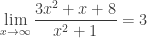
Relate the limit, value and graph of the function. In the example above, the graph looks like the line y=x+2 with a gap or hole at the point (2, 4). Another example: \displaystyle \underset{x\to \infty }{\mathop{\lim }}\,\frac{3{{x}^{2}}+x+8}{{{x}^{2}}+1}=3 since, the graph gets closer to y = 3 as you go farther to the right. The line y = 3 is a horizontal asymptote.

Do this numerically as well:  \displaystyle \frac{3{{x}^{2}}+x+8}{{{x}^{2}}+1}=3+\frac{x+5}{{{x}^{2}}+1} and since the fraction gets smaller as |x| gets larger, the function approaches 3 from above when x > 0 and from below when x < 0 (why?)

Extra for your experts: Discuss the reason for the jump discontinuity of

\displaystyle f\left( x \right)=\frac{\cos \left( x \right)\sqrt{{{x}^{2}}-2x+1}}{x-1}

Why Limits?

There are four important things before calculus and in beginning calculus for which we need the concept of limit.

    1. The first is continuity. Most of the time in pre-calculus mathematics and in the calculus we deal with nice continuous functions or functions that are not continuous at just a few points. Limits give us the vocabulary and the mathematics necessary to describe and deal with discontinuities of functions. Historically, the modern (delta-epsilon) definition of limit comes out of Weierstrass’ definition of continuity.
    2. Asymptotes: A vertical asymptote is the graphical feature of function at a point where its limit equals positive or negative infinity. A horizontal asymptote is the (finite) limit of a function as x approaches positive or negative infinity.

Ideally, one would hope that students have seen these phenomena and have used the terms limit and continuity informally before they study calculus. This is where the study of calculus starts. The next two items are studied in calculus and are based heavily on limit.

3. The tangent line problem. The definition of the derivative as the limit of the slope of a secant line to a graph is the first of the two basic ideas of the calculus. This single idea is the basis for all the concepts and applications of differential calculus.

4. The area problem. Using limits it is possible to find the area of a region with a curved side, even if the curve is not something simple like a semi-circle. The definite integral is defined as the limit of a Riemann sum and gives the area regions with a curved side. This then can be extended to huge number of very practical applications many having nothing to do with area.

So these are the main ways that limits are used in beginning calculus. Students need a good visual  understanding, what the graph looks like,  of the first two situations listed above and how limits describe and define them. This is also necessary later when third and fourth come up.