Some Notes

I didn’t come across anything calculusy to write about this week, so here are a few other items you might be interested in.

Two Explorations

Two explorations previously posted on topics that come up this time of year.

Differential Equations.

An exploration in Differential Equations is a summary/review exploration in which students will work with these topics using the tools of algebra, calculus, and technology to fully investigate a function and to find all its foibles.

    • Finding the general solution of the differential equation by separating the variables
    • Checking the solution by substitution
    • Using a graphing utility to explore the solutions for all values of the constant of integration, C
    • Finding the solutions’ horizontal and vertical asymptotes
    • Finding several particular solutions
    • Finding the domains of the particular solutions
    • Finding the extreme value of all solutions in terms of C
    • Finding the second derivative (implicit differentiation)
    • Considering concavity
    • Investigating a special case or two

Sequences

A Lesson on Sequences was originally posted last July. The lesson explores sequences and the Completeness Axiom. Parts of it could work for an Algebra 1 class studying Irrational numbers and all of it could be used as an introductory lesson on sequences in calculus.

If you use either or both of these, I’d like to hear about how they went. Please use to Comment button at the end of any post to share your experiences.


AP Calculus Panel Discussion

The AP Calculus panel discussion at the NCTM Annual Meeting in Chicago will take place on April 2, 2020 from 3:00 to 5:30 pm CST in room #E253d of the McCormick Place – Lakeside Center.

The speakers will include:

Julie Clarke, chief reader.

Stephanie Ogden, director, AP Calculus for the College Board.

Mary Wiltjer, Long time AP Calculus teacher and (fairly) new reader.

Lin McMullin, AP Calculus Community moderator and your host.

The main topic will be the scoring of the 2019 AP Calculus exams. There will be time for your questions for the panel. There will be a raffle. The event is sponsored by Bedford, Freeman and Worth publisher of AP Calculus textbooks, and D & S Marketing Systems, Inc. publishers of review books for AP subjects.

Hope you can make it.


Posts on reviewing for the AP Calculus Exams

I have revised and updated the series of posts on reviewing for the exams that I post each year. This series of 12 posts will appear on Tuesdays and Fridays starting February 25, 2020, ending in the beginning of April. These include the 10 “type” questions that appear on the free-response sections with suggestions on what and how to review them. You’re not behind schedule: most classes begin reviewing in April. These are posted before then, so you’ll have time to use them for planning ahead of time.

Tuesday February 25, 2020 – AP Exam Review
Friday, February 28, 2020 – Resources for reviewing
Tuesday March 3, 2020: Rate and accumulation questions (Type 1)
Friday March 6, 2020: Linear motion problems (Type 2)
Tuesday March 10, 2020: Graph analysis problems (Type 3)
Friday March 13, 2020: Area and volume problems (Type 4)
Tuesday March 17, 2020: Table and Riemann sum questions (Type 5)
Friday March 20, 2020: Differential equation questions (Type 6)
Tuesday March 24, 2020: Other questions (Type 7)
Friday March 27, 2020: Parametric and vector questions (Type 8) BC topic
Tuesday March 31, 2020: Polar equations questions (Type 9) BC Topic
Friday April 3, 2020: Sequences and Series questions (Type 10) BC Topic


Quanta Magazine

Quanta Magazine is an online magazine that has articles on Physics. Mathematics, Biology, and Computer Science. The articles are interesting and timely. There are always a few articles on mathematics and many on the other subjects include mathematics.

They also publish a podcast.  A new puzzle appears bi-monthly.

You may subscribe to a weekly e-mail with links to current articles. (While all I need is another e-mail, getting this one reminds me to read the magazine so I don’t forget this great resource.)

You and your students may find Quanta interesting.


Getting Started

As you get ready to start school, here are some thoughts on the first week in AP Calculus. I looked back recently at some of the “first week of school” advice I offered in the past. Here’s a quick (actually, a bit longer than I planned) summary with some new ideas.

  1. The last time I taught AP Calculus during review time a student asked if there was a list of what’s on the exam. Duh! Why didn’t I think of that? So, I made copies of the list (from the old Acorn Book) and gave it to everyone. I should have done that on Day 1. So, my first suggestion is to make a copy of the “Mathematical Practices” and the “Course at a Glance” from the 2020 AP Calculus Course and Exam Description (p. 14 and p. 20 – 23) and give them to your students. Check off the topics as you do them during the year. A “Course at a Glance” poster comes with the hard copy of the 2019 Course and Exam Description available from the College Board or at APSIs and Workshops. See here. Hang the poster in your classroom. Refer to it often throughout the year.
  1. DON’T REVIEW! Yes, students have forgotten everything they ever learned in mathematics, but if you reteach it now, they will forget it again by the time they need it next week or next January. So, don’t waste the time, rather, plan to review material from kindergarten through pre-calculus when the topics come up during the year. Include short reviews in your lesson plans. For instance, when you study limits, you will need to simplify rational expressions – that’s when you review rational expressions. When you look at the graphs of the trigonometric functions, that’s when to review the graphs of the parent functions, a lot of the terminology related to graphs, discontinuities, asymptotes, and even the values of the trigonometric functions of the special angles. Months from now you’ll be looking at inverse functions, that’s when you review inverses.
  1. In keeping with Unit 1 Topic 1, you may want to start with a brief introduction to calculus. Several years ago, when I first started this blog, Paul A. Foerster, was nice enough to share some preview problems. They give a taste of derivatives and integrals in the first week of school and get the kids into calculus right off the bat. Here is an updated version. Paul, who retired a few years ago after 50 (!) years of teaching, is Teacher Emeritus of Mathematics of Alamo High Heights School in San Antonio, Texas. He is the author of several textbooks including Calculus: Concepts and Applications. More information about the text and accompanying explorations can be found on the first page of the explorations. Thank you, Paul!
  1. If you are not already a member, I suggest you join the AP Calculus Community. We have over 18,000 members all interested in AP Calculus. The community has an active bulletin board where you can ask and answer questions about the courses. Teachers and the College Board also post resources for you to use. College Board official announcements are also posted here. I am the moderator of the community and I hope to see you there!
  1.  Here are some links to places on this blog that you may find helpful:
    1. Pacing– organizing your year.
    2. Check the Resource page from this blog.
    3. Calculator information:
    4. Miscellany: These posts discuss basic ideas that I always hoped students knew about mathematics before starting calculus

NEW AP Calculus CED Is Now Available

The new Course and Exam Description for AP Calculus AB & BC (CED 2019) effective for the  coming school year has been published and is available electronically at the course homepages. The direct link is

https://apcentral.collegeboard.org/pdf/ap-calculus-ab-bc-course-and-exam-description-0.pdf?course=ap-calculus-ab

This document is for both AB and BC courses.

There will be no change in the exam style and format, and no change in what is tested on the exams.

The organization has changed from the 2016 CED. Instead of a list of topics the course is organized into 10 Units with the topics for each unit. It is almost the start of a syllabus for the course. (No one is required to follow the outline. You may do your own thing, so long as you teach the required content.)  The electronic version contains live links to other resources and addition material to help you organize and teach your course.

The CED 2019 is also available free, gratis, for nothing in a binder so you can intersperse your own notes, worksheet, and activities in each unit. AP teachers in the United States who have completed the AP Course Audit can request a free copy of the binder by January 31, 2020. The binders will be mailed beginning in June 2019. Sign up to get yours here.

Looking ahead – August: the AP Classroom.

On August 1, 2019 the new AP Classroom will open online. This includes thousands of actual AP exam questions from past exams, AP files, and 1200 new questions. They are organized by the Units in the CED-2019. Teachers may access them and allow their students to do so by assigning them electronically. Feedback for students will include not just the correct answers but a discussion of the mistakes that may lead to the wrong answers of the multiple-choice questions. For more information and the other features of the AP Classroom use the links above to go to the course homepage and scroll down. You may also like this short video. It has more information about the AP Classroom.

Other AP Courses.

A new CED and the AP Classroom material is available for all AP 35 Courses (except AP Computer Science Principles, AP Seminar, and AP Research). Please be sure teachers of other AP Courses in your school and district are aware of this.


AP Exam Review Posts

Here are the links to the various review posts for this year.


Brushing Up the Blog

Happy Thanksgiving!

I’ve been working this month on making things at the Teaching Calculus blog easier to find. There are about 360 posts and it’s getting difficult for me to find things. Here is the new line up on the black navigation menu at the top of each page. Click each to see more.

HOME

This is the place where the blog post show up in chronological order with the latest on top. Under it are four featured post, which usually are just the four most recent posts. Under that are the remaining posts.

TOPICS a new menu

Under this menu I’ve brought together all the post on each of the main topics in first-year calculus. I hope this helps you find posts more easily. New posts will be added to these lists as they are posted.

OTHER RESOURCES a reorganized menu

Here I’ve listed other posts under these headings:

  • Before you Start contains links to posts about things you may want to consider before the year begins including some Algebra pre-calculus topics.
  • Calculators and Technology has information and ideas about calculators, calculator use on the AP Calculus exams, and other technology.
  • Essays are posts on other topics related to calculus.
  • Good Questions has links to individual questions I’ve found interesting and/or instructive; questions you can adapt and expand.
  • The CED has posts related to the AP Calculus Course and Exam Description for AP Calculus.
  • Presentations contains links to PowerPoint presentations from presentations and talks I have given. You may use them if you like.
  • Resources from Posts has links to things mentioned in posts that you may be looking for.
  • Monthly – this monthly list of topics will remain for a while. Since the Topics menu list all these and more, I will be removing this menu soon.

VIDEOS

This menu links to about 57 videos on calculus topics that I made when I was National Director of Mathematics Programs for the National Math and Science Initiative (NMSI). They were made in 2012, but the math hasn’t changed. There are for students and teachers.

WEBSITE

Here are the remnants of a website I abandoned some time ago. Most of this is out of date, but i didn’t want to totally lose it. don’t be surprised if it disappears some time soon

ABOUT & CONTACT

My contact information is here.


As I continue brush things up I will be reorganizing, rearranging, and renaming, and moving some items elsewhere. If you think something has gone lost, if you find a typo, or an incorrect link, please let me know at this email address

If you have any calculus questions or a suggestion for a post, please contact me at the same email address

Please use the LIKE button at the bottom of each post. (assuming you like it); It helps me know what you like and find helpful.


On Scaling

Why “scaling” is necessary

No teacher can make two tests on the same topics equal in difficulty. No two teachers, even if they collaborate, can make two tests on the same topic equal in difficulty. No two teachers in different schools, districts, or states can make two tests on the same subject equal in difficulty. Even professional testing companies, such as the Educational Testing Service (ETS) that writes the AP exams, cannot write two tests on the same courses of equal difficulty.

Scaling is needed to account for the difference in difficulty. Scaling attempts to make the scores on different forms of a test indicate that a student writing the test has the same amount of knowledge as another student with a similar score.

The ETS does this by pre-testing its items on college students and including several questions from previous years to help judge the difficulty from year to year. They do a great deal of statistics on each item each year. But they do not pretend that this year’s test is the same difficulty as last year’s test. After their computations and consultations with colleges are done, they scale the test. Their goal is to make the score indicate the same amount of knowledge from test to test and year to year.

A teacher cannot do that in his or her class. They don’t have the resources or the time. Yet, there are ways to even out the difficulty of your classroom tests and quizzes. .

Some poor ways to scale

In what follows, P will represent the percentage of the total points available on a test that a student earns, and S will equal the score the student is given for that percentage.

Percentage scaling (S = P): For many years I, and I expect most teachers, simply let S = P. But sometimes the scores were kind of low: the test was too hard, or the students didn’t do well (or maybe the teacher didn’t do well). What to do? Among the usual solutions are (1) give a make-up test, (2) let the students make corrections to earn back some of the points, (3) scale the test by raising all the grades arbitrarily, or (4) make sure the next test is “easy.” I’ve tried all of them.

Doesn’t make too much sense, does it?

Categories: For quite a few years, I listed the percentages from highest to lowest and looked for natural breaks to separate the scores into 90, 80, 70, etc. Intermediate scores were spread between the cut points. If you don’t need a number to put on the report cards, the categories become A, B, C, etc. with perhaps a “+” or a “–“ attached.

Comic Interlude – the “Square Root Scale”

The “square root scale” is S=10\sqrt{P}. So, a 36 is scaled to a 60, an 81 to a 90, and a 70 to an 84. What this accomplishes is to raise everyone score for no reason other than to raise the score. See the graph below. 
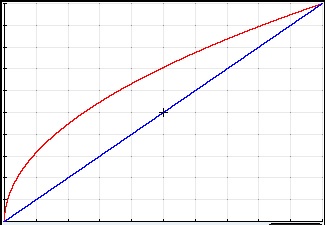
The Square Root Curve,S=10\sqrt{P}., in red and the Percentage Curve, S = P, in blue

Compared to the percentage grade, the low scores get raised more than the higher scores. Everyone wins big time, but what does it tell you? I can see no justification for this, except maybe the “complicated” algebra involved fools the students, administrators, and parents into thinking that something really scientific is going on. It’s not.

(Since this is a calculus blog, there is a calculus exercise in the appendix below that analyzes this scheme.)

A Better Choice for Scaling – the Kennedy Scale

While no method is perfect, this method suggested in Assessing True Academic Success by Dan Kennedy [1] is a reasonable and easy one. The entire article is worth reading every year and discusses a lot about assessment, besides just scaling.

He writes of his method, “Mathematically, the effect of scaling is to adjust the mean, a primary goal, and reduce the standard deviation, a secondary effect that helps me keep the entire class engaged.” “[Teachers] can challenge [their] students to do just about anything, then see how far they can go. …[Students] are freed from the burden of getting a certain percent right, so they can concentrate on doing as much as they can as well as they can.”

I used this method for BC Calculus and 8th grade Algebra 1 in the year I came out of retirement and was happy with the results.

Here’s how the method works. First, determine the class mean you desire. Kennedy suggests a class average of 82 for regular classes, 85 for electives, and 90 for advanced. These are based on his school wide empirical (historical) data. You may use your own data or just what you think is reasonable.

Using two data points (class mean, desired mean) and (highest score, 99). (The 99 could be adjusted as you see fit.} Write the equation of the line through these points (P, S) expressing S as a function of P. Use this function to scale the test.

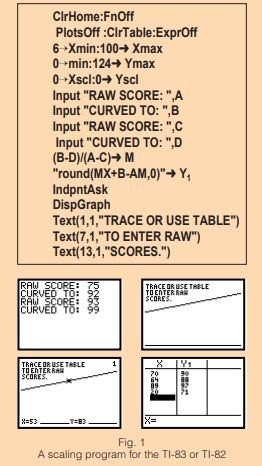
This TI-8x program, from the same article, will easily compute the scores for you. (There is a typo in the fourth line; it should read 0->Ymin:126->Ymax.)


Update Excel Spread Sheet for Kennedy Scale. 

At the suggestion of a reader, here is an Excel spreadsheet for you may download for the Kennedy Curve. Enter the four values at the top left and the scores w ill be calculated.

Updated December 8, 2020


Update Desmos Program for Kennedy Score 

Dan Anderson sent a comment (see below) with a link to a Desmos graph he made that will calculate the Kennedy scale for your tests. You can access the graph here. Once you’ve opened it, save it to your Desmos files.

It works like this: enter the 4 numbers in the left column AverageRawScore, DesiredAverage, MaxRawScore, and DesiredMax as they apply to your test. The scaled scores will appear in the table in the lower left.

To scale your exam, delete everything in the x1 column and enter your scores (in any order, with duplicates). The scaled scores appear in the second column of the table and the pairs are graphed.

The two highlighted points are (AverageRawScore, DesiredAverage) and (MaxRawScore, DesiredMax). These may be dragged to see the effect of changing them.

A final caution: If the AverageRawScore is greater then or equal to the DesiredAverage (or even close), then some scores may be scaled down. You probably want to avoid this (although, it is consistent with the idea).

Updated October 13, 2018

Update October 19, 2020


Remember, by scaling, you are not giving away free points; you are trying to account for the difference in difficulty from one test to the next.


Scaling Different Versions of the Same Test How to adapt the Kennedy method when using different versions of the same test in your class.

Update August 24, 2021

Appendix: An analysis of the Square Root Curve – A Calculus Exercise 

For the function S=10\sqrt{P}.

  1. Determine the percentage score(s), P, which receives the least points using this method. Justify your answer.
  2. Determine the percentage score(s), P, which receives the most points using this method. Justify your answer.
  3. At the value found in 2, what is the slope of the line tangent to the graph of S=10\sqrt{P}?
  4. Compare your answer for 3 to the slope of S = P. Why must this be so? Is it related to the MVT?

Solution

  1. Since the Square Root curve lies above the percentage curve all the values receive some increase except the end points (P = 0 and P = 100) which receive no increase.
  2. Let I = the increase in  the score, then 

I=10\sqrt{P}-P

\displaystyle \frac{{dI}}{{dP}}=\frac{{10}}{{2\sqrt{P}}}-1

\displaystyle \frac{{10}}{{2\sqrt{P}}}-1=0,\text{ when }P=25

This is the maximum since it is the only place where P’ changes from positive to negative. At P = 25 the score is raised by 25 points to a 50.

3. \displaystyle \frac{{dS}}{{dP}}=\frac{{10}}{{2\sqrt{P}}}. At P = 25, dS/dP = 1. The slope of the tangent line is 1.

4. At P = 25 the slope of the tangent line to the square root scale is 1: the tangent is parallel to the percentage graph. The square root scale to the left of P =25 is raising faster then S = P therefore its slope is greater. After P = 25 the slope of the square root scale decreases and drops faster than the slope of S = P. P = 25 is the place where the slope changes from steeper to less steep and thus where the slopes are equal. This is the farthest point vertically above the percentage graph. This is also the point guaranteed by the MVT on the interval [0, 100].


[1] Assessing True Academic Success   by Dan Kennedy, The Mathematics Teacher, September 1999, page 462 – 466).


Exam Day !

Best wishes to everyone tomorrow.

Hope your students do well!