Summer … At last!

Summer … At last!

I hope you have all either completed your year or are close to it. Take some time to relax.

I am working on a series of nine summer post which will be begin on Tuesdays starting June 22. Each will look at one of the nine 2021 free-response questions. I will not be presenting their solutions; you can find them online. Rather, I will try to suggest ways that you can adapt the questions for use during the year. This may include ways to slightly change the question, ask additional questions from the same stem, and use the question to explore the topic further and deeper. I hope you’ll find them useful.

Please join me then and enjoy your summer!

AP Test Week …

Or is it more like a month? Either way the time has come; all that work is about to finish. Hope you can look back on a good year of teaching, even though it was very different. Good Luck to your students.

2021 Review Notes

About this time of year, I have been posting notes on reviewing and on the ten types of problems that usually appear on the AP Calculus Exams AB and BC. Since the types do not change, I am posting all the links below. They are only slightly revised from last year. You can also find them under “AP Exam Review” on the black navigation bar above.  

Each link provides a list of “What students should know” and links to other post and questions from past exams related to the type under consideration.

Note that the 10 Types are not the same as the 10 Units in the Fall 2020 Course and Exam Description. This is because many of the exam questions have parts from different units.

Here are the links to the various review posts:

When assigning past exams questions for review (and you should assign past exam question), keep in mind that students can find the scoring standards online. Even though the AP program forbids this and makes every effort to prevent them from being posted, they are there. Students can “research” the solution. Keep this in mind when assigning questions from past exams. Here is a suggestion Practice Exams – A Modest Proposal


Analytical Applications of Differentiation – Unit 5

Unit 5 covers the application of derivatives to the analysis of functions and graphs. Reasoning and justification of results are also important themes in this unit. (CED – 2019 p. 92 – 107). These topics account for about 15 – 18% of questions on the AB exam and 8 – 11% of the BC questions.

You may want to consider teaching Unit 4 after Unit 5. Notes on Unit 4 are here.

Reasoning and writing justification of results are mentioned and stressed in the introduction to the topic (p. 93) and for most of the individual topics. See Learning Objective FUN-A.4 “Justify conclusions about the behavior of a function based on the behavior of its derivatives,” and likewise in FUN-1.C for the Extreme value theorem, and FUN-4.E for implicitly defined functions. Be sure to include writing justifications as you go through this topic. Use past free-response questions as exercises and also as guide as to what constitutes a good justification. Links in the margins of the CED are also helpful and give hints on writing justifications and what is required to earn credit. See the presentation  Writing on the AP Calculus Exams and its handout

Topics 5.1

Topic 5.1 Using the Mean Value Theorem While not specifically named in the CED, Rolle’s Theorem is a lemma for the Mean Value Theorem (MVT). The MVT states that for a function that is continuous on the closed interval and differentiable over the corresponding open interval, there is at least one place in the open interval where the average rate of change equals the instantaneous rate of change (derivative). This is a very important existence theorem that is used to prove other important ideas in calculus. Students often confuse the average rate of change, the mean value, and the average value of a function – See What’s a Mean Old Average Anyway?

Topics 5.2 – 5.9

Topic 5.2 Extreme Value Theorem, Global Verses Local Extrema, and Critical Points An existence theorem for continuous functions on closed intervals

Topic 5.3 Determining Intervals on Which a Function is Increasing or Decreasing Using the first derivative to determine where a function is increasing and decreasing.

Topic 5.4 Using the First Derivative Test to Determine Relative (Local) Extrema Using the first derivative to determine local extreme values of a function

Topic 5.5 Using the Candidates’ Test to Determine Absolute (Global) Extrema The Candidates’ test can be used to find all extreme values of a function on a closed interval

Topic 5.6 Determining Concavity of Functions on Their Domains FUN-4.A.4 defines (at least for AP Calculus) When a function is concave up and down based on the behavior of the first derivative. (Some textbooks may use different equivalent definitions.) Points of inflection are also included under this topic.

Topic 5.7 Using the Second Derivative Test to Determine Extrema Using the Second Derivative Test to determine if a critical point is a maximum or minimum point. If a continuous function has only one critical point on an interval then it is the absolute (global) maximum or minimum for the function on that interval.

Topic 5.8 Sketching Graphs of Functions and Their Derivatives First and second derivatives give graphical and numerical information about a function and can be used to locate important points on the graph of the function.

Topic 5.9 Connecting a Function, Its First Derivative, and Its Second Derivative First and second derivatives give graphical and numerical information about a function and can be used to locate important points on the graph of the function.

Topics 5.10 – 5.11

Optimization is important application of derivatives. Optimization problems as presented in most text books, begin with writing the model or equation that describes the situation to be optimized. This proves difficult for students, and is not “calculus” per se. Therefore, writing the equation has not be asked on AP exams in recent years (since 1983). Questions give the expression to be optimized and students do the “calculus” to find the maximum or minimum values. To save time, my suggestion is to not spend too much time writing the equations; rather concentrate on finding the extreme values.

Topic 5.10 Introduction to Optimization Problems 

Topic 5.11 Solving Optimization Problems

Topics 5.12

Topic 5.12 Exploring Behaviors of Implicit Relations Critical points of implicitly defined relations can be found using the technique of implicit differentiation. This is an AB and BC topic. For BC students the techniques are applied later to parametric and vector functions.


Timing

Topic 5.1 is important and may take more than one day. Topics 5.2 – 5.9 flow together and for graphing they are used together; after presenting topics 5.2 – 5.7 spend the time in topics 5.8 and 5.9 spiraling and connecting the previous topics. Topics 5.10 and 5.11 – see note above and spend minimum time here. Topic 5.12 may take 2 days.

The suggested time for Unit 5 is 15 – 16 classes for AB and 10 – 11 for BC of 40 – 50-minute class periods, this includes time for testing etc.

Finally, were I still teaching, I would teach this unit before Unit 4. The linear motion topic (in Unit 4) are a special case of the graphing ideas in Unit 5, so it seems reasonable to teach this unit first. See Motion Problems: Same thing, Different Context

This is a re-post and update of the third in a series of posts from last year. It contains links to posts on this blog about the differentiation of composite, implicit, and inverse functions for your reference in planning. Other updated post on the 2019 CED will come throughout the year, hopefully, a few weeks before you get to the topic. 


Previous posts on these topics include:

Then There Is This – Existence Theorems

What’s a Mean Old Average Anyway

Did He, or Didn’t He?   History: how to find extreme values without calculus

Mean Value Theorem

Foreshadowing the MVT

Fermat’s Penultimate Theorem

Rolle’s theorem

The Mean Value Theorem I

The Mean Value Theorem II

Graphing

Concepts Related to Graphs

The Shapes of a Graph

Joining the Pieces of a Graph

Extreme Values

Extremes without Calculus

Concavity

Reading the Derivative’s Graph

        Other Asymptotes

Real “Real-life” Graph Reading

Far Out! An exploration

Open or Closed  Should intervals of increasing, decreasing, or concavity be open or closed?

Others

Lin McMullin’s Theorem and More Gold  The Golden Ratio in polynomials

Soda Cans  Optimization video

Optimization – Reflections   

Curves with Extrema?

Good Question 10 – The Cone Problem

Implicit Differentiation of Parametric Equations    BC Topic


Here are links to the full list of posts discussing the ten units in the 2019 Course and Exam Description.

Limits and Continuity – Unit 1  (8-11-2020)

Definition of t he Derivative – Unit 2  (8-25-2020)

Differentiation: Composite, Implicit, and Inverse Function – Unit 3  (9-8-2020)

Contextual Applications of the Derivative – Unit 4   (9-22-2002)   Consider teaching Unit 5 before Unit 4

Analytical Applications of Differentiation – Unit 5  (9-29-2020) Consider teaching Unit 5 before Unit 4 THIS POST

LAST YEAR’S POSTS – These will be updated in coming weeks

2019 – CED Unit 6 Integration and Accumulation of Change

2019 – CED Unit 7 Differential Equations  Consider teaching after Unit 8

2019 – CED Unit 8 Applications of Integration   Consider teaching after Unit 6, before Unit 7

2019 – CED Unit 9 Parametric Equations, Polar Coordinates, and Vector-Values Functions 

2019 CED Unit 10 Infinite Sequences and Series


Summertime

Summertime and the living is easy, or so they sing. The school year is over, quite a year as it turned out. Looking ahead I do not plan on a lot of posts for the blog. I am going to do a little more reorganization to make things easier to find. In August I will start re-posting links to blog posts by the units in the AP Calculus Course and Exam Description, so they will be handy as you plan for next year.

I am always looking for things to write about, so if you have any suggestions, comments, problems, questions, or ideas, please write and I will try to help. I like and need ideas for posts.

Meanwhile, stay safe. Wear a mask and socially distance while you are out. Here in New York folks have been doing that for the last three months or more and it has helped as our state number continue to improve. Please be careful.

Have a good summer!


Testing, but Not for Calculus

While calculus teachers are concerned with the new format of this year’s AP Calculus exams, there is other testing that is important now: tests for disease. Today’s post is not about calculus; mathematically, it is about conditional probability. In the big picture, it is about tests for disease and their accuracy. .

No test for any disease is totally accurate. Here are some notes on the concerns with testing.

The results of a health-related test fall into four categories. Before listing them I will define some variables:

  • Let n be the number of people tested
  • Let r be the proportion of the population tested who have the disease. 0 < r < 1. This number must be an estimate.
  • Let a be the accuracy of the test. That is, the proportion of the test results that are correct (true). No test is 100% accurate, so 0 < a < 1. The tests are developed with known samples, so a is based on that result. See [3] for values of actual tests.

The four categories of results are:

  • True positive results (T+). The person tested has the disease and the test correctly identifies indicates this \displaystyle T+=nra
  • True negative results (T-). The person tested does not have the disease and the test correctly indicates this \displaystyle T-=na\left( {1-r} \right)
  • False positive result (F+). The person tested does not have the disease, but the test incorrectly indicates they do.\displaystyle F+=n\left( {1-r} \right)\left( {1-a} \right)
  • False negative result (F-). The person tested has the disease and the test incorrectly indicates they do not. \displaystyle F-=nr\left( {1-a} \right)

The concern is with the latter two categories.

  • The proportion of positive results that are false is the false positive rate (also called the sensitivity) – the number of false positive results divided by the total number of positive results = \displaystyle \frac{{(1-r)(1-a)}}{{ra+(1-r)(1-a)}}. The n has simplified out of the expression. Even for accurate tests, this number may be quite large.
  • The proportion of negative results that are false is the false negative rate (also called the specificity) – the number of false negative results divided by the total number of false results = \displaystyle \frac{{r(1-a)}}{{a(1-r)+r(1-a)}}. The n has simplified out of the expression.
…[A]accuracy needs to be high. The prevalence of Covid-19 is estimated at around 5% in the US, and at this low level the risk of false positives becomes a major problem. If a serological test [a blood test for the virus’s antibodies] has 90% specificity, its positive predictive value will be 32.1% – meaning nearly 70% of positive results will be false. At this same disease prevalence, a test with 95% specificity will lead to a 50% false positive rate. Only at 99% specificity does the false positive rate become anywhere near acceptable, and even here 16% of positive results would still be wrong.

Elizabeth Cairns at Evaluate 

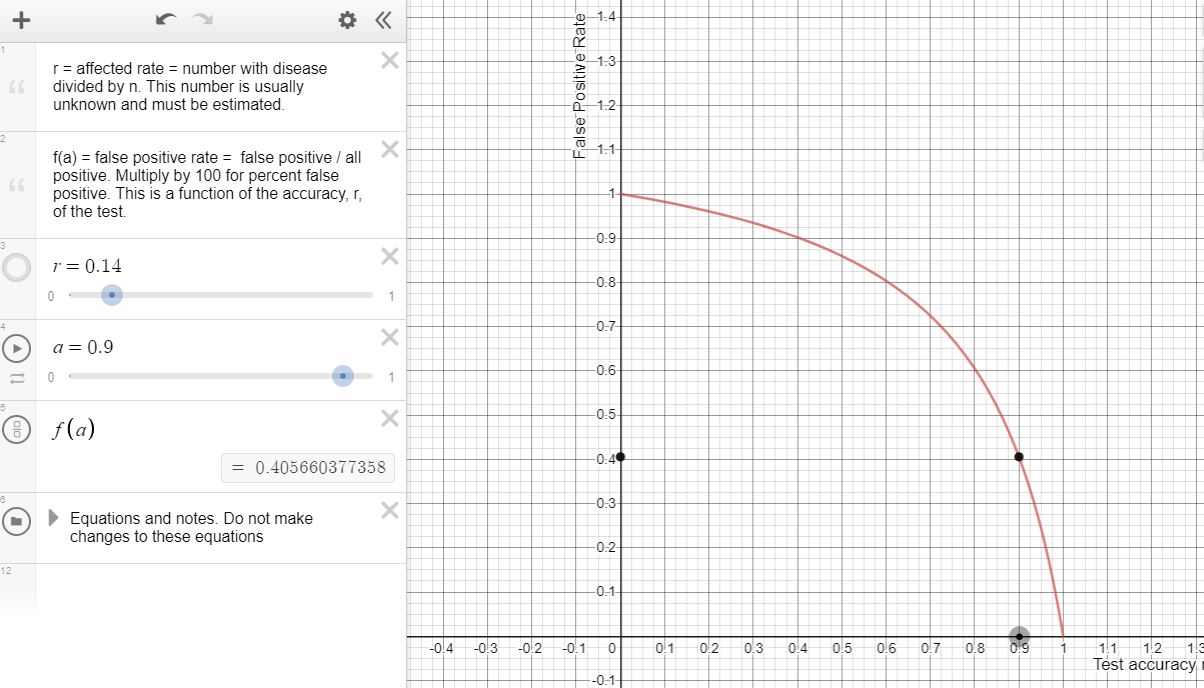
To examine the false positive rate, you may use this Desmos graph. Use the r-slider to adjust the proportion of the population that is believed to be affected. Use the a-slider to change the accuracy of the test. The number given by f(a) is the false positive rate.

Last week the results of a preliminary random sample of New York state residents for Covid-19 indicated a state-wide infection rate of 14% (r = 0.14). (This, I hope, is high, but it is what we have at the moment.) The accuracy of the test was not given. Assuming a 90% accuracy rate (a = 0.90), gives a false positive rate of just over 40% (f(0.90) = 0.406). Even at 95% accuracy (a = 0.95), the false positive rate is 50%. The graph below is set for these values. You may investigate other settings using the link above.

This is the concern. About 40% of the positive results are false; the people are told they have the disease, but they do not. Only about 60% of the positive results are correct. We don’t know which among the positive results really have the disease. We cannot tell for any individual, yet they all must be treated as though they have the disease using up valuable resources.

This happens because a very large number of people do not have the disease: the inaccuracy of the test produces a large number of false positive results. This concern is inherent in all such tests and must be accounted for. It is very important to have extremely accurate tests or to be able to account for the false positives.

A similar graph for the false negative results is here. Using the same values as above, the false negative rate is about 1.7%. These people have the disease but are told they don’t. This too is a concern, since they won’t get treated.

Please stay well and stay home.


REFERENCES

  1. False Positive Rates
  2. Sensitivity and Specificity
  3. Covid-19 Antibody Tests Face a Very Specific Problem This article contains a list of the accuracy figures (sensitivity (false positive rate) and  specificity (false negative rate)) of the currently available tests for SARS-CoV-2, the virus that causes Covid-19.
  4. The Evaluate website has good daily updates on worldwide Covid-19 data.

..


Some Notes

I didn’t come across anything calculusy to write about this week, so here are a few other items you might be interested in.

Two Explorations

Two explorations previously posted on topics that come up this time of year.

Differential Equations.

An exploration in Differential Equations is a summary/review exploration in which students will work with these topics using the tools of algebra, calculus, and technology to fully investigate a function and to find all its foibles.

    • Finding the general solution of the differential equation by separating the variables
    • Checking the solution by substitution
    • Using a graphing utility to explore the solutions for all values of the constant of integration, C
    • Finding the solutions’ horizontal and vertical asymptotes
    • Finding several particular solutions
    • Finding the domains of the particular solutions
    • Finding the extreme value of all solutions in terms of C
    • Finding the second derivative (implicit differentiation)
    • Considering concavity
    • Investigating a special case or two

Sequences

A Lesson on Sequences was originally posted last July. The lesson explores sequences and the Completeness Axiom. Parts of it could work for an Algebra 1 class studying Irrational numbers and all of it could be used as an introductory lesson on sequences in calculus.

If you use either or both of these, I’d like to hear about how they went. Please use to Comment button at the end of any post to share your experiences.


AP Calculus Panel Discussion

The AP Calculus panel discussion at the NCTM Annual Meeting in Chicago will take place on April 2, 2020 from 3:00 to 5:30 pm CST in room #E253d of the McCormick Place – Lakeside Center.

The speakers will include:

Julie Clarke, chief reader.

Stephanie Ogden, director, AP Calculus for the College Board.

Mary Wiltjer, Long time AP Calculus teacher and (fairly) new reader.

Lin McMullin, AP Calculus Community moderator and your host.

The main topic will be the scoring of the 2019 AP Calculus exams. There will be time for your questions for the panel. There will be a raffle. The event is sponsored by Bedford, Freeman and Worth publisher of AP Calculus textbooks, and D & S Marketing Systems, Inc. publishers of review books for AP subjects.

Hope you can make it.


Posts on reviewing for the AP Calculus Exams

I have revised and updated the series of posts on reviewing for the exams that I post each year. This series of 12 posts will appear on Tuesdays and Fridays starting February 25, 2020, ending in the beginning of April. These include the 10 “type” questions that appear on the free-response sections with suggestions on what and how to review them. You’re not behind schedule: most classes begin reviewing in April. These are posted before then, so you’ll have time to use them for planning ahead of time.

Tuesday February 25, 2020 – AP Exam Review
Friday, February 28, 2020 – Resources for reviewing
Tuesday March 3, 2020: Rate and accumulation questions (Type 1)
Friday March 6, 2020: Linear motion problems (Type 2)
Tuesday March 10, 2020: Graph analysis problems (Type 3)
Friday March 13, 2020: Area and volume problems (Type 4)
Tuesday March 17, 2020: Table and Riemann sum questions (Type 5)
Friday March 20, 2020: Differential equation questions (Type 6)
Tuesday March 24, 2020: Other questions (Type 7)
Friday March 27, 2020: Parametric and vector questions (Type 8) BC topic
Tuesday March 31, 2020: Polar equations questions (Type 9) BC Topic
Friday April 3, 2020: Sequences and Series questions (Type 10) BC Topic


Quanta Magazine

Quanta Magazine is an online magazine that has articles on Physics. Mathematics, Biology, and Computer Science. The articles are interesting and timely. There are always a few articles on mathematics and many on the other subjects include mathematics.

They also publish a podcast.  A new puzzle appears bi-monthly.

You may subscribe to a weekly e-mail with links to current articles. (While all I need is another e-mail, getting this one reminds me to read the magazine so I don’t forget this great resource.)

You and your students may find Quanta interesting.