2019 CED Unit 9: Parametric Equations, Polar Coordinates, and Vector-Valued Functions

Unit 9 includes all the topics listed in the title. These are BC only topics (CED – 2019 p. 163 – 176). These topics account for about 11 – 12% of questions on the BC exam.

Comments on Prerequisites: In BC Calculus the work with parametric, vector, and polar equations is somewhat limited. I always hoped that students had studied these topics in detail in their precalculus classes and had more precalculus knowledge and experience with them than is required for the BC exam. This will help them in calculus, so see that they are included in your precalculus classes.

Topics 9.1 – 9.3 Parametric Equations

Topic 9.1: Defining and Differentiation Parametric Equations. Finding dy/dx in terms of dy/dt and dx/dt

Topic 9.2: Second Derivatives of Parametric Equations. Finding the second derivative. See Implicit Differentiation of Parametric Equations this discusses the second derivative.

Topic 9.3: Finding Arc Lengths of Curves Given by Parametric Equations. 

Topics 9.4 – 9.6 Vector-Valued Functions and Motion in the plane

Topic 9.4 : Defining and Differentiating Vector-Valued Functions. Finding the second derivative. See this A Vector’s Derivatives which includes a note on second derivatives. 

Topic 9.5: Integrating Vector-Valued Functions

Topic 9.6: Solving Motion Problems Using Parametric and Vector-Valued Functions. Position, Velocity, acceleration, speed, total distance traveled, and displacement extended to motion in the plane. 

Topics 9.7 – 9.9 Polar Equation and Area in Polar Form.

Topic 9.7: Defining Polar Coordinate and Differentiation in Polar Form. The derivatives and their meaning.

Topic 9.8: Find the Area of a Polar Region or the Area Bounded by a Single Polar Curve

Topic 9.9: Finding the Area of the Region Bounded by Two Polar Curves. Students should know how to find the intersections of polar curves to use for the limits of integration. 


Timing

The suggested time for Unit 9 is about 10 – 11 BC classes of 40 – 50-minutes, this includes time for testing etc.


Previous posts on these topics :

Parametric Equations

Vector Valued Functions

Polar Form

2019 CED Unit 4: Contextual Applications of the Derivative

Unit 4 covers rates of change in motion problems and other contexts, related rate problems, linear approximation and L’Hospital’s Rule. (CED – 2019 p. 82 – 90). These topics account for about 10 – 15% of questions on the AB exam and 6 – 9% of the BC questions.

Topics 4.1 – 4.6

Topic 4.1 Interpreting the Meaning of the Derivative in Context Students learn the meaning of the derivative in situations involving rates of change.

Topic 4.2 Linear Motion The connections between position, velocity, speed, and acceleration. This topic may work  better after the graphing problems in Unit 5, since many of the ideas are the same. See Motion Problems: Same Thing, Different Context

Topic 4.3 Rates of Change in Contexts Other Than Motion Other applications

Topic 4.4 Introduction to Related Rates Using the Chain Rule

Topic 4.5 Solving Related Rate Problems

Topic 4.6 Approximating Values of a Function Using Local Linearity and Linearization The tangent line approximation

Topic 4.7 Using L’Hospital’s Rule for Determining Limits of Indeterminate Forms. Indeterminate Forms of the type \displaystyle \tfrac{0}{0} and \displaystyle \tfrac{\infty }{\infty }. (Other forms may be included, but only these two are tested on the AP exams.)

Topic 4.1 and 4.3 are included in the other topics, topic 4.2 may take a few days, Topics 4.4 – 4.5 are challenging for many students and may take 4 – 5 classes, 4.6 and 4.7 two classes each. The suggested time is 10 -11 classes for AB and 6 -7 for BC. of 40 – 50-minute class periods, this includes time for testing etc.


Posts on these topics include:

Motion Problems 

Motion Problems: Same Thing, Different Context

Speed

A Note on Speed

Related Rates

Related Rate Problems I

Related Rate Problems II

Good Question 9 – Related rates

Linear Approximation

Local Linearity 1

Local Linearity 2 

L’Hospital’s Rule

Locally Linear L’Hôpital  

L’Hôpital Rules the Graph  

Determining the Indeterminate

Determining the Indeterminate 2


Here are links to the full list of posts discussing the ten units in the 2019 Course and Exam Description.

2019 CED – Unit 1: Limits and Continuity

2019 CED – Unit 2: Differentiation: Definition and Fundamental Properties.

2019 CED – Unit 3: Differentiation: Composite , Implicit, and Inverse Functions

2019 CED – Unit 4 Contextual Applications of the Derivative  Consider teaching Unit 5 before Unit 4

2019 – CED Unit 5 Analytical Applications of Differentiation  Consider teaching Unit 5 before Unit 4

2019 – CED Unit 6 Integration and Accumulation of Change

2019 – CED Unit 7 Differential Equations  Consider teaching after Unit 8

2019 – CED Unit 8 Applications of Integration   Consider teaching after Unit 6, before Unit 7

2019 – CED Unit 9 Parametric Equations, Polar Coordinates, and Vector-Values Functions 

2019 CED Unit 10 Infinite Sequences and Series


Type 2 Questions: Linear Motion

We continue the discussion of the various type questions on the AP Calculus Exams with linear motion questions.

“A particle (or car, or bicycle) moves on a number line ….”

These questions may give the position equation, the velocity equation (most often), or the acceleration equation of something that is moving, along with an initial condition. The questions ask for information about motion of the particle: its direction, when it changes direction, its maximum position in one direction (farthest left or right), its speed, etc.

The particle may be a “particle,” a person, car, a rocket, etc.  Particles don’t really move in this way, so the equation or graph should be considered to be a model. The question is a versatile way to test a variety of calculus concepts since the position, velocity, or acceleration may be given as an equation, a graph, or a table; be sure to use examples of all three forms during the review.

Many of the concepts related to motion problems are the same as those related to function and graph analysis (Type 3). Stress the similarities and show students how the same concepts go by different names. For example, finding when a particle is “farthest right” is the same as finding the when a function reaches its “absolute maximum value.” See my post for November 16, 2012 for a list of these corresponding terms. There is usually one free-response question and three or more multiple-choice questions on this topic.

The position, s(t), is a function of time. The relationships are:

  • The velocity is the derivative of the position, {s}'\left( t \right)=v\left( t \right). Velocity is has direction (indicated by its sign) and magnitude. Technically, velocity is a vector; the term “vector” will not appear on the AB exam.

  • Speed is the absolute value of velocity; it is a number, not a vector. See my post for November 19, 2012.
  • Acceleration is the derivative of velocity and the second derivative of position, \displaystyle a\left( t \right)={v}'\left( t \right)={{s}'}'\left( t \right). It, too, has direction and magnitude and is a vector.
  • Velocity is the antiderivative of the acceleration
  • Position is the antiderivative of velocity.

What students should be able to do:

  • Understand and use the relationships above.
  • Distinguish between position at some time and the total distance traveled during the time period.
  • The total distance traveled is the definite integral of the speed (absolute value of velocity) \displaystyle \int_{a}^{b}{\left| v\left( t \right) \right|}\,dt.
  • The net distance traveled, displacement, is the definite integral of the velocity (rate of change): \displaystyle \int_{a}^{b}{v\left( t \right)}\,dt. Note that “displacement” has not been used preciously on AP exam, but (as per the new Course and Exam Description) may be used now. Be sure your students know this term.
  • The final position is the initial position plus the displacement (definite integral of the rate of change from xa to x = t): \displaystyle s\left( t \right)=s\left( a \right)+\int_{a}^{t}{v\left( x \right)}\,dx Notice that this is an accumulation function equation (Type 1).

  • Initial value differential equation problems: given the velocity or acceleration with initial condition(s) find the position or velocity. These are easily handled with the accumulation equation in the bullet above.
  • Find the speed at a given time. The speed is the absolute value of the velocity.
  • Find average speed, velocity, or acceleration
  • Determine if the speed is increasing or decreasing.
    • If at some time, the velocity and acceleration have the same sign then the speed is increasing.If they have different signs the speed is decreasing.
    • If the velocity graph is moving away from (towards) the t-axis the speed is increasing (decreasing). See my post for November 19, 2012.
    • There is also a worksheet on speed here
    • THe analytic approach to speed: A Note on Speed
  • Use a difference quotient to approximate derivative.
  • Riemann sum approximations.
  • Units of measure.
  • Interpret meaning of a derivative or a definite integral in context of the problem

Shorter questions on this concept appear in the multiple-choice sections. As always, look over as many questions of this kind from past exams as you can find.

This may be an AB or BC question. The BC topic of motion in a plane, (Type 8: parametric equations and vectors) will be discussed in a later post.

Free-response examples:

  • Equation stem 2017 AB 5,
  • Graph stem: 2009 AB1/BC1,
  • Table stem 2015 AB 3/BC3

Multiple-choice examples from non-secure exams:

  • 2012 AB 6, 16, 28, 79, 83, 89
  • 2012 BC 2, 89


Updated January 31, 2019, March 12, 2021

A Note on Speed

A quick note on speed.

The idea of differentiating speed to determine where it is increasing or decreasing is perfectly reasonable.

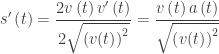
\displaystyle \text{Speed}=s(t)=\left| {v\left( t \right)} \right|=\sqrt{{{{{\left( {v(t)} \right)}}^{2}}}}. Then,

\displaystyle {s}'\left( t \right)=\frac{{2v\left( t \right){v}'\left( t \right)}}{{2\sqrt{{{{{\left( {v(t)} \right)}}^{2}}}}}}=\frac{{v\left( t \right)a\left( t \right)}}{{\sqrt{{{{{\left( {v(t)} \right)}}^{2}}}}}}

Since the denominator is positive, \displaystyle {s}'\left( t \right)>0 and speed is increasing when \displaystyle v\left( t \right) and \displaystyle a\left( t \right) have the same sign, and \displaystyle {s}'\left( t \right)<0 and speed is decreasing when they have different signs.

As a practical matter, this is the “long way.” It requires you to calculate the sign of the velocity and acceleration and some other stuff. So, the traditional way, without the other stuff, is faster. On the other hand, it carries over nicely to higher dimensions where the velocity and acceleration vectors do not have signs, per se. 

See also a previous post on Speed here.

(This occurred to me in the shower this morning; I don’t think I ever realized it before – TMI.)

Parametric and Vector Equations

In the plane, the position of a moving object as a function of time, t, can be specified by a pair of parametric equations x=x\left( t \right)\text{ and }y=y\left( t \right) or the equivalent vector \left\langle x\left( t \right),y\left( t \right) \right\rangle . The path is the curve traced by the parametric equations or the tips of the position vector. .

The velocity of the movement in the x- and y-direction is given by the vector \left\langle {x}'\left( t \right),{y}'\left( t \right) \right\rangle . The vector sum of the components gives the direction of motion. Attached to the tip of the position vector this vector is tangent to the path pointing in the direction of motion.

The length of this vector is the speed of the moving object. \text{Speed }=\sqrt{{{\left( {x}'\left( t \right) \right)}^{2}}+{{\left( {y}'\left( t \right) \right)}^{2}}}. (Notice that this is the same as the speed of a particle moving on the number line with one less parameter: On the number line \text{Speed}=\left| v \right|=\sqrt{{{\left( {x}'\left( t \right) \right)}^{2}}}.)

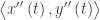
The acceleration is given by the vector \left\langle {{x}'}'\left( t \right),{{y}'}'\left( t \right) \right\rangle .

What students should know how to do:

  • Vectors may be written using parentheses, ( ), or pointed brackets, \left\langle {} \right\rangle , or even \vec{i},\vec{j} form. The pointed brackets seem to be the most popular right now, but all common notations are allowed and will be recognized by readers.
  • Find the speed at time t\text{Speed }=\sqrt{{{\left( {x}'\left( t \right) \right)}^{2}}+{{\left( {y}'\left( t \right) \right)}^{2}}}
  • Use the definite integral for arc length to find the distance traveled \displaystyle \int_{a}^{b}{\sqrt{{{\left( {x}'\left( t \right) \right)}^{2}}+{{\left( {y}'\left( t \right) \right)}^{2}}}}dt. Notice that this is the integral of the speed (rate times time = distance).
  • The slope of the path is \displaystyle \frac{dy}{dx}=\frac{{y}'\left( t \right)}{{x}'\left( t \right)}. See this post for more on finding the first and second derivatives with respect to x.
  • Determine when the particle is moving left or right,
  • Determine when the particle is moving up or down,
  • Find the extreme position (farthest left, right, up, down, or distance from the origin).
  • Given the position find the velocity by differentiating; given the velocity find the acceleration by differentiating.
  • Given the acceleration and the velocity at some point find the velocity by integrating; given the velocity and the position at some point find the position by integrating. These are just initial value differential equation problems (IVP).
  • Dot product and cross product are not tested on the BC exam, nor are other aspects.


Here are two past post on this topic:

Implicit Differentiation of Parametric Equation

A Vector’s Derivatives


Extreme Values and Linear Motion

Two more applications of differentiation are finding extreme values and the analysis of linear motion.

Extreme Values

The Marble and the Vase

Extremes without Calculus

A Standard Problem

Far Out!

Linear Motion – Motion on a Line 

Type 2 Problems

Motion Problems: Same Thing, Different Context

The Ubiquitous Particle Motion Problem  – a PowerPoint Presentation and its Handout

Brian Leonard’s Particle Motion Game Velocity Game  and answers Velocity game Answers

Matching Motion – an activity

Speed


Linear Motion (Type 2)

“A particle (or car, or bicycle) moves on a number line ….”

These questions may give the position equation, the velocity equation or the acceleration equation of something that is moving, along with an initial condition. The questions ask for information about motion of the particle: its direction, when it changes direction, its maximum position in one direction (farthest left or right), its speed, etc.

The particle may be a “particle,” a person, car, a rocket, etc.  Particles don’t really move in this way, so the equation or graph should be considered to be a model. The question is a versatile way to test a variety of calculus concepts since the position, velocity, or acceleration may be given as an equation, a graph, or a table; be sure to use examples of all three forms during the review.

Many of the concepts related to motion problems are the same as those related to function and graph analysis (Type 3). Stress the similarities and show students how the same concepts go by different names. For example, finding when a particle is “farthest right” is the same as finding the when a function reaches its “absolute maximum value.” See my post for November 16, 2012 for a list of these corresponding terms.

The position, s(t), is a function of time. The relationships are

  • The velocity is the derivative of the position, {s}'\left( t \right)=v\left( t \right). Velocity is has direction (indicated by its sign) and magnitude. Technically, velocity is a vector; the term “vector” will not appear on the AB exam.
  • Speed is the absolute value of velocity; it is a number, not a vector. See my post for November 19, 2012.
  • Acceleration is the derivative of velocity and the second derivative of position, \displaystyle a\left( t \right)={v}'\left( t \right)={{s}'}'\left( t \right). It, too, has direction and magnitude and is a vector.
  • Velocity is the antiderivative of the acceleration
  • Position is the antiderivative of velocity.

What students should be able to do:

  • Understand and use the relationships above.
  • Distinguish between position at some time and the total distance traveled during the time period.
  • The total distance traveled is the definite integral of the speed \displaystyle \int_{a}^{b}{\left| v\left( t \right) \right|}\,dt.
  • The net distance traveled, displacement, is the definite integral of the velocity (rate of change): \displaystyle \int_{a}^{b}{v\left( t \right)}\,dt. Note that “displacement” has not been used preciously on AP exam, but (as per the new Course and Exam Description) may be used now. Be sure your students know this term.
  • The final position is the initial position plus the definite integral of the rate of change from xa to x = t: \displaystyle s\left( t \right)=s\left( a \right)+\int_{a}^{t}{v\left( x \right)}\,dx Notice that this is an accumulation function equation (Type 1).
  • Initial value differential equation problems: given the velocity or acceleration with initial condition(s) find the position or velocity. These are easily handled with the accumulation equation in the bullet above.
  • Find the speed at a given time. The speed is the absolute value of the velocity.
  • Find average speed, velocity, or acceleration
  • Determine if the speed is increasing or decreasing.
  • If at some time, the velocity and acceleration have the same sign then the speed is increasing.If they have different signs the speed is decreasing.
  • If the velocity graph is moving away from (towards) the t-axis the speed is increasing (decreasing).
  • See my post for November 19, 2012.
  • Use a difference quotient to approximate derivative.
  • Riemann sum approximations.
  • Units of measure.
  • Interpret meaning of a derivative or a definite integral in context of the problem

Shorter questions on this concept appear in the multiple-choice sections. As always, look over as many questions of this kind from past exams as you can find.

For some previous posts on this subject see November 1619, 2012, January 21, 2013. There is also a worksheet on speed here and on the Resources pages (click at the top of this page).

The BC topic of motion in a plane, (Type 8: parametric equations and vectors) will be discussed in a later post.


Next Posts:

Friday March 10: Graph Analysis (Type 3)

Tuesday March 14: Area and Volume (Type 4)

Friday March 17: Table and Riemann sums (Type 5)

Tuesday Match 21: Differential Equations (Type 6)

Friday March 24: Others (Type 7: related rates, implicit differentiation, etc.)