The Ubiquitous Particle Motion Question

On Friday April 19, 2013 I am giving a presentation at the NCTM Annual Meeting entitled

The Ubiquitous Particle Motion Question on the AP Calculus Exams.

If you are in Denver please join me at  9:30 AM – 10:30 AM, Convention Center, Room: Mile High 2 C

Here are the slides and handout for session.

The Ubiquitous Particle Motion Question (.pdf)  velocity game corrected answers 4-23-2013

Motion Problems NCTM (.pptx)

Challenge Answer

I posted a challenge question on March 28, 2013. Only one person, “April,” replied with an explanation and it was a very good and succinct answer. You may read it here.

The conundrum resulted from trying to calculate when a parabolic bowl was half full. Using the “disk” method there was one answer; using the “shell” method resulted in a different answer. Both are correct; how can that be?

The explanation is this:

When you half fill the bowl in the usual way, by pouring water into it, the water accumulates in the bottom until the bowl is half full, as shown below. This is the result you get using the “disk” method.

Washer 2

But filling the bowl by “shells” is different. Think of spraying the y-axis with paint.  When the paint dries, spray another layer, and then another. Each layer is a “shell.” The paint accumulates as “shells” around the y-axis until the bowl is half full. The paint forms a cylinder with a rounded (parabolic) bottom that fills half the bowl, as shown below.

Shell 2

Geometry Counts

Does Simplifying Make Things Simpler?

I taught a class today on volumes of solid of revolution; specifically, the ones with holes through them by the so-called “washer method.”  For this method you often see the formula

\displaystyle V=\pi \int_{a}^{b}{{{R}^{2}}-{{r}^{2}}}dx

Where R is “outside radius” and r is the “inside radius” and both are functions of x.

It seems to me that this “simplified” form is unduly complicated.

We first worked a problem where a region was rotated around its horizontal edge (Disk method). The region was between y=\sqrt{x}, and the line y=-3 between x = 0 and x = 4, revolved around y=-3.

\displaystyle V=\int_{0}^{4}{\pi {{\left( \sqrt{x}-\left( -3 \right) \right)}^{2}}dx}.

Then I asked them to change the region to that between the graph of y=\sqrt{x} and the line y=\tfrac{1}{2}x again revolved around y=-3. These graphs intersect at x = 0 and x = 4. (How convenient!).

Someone immediately had the idea to revolve the line only and subtract the answer from the last answer:

 \displaystyle V=\int_{0}^{4}{\pi {{\left( \sqrt{x}-\left( -3 \right) \right)}^{2}}dx}-\int_{0}^{4}{\pi {{\left( \tfrac{1}{2}x-\left( -3 \right) \right)}^{2}}dx}

Done!

Isn’t that good enough? Is there any need, ever, to set up the washer? Can’t you always subtract the inside volume from the outside volume?

Now I know that

\displaystyle \int_{0}^{4}{\pi {{\left( \sqrt{x}-\left( -3 \right) \right)}^{2}}dx}-\int_{0}^{4}{\pi {{\left( \tfrac{1}{2}x-\left( -3 \right) \right)}^{2}}dx}=

\displaystyle \pi \int_{0}^{4}{{{\left( \sqrt{x}-\left( -3 \right) \right)}^{2}}-}{{\left( \tfrac{1}{2}x-\left( -3 \right) \right)}^{2}}dx

And the latter is shorter and simpler to look at – only one \pi and only one integral sign, but which is really easier to understand and set up? Which shows you really what you’re doing?

Just sayin’.

Challenge

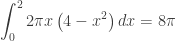
A student was asked to find the volume of the bowl-shaped figure generated when the curve y = x2 from x = 0 to x = 2 is revolved around the y-axis. She used the disk method and found the volume to be \displaystyle \int_{0}^{4}{\pi ydy}=8\pi . To check her work she used the method of cylindrical shells and found the same answer: \displaystyle\int_{0}^{2}{2\pi x\left( 4-{{x}^{2}} \right)dx}=8\pi .

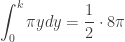
The second part of the question asked for the value of x for which the bowl would be half full. So she first solved the equation \displaystyle \int_{0}^{k}{\pi ydy=\frac{1}{2}\cdot 8\pi }  and found k=2\sqrt{2}. This is a y-value so the corresponding x-value is \sqrt{2\sqrt{2}}\approx 1.682. She again checked her work by shells by solving \displaystyle \int_{0}^{k}{2\pi x\left( 4-{{x}^{2}} \right)dx=\frac{1}{2}\cdot 8\pi } and found that k=\sqrt{-2\left( \sqrt{2}-2 \right)}\approx 1.082. (This is the x-value.)

Both computations are correct. Can you explain to her why her answers are different? Use the comment box below to share your explanations. I will post mine in a week or so.

Differential Equations

AP Type Questions 6

Differential equations are tested every year. The actual solving of the differential equation is usually the main part of the problem, but it is accompanied by a question about its slope field or a tangent line approximation or something else related. BC students may also be asked to approximate using Euler’s Method. Large parts of the BC questions are often suitable for AB students and contribute to the AB subscore of the BC exam.

What students should be able to do

  • Find the general solution of a differential equation using the method of separation of variables (this is the only method tested).
  • Find a particular solution using the initial condition to evaluate the constant of integration – initial value problem (IVP).
  • Understand that proposed solution of a differential equation is a function (not a number) and if it and its derivative are substituted into the given differential equation the resulting equation is true. This may be part of doing the problem even if solving the differential equation is not required (see 2002 BC 5 – parts a, b and d are suitable for AB)
  • Growth-decay problems.
  • Draw a slope field by hand.
  • Sketch a particular solution on a (given) slope field.
  • Interpret a slope field.
  • Use the given derivative to analyze a function such as finding extreme values
  • For BC only: Use Euler’s Method to approximate a solution.
  • For BC only: use the method of partial fractions to find the antiderivative after separating the variables.
  • For BC only: understand the logistic growth model, its asymptotes, meaning, etc. The exams have never asked students to actually solve a logistic equation IVP.

Shorter questions on this concept appear in the multiple-choice sections. As always, look over as many questions of this kind from past exams as you can find.

For some previous posts on this subject see November 26, 2012,  January 21, 2013 February 1, 6, 2013

Motion on a Line

AP Type Questions 4

These questions may give the position equation, the velocity equation or the acceleration equation of something that is moving, along with an initial condition. The questions ask for information about motion of the particle: its direction, when it changes direction, its maximum position in one direction (farthest left or right), its speed, etc.  

The particle may be a “particle,” a person, car, a rocket, etc.  Particles don’t really move in this way, so the equation or graph should be considered to be a model. The question is a versatile way to test a variety of calculus concepts.

The position, velocity or acceleration may be given as an equation, a graph or a table; be sure to use examples of all three forms during the review. 

Many of the concepts related to motion problems are the same as those related to function and graph analysis. Stress the similarities and show students how the same concepts go by different names. For example, finding when a particle is “farthest right” is the same as finding the when a function reaches its “absolute maximum value.” See my post for November 16, 2012 for a list of these corresponding terms.

The position, s(t), is a function of time. The relationships are

  • The velocity is the derivative of the position, {s}'\left( t \right)=v\left( t \right). Velocity is has direction (indicated by its sign) and magnitude. Technically, velocity is a vector; the term “vector” will not appear on the AB exam.
  • Speed is the absolute value of velocity; it is a number, not a vector. See my post for November 19, 2012.
  • Acceleration is the derivative of velocity and the second derivative of position, \displaystyle a\left( t \right)={v}'\left( t \right)={{s}'}'\left( t \right). It, too, has direction and magnitude and is a vector.

  • Velocity is the antiderivative of the acceleration
  • Position is the antiderivative of velocity.

What students should be able to do:

  • Understand and use the relationships above.
  • Distinguish between position at some time and the total distance traveled during the time
    • The total distance traveled is the definite integral of the speed \displaystyle \int_{a}^{b}{\left| v\left( t \right) \right|}\,dt:
    • The net distance (displacement) is the definite integral of the velocity (rate of change): \displaystyle \int_{a}^{b}{v\left( t \right)}\,dt
    • The final position is the initial position plus the definite integral of the rate of change from x = a to x = t: \displaystyle s\left( t \right)=s\left( a \right)+\int_{a}^{t}{v\left( x \right)}\,dx Notice that this is an accumulation function equation.
  • Initial value differential equation problems: given the velocity or acceleration with initial condition(s) find the position or velocity. These are easily handled with the accumulation equation in the bullet above.
  • Find the speed at a particular time. The speed is the absolute value of the velocity.
  • Find average speed, velocity, or acceleration
  • Determine if the speed is increasing or decreasing.
    • If at some time, the velocity and acceleration have the same sign then the speed is increasing.
    • If they have different signs the speed is decreasing.
    • If the velocity graph is moving away from (towards) the t-axis the speed is increasing (decreasing).
  • Use a difference quotient to approximate derivative
  • Riemann sum approximations
  • Units of measure
  • Interpret meaning of a derivative or a definite integral in context of the problem

Shorter questions on this concept appear in the multiple-choice sections. As always, look over as many questions of this kind from past exams as you can find.

For some previous posts on this subject see November 16, 19, 2012, January 21, 2013. There is also a worksheet on speed here and on the Resources pages (click at the top of this page).

The BC topic of motion in a plane, (parametric equations and vectors) will be discussed in a later post (March 15, 2013, tentative date)

Area and Volume Questions

AP Type Questions 4

Given equations that define a region in the plane students are asked to find its area and the volume of the solid formed when the region is revolved around a line or used as a base of a solid with regular cross-sections. This standard application of the integral has appeared every year since 1969 on the AB exam and all but one year on the BC exam.

If this appears on the calculator active section, it is expected that the definite integrals will be evaluated on a calculator. Students should write the definite integral with limits on their paper and put its value after it.  It is not required to give the antiderivative and if students give an incorrect antiderivative they will lose credit even if the final answer is (somehow) correct.

There is a calculator program available that will give the set-up and not just the answer so recently this question has been on the no calculator allowed section. (The good news is that the integrals will be easy or they will be set-up but do not integrate questions.)

What students should be able to do:

  • Find the intersection(s) of the graphs and use them as limits of integration (calculator equation solving). Write the equation followed by the solution; showing work is not required. Usually no credit is earned until the solution is used in context (as a limit of integration).
  • Find the area of the region between the graph and the x-axis or between two graphs.
  • Find the volume when the region is revolved around a line, not necessarily an axis, by the disk/washer method. (Shell method is never necessary, but is eligible for full credit if properly used).
  • Find the volume of a solid with regular cross-sections whose base is the region between the curves. But see 2009 AB 4(b)
  • Find the equation of a vertical line that divides the region in half (area or volume). This involves setting up and solving an integral equation where the limit is the variable for which the equation is solved.
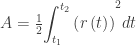
  • For BC only – find the area of a region bounded by polar curves:

\displaystyle A=\tfrac{1}{2}{{\int_{{{t}_{1}}}^{{{t}_{2}}}{\left( r\left( t \right) \right)}}^{2}}dt

Shorter questions on this concept appear in the multiple-choice sections. As always, look over as many questions of this kind from past exams as you can find.

For some previous posts on this subject see January 9, 11, 2013