Why Optimization?

Unit 5 ends with a return to a realistic context. To optimize something means to find the best way to do it. “Best” or “optimum” may mean the quickest, the cheapest, the most profitable, or the easiest way to do something.

For example, you may be asked to build a box of a given volume with the least, and therefore cheapest, amount of material. Thus, these are really problems where you need to find the maximum or minimum of the function that models the situation.  There are applications to engineering, finance, science, medicen, and economics among others.

The most difficult part of these problems is often writing the equation to be optimized; not the calculus involved. Once you have the model, finding the extreme value is easy.

The last part of this unit extends the ideas of this unit to implicit relations, those whose graph may not be a function. These too, increase, decrease, and have extreme values. The same techniques help you to find them.  


Course and Exam Description Unit 5 Sections 11 and 12


A note for teachers: You are not behind scheduel. Please remember that I am posing this series ahead, probably well ahead, of where you are. This is so that they will be here when you get here.


Why Existence Theorems?

An existence theorem is a theorem that says, if the hypotheses are met, that something, usually a number, must exist.

For example, the Mean Value Theorem is an existence theorem: If a function f is defined on the closed interval [a, b] and differentiable on the open interval (a, b), then there exists a number c in the open interval (a, b) such that \displaystyle {f}'\left( c \right)\left( {b-a} \right)=f\left( b \right)-f\left( a \right).

The phrase “there exists” also means “there is” and “there is at least one.” In fact, it is a good idea when seeing an existence theorem to reword it using each of these other phrases. “There is at least one” reminds you that there may be more than one number that satisfies the condition. The mathematical shorthand for these phrases is an upper-case E written backwards: \displaystyle \exists .

  • …then there is a number c in the open interval (a, b) such that…
  • …then there is at least one number c in the open interval (a, b) such that…
  • …then \displaystyle \exists c in the open interval (a, b) such that…

Textbooks, after presenting an existence theorem, usually follow-up with some exercises asking you to actually find the value that exists: “Find the value of c guaranteed by the Mean Value Theorem for the function … on the interval ….” These exercises may help you remember the formula involved.

But, the important thing about most existence theorems is that the number exists, not what the number is.

Other important existence theorems in calculus

The Intermediate Value Theorem

If f is continuous on the interval [a, b] and M is any number between f(a) and f(b), then there exists a number c in the open interval (a, b) such that f(c) = M.

Another wording of the IVT: If f is continuous on an interval and f changes sign in the interval, then there must be at least one number c in the interval such that f(c) = 0

Extreme Value Theorem

If f is continuous on the closed interval [a, b], then there exists a number c in [a, b] such that \displaystyle f\left( c \right)\ge f\left( x \right) for all x in the interval.

Another wording: Every function continuous on a closed interval has (i.e. there exists) a maximum value in the interval.

If f is continuous on the closed interval [a, b], then there exists a number c in [a, b] such that \displaystyle f\left( c \right)\le f\left( x \right) for all x in the interval. Or: Every function continuous on a closed interval has (i.e. there exists) a minimum value in the interval.

Critical Points

If f is differentiable on a closed interval and \displaystyle {f}'\left( x \right) changes sign in the interval, then there exists a critical point in the interval.

Rolle’s theorem

If a function f is defined on the closed interval [a, b] and differentiable on the open interval (a, b) and f(a) = f(b), then there must exist a number c in the open interval (a, b) such that \displaystyle {f}'\left( c \right)=0.

Mean Value Theorem – Other forms

If I drive a car continuously for 150 miles in three hours, then there is a time when my speed was exactly 50 mph.

If a function f is defined on the closed interval [a, b] and differentiable on the open interval (a, b), then there is a point on the graph of f where the tangent line is parallel to the segment between the endpoints.

Cogito, ergo sum

And finally, we have Descartes’ famous “theorem:” Cogito, ergo sum (in Latin) or in the original French, Je pense, donc je suis, translated as “I think, therefore I am” proving his own existence.


Why Analytical Applications?

The last unit showed you some ways the derivative may be used to solve problems in the context of realistic situations. This unit looks at analytical applications of the derivative – that is applications apparently unrelated to any kind of real situation. This is a bit misleading since the things you will learn are meant to be extended to practical problems. It’s just that for now we will study the ideas and techniques in general, not in any context.

The unit begins with two important theorems. The Mean Value Theorem that relates the average rate of change of a function to the instantaneous rate of change (the derivative), The MVT, as it is called, helps prove other important ideas especially the Fundamental Theorem of Calculus at the beginning of the integration.

The other theorem is the Extreme Value Theorem. The EVT tells you about the existence of maximum and/or minimum values of a function on a closed interval.

Both are existence theorems, theorems that tell you that something important or useful exists and what conditions are required for it to exist. More on existence theorems in my next post.

As with all theorems, learn the hypothesis and conclusion. The graphical interpretation makes these easy to understand.

You will learn how to determine where a function is increasing and decreasing. This leads to finding the maximum or minimum points – where the function changes from increasing to decreasing or vice versa: You will learn three “tests” – theorems really – to justify the extreme value.

Along with that you will learn some more about the second derivative and concavity.

These ideas and theorems will help you accurately draw the graph of a function and nail down the precise location of the important points and tell what is happening between them. Yes, your graphing calculator can do that, but you’re taking this course to learn why.

You will be asked to determine information about the function from its derivatives – plural.  The derivative may be given as a function, a graph, or even a table of values.

You will also be asked to justify your reasoning – tell how you can be sure what you say is correct. You do that by citing the theorem that applies and check its hypotheses, not by Paige’s method:

These concepts are tested on the AP Calculus exams and often produce the lowest scores of the six free-response questions. Yet, if you learn these concepts, that question can be the easiest.

P.S. Some books use the Latin words extremum (singular) or extrema (plural). They mean the extreme value(s). Maybe they have hung around so that the uninitiated will think calculus is difficult and confusing. I don’t know. Use them if you like: impress your (uninitiated) friends.


Course and Exam Description Unit 5 Topics 5.1 through 5.9

Why L’Hospital’s Rule?

Why L’Hospital’s Rule?

We are now at the point where we can look at a special technique for finding some limits. Graph on your calculator y = sin(x) and y = x near the origin. Zoom in a little bit. The line is tangent to sin(x) at the origin and their values are almost the same. Look at the two graphs near the origin and see if you can guess the limit of their ratio at the origin:   \displaystyle \underset{{x\to 0}}{\mathop{{\lim }}}\,\frac{{\sin \left( x \right)}}{x}?.

In this example, if you substitute zero into the expression you get zero divided by zero and there is no way to divide out the zero in the dominator as you could with rational expressions.  

This kind of thing is called an indeterminate form. The limit of an indeterminate form may have a value, but in its current form you cannot determine what it is. When you studied limits, you were often able to factor and divide out the denominator and find the limit for what was left. With \displaystyle \frac{{\sin \left( x \right)}}{x} you can’t do that.  

But by replacing the expressions with their local linear approximations, the offending factor will divide out leaving you with the ratio of the derivatives (slopes). This limit may be easier to find.

The technique is called L’Hospital’s Rule, after Guillaume de l’Hospital (1661 – 1704) whose idea it wasn’t! He sort of “borrowed’ it from Johann Bernoulli (1667 – 1784).

L’Hospital’s Rule gives you a way of finding limits of indeterminate forms. You will look at indeterminate forms of the types \displaystyle \tfrac{0}{0} and \displaystyle \tfrac{\infty }{\infty }. The technique may be expanded to other indeterminate forms like  \displaystyle {{1}^{\infty }},\ 0\cdot \infty ,\ \infty -\infty ,\ {{0}^{0}},\text{and }{{\infty }^{0}}, which are not tested on the AP Calculus exams.
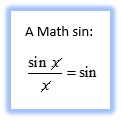
Like other “rules” in math, L’Hospital’s Rule is really a theorem. Before you use it, you must check that the hypotheses are true. And on the AP Calculus exams you must show in writing that you have checked.


Course and Exam Description Unit 4 Topic 7

Why Approximate?

In real life everything is messier than in calculus. You are used to getting “exact” answers in mathematics. You will soon find situations where the only way to get an answer is to approximate it.

Over the year, you will learn several techniques for approximating. In college, you may take a course called Numerical Approximations, learning approximation techniques. If you use calculators or computers to find a solution; these are often approximations requiring a lot of arithmetic.

Graphing calculators approximate difference quotients using the symmetric difference quotient with a very small value of \displaystyle \Delta x.

Remember when you zoomed in on a function and found that close-up it looked like a line. Over small distances near the point of tangency the tangent line has approximately the same y-coordinates as the function. This is called local linearity – over very short intervals most functions appear linear.

One way to approximate a function’s value is to travel along the tangent line from a point you know to a nearby point that you don’t know. You do this by writing the equation of the tangent line at the point you know and then moving a short distance along it. The line’s y-coordinate is close to the function’s and may be used to approximate it. Soon, when you study differential equations, you will use this idea in a slightly different way. When you get to integration and later infinite series you will learn more approximation techniques.

With any approximation, it is useful to know how close the approximation is to the value you are approximating. The first shot at this is to look at the concavity near where you are working. From the concavity you can tell if the tangent line lies above or below the curve. With that, you can determine whether you have an overestimate or an underestimate.

Now, let’s see how close we can get.


Course and Exam Description Unit 4 Section 4.6, Unit 10 Sections 10.2 and 10.10

Why Related Rates?

There are situations where a dependent variable is dependent on more than one independent variable. For example, the volume of a rectangular box depends on its length, width, and height, \displaystyle V=lwh.

Think of a box shaped balloon being blown up.  The volume and all three dimensions are all changing at the same time. Their rates of change are related to each other.

Since rates of change are derivatives, all the derivatives are related. Given several of the rates, you can find the others.

In these problems you use implicit differentiation to find the relationship between the variables and their derivatives. That means that you differentiate with respect to time. And time is usually not one of the variables in the equations. \displaystyle V=lwh – see no t anywhere. Really, the length, width and height are all functions of time; you just don’t see the t.

Sometimes the substitutions required to work your way through these problems are the tricky part. So, be careful with your algebra.


Course and Exam Description Unit 4 sections 4.3 to 4.5.

Why Linear Motion?

Now that you know how to compute derivatives it is time to use them. The next few topics and my next few posts will discuss some of the applications of derivatives, and some of the things you can use them for.

The first is linear motion or motion along a straight line.

Derivatives give the rate of change of something that is changing. Linear motion problems concern the change in the position of something moving in a straight line. It may be someone riding a bike, driving a car, swimming, or walking or just a “particle” moving on a number line.

The function gives the position of whatever is moving as a function of time. This position is the distance from a known point often the origin. The time is the time the object is at the point. The units are distance units like feet, meters, or miles.

The derivative position is velocity, the rate of change of position with respect to time.  Velocity is a vector; it has both magnitude and direction. While the derivative appears to be just a number its sign counts: a positive velocity indicates movement to the right or up, and negative to the left or down. Units are things like miles per hour, meters per second, etc.

The absolute value of velocity is the speed which has the same units as velocity but no direction.

The second derivative of position is acceleration. This is the rate of change of velocity. Acceleration is also a vector whose sign indicates how the velocity is changing (increasing or decreasing). The units are feet per minute per minute or meters per second per second. Units are often given as meters per second squared (m/s2) which is correct but meters per second per second helps you understand that the velocity in meters per second is changing so much per second.   

Of these four, velocity may be the most useful. You will learn how to use the velocity (the first derivative) and its graph to determine how the particle moves over intervals of time: when it is moving left or right, when it stops, when it changes direction, whether it is speeding up or slowing down, how far the object moves, and so on. You can also find the position from the velocity if you also know the starting position.

You will work with equations and with graphs without equations. Reading the graphs of velocity and acceleration is an important skill to learn.

The reasoning used in linear motion problems is the same as in other applications. What you do is the same; what it means depends on the context.

Not to scare anyone, but linear motion problems appear as one of the six free-response questions on the AP Calculus exams almost every year as well as in several the multiple-choice questions.

So, let’s get moving!


Course and Exam Description Unit 4 Sections 4.1 and 4.2