April 2016 – Exam Review

This is a copy of my March 2016 post. It is review time and here are the links to my post on reviewing for the AP Calculus Exams

This year’s AP Calculus exams are on the morning of Thursday May 5, 2016. This month AP Calculus teachers will continue their review for the exams. The links to past posts on getting ready and reviewing for the exams are below. I’m posting them ahead of time so you will have time to use them in your planning.

Exam questions:

Released free-response questions are available from AP Central. Click here for AB and here for BC. Released multiple-choice questions are available only to teachers at your AP Audit website (click on “Secure Documents” on the lower left of the screen. Remember that these four years’ exams (2012 – 2015) are not allowed to leave your room (literally) and they may not be posted anywhere on-line.

Indices to released exam questions:

Click the links to an index to the multiple-choice (2003, 2008) and free-response (thru 2015) exam questions. These are Excel spreadsheets; click the arrow at the top of any column and narrow your search by checking exactly what you are looking for. These were prepared by Mark Howell and are available thanks to Skylight Publishing. (www.skylit.com)

I have a shorter and much less detailed three-page free-response  (1998 – 2015) index and multiple-choice (2003, 2008, 2012 – 2015 ) index. Click here.The multiple choice question are grouped by the “Type Questions” referred to below. One interesting feature is that you can see at a glance the number of times each type question was asked from year to year; this may help you decide what to emphasize.

Getting Ready for the AP exams (links to past posts)

The AP Calculus Exams

Using AP Questions All Year

Ideas for Reviewing for the AP Calculus Exams

Practice exams – A Modest Proposal All the past exams are available online – what to consider when your students find them.

Writing on the AP Calculus Exam Don’t miss these 7+ FR points.

Interpreting Graphs AP Type Question 1

The Rate / Accumulation Question AP Type Question 2

Area and Volume Questions AP Type Question 3

Motion on a Line AP Type Question 4

The Table Question AP Type Question 5

Differential Equations AP Type Question 6

Implicit Relations and Related Rates AP Type Question 7

Parametric and Vector Equations AP Type Question 8 (BC)

Polar Curves AP Type Question 9 (BC)

Sequences and Series AP Type Question 10 (BC)

Calculator Use on the AP Exams

And some last-minute advice Getting Ready for the Exam

shoe


.

March 2016 – Exam Review

get-a-5These year’s AP Calculus exams are on the morning of Thursday May 5, 2016. Later this month or early next month AP Calculus teachers will begin their review for the exams. The links to past posts on getting ready and reviewing for the exams are below. I’m posting them ahead of time so you will have time to use them in your planning.

Exam questions:

Released free-response questions are available from AP Central. Click here for AB and here for BC. Released multiple-choice questions are available only to teachers at your AP Audit website (click on “Secure Documents” on the lower left of the screen. Remember that these four years’ exams (2012 – 2015) are not allowed to leave your room (literally) and they may not be posted anywhere on-line.


Indices to released exam questions:

Click the links to an index to the multiple-choice and free-response exam questions. These are Excel spreadsheets; click the arrow at the top of any column and narrow your search by checking exactly what you are looking for. These were prepared by Mark Howell and are available thanks to Skylight Publishing. (www.skylit.com)

I have a shorter and much less detailed three-page free-response  (1998 – 2015) index and multiple-choice (2003, 2008, 2012 – 2015 ) index. Click here.The multiple choice question are grouped by the “Type Questions” referred to below. One interesting feature is that you can see at a glance the number of times each type question was asked from year to year; this may help you decide what to emphasize.

Getting Ready for the AP exams (links to past posts)

The AP Calculus Exams

Using AP Questions All Year

Ideas for Reviewing for the AP Calculus Exams

Practice exams – A Modest Proposal All the past exams are available online – what to consider when your students find them.

Writing on the AP Calculus Exam Don’t miss these 7+ FR points.

Interpreting Graphs AP Type Question 1

The Rate / Accumulation Question AP Type Question 2

Area and Volume Questions AP Type Question 3

Motion on a Line AP Type Question 4

The Table Question AP Type Question 5

Differential Equations AP Type Question 6

Implicit Relations and Related Rates AP Type Question 7

Parametric and Vector Equations AP Type Question 8 (BC)

Polar Curves AP Type Question 9 (BC)

Sequences and Series AP Type Question 10 (BC)

Calculator Use on the AP Exams

And some last-minute advice Getting Ready for the Exam


.

Good Question 6: 2000 AB 4

2000 AB 4 Water tankAnother of my favorite questions from past AP exams is from 2000 question AB 4. If memory serves it is the first of what became known as an “In-out” question. An “In-out” question has two rates that are working in opposite ways, one filling a tank and the other draining it.

In subsequent years we saw a question with people entering and leaving an amusement park (2002 AB2/BC2), sand moving on and off a beach (2005 AB 2), another tank (2007 AB2), an oil leak being cleaned up (2008 AB 3), snow falling and being plowed (2010 AB 1), gravel being processed (2013 AB1/BC1), and most recently water again flowing in and out of a pipe (2015 AB1/BC1). The in-between years saw rates in one direction only but featured many of the same concepts.

The questions give rates and ask about how the quantity is changing. As such, they may be approached as differential equation initial value problems, but there is an easier way. This easier way is that a differential equation that gives the derivative as a function of a single variable, t, with an initial point \left( {{t}_{0}},y\left( {{t}_{0}} \right) \right) always has a solution of the form

y\left( t \right)=y\left( {{t}_{0}} \right)+\int_{{{t}_{0}}}^{t}{{y}'\left( x \right)dx}.

This is sometimes called the “accumulation equation.” The integral of a rate of change {y}'\left( t \right) gives the net amount of change over the interval of integration [{{t}_{0}},t]. When this is added to the initial amount the result is an expression that gives the amount at any time t.

In a motion context, this same idea is that the position at any time t, is the initial position plus the displacement:
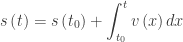
\displaystyle s\left( t \right)=s\left( {{t}_{0}} \right)+\int_{{{t}_{0}}}^{t}{v\left( x \right)dx} where v\left( t \right)={s}'\left( t \right)

The scoring standard gave both forms of the solution. The ease of the accumulation form over the differential equation solution was evident and subsequent standards only showed this one.

2000 AB 4

The question concerned a tank that initially contained 30 gallons of water. We are told that water is being pumped into the tank at a constant rate of 8 gallons per minute and the water is leaking out at the rate of \sqrt{t+1} gallons per minute.

Part a asked students to compute the amount of water that leaked out in the first three minutes. There were two solutions given. The second solves the problem as an initial value differential equation:

Let L(t) be the amount that leaks out in t minutes then

\displaystyle \frac{dL}{dt}=\sqrt{t+1}

L\left( t \right)=\frac{2}{3}{{\left( t+1 \right)}^{3/2}}+C

L\left( 0 \right)=\frac{2}{3}{{\left( 0+1 \right)}^{3/2}}+C=0 since nothing has leaked out yet, so C = -2/3

L\left( t \right)=\frac{2}{3}{{\left( t+1 \right)}^{3/2}}-\frac{2}{3}

L\left( 3 \right)=\frac{14}{3}

The first method, using the accumulation idea takes a single line:

\displaystyle L\left( 3 \right)=\int_{0}^{3}{\sqrt{t+1}dt}=\left. \frac{2}{3}{{\left( t+1 \right)}^{3/2}} \right|_{0}^{3}=\frac{2}{3}{{\left( 4 \right)}^{3/2}}-\frac{2}{3}{{\left( 1 \right)}^{3/2}}=\frac{14}{3}

I think you’ll agree this is easier and more direct.

Part b asked how much water was in the tank at t = 3 minutes.  We have 30 gallons to start plus 8(3) gallons pumped in and 14/3 gallons leaked out gives 30 + 24 – 14/3 = 148/3 gallons.

This part, worth only 1 point, was a sort of hint for the next part of the question.

Part c asked students to write an expression for the total number of gallons in the tank at time t.

Following part b the accumulation approach gives either

\displaystyle A\left( t \right)=30+8t-\int_{0}^{t}{\sqrt{x+1}dx}  or

\displaystyle A\left( t \right)=30+\int_{0}^{t}{\left( 8-\sqrt{x+1} \right)dx}.

The first form is not a simplification of the second, but rather the second form is treating the difference of the two rates, in minus out, as the rate to be integrated.

The differential equation approach is much longer and looks like this:
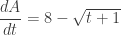
\displaystyle \frac{dA}{dt}=8-\sqrt{t+1}

A\left( t \right)=8t-\frac{2}{3}{{\left( t+1 \right)}^{3/2}}+C

A\left( 0 \right)=30=8(0)-\frac{2}{3}{{\left( 0+1 \right)}^{3/2}}+C, so C=\frac{92}{3}

A\left( t \right)=8t-\frac{2}{3}{{\left( t+1 \right)}^{3/2}}+\frac{92}{3}

Again, this is much longer. In recent years when asking student to write an expression such as this, the directions included a phrase such as “write an equation involving one or more integrals that gives ….” This pretty much leads students away from the longer differential equation initial value problem approach.

Part d required students to find the time when in the interval 0\le t\le 120 minutes the amount of water in the tank was a maximum and to justify their answer. The usual method is to find the derivative of the amount, A(t), set it equal to zero, and then solve for the time.

{A}'\left( t \right)=8-\sqrt{t+1}

Notice that this is the same regardless of which of the three forms of the expression for A(t) you start with. Thus, an excellent example of the Fundamental Theorem of Calculus used to find the derivative of a function defined by an integral. Or you could just start here without reference to the forms above: the overall rate in the rate in minus the rate out.

{A}'\left( t \right)=0 when t = 63

This is a maximum by the First Derivative Test since for 0 < t < 63 the derivative of A is positive and for 63 < t <120 the derivative of A is negative.

There is an additional idea on this part of the question in the Teaching Suggestions below.


I like this question because it is a nice real (as real as you can hope for on an exam) situation and for the way the students are led through the problem. I also like the way it can be used to compare the two methods of solution.  Then the way they both lead to the same derivative in part d is nice as well. I use this one a lot when working with teachers in workshops and summer institutes for these very reasons.

Teaching Suggestions

  • Certainly, have your students work through the problem using both methods. They need to learn how to solve an initial value problem (IVP) and this is good practice. Additionally, it may help them see how and when to use one method or the other.
  • Be sure the students understand why the three forms of A(t) in part c give the same derivative in part d. This makes an important connection with the Fundamental theorem of Calculus.
  • Like many good AP questions part d can be answered without reference to the other parts. The question starts with more water being pumped in than leaking out. This will continue until the rate at which the water leaks out overtakes the rate at which it is being pumped in. At that instant the rate “in” equals the rate “out” so you could start with 8=\sqrt{t+1}. After finding that t = 63, the answer may be justified by stating that before this time more water is being pumped in than is leaking out and after this time the rate at which water leaks out is greater than the rate at which it is pumped in, so the maximum must occur at t = 63.
  • And as always, consider the graph of the rates.

2000 AB 4

I used this question as the basis of a lesson in the current AP Calculus Curriculum Module entitled Integration, Problem Solving and Multiple Representations © 2013 by the College Board. The lesson gives a Socratic type approach to this question with a number of questions for each part intended to help the teacher not only work through this problem but to bring out related ideas and concepts that are not in the basic question. The module is currently available at AP sponsored workshops and AP Summer Institutes. Eventually, it will be posted at AP Central on the AB and BC Calculus Home Pages.

Using AP Questions All Year

This appeared as a reply to a question on the AP Calculus Community bulletin board on August 1, 2015. It has been revised for the blog. 

AP Calculus teachers find it helpful to use actual AP free-response (FR) and multiple-choice (MC) questions on their exams and for homework throughout the year. Early in the year, it is difficult to find or write a free-response style question that can be used for this purpose. This is because FR questions typically cover topics from the entire year – differentiation and integration topics in the same question. This is done to make “the course a cohesive whole rather than a collection of unrelated topics” (to quote the AP Calculus Philosophy statement). Using actual questions helps students will see how disparate topics can be included in one question, but in the beginning of the year you cannot really do that.

Experienced teachers recommend using AP questions throughout the year. They do so by adapting them. This can be done by using only the parts of FR questions that students have studied. They either omit the other parts and adjust the Calculus1points accordingly, or they add new parts on the topics students have studied that can be answered from the same stem, thus going deeper into the topic. At the beginning of the year through mid-year do not be too concerned about copying the style and format of actual AP questions. There will be plenty of time later in the year and during review for that. All year long concentrate on the content and topics in the questions. Add questions to explore the topics in more depth. This is easy to do, since AP questions, by including topics from the entire year, must omit some obvious questions that could be asked using the same stem. My occasional series on “Good Questions” has suggestions and examples on how to do this.

Multiple-choice questions are a little easier to use, since they typically test only one topic. Even here adjustments can be made. Try giving a MC question without the choices – make it a constructed response question and check their work; or leave the choices, require students show their work, and grade it.  Often MC questions can be expanded as well. For an example, see my post Good Question 4.

The person who wrote the original post on the AP Calculus Community was trying to write a question on limits for her first test. I suggested:

As for a limit based FR question see my blog post Good Question 5. This question concerns an AP question from 1998 AB 2. Students were asked in part (a) to find the limits of a function 2x{{e}^{2x}} at plus and minus infinity (end behavior). In part (b) they were asked to find the minimum value of the function. At the beginning of the year students won’t know how to do the calculus involved, but you could just give them the minimum or have them graph the function and find the minimum using their graphing calculator. (Yes, I know that’s not allowed on the AP exam, but the point is to use the result in the next two parts of the question). Knowing the minimum, in part (c) students were asked for the range of the function (combining the results of (a) and (b). Then in part (d) students were asked about the minimum of the similar family of functions of the form bx{{e}^{bx}}. This can be answered without using calculus (although using calculus was intended); the blog post will explain how – and some students actually did this on the exam.


.

Good Question 3 1995 BC 5

A word before we look at one of my favorite AP exam questions, I put some of my presentations in a new page. Look under the “Resources” tab above, and you will see a new page named “Presentations.” There are PowerPoint slides and the accompanying handouts from some talks I’ve given in the last few years. I also use them in my workshops and AP Summer Institutes.

This continue a discussion of some of my favorite question and how to use them in class.You can find the others by entering “Good Question” in the search box on the right.

Today we look at one of my favorite AP exam questions. This one is from the 1995 BC exam; the question is also suitable for AB students. Even though it is 20 years old, it is still a good question.  1995 was the first year that graphing calculators were required on the AP Calculus exams.They were allowed, but not required for all 6 questions.

1995 BC 5

The question showed the three figures below and identified figure 1 as the graph of f\left( x \right)={{x}^{2}}  and figure 2 as the graph of g\left( x \right)=\cos \left( x \right).  The question then allowed as how one might think of the graph is figure 3 as the graph of h\left( x \right)={{x}^{2}}+\cos \left( x \right), the sum of these two functions. Not that unreasonable an assumption, but apparently not correct.
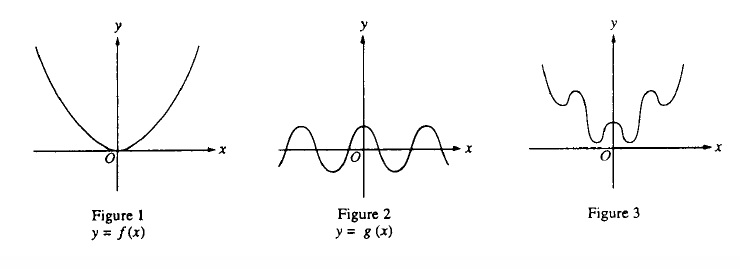
1995 BC 5

Part a: The students first were asked to sketch the graph of h\left( x \right) in a window with [–6, 6] x [–6, 40] (given this way). A box with axes was printed in the answer booklet.  This was a calculator required question and the result on a graphing calculator looks like this:


1995 BC 5

y={{x}^{2}}+\cos \left( x \right).
The window is [-6,6] x [-6, 40]

Students were expected to copy this onto the answer page. Note that the graph exits the screen below the top corners and it does not go through the origin. Both these features had to be obvious on the student’s paper to earn credit.

Part b: The second part of the question instructed students to use the second derivative of h\left( x \right) to explain why the graph does not look like figure 3.

\displaystyle \frac{dy}{dx}=2x-\sin \left( x \right)

\displaystyle \frac{{{d}^{2}}y}{d{{x}^{2}}}=2-\cos \left( x \right)

Students then had to observe that the second derivative was always positive (actually it is always greater than or equal to 1) and therefore the graph is concave up everywhere. Therefore, it cannot look like figure 3.

Part c: The last part of the question required students to prove (yes, “prove”) that the graph of y={{x}^{2}}+\cos \left( kx \right) either had no points of inflection or infinitely many points of inflection, depending on the value of the constant k.
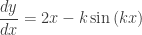
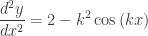
Successful student first calculated the second derivative:

\displaystyle \frac{dy}{dx}=2x-k\sin \left( kx \right)

\displaystyle \frac{{{d}^{2}}y}{d{{x}^{2}}}=2-{{k}^{2}}\cos \left( kx \right)

Then considering the sign of the second derivative, if {{k}^{2}}\le 2, \frac{{{d}^{2}}y}{d{{x}^{2}}}\ge 0 and there are no inflection points (the graph is always concave up). But, if {{k}^{2}}>2, then since y” is periodic and changes sign, it does so infinitely many times and there are then infinitely many inflection points. See the figure below.
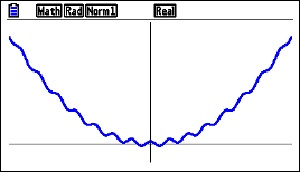

k = 8

k = 8


Using this question as a class exercise

Notice how the question leads the student in the right direction. If they go along with the problem they are going in the right direction. In class, I would be inclined to make them work for it.

  1. First, I would ask the class if figure 3 is the correct graph of h\left( x \right)={{x}^{2}}+\cos \left( x \right). I would let them, individually, in groups, or as a class suggest and defend an answer. I would not even suggest, but certainly not mind, if they used a graphing calculator.
  2. Once they determined the correct answer, I would ask them to justify (or prove) their conjecture. Again, no hints; let the class struggle until they got it. I may give them a hint along the lines of what does figure 3 have or do that the correct graph does not. (Answer: figure 3 changes concavity). Sooner or later someone should decide to check out the second derivative.
  3. Then I’d ask what could be the equation for a graph that does look like figure 3. You could give hints along the line of changing the coefficients of the terms of the second derivative. There are several ways to do this and all are worth considering.
    1. Changing the coefficient of the x2 term (to a proper fraction, say, 0.02) will do the trick. If that’s what they come up with fine – it’s correct.
    2. If you want to be picky, this causes the graph to go negative and figure 3 does not do that, but I ‘d let that go and ask if changing the coefficient of the cosine term in the second derivative can be done and if so how do you do that.
    3. This may be done by simply putting a number in front of the cosine term of the original function, say h\left( x \right)={{x}^{2}}+6\cos \left( x \right), but the results really do not look like figure 3,
    4. If necessary, give them the hint y={{x}^{2}}+\cos \left( kx \right)

1995 was the first year graphing calculators were required on the AP Calculus exams. They were allowed for all questions, but most questions had no place to use them. The parametric equation question on the same test, 1995 BC 1, was also a good question that made use of the graphing capability of calculators to investigate the relative motion of two particles in the plane.   The AB Exam in 1995 only required students to copy one graph from their calculator.

Both BC questions were generally well received at the reading. I know I liked them. I was looking forward to more of the same in coming years.

I was disappointed.

There was an attempt the following year (1997 AB4/BC4), but since then nothing investigating families of functions (i.e.  like these with a parameter that affects the shape of the graph) or anything similar has appeared on the exams. I can understand not wanting to award a lot of points for just copying the graph from your calculator onto the paper, but in a case like this where the graph leads to a rich investigation of a counterintuitive situation I could get over my reluctance.

But that’s just me.

Practice Exams – A Modest Proposal

Starting in 2012 the College Board provided full actual AP Calculus exams, AB and BC, for teachers who had an audit on file to use with their students as practice exams. These included multiple-choice and free-response questions from the international exam. (The 2012 exam has now been released and is no longer considered secure. All the practice exams since then are considered secure.) The free-response questions from the operational (main USA) exam are released to everyone shortly after the exams are given and their scoring standards are released in the fall. These are not secure and may be shared with your students.

The rules about using the secure practice exams are quite restrictive. I quote:

AP Practice Exams are provided by the College Board for AP Exam preparation. Teachers are permitted to download the materials and make copies to use with their students in a classroom setting only. To maintain the security of the exams, teachers should collect all materials after their administration and keep them in a secure location. Exams may not be posted on school or personal websites, nor electronically redistributed for any reason. Further distribution of these materials outside of the secure College Board site disadvantages teachers who rely on uncirculated questions for classroom testing. Any additional distribution is in violation of the College Board’s copyright policies and may result in the termination of Practice Exam access for your school as well as the removal of access to other online services such as the AP Teacher Community and Online Score Reports. (Emphasis in original)

Bubble SheetPractice exams are a good thing to use to help get your students ready for the real exam. They

  • Help students understand the style and format of the questions and the exam,
  • Give students practice in working under time pressure
  • Help students identify their calculus weaknesses, to pinpoint the concepts and topics they need to brush up on before the real exam.
  • Give students an idea of their score 5, 4, 3, 2, or 1.

Teachers also assign a grade on the exam and count it as part of the students’ averages.

The problem is that some of the exams in whole or part have found their way onto the internet. (Imagine.) The College Board does act when they learn of such a situation. Nevertheless, students have often be able to, shall we say, “research” the questions ahead of their practice exams. Teachers are, quite rightly, upset about this and considered the “research” cheating.

To deal with this situation I offer …

A Modest Proposal

Don’t grade the practice exam or count it as part of the students’ averages.

Athletes are not graded on their practices, only the game counts. Athletes practice to maintain their skills and improve on their weakness. Make it that way with your practice tests.

Calculus students are intelligent. Explain to them why you are asking them to take a practice exam; how it will help them find their weaknesses so they can eliminate them, how they will use the exam to maintain their skills and improve on their weakness, and how this will help them on the real exam.  By taking the pressure of a grade away, students can focus on improvement.

Make it an incentive not to be concerned about a grade.

______________________________

(Confession: When I was teaching, I often had nothing to base a fourth quarter grade on. School started after Labor Day and the fourth quarter began about two weeks before the AP exam (and ran another 6 or 7 week after it). Students were required to take a final exam given the week after the AP exam and then they were done. The fourth quarter grade was usually the average of the first three quarters.)

Update June 7, 2015: There are some good ideas in the replies below. Check them out.

Update 2 April 7, 2018. Several updates to the first paragraph.

Update 3: March 13, 2019


Teaching AP Calculus – The Book

I am happy to announce that the third edition of my book Teaching AP Calculus is now available.

Teaching AP Calculus - Third Edition

Teaching AP Calculus is a summer institute in book form. The third edition is one-third longer than the previous edition and contains more insights, thoughts, hints, and ideas that you will not find in textbooks. There are references to actual AP Calculus exam questions to help you understand how the concepts are actually tested. New teachers will find a place to begin, and experienced AP teachers will find a wealth of new ideas. Whether this is your first year or your twenty-fifth, there is something here for you.

The book has 295 pages of information with 23 chapters in three sections, plus 4 appendices and an index.

Section I The first section of Teaching AP Calculus is about what you should know to get started teaching an AP calculus course. It will tell you where to find resources. The Philosophy and Goals are explained. There is a chapter on finding and recruiting students, pacing and planning the year. A chapter is devoted to technology, especially the use of graphing calculators; this is an important part of the course. The last chapter in the section talks about the prerequisites and things students should know before they start AP calculus.

Section 2 The middle section of Teaching AP Calculus is the longest. In it all of the topics that should be included in the AB and BC courses are discussed: limits, derivatives and their applications, definite integrals and their applications, differential equations, and the additional topics of parametric and polar equations, and power series that are tested on only the BC exam.

These chapters present ideas about how to present the topics. The chapters include some classroom activities. The last chapter is concerned with the writing that students must do on the exams: how to justify and explain their answers.

Margin references lead the reader to actual AP Calculus exam questions on all the important concepts.

Section 3 The last section of Teaching AP Calculus is about the AP exams. Here you will learn how the exams are made up and graded. You will learn how to read the scoring standards. The “type” questions on the exams are each discussed in detail along with what your students should know about them. The final chapter is for you and especially your students. It has lots of information and hints on how to do well on the AP calculus exams.

Teaching AP Calculus may be ordered online at http://www.dsmarketing.com/teapca.html. The website includes sample sections from the book and downloads of calculator programs mentioned in the book.

I hope both new and experienced teachers will find Teaching AP Calculus useful  and informative.

AP Summer Institute leaders: To obtain complimentary examination copy of Teaching AP Calculus, third edition, to show your participants email info@dsmarketing.com. Please include your full name, complete shipping address with zip code, and the location and date of your APSI.