2019 CED Unit 4: Contextual Applications of the Derivative

Unit 4 covers rates of change in motion problems and other contexts, related rate problems, linear approximation and L’Hospital’s Rule. (CED – 2019 p. 82 – 90). These topics account for about 10 – 15% of questions on the AB exam and 6 – 9% of the BC questions.

Topics 4.1 – 4.6

Topic 4.1 Interpreting the Meaning of the Derivative in Context Students learn the meaning of the derivative in situations involving rates of change.

Topic 4.2 Linear Motion The connections between position, velocity, speed, and acceleration. This topic may work  better after the graphing problems in Unit 5, since many of the ideas are the same. See Motion Problems: Same Thing, Different Context

Topic 4.3 Rates of Change in Contexts Other Than Motion Other applications

Topic 4.4 Introduction to Related Rates Using the Chain Rule

Topic 4.5 Solving Related Rate Problems

Topic 4.6 Approximating Values of a Function Using Local Linearity and Linearization The tangent line approximation

Topic 4.7 Using L’Hospital’s Rule for Determining Limits of Indeterminate Forms. Indeterminate Forms of the type \displaystyle \tfrac{0}{0} and \displaystyle \tfrac{\infty }{\infty }. (Other forms may be included, but only these two are tested on the AP exams.)

Topic 4.1 and 4.3 are included in the other topics, topic 4.2 may take a few days, Topics 4.4 – 4.5 are challenging for many students and may take 4 – 5 classes, 4.6 and 4.7 two classes each. The suggested time is 10 -11 classes for AB and 6 -7 for BC. of 40 – 50-minute class periods, this includes time for testing etc.


Posts on these topics include:

Motion Problems 

Motion Problems: Same Thing, Different Context

Speed

A Note on Speed

Related Rates

Related Rate Problems I

Related Rate Problems II

Good Question 9 – Related rates

Linear Approximation

Local Linearity 1

Local Linearity 2 

L’Hospital’s Rule

Locally Linear L’Hôpital  

L’Hôpital Rules the Graph  

Determining the Indeterminate

Determining the Indeterminate 2


Here are links to the full list of posts discussing the ten units in the 2019 Course and Exam Description.

2019 CED – Unit 1: Limits and Continuity

2019 CED – Unit 2: Differentiation: Definition and Fundamental Properties.

2019 CED – Unit 3: Differentiation: Composite , Implicit, and Inverse Functions

2019 CED – Unit 4 Contextual Applications of the Derivative  Consider teaching Unit 5 before Unit 4

2019 – CED Unit 5 Analytical Applications of Differentiation  Consider teaching Unit 5 before Unit 4

2019 – CED Unit 6 Integration and Accumulation of Change

2019 – CED Unit 7 Differential Equations  Consider teaching after Unit 8

2019 – CED Unit 8 Applications of Integration   Consider teaching after Unit 6, before Unit 7

2019 – CED Unit 9 Parametric Equations, Polar Coordinates, and Vector-Values Functions 

2019 CED Unit 10 Infinite Sequences and Series


2019 CED – Unit 3: Differentiation: Composite, Implicit, and Inverse Functions

Unit 3 covers the Chain Rule, differentiation techniques that follow from it, and higher order derivatives. (CED – 2019 p. 67 – 77). These topics account for about 9 – 13% of questions on the AB exam and 4 – 7% of the BC questions.

Topics 3.1 – 3.6

Topic 3.1 The Chain Rule. Students learn how to apply the Chain Rule in basic situations.

Topic 3.2 Implicit Differentiation. The Chain Rule is used to find the derivative of implicit relations.

Topic 3.3 Differentiation Inverse Functions.  The Chain Rule is used to differentiate inverse functions.

Topic 3.4 Differentiating Inverse Trigonometric Functions. Continuing the previous section, the ideas of the derivative of the inverse are applied to the inverse trigonometric functions.

Topic 3.5 Selecting Procedures for Calculating Derivatives. Students need to be able to choose which differentiation procedure should be used for any function they are given. This is where you can review (spiral) techniques from Unit 2 and practice those from this unit.

Topic 3.6 Calculating Higher Order Derivatives. Second and higher order derivatives are considered. Also, the notations for higher order derivatives are included here.


Topics 3.2, 3.4, and 3.5 will require more than one class period. You may want to do topic 3.6 before 3.5 and use 3.5 to practice all the differentiated techniques learned so far. The suggested number of 40 – 50-minute class periods is about 10 – 11 for AB and 8 – 9 for BC. This includes time for testing etc.
Posts on these topics include:

Foreshadowing the Chain Rule

The Power Rule Implies Chain Rule

The Chain Rule

           Seeing the Chain Rule

Derivative Practice – Numbers

Derivative Practice – Graphs

Experimenting with CAS – Chain Rule

Implicit Differentiation of Parametric Equations


This series of posts reviews and expands what students know from pre-calculus about inverses. This leads to finding the derivative of exponential functions, ax, and the definition of e, from which comes the definition of the natural logarithm.

Inverses Graphically and Numerically

The Range of the Inverse

The Calculus of Inverses

The Derivatives of Exponential Functions and the Definition of e and This pair of posts shows how to find the derivative of an exponential function, how and why e is chosen to help this differentiation.

Logarithms Inverses are used to define the natural logarithm function as the inverse of ex. This follow naturally from the work on inverses. However, integration is involved and this is best saved until later. I will mention it then.
Here are links to the full list of posts discussing the ten units in the 2019 Course and Exam Description.

2019 CED – Unit 1: Limits and Continuity

2019 CED – Unit 2: Differentiation: Definition and Fundamental Properties.

2019 CED – Unit 3: Differentiation: Composite , Implicit, and Inverse Functions

2019 CED – Unit 4 Contextual Applications of the Derivative  Consider teaching Unit 5 before Unit 4

2019 – CED Unit 5 Analytical Applications of Differentiation  Consider teaching Unit 5 before Unit 4

2019 – CED Unit 6 Integration and Accumulation of Change

2019 – CED Unit 7 Differential Equations  Consider teaching after Unit 8

2019 – CED Unit 8 Applications of Integration   Consider teaching after Unit 6, before Unit 7

2019 – CED Unit 9 Parametric Equations, Polar Coordinates, and Vector-Values Functions 

2019 CED Unit 10 Infinite Sequences and Series


Updated to include the series on inverses – July 7, 2020

2019 CED – Unit 2: Differentiation: Definition and Fundamental Properties.

Unit 2 contains topics rates of change, difference quotients, and the definition of the derivative (CED – 2019 p. 51 – 66). These topics account for about 10 – 12% of questions on the AB exam and 4 – 7% of the BC questions.

Topics 2.1 – 2.4: Introducing and Defining the Derivative 

Topic 2.1: Average and Instantaneous Rate of Change. The forward difference quotient is used to introduce the idea of rate of change over an interval and its limit as the length of the interval approaches zero is the instantaneous rate of change.

Topic 2.2: Defining the derivative and using derivative notation. The derivative is defined as the limit of the difference quotient from topic 1 and several new notations are introduced. The derivative is the slope of the tangent line at a point on the graph. Explain graphically, numerically, and analytically how the three representations relate to each other and the slope.

Topic 2.3 Estimating the derivative at a point.  Using tables and technology to approximate derivatives is used in this topic. The two resources in the sidebar will be helpful here.

Topic 2.4: Differentiability and Continuity. An important theorem is that differentiability implies continuity – everywhere a function is differentiable it is continuous.  Its converse is false – a function may be continuous at a point, but not differentiable there. A counterexample is the absolute value function, |x|, at x = 0.

One way that the definition of derivative is tested on recent exams which bothers some students is to ask a limit like

\displaystyle \underset{{x\to 0}}{\mathop{{\lim }}}\,\frac{{\tan \left( {\tfrac{\pi }{4}+x} \right)-\tan \left( {\tfrac{\pi }{4}} \right)}}{x}.

From the form of the limit students should realize this as the limit definition of the derivative. The h in the definition has been replaced by x. The function is tan(x) at the point where \displaystyle a=\tfrac{\pi }{4}. The limit is \displaystyle {{\sec }^{2}}\left( {\tfrac{\pi }{4}} \right)=2.

Topics 2.5 – 2.10: Differentiation Rules

The remaining topics in this chapter are the rules for calculating derivatives without using the definition. These rules should be memorized as students will be using them constantly. There will be additional rules in Unit 3 (Chain Rule, Implicit differentiation, higher order derivative) and for BC, Unit 9 (parametric and vector equations).

Topic 2.5: The Power Rule

Topic 2.6: Constant, sum, difference, and constant multiple rules

Topic 2.7: Derivatives of the cos(x), sin(x), ex, and ln(x). This is where you use the squeeze theorem.

Topic 2.8. The Product Rule

Topic 2.9: The Quotient Rule

Topic 2.10: Derivative of the other trigonometric functions

The rules can be tested directly by just asking for the derivative or its value at a point for a given function. Or they can be tested by requiring the students to use the rule of an general expression and then find the values from a table, or a graph. See 2019 AB 6(b)


The suggested number of 40 – 50 minute class periods is 13 – 14 for AB and 9 – 10  for BC. This includes time for testing etc. Topics 2.1, 2,2, and 2.3 kind of flow together, but are important enough that you should spend time on them so that students develop a good understanding of what a derivative is. Topics 2.5 thru 2.10 can be developed in 2 -3 days, but then time needs to be spent deciding which rule(s) to use and in practice using them. The sidebar resource in the CED on “Selecting Procedures for Derivative” may be helpful here.


Other post on these topics

DEFINITION OF THE DERIVATIVE

Local Linearity 1  The graphical manifestation of differentiability with pathological examples.

Local Linearity 2   Using local linearity to approximate the tangent line. A calculator exploration.

Discovering the Derivative   A graphing calculator exploration

The Derivative 1  Definition of the derivative

The Derivative 2   Calculators and difference quotients

Difference Quotients 1

Difference Quotients II

Tangents and Slopes

         Differentiability Implies Continuity

FINDING DERIVATIVES 

Why Radians?  Don’t do calculus without them

The Derivative Rules 1  Constants, sums and differences, powers.

The Derivative Rules 2  The Product rule

The Derivative Rules 3  The Quotient rule


Here are links to the full list of posts discussing the ten units in the 2019 Course and Exam Description.

2019 CED – Unit 1: Limits and Continuity

2019 CED – Unit 2: Differentiation: Definition and Fundamental Properties.

2019 CED – Unit 3: Differentiation: Composite , Implicit, and Inverse Functions

2019 CED – Unit 4 Contextual Applications of the Derivative  Consider teaching Unit 5 before Unit 4

2019 – CED Unit 5 Analytical Applications of Differentiation  Consider teaching Unit 5 before Unit 4

2019 – CED Unit 6 Integration and Accumulation of Change

2019 – CED Unit 7 Differential Equations  Consider teaching after Unit 8

2019 – CED Unit 8 Applications of Integration   Consider teaching after Unit 6, before Unit 7

2019 – CED Unit 9 Parametric Equations, Polar Coordinates, and Vector-Values Functions 

2019 CED Unit 10 Infinite Sequences and Series


Limit of Composite Functions

Recently, a number of questions about the limit of composite functions have been discussed on the AP Calculus Community bulletin board and also on the AP Calc TEACHERS – AB/BC Facebook page. The theorem that we would like to apply in these cases is this:

If f is continuous at b and \underset{{x\to a}}{\mathop{{\lim }}}\,g\left( x \right)=b, then \underset{{x\to a}}{\mathop{{\lim }}}\,f\left( {g\left( x \right)} \right)=f\left( b \right).

That is, \underset{{x\to a}}{\mathop{{\lim }}}\,f\left( {g\left( x \right)} \right)=f\left( {\underset{{x\to a}}{\mathop{{\lim }}}\,g\left( x \right)} \right)

The problem is that in the examples one or the other of the hypotheses (continuity or the existence of  \underset{{x\to a}}{\mathop{{\lim }}}\,g\left( x \right)) is not met. Therefore, the theorem cannot be used. This does not mean that the limits necessarily do not exist, rather that we need to find some other way of determining them. We need a workaround. Let’s look at some.

Example 1: The first example is from the 2016 BC International exam, question 88. Students were given the graph at the right and asked to find  \displaystyle \underset{{x\to 0}}{\mathop{{\lim }}}\,f\left( {1-{{x}^{2}}} \right).

At first glance it appears that as x approaches zero,  \left( {1-{{x}^{2}}} \right) approaches 1 and the limit does not exist since f is not continuous at 1, so the theorem cannot be used. However, on closer examination, we see that \left( {1-{{x}^{2}}} \right) is always less than 1, so \left( {1-{{x}^{2}}} \right) is approaching 1 from the left (or from below). Therefore, as f approaches 1 from the left \displaystyle \underset{{x\to 0}}{\mathop{{\lim }}}\,f\left( {1-{{x}^{2}}} \right)=\underset{{x\to {{1}^{-}}}}{\mathop{{\lim }}}\,f\left( x \right)=3

Another approach is to try to write the equation of f. Although we cannot be certain, it appears that: f\left( x \right)={{x}^{2}}+2,x<1.

Then,  f\left( {1-{{x}^{2}}} \right)={{\left( {1-{{x}^{2}}} \right)}^{2}}+2={{x}^{4}}-2{{x}^{2}}+3,x<1. In this form the limit is obviously 3.

Example 2: The second example is also based on a graph. Given the graph of a function f, shown at the left, what is  \displaystyle \underset{{x\to 0}}{\mathop{{\lim }}}\,f\left( {f\left( x \right)} \right) ?

\underset{{x\to 0}}{\mathop{{\lim }}}\,f\left( x \right)=2. Since f is not continuous at 2, the theorem cannot be used. But, notice that as x approaches 0 from both sides, the limit 2 is approached from the left (from below). So we need to find the value of f as its argument approaches  {{2}^{-}}. From the graph, this value is zero; So, \underset{{x\to 0}}{\mathop{{\lim }}}\,f\left( {f\left( x \right)} \right)=0


To clarify this a little more, let’s look at a similar problem suggested by Sondra Edwards on the Facebook site: Consider this similar function:

Now as we approach 0 from both sides  \underset{{x\to 0}}{\mathop{{\lim }}}\,f\left( x \right)=2 approached from both sides. But now f(2) does not exist (DNE). (This is the “outside” f, which is not continuous here.) This time, the limiting value, 2, is approached from both sides. Therefore, \underset{{x\to 0}}{\mathop{{\lim }}}\,f\left( {f\left( x \right)} \right) DNE. There is no way to work around the discontinuity.

For a similar question see here


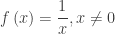
Example 3: If \displaystyle f\left( x \right)=\frac{1}{x},x\ne 0, what is \displaystyle \underset{{x\to 0}}{\mathop{{\lim }}}\,f\left( {f\left( {x)} \right)} \right) ?

Here again, the theorem cannot be used, since the “inside” function has no limit as x approaches 0. But, this function is its own inverse, so \displaystyle f\left( {f\left( {x)} \right)} \right)=x, and \displaystyle \underset{{x\to 0}}{\mathop{{\lim }}}\,f\left( {f\left( x \right)} \right)=\underset{{x\to 0}}{\mathop{{\lim }}}\,x=0


2019 CED Unit 1 – Limits and Continuity

This is the first of a series of blog posts that I plan to write over the next few months, staying a little ahead of where you are so you can use anything you find useful in your planning. Look for this series every 2 – 4 weeks.

Unit 1 contains topics on Limits and Continuity. (CED – 2019 p. 36 – 50). These topics account for about 10 – 12% of questions on the AB exam and 4 – 7% of the BC questions.

Logically, limits come before continuity since limit is used to define continuity. Practically and historically, continuity comes first. Newton and Leibnitz did not have the concept of limit the way we use it today. It was in the early 1800’s that the epsilon-delta definition of limit was first given by Bolzano (whose work was overlooked) and then by Cauchy and Weierstrass. But their formulation did not use the word “limit”, rather the use was part of their definition of continuity. Only later was it pulled out as a separate concept and then returned to the definition of continuity as a previously defined term.

Students should have plenty of experience in their math courses before calculus with functions that are and are not continuous. They should know the names of the types of discontinuities – jump, removable, infinite, etc. As you go through this unit, you may want to quickly review these terms and concepts as they come up.

(As a general technique, rather than starting the year with a week or three of review – which the students need but will immediately forget again – be ready to review topics as they come up during the year as they are needed – you will have to do that anyway. See Getting Started #2)

Topics 1.1 – 1.9: Limits

Topic 1.1: Suggests an introduction to calculus to give students a hint of what’s coming. See Getting Started #3

Topic 21.: Proper notation and multiple-representations of limits.

There is an exclusion statement noting that the delta-epsilon definition of limit is not tested on the exams, but you may include it if you wish. The epsilon-delta definition is not tested probably because it is too difficult to write good questions. Specifically, (1) the relationship for a linear function is always  \delta =\frac{\varepsilon }{{\left| m \right|}}  where m is the slope and is too complicated to compute for other functions, and (2) for a multiple-choice question the smallest answer must be correct. (Why?)

Topic 1.3: One-sided limits.

Topic 1.4: Estimating limits numerically and from tables.

Topic 1.5: Algebraic properties of limits.

Topic 1.6: Simplifying expressions to find their limits. This can and should be done along with learning the other concepts and procedures in this unit.

Topic 1.7: Selecting the proper procedure for finding a limit. The first step is always to substitute the value into the limit. If this comes out to be number than that is the limit. If not, then some manipulation may be required. This can and should be done along with learning the other concepts and procedures in this unit.

Topic 1.8: The Squeeze Theorem is mainly used to determine \underset{{x\to 0}}{\mathop{{\lim }}}\,\frac{{\sin \left( x \right)}}{x}=1 which in turn is used in finding the derivative of the sin(x). (See Why Radians?) Most of the other examples seem made up just for exercises and tests. (See 2019 AB 6(d)). Thus, important, but not too important.

Topic 1.9: Connecting multiple-representations of limit. This can and should be done along with learning the other concepts and procedures in this unit. Dominance, Topic 15, may be included here as well (EK LIM-2.D.5)

Topics 1.10 – 1.16 Continuity

Topic 1.10: Here you can review the different types of discontinuities with examples and graphs.

Topic 1.11: The definition of continuity. The EK statement does not seem to use the three-hypotheses definition. However, for the limit to exist and for f(c) to exist, they must be real numbers (i.e. not infinite). This is tested often on the exams, so students should have practice with verifying that (all three parts of) the hypothesis are met and including this in their answers.

Topic 1.12: Continuity on an interval and which Elementary Functions are continuous for all real numbers.

Topic 1.13: Removable discontinuities and handing piecewise – defined functions

Topic 1.14: Vertical asymptotes and unbounded functions. Here be sure to explain the difference between limits “equal to infinity” and limits that do not exist (DNE). See Good Question 5: 1998 AB2/BC2.

Topic 1.15: Limits at infinity, or end behavior of a function. Horizontal asymptotes are the graphical manifestation of limits at infinity or negative infinity. Dominance is included here as well (EK LIM-2.D.5)

Topic 1.16: The Intermediate Value Theorem (IVT) is a major and important result of a function being continuous. This is perhaps the first Existence Theorem students encounter, so be sure to stop and explain what an existence theorem is.


The suggested number of 40 – 50 minute class periods is 22 – 23 for AB and 13 – 14 for BC. This includes time for testing etc. If time seems to be a problem you can probably combine topics 3 – 5, topics 6 -7, topics 11 – 12. Topics 6, 7, and 9 are used with all the limit work.


There are three other important limits that will be coming in later Units:

The definition of the derivative in Unit 2, topics 1 and 2

L’Hospital’s Rule in Unit 4, topic 7

The definition of the definite integral in Unit 6, topic 3.

Posts on Continuity

CONTINUITY To help understand limits it is a good idea to look at functions that are not continuous. Historically and practically, continuity should come before limits. On the other hand, the definition of continuity requires knowing about limits. So, I list continuity first. The modern definition of limit was part of Weierstrass’ definition of continuity.

Continuity (8-13-2012)

Continuity (8-21-2013) The definition of continuity.

Continuous Fun (10-13-2015) A fuller discussion of continuity and its definition

Right Answer – Wrong Question (9-4-2013) Is a function continuous even if it has a vertical asymptote?

Asymptotes (8-15-2012) The graphical manifestation of certain limits

Fun with Continuity (8-17-2012) the Diriclet function

Far Out! (10-31-2012) When the graph and dominance “disagree” From the Good Question series

Posts on Limits

Why Limits? (8-1-2012)

Deltas and Epsilons (8-3-2012) Why this topic is not tested on the AP Calculus Exams.

Finding Limits (8-4-2012) How to…

Limit of Composite Functions

Dominance (8-8-2012) See limits at infinity

Determining the Indeterminate (12-6-2015) Investigating an indeterminate form from a differential equation. From the Good Question series.

Locally Linear L’Hôpital (5-31-2013) Demonstrating L’Hôpital’s Rule (a/k/a L’Hospital’s Rule)

L’Hôpital’s Rules the Graph (6-5-2013)


Here are links to the full list of posts discussing the ten units in the 2019 Course and Exam Description.

2019 CED – Unit 1: Limits and Continuity

2019 CED – Unit 2: Differentiation: Definition and Fundamental Properties.

2019 CED – Unit 3: Differentiation: Composite , Implicit, and Inverse Functions

2019 CED – Unit 4 Contextual Applications of the Derivative  Consider teaching Unit 5 before Unit 4

2019 – CED Unit 5 Analytical Applications of Differentiation  Consider teaching Unit 5 before Unit 4

2019 – CED Unit 6 Integration and Accumulation of Change

2019 – CED Unit 7 Differential Equations  Consider teaching after Unit 8

2019 – CED Unit 8 Applications of Integration   Consider teaching after Unit 6, before Unit 7

2019 – CED Unit 9 Parametric Equations, Polar Coordinates, and Vector-Values Functions 

2019 CED Unit 10 Infinite Sequences and Series


Getting Started

As you get ready to start school, here are some thoughts on the first week in AP Calculus. I looked back recently at some of the “first week of school” advice I offered in the past. Here’s a quick (actually, a bit longer than I planned) summary with some new ideas.

  1. The last time I taught AP Calculus during review time a student asked if there was a list of what’s on the exam. Duh! Why didn’t I think of that? So, I made copies of the list (from the old Acorn Book) and gave it to everyone. I should have done that on Day 1. So, my first suggestion is to make a copy of the “Mathematical Practices” and the “Course at a Glance” from the 2020 AP Calculus Course and Exam Description (p. 14 and p. 20 – 23) and give them to your students. Check off the topics as you do them during the year. A “Course at a Glance” poster comes with the hard copy of the 2019 Course and Exam Description available from the College Board or at APSIs and Workshops. See here. Hang the poster in your classroom. Refer to it often throughout the year.
  1. DON’T REVIEW! Yes, students have forgotten everything they ever learned in mathematics, but if you reteach it now, they will forget it again by the time they need it next week or next January. So, don’t waste the time, rather, plan to review material from kindergarten through pre-calculus when the topics come up during the year. Include short reviews in your lesson plans. For instance, when you study limits, you will need to simplify rational expressions – that’s when you review rational expressions. When you look at the graphs of the trigonometric functions, that’s when to review the graphs of the parent functions, a lot of the terminology related to graphs, discontinuities, asymptotes, and even the values of the trigonometric functions of the special angles. Months from now you’ll be looking at inverse functions, that’s when you review inverses.
  1. In keeping with Unit 1 Topic 1, you may want to start with a brief introduction to calculus. Several years ago, when I first started this blog, Paul A. Foerster, was nice enough to share some preview problems. They give a taste of derivatives and integrals in the first week of school and get the kids into calculus right off the bat. Here is an updated version. Paul, who retired a few years ago after 50 (!) years of teaching, is Teacher Emeritus of Mathematics of Alamo High Heights School in San Antonio, Texas. He is the author of several textbooks including Calculus: Concepts and Applications. More information about the text and accompanying explorations can be found on the first page of the explorations. Thank you, Paul!
  1. If you are not already a member, I suggest you join the AP Calculus Community. We have over 18,000 members all interested in AP Calculus. The community has an active bulletin board where you can ask and answer questions about the courses. Teachers and the College Board also post resources for you to use. College Board official announcements are also posted here. I am the moderator of the community and I hope to see you there!
  1.  Here are some links to places on this blog that you may find helpful:
    1. Pacing– organizing your year.
    2. Check the Resource page from this blog.
    3. Calculator information:
    4. Miscellany: These posts discuss basic ideas that I always hoped students knew about mathematics before starting calculus