Recently, the College Board removed all the past AP Calculus exams dating back to 1998. This included free-0response questions and full exam with multiple-choice questions. The questions will be included in the AP Classroom section.
From now on, only free-response questions from the most recent three years will be available along with their scoring guidelines and other data. I understand that they will release a new full exam in January 2026, and then every three years after that as they did in the past.
UPDATE (September 7, 2025) There are three full (MC & FR) practice exams (2017, 2018, and 2019) for AB and BC available at your audit website. Sign in and click on “Resources” at the top. Then click on “Practice Exams and Secure Documents.”
While I have many favorite questions and exams from long ago, three years is enough for practice for the AP Exams in the spring.
So, two things:
I suggest you download the exams, so you’ll have a copy when they “disappear.” If you really need older exams, I suggest you contact colleagues who may have downloaded copies.
In this blog, I have referred to and discussed questions from past exams. Due to copyright regulations, I have not quoted the questions exactly. I have always tried to paraphrase enough of a question, so the discussion makes sense. There may be links to past exams that are no longer live. There are far too many to attempt to “fix” them. Sorry. I hope that will suffice.
The scoring guidelines and other information from the reading are usually posted in the fall. I’m sure there will be teacher who post their solutions to the AP Calculus Community starting today. So, look there to see how they compare to yours.
For several years now, I’ve been posting a series of notes on reviewing for the AP Calculus Exams. The questions on the AP Calculus exams, both multiple-choice and free response, fall into ten types. I’ve published posts on each. The ten types have not changed over the years, so there is not much to add. They are updated from time to time. The posts may be found under the “Blog Guide” tab above: click on AP Exam Review. The same links are below with a brief explanation of each.
This year’s AP Calculus exams will be given on Monday May 13, 2024, at 8:00 am local time.
I hope these will help as you, teachers and students, to review for this year’s exam.
General information and suggestions for teachers
AP Exam Review – Suggestions, hints, information, and other resources for reviewing. How to get started. What to tell your students. Simulated (mock) exams.
To dx or not to dx – Yes, use past exams and the scoring guideline to review, but don’t worry about the fine points of scoring; be more stringent than the readers.
Practice Exams – A Modest Proposal Like it or not (and the AP folks certainly do not) the answers are all online. What to do about that. Don’t overlook the replies at the end of this post.
Other than simply finding a limit, a derivative, an antiderivative, or evaluating a definite integral, the AP Calculus exam questions fall into these ten types. These are different from the ten units in the CED. Students are often expected to use knowledge from more than one AP Calculus unit in a single question.
These posts outline what each type of question covers and what students should be able to do. They include references to good questions, free-response and multiple-choice, and links to other posts on the topic.
These ten types appear in multiple-choice and free response questions. This type analysis provides an index to the questions by type. In addition the multiple-choice questions include straightforward questions (find a limit, compute a derivative, etc.)
Type 1 questions – Rate and accumulation questions. Contextual questions about things that are changing. Careful reading is the first step. Good graphing calculator skills are essential since this is usually a calculator active question.
Type 2 questions – Linear motion problems. Motion on a line in a context or not. Students must analyze the motion: position, velocity, and acceleration. Again, often a calculator active question.
Type 3 questions – Graph analysis. Given the derivative often as a graph, students must answer questions about the function – extreme values, increasing, decreasing, concavity, etc.
Type 4 questions – Area and volume problems. Student must find the area of a region enclosed by one or more curves, find the volume of a solid with regular cross-sections, and/or find the volume of a solid of revolution (which is, of course, a regular cross-section).
Type 5 questions – Riemann Sum & Table Problems. Starting with a short table of values of a function, and/or its derivative students are required to find Riemann sums and other information about the function often in a contextual situation.
Type 6 questions – Differential equations. Students are asked to solve a first-order separable differential equation, work with a slope field, or other related ideas. BC students may be asked to use Euler’s Method to approximate a value and discuss the logistic equation.
Type 7 questions – Miscellaneous. These include finding the first and second derivative of implicitly defined relation, solving a related rate problem or other topics not included in the other types.
Type 10 questions – Sequences and Series (BC topic) Questions ask student to determine the convergence of series using various convergence tests and to write and work with a Taylor and Maclaurin series, find its radius and interval of convergence.
The notes always available from the menu line at the top of the page: click on Blog Guide > AP Exam Review
Also, Calc-Medic has posted a searchable database of all the AP Calculus Free-response questions from 1998 on. The link is here. While you’re there take a look at their website which has lots of resources and free lesson plans. For more on Calc-medic see this post.
Updates: March 9, 2023 – Calc-medic, March 2, 2024
When you’re reviewing for the AP Calculus exams your goal is to make mistakes. Why make mistakes? Easy: to find out what you’re doing wrong so you can fix it. And to find out what you don’t know so you can learn it.
Your teacher will assign free-response questions, FRQs, from real AP Calculus exams from past years. Give yourself about 15 minutes and try to answer the question. (Fifteen minutes is about the time you have for each FRQ on the exam.) After fifteen minutes, stop. Check your work.
The questions, answers, solutions, and most importantly the scoring guidelines for FRQs are all online here for AB, and here for BC. Each FRQ is worth nine points. The scoring guidelines will show you what must be on your paper to earn each point.
Now you can copy the absolutely perfect answer for your FRQs and hand it in to your teacher. This won’t impress or fool your teacher because he or she has the guidelines too. More importantly this won’t help you. When reviewing mistakes are good. Study your mistakes and learn from them.
If you made a simple arithmetic or algebra mistake, learn to be more careful. One very common mistake is simplifying your answer incorrectly. Remember, you do not have to simplify numerical or algebraic answers. If you write “ 1 + 1 “ and the correct answer is 2, the “ 1 + 1 ” earns the point. But if you simplified it to 3, you lose the point you already earned. (The standards show simplified answers, so the readers will know what they are for (foolish?) students who chose to simplify.) simplifying also wastes time.
If you’re unsure how to write justifications, explanations, and other written answers, use the scoring guidelines as samples or templates. Learn to say what you need to say. Don’t say too much. You will not earn full credit for the correct answer and correct work if the question asks for a justification, and you don’t write one.
If you really don’t know how to answer a question you’ve made an important mistake. This is the thing you need to work on until you understand the concept or method. This requires more than just reading the solution on the guideline. Go back to your notes, ask your friends, ask your teacher, find out what you’re missing and learn it. Look at similar questions from other exams.
For multiple-choice questions only the answers are available. Nevertheless, be sure you understand your mistakes.
There are 7 types of questions on the AB exam and an additional 3 on the BC exam. These are not the same as the ten units you’ve been studying, because AP exam questions often have parts from more than one unit. On March 5, I will post links to all the types. The discussion of each type will include a list of what you should know and be able to do for each type along with other hints.
Now, when you actually take the AP Calculus exam your goal changes. Here you want to earn all the points you can. If you run across something you know you don’t know on the exam, leave it. Go onto something you do know. Don’t waste your time on something you’re not sure of. You can always come back if you have time.
The question below appears in the new Course and Exam Description (CED) for AP Calculus, and has caused some questions since it is not something included in most textbooks and has not appeared on recent exams.
Example 1
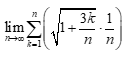
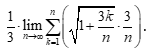
Which of the following integral expressions is equal to
There were 4 answer choices that we will consider in a minute.
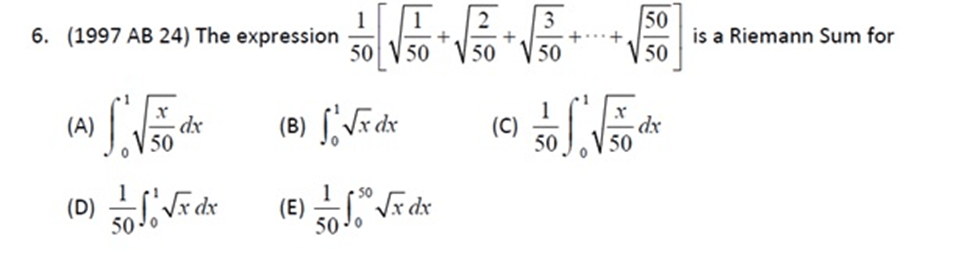
To the best of my recollection the last time a question of this type appeared on the AP Calculus exams was in 1997, when only about 7% of the students taking the exam got it correct. Considering that by random guessing about 20% should have gotten it correct, this was a difficult question. This question, the “radical 50” question is at the end of this post.
The first key to answering the question is to recognize the limit as a Riemann sum. In general, a right-side Riemann sum for the function f on the interval [a, b] with n equal subdivisions has the form:
To evaluate the limit and express it as an integral, we must identify, a, b, and f. I usually begin by looking for (b – a)/n. In this problem (b – a)/n = 1/n and from this conclude that b – a = 1, so b = a + 1.
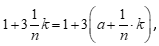
Then rewriting the radicand as
It appears that the function is
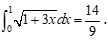
and the limit is
.This is the first answer choice. The choices are:
In this example, choices B, C, and D can be eliminated as soon as we determine that b = a + 1, but that is not always the case.
Let’s consider another example:
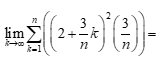
Example 2:
As before consider (b – a)/n = 3/n implies that b = a + 3. And the function appears to be
on the interval [0, 3], so the limit is
BUT
What is we take a = 2. If so, the limit is
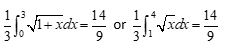
And now one of the “problems” with this kind of question appears: the answer written as a definite integral is not unique!
Not only are there two answers, but there are many more possible answers. These two answers are horizontal translations of each other, and many other translations are possible, such as
Returning to example 1, using something like a u-substitution, we can rewrite the original limit as .
Now b = a + 3 and the limit could be either
You will probably have your students write Riemann sums with a small value of n when you are teaching Riemann sums leading up to the Fundamental Theorem of Calculus. You can make up problems like this these by stopping after you get to the limit, giving your students just the limit, and have them work backwards to identify the function(s) and interval(s). You could also give them an integral and ask for the associated Riemann sum. Question writes call a question like this a reversal question, since the work is done in reverse of the usual way.
Another example appears in the 2016 “Practice Exam” available at your audit website. It is question AB 30. That question gives the definite integral and asks for the associate Riemann sum; a slightly different kind of reversal. Since this type of question appears in both the CED examples and the practice exam, chances of it appearing on future exams look good.
Critique of the problem
I’m not sure if this type of problem has any practical or real-world use. Certainly, setting up a Riemann sum is important and necessary to solve a variety of problems. After all, behind every definite integral there is a Riemann sum. But starting with a Riemann sum and finding the function and interval does not seem to me to be of practical use.
The CED references this question to MPAC 1: Reasoning with definitions and theorems, and to MPAC 5: Building notational fluency. They are appropriate, but still is the question ever done outside a test or classroom setting?
Another, bigger, problem is that the answer choices to Example 1 force the student to do the problem in a way that gets one of the answers. It is perfectly reasonable for the student to approach the problem a different way, and get another correct answer that is not among the choices. This is not good. The question could be fixed by giving the answer choices as numbers. These are the numerical values of the 4 choices:
As you can see that presents another problem.
Finally, here is the question from 1997, for you to try:
Answer B. Hint n = 50
_______________________________
Note: The original of this post was lost somehow. I’ve recreated it here. Sorry if anyone was inconvenienced. LMc May 5, 2024
For several years now, I’ve been posting a series of notes on reviewing for the AP Calculus Exams. The questions on the AP Calculus exams, both multiple-choice and free response, fall into ten types. I’ve published posts on each. The ten types have not changed over the years, so there is not much to add. They are updated from time to time. The posts may be found under the “Blog Guide” tab above: click on AP Exam Review. The same links are below with a brief explanation of each.
I hope these will help as you review for this year’s exam.
General information and suggestions
AP Exam Review – Suggestions, hints, information, and other resources for reviewing. How to get started. What to tell your students. Simulated (mock) exams.
To dx or not dx – Yes, use past exams and the scoring guideline to review, but don’t worry about the fine points of scoring; be more stringent than the readers.
Practice Exams – A Modest Proposal Like it or not (and the AP folks certainly do not) the answers are all online. What to do about that. Don’t overlook the replies at the end of this post.
Other than simply finding a limit, a derivative, an antiderivative, or evaluating a definite integral, the AP Calculus exam questions fall into these ten types. These are different from the ten units in the CED. Students are often expected to use knowledge from more than one unit in a single question.
These posts outline what each type of question covers and what students should be able to do. They include references to good questions, free-response and multiple-choice, and links to other posts on the topic.
Type 1 questions – Rate and accumulation questions. Contextual questions about things that are changing. Careful reading is the first step. Good graphing calculator skills are essential since this is usually a calculator active question.
Type 2 questions – Linear motion problems. Motion on a line in a context or not. Students must analyze the motion: position, velocity, and acceleration. Again, often a calculator active question.
Type 3 questions – Graph analysis. Given the derivative often as a graph, students must answer questions about the function – extreme values, increasing, decreasing, concavity, etc.
Type 4 questions – Area and volume problems. Student must find the area of a region enclosed by one or more curves, find the volume of a solid with regular cross-sections, and/or find the volume of a solid of revolution.
Type 5 questions – Riemann Sum & Table Problems. Starting with a short table of values of a function, and/or its derivative students are required to find Riemann sums and other information about the function often in a contextual situation.
Type 6 questions – Differential equations. Students are asked to solve a first-order separable differential equation, work with a slope field, or other related ideas. BC students may be asked to use Euler’s Method to approximate a value and discuss the logistic equation.
Type 7 questions – Miscellaneous. These include finding the first and second derivative of implicitly defined relation, solving a related rate problem or other topics not included in the other types.
Type 10 questions – Sequences and Series (BC topic) Questions ask student to determine the convergence of series using various convergence tests and to write and work with a Taylor and Maclaurin series, find its radius and interval of convergence.
Also, Calc-Medic has posted a searchable database of all the AP Calculus Free-response questions from 1998 on. The link is here. While you’re there take a look at their website which has lots of resources and free lesson plans. For mor on Calc-medic see this post.
This year’s exam will be given on Monday May 8, 2023, at 8:00 am local time.
As you probably realize by now, I think graphs, drawing and other visuals are a great aid in teaching and learning mathematics. Desmos is a free graphing app that many teachers and students use to graph and make other illustrations. Demonstrations can be made in advance and shared with students and other teachers.
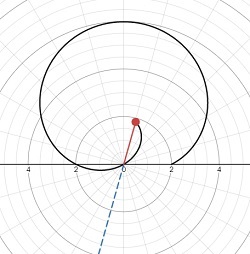
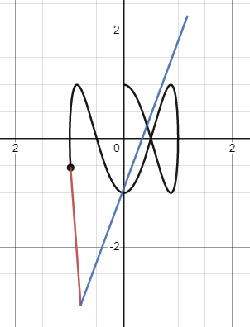
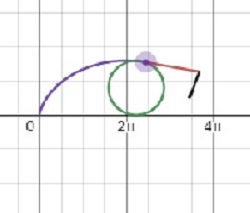
Recently, I was looking a some material from Unit 9 Parametric Equation, Polar Coordinates, and Vector-Valued Functions, BC topics, from the current AP Calculus CED. I ended up making three new Desmos illustrations for use in this unit. They will also be useful in a precalculus course introducing these topics. Hope you find them helpful.
You may replace the polar equation with any polar equation you are interested in. There are directions in the demo. Moving the “a” slider will show a ray rotating around the pole. The “a” value is the angle, , in radians between the ray and the polar axis. On the ray is a segment with a point at its end. This segment’s length is . As you rotate the ray you can see the polar graph drawn. When the segment extend in the opposite direction from the ray.
This demo may be used to introduce or review how polar equation work. An interesting extension is to enter something for the argument of the function that is not an integer muntiple of and extend the domain past , for example
A parametric equation and the vector equation of the same curve differ only in notation. So, this demo works for both. Following the directions in the demo, you may see the graph being drawn using the “a” slider. You may turn on (1) the position vector and its components, (2) add the velocity vector attached to the moving point and “pulling” it to its new position, and (3) the acceleration vector “pulling” the velocity vector.
You may enter any parametric/vector equation. When you do, you will also have to enter its first and second derivative. Follow the directions in the demonstration.
This demo shows the path on a rolling wheel called a cycloid. The “a” slider moves the position of the point on the wheel. The point may be on the rim of the wheel (, on the interior of the wheel (), or outside the wheel ( – think the flange on a train wheel). Use the “u” slider to animate the drawing. The velocity and acceleration vectors are shown; they may be turned off. The velocity vector is tangent to the curve (not to the circle) and seems to “pull” the point along the curve. The acceleration vector “pulls” the velocity vector. The equation in this demo should not be changed.
The last two demonstrations give a good idea of how the velocity and acceleration vectors affect the movement of the point.