Writing on the AP Calculus Exams

The goals of the AP Calculus program state that, “Students should be able to communicate mathematics and explain solutions to problems both verbally and in well written sentences.” For obvious reasons the verbal part cannot be tested on the exams; it is expected that you will do that in your class. The exams do require written answers to a number of questions. The number of points riding on written explanations on recent exams is summarized in the table below.

 Year AB BC
2007 9 9
2008 7 8
2009 7 3
2010 7 7
2011 7 6
2012 9 7
2013 9 7
2014 6 3

The average is between 6 and 8 points each year with some years having 9. That’s the equivalent of a full question. So this is something that should not be overlooked in teaching the course and in preparing for the exams. Start long before calculus; make writing part of the school’s math program.

That a written answer is expected is indicated by phrases such as:

  • Justify you answer
  • Explain your reasoning
  • Why?
  • Why not?
  • Give a reason for your answer
  • Explain the meaning of a definite integral in the context of the problem.
  • Explain the meaning of a derivative in the context of the problem.
  • Explain why an approximation overestimates or underestimates the actual value

How do you answer such a question? The short answer is to determine which theorem or definition applies and then show that the given situation specifically meets (or fails to meet) the hypotheses of the theorem or definition.

Explanations should be based on what is given in the problem or what the student has computed or derived from the given, and be based on a theorem or definition. Some more specific suggestions:

  • To show that a function is continuous show that the limit (or perhaps two one-sided limits) equals the value at the point. (See 2007 AB 6)
  • Increasing, decreasing, local extreme values, and concavity are all justified by reference to the function’s derivative. The table below shows what is required for the justifications. The items in the second column must be given (perhaps on a graph of the derivative) or must have been established by the student’s work.
Conclusion Establish that
y is increasing y’ > 0  (above the x-axis)
y is decreasing y’ < 0   (below the x-axis)
y has a local minimum y’ changes  – to + (crosses x-axis below to above) or {y}'=0\text{ and }{{y}'}'>0

y has a local maximum y’ changes + to –  (crosses x-axis above to below) or {y}'=0\text{ and }{{y}'}'<0
y is concave up y’ increasing  (going up to the right) or {{y}'}'>0
y is concave down y’ decreasing  (going down to the right) or {{y}'}'<0
y has point of inflection y’ extreme value  (high or low points) or {{y}'}' changes sign.
  •  Local extreme values may be justified by the First Derivative Test, the Second Derivative Test, or the Candidates’ Test. In each case the hypotheses must be shown to be true either in the given or by the student’s work.
  • Absolute Extreme Values may be justified by the same three tests (often the Candidates’ Test is the easiest), but here the student must consider the entire domain. This may be done (for a continuous function) by saying specifically that this is the only place where the derivative changes sign in the proper direction. (See the “quiz” below.)
  • Speed is increasing on intervals where the velocity and acceleration have the same sign; decreasing where they have different signs. (2013 AB 2 d)
  • To use the Mean Value Theorem state that the function is continuous and differentiable on the interval and show the computation of the slope between the endpoints of the interval. (2007 AB 3 b, 2103 AB3/BC3)
  • To use the Intermediate Value Theorem state that the function is continuous and show that the values at the endpoints bracket the value in question (2007 AB 3 a)
  • For L’Hôpital’s Rule state that the limit of the numerator and denominator are either both zero or both infinite. (2013 BC 5 a)
  • The meaning of a derivative should include the value and (1) what it is (the rate of change of …, velocity of …, slope of …), (2) the time it obtains this value, and (3) the units. (2012 AB1/BC1)
  • The meaning of a definite integral should include the value and (1) what the integral gives (amount, average value, change of position), (2) the units, and (3) what the limits of integration mean. One way of determining this is to remember the Fundamental Theorem of Calculus \displaystyle \int_{a}^{b}{{f}'\left( x \right)dx}=f\left( b \right)-f\left( a \right). The integral is the difference between whatever f represents at b and what it represents at a. (2009 AB 2 c, AB 3c, 2013 AB3/BC3 c)
  • To show that a theorem applies state and show that all its hypotheses are met. To show that a theorem does not apply show that at least one of the hypotheses is not true (be specific as to which one).
  • Overestimates or underestimates usually depend on the concavity between the two points used in the estimates.

A few other things to keep on mind:

  • Avoid pronouns. Pronouns need antecedents. “It’s increasing because it is positive on the interval” is not going to earn any points.
  • Avoid ambiguous references. Phrases such as “the graph”, “the derivative” , or “the slope” are unclear. When they see “the graph” readers are taught to ask “the graph of what?” Do not make them guess. Instead say “the graph of the derivative”, “the derivative of f”, or “the slope of the derivative.”
  • Answer the question. If the question is a yes or no question then say “yes” or “no.” Every year students write great explanations but never say whether they are justifying a “yes” or a “no.”
  • Don’t write too much. Usually a sentence or two is enough. If something extra is in the explanation and it is wrong, then the credit is not earned even though the rest of the explanation is great.

As always, look at the scoring standards from past exam and see how the justifications and explanations are worded. These make good templates for common justifications. Keep in mind that there are other correct ways to write the justifications.

QUIZ

Here is a quiz that can help your students learn how to write good explanations.

Let f\left( x \right)={{e}^{x}}\left( x-3 \right) for 0\le x\le 5. Find the location of the minimum value of f(x). Justify your answer three different ways (without reference to each other).

The minimum value occurs at x = 2. The three ways to justify this are the First Derivative Test, the Second Derivative Test and the Candidates’ Test. (Don’t tell your students what they are – they should know that.) Then compare and contrast the students’ answers. Let them discuss and criticize each other’s answers.



 

calculus

My New Calculator

I bought a new handheld calculator!Curta-1

Actually, it is not new; it was made about 1965. It is a Curta Type I.

Curta calculators were invented by Curt Herzstark (1902 – 1988) who, according to Wikipedia:

… was born in Vienna, the son of Marie and Samuel Jakob Herzstark. His father was Jewish and his mother, born a Catholic, converted to Lutheranism and raised Herzstark Lutheran.[1][2] In 1938, while he was technical manager of his father’s company Rechenmaschinenwerk AUSTRIA Herzstark & Co., Herzstark had already completed the design, but could not manufacture it due to the Nazi German annexation of Austria. … perhaps influenced by the fact that his father was a liberal Jew, the Nazis arrested him for “helping Jews and subversive elements” and “indecent contacts with Aryan women” and sent him to the Buchenwald concentration camp. However, the reports of the army about the precision-production of the firm AUSTRIA and especially about the technical expertise of Herzstark led the Nazis to treat him as an “intelligence-slave”.… he was called to work in the factory linked to the camp…. There he was ordered to make a drawing of the construction of his calculator, so that the Nazis could ultimately give the machine to the Führer as a gift after the successful end of the war. The preferential treatment this allowed ensured that he survived his stay at Buchenwald until the camp’s liberation in 1945, by which time he had redrawn the complete construction from memory.[3]

After the war he moved to Liechtenstein. In 1947 they started building and selling the calculators. Production continued until 1971 when handheld electronic calculators became widely available. In that time 79,572 Type I and 61,660 Type II machines were built. The Type II calculators have an additional two figures accuracy.

The calculator, which has about 600 parts, is based in the stepped cylinder (also called the Leibniz wheel) invented by Gottfried Wilhelm Leibniz who, as I recall, also did some work in calculus. The stepped cylinder has been used in calculating machines since Leibniz’s time.

Here is an excellent video animation explaining how the calculator works.

Of course all it does is add. Subtraction is accomplished using nines complement arithmetic, Since multiplication is repeated addition and division is repeated subtraction, it can also do those operations. But then things get interesting. There are lots of other arithmetic operations that can be done on a Curta calculator. They make use of various numerical algorithms for engineering, and business applications. If you are interested in more about this click here. For a quick example, the video below shows how to calculate square roots on a Curta using the idea that the square of any positive integer, n, is the sum of the first n odd integers, {{n}^{2}}=1+3+5+\cdots +\left( 2n-1 \right)  There are actually several algorithms for square roots and others for cube roots.

There is a Curta Calculator website. Here you will find lots of information about the Curta calculators including technical information and drawings, historical material, pictures, articles, simulators, cleaning and repair instructions, photos and videos.

Now, if I could just figure out where the batteries go….

.

March

The AP Calculus exams this year are on Tuesday morning May 5, 2015. Most of you will be finishing your new work this month and getting ready to review. As usual I like to stay a little ahead of where you are so you have time to consider what is offered here.

To help you plan ahead, below are links to previous posts specifically on reviewing for the AP Calculus exams and on the type questions that appear on the free-response sections of the exams.

I suggest you review by topic spending 1 – 3 days on each type so that students can see the things that are asked for and the different ways they are asked. Most of the questions include topics taught at different times during the year; students are not used to this. By considering each type separately students will learn how to pull together what they have been studying all year.

Many of the same ideas are tested in smaller “chunks” on the multiple-choice sections, so looking at the type should help with not only free-response questions but many of the multiple-choice questions as well. You may also find multiple-choice questions for each of the types and assign a few of them along with the corresponding free-response type.

Ideas for Reviewing for the AP Calculus Exams

Calculator Use on the AP Exams (AB & BC)

Interpreting Graphs AP Type Questions 1  chalkboard_math_notes

The Rate/Accumulation Question AP Type Question 2

Area and Volume Questions AP Type Question 3

Motion on a Line AP Type Question 4

The Table Question AP Type Question 5

Differential Equations AP Type Question 6

Implicit Relations and Related Rates AP Type Question 7 

Parametric and Vector Equations AP Type Question 8 (BC)

Polar Curves AP Type Question 9 (BC)

Sequences and Series AP Type Question 10 (BC)

I’ll be traveling this month to do some workshops and will not be posting too much new until I return.

Euler’s Method for Making Money

Chip Rollinson is a teacher at Buckingham Browne & Nichols School in Cambridge, Massachusetts. Today’s post is a note he sent to the AP Calculus Community bulletin board that I found interesting. I will share it with you with his permission. I made some minor edits. Chip wrote on February 5, 2015:

I had an epiphany today about the relationship between Euler’s Method and compounding growth. I had never made the connection before. I thought it was cool so I decided I needed to share it.

Consider the differential equation \frac{dA}{dt}=rA with the condition A(0) = P. Solving this equation gives A\left( t \right)=P{{e}^{rt}}, but let’s ignore this for now.

Let’s look at this differential equation using Euler’s Method.

Leonhard Euler1707 - 1783

Leonhard Euler
1707 – 1783

Let’s start with a step size of \tfrac{1}{12} and use (0, P) as the “starting point.”

After one step, you arrive at the point \displaystyle \left( \tfrac{1}{12},P+\tfrac{r}{12}P \right)=\left( \tfrac{1}{12},P\left( 1+\tfrac{r}{12} \right) \right)

After 2 steps, you arrive at the point \displaystyle \left( \tfrac{2}{12},P+\tfrac{2}{12}P+\tfrac{{{r}^{2}}}{144}P \right)=\left( \tfrac{2}{12},P{{\left( 1+\tfrac{r}{12} \right)}^{2}} \right)

After 3 steps, you arrive at the point \displaystyle \left( \tfrac{3}{12},P+\tfrac{3}{12}rP+\tfrac{3}{144}{{r}^{2}}P+P\tfrac{3}{1728}{{r}^{3}} \right)=\left( \tfrac{3}{12},P{{\left( 1+\tfrac{r}{12} \right)}^{3}} \right)

After 4 steps, you arrive at the point \displaystyle \left( \tfrac{4}{12},P{{\left( 1+\tfrac{r}{12} \right)}^{4}} \right)

And so on …

After 12 steps, you arrive at the point \displaystyle \left( 1,P{{\left( 1+\tfrac{r}{12} \right)}^{12}} \right)

After 120 steps, you arrive at the point \displaystyle \left( 10,P{{\left( 1+\tfrac{r}{12} \right)}^{120}} \right)

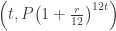
After 12t steps, you arrive at the point \displaystyle \left( t,P{{\left( 1+\tfrac{r}{12} \right)}^{12t}} \right)

Do these y-values look familiar? It’s the amount you’d have if you were compounding monthly with a yearly interest rate of r for a year, 10 years, and t years.

If the step size were \displaystyle \tfrac{1}{365} instead, you would arrive at the points

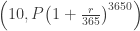
\displaystyle \left( 1,P{{\left( 1+\tfrac{r}{365} \right)}^{365}} \right), and \left( 10,P{{\left( 1+\tfrac{r}{365} \right)}^{3650}} \right), and \displaystyle \left( t,P{{\left( 1+\tfrac{r}{365} \right)}^{365t}} \right).

These y-values are the amount you’d have if you were compounding daily for a year, 10 years, and t years.

If the step size were \tfrac{1}{n}, the point after t years is \displaystyle \left( t,P{{\left( 1+\tfrac{r}{n} \right)}^{nt}} \right)

If n went to infinity, you would arrive at the point \displaystyle \left( t,P{{e}^{rt}} \right), the y-value for continuously compounding. This is the solution of  the differential equation mentioned above.

I’d never made this connection before, but it makes perfect sense now.

The actual problem that got me thinking about all of this was:

Suppose that you now have $6000, you expect to save an additional $3000 during each year, and all of this is deposited in a bank paying 4% interest compounded continuously.

This generates the differential equation: \displaystyle \frac{dA}{dt}=0.04t+3000

This was a fun one to do out. I started with a step size of 1/12 and then made them smaller. I derived the solution from Euler’s Method!


So writes Chip Rollinson. He included the following links to his computations: here and here

Then there were some interesting comments from others.

1. Mark Howell pointed out that if \displaystyle \frac{dy}{dx}=f\left( x \right), that is if the derivative is a function of x only, then Euler’s method is the same as a left Riemann sum approximation.

This would make a good exercise for your students to show given a derivative, a starting point, and a small number of steps. Try \frac{dy}{dx}={{x}^{3}}, and use Euler’s Method with 4 steps starting at (0, 0) and then a left-Riemann sum with 4 terms to approximate \int_{0}^{1}{{{x}^{3}}dx},  (Answer: \tfrac{9}{64})

2. Dan Teague went further and pointed out that this is really the development of the Fundamental Theorem of Calculus for a particular function. He contributed this development of the concept.

So Thank You Chip for this and the several other comments you’ve contributed to other post on this blog. And thank you Mark and Dan for your contributions.


A Family of Functions

Good Question 2, continued. 

Today we continue looking at Good Question 2 from our last post. The jumping off place was the BC calculus exam question 5 from 2002. We looked at the differential equation \displaystyle \frac{dy}{dx}=2y-4x and its slope field and discussed the questions asked on the exam. Then we saw how to actually solve the equation and found the general solution to be y\left( x \right)=C{{e}^{2x}}+2x+1.

The general solution of a differential equation contains a constant and therefore defines a family of functions all of whom satisfy the differential equation; they have similar, but slightly different graphs. Let’s look at and discuss the similarities and differences.

In using this with a class I suggest you present it step by step with lots of questions (more than I have here) to help them find the way to the full description of the family of functions. Alternatively, you could be very general and ask them to discuss (and justify) end behavior and the location of any extreme values or other interesting features individually or in small groups.

The Rule of Four says that all mathematical situations should be looked at analytically (i.e. with equations), graphically, numerically and verbally. In the previous post the analytic considerations were foremost and the slope field accounted for the graphical aspect. Euler’s method was numerical. Today the numerical comes to the forefront to help us discuss the graph. (Fro the verbal, well, I’ve never been accused of not being verbose, writing-wise.)

The two numbers that need to be considered are the parameter C and numerical size of e2x.

When C = 0 the solution reduces to y = 2x + 1. This is a line. If we rewrite the general solution as y\left( x \right)=\left( 2x+1 \right)+C{{e}^{2x}} and realize that e2x is always positive, we can see that solutions with C > 0 lie above the line and those with C < 0 lie below.

Left end behavior

Look at the x-values moving from the origin to the left; where x is negative and getting larger in absolute value. Here e2x will get very small and the solution will all get closer to the line y = 2x + 1. If C > 0 the solutions will be a little above the line and if C < 0 they will lie just below the line.

Therefore, the left end behavior is that the functions approach y = 2x + 1 as a slant asymptote.

Maximum Points

In the previous post we determined that the origin was a maximum point of the solution that contained the origin (C = –1).  Are there extreme points for any other solutions?

The maximums occur where \displaystyle \frac{dy}{dx}=0, that is where 2y-4x=0 or y=2x. We know they are maximums by the second derivative test: \displaystyle \frac{{{d}^{2}}y}{d{{x}^{2}}}=2\frac{dy}{dx}-4=4C{{e}^{2x}}-2<0 when C  < 0. All the curves with C < 0 are concave down on their entire domain.

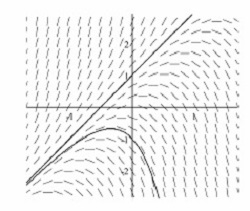
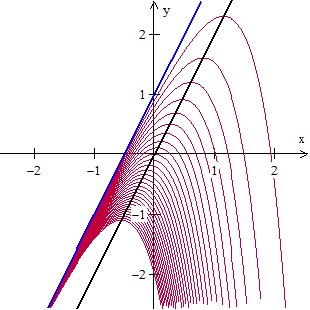
What does this mean? It means that for all the members of the family of solutions that have C < 0 have a maximum point, and that maximum point will be on the line y=2x.

Which members of the family can have maximums? Since y=2x lies below y=2x+1 only those with C < 0 will have maximums.
"Thirty

The graph above shows 30 members of the family with C = –3 (bottom curve) to C = –0.1 (top curve). The equation of the black line is y= 2x and the equation of the blue line is y= 2x + 1. Note that all the maximum points lie on the line y= 2x.

The curves with C > 0 lie above the line y= 2x + 1. For these curves \displaystyle \frac{{{d}^{2}}y}{d{{x}^{2}}}=2\frac{dy}{dx}-4=2\left( 2y-4x \right)-4=4y-8x-4

This expression will be positive when 4y-8x-4>0 or y>2x+1. In other words, when the curve lies above the line y= 2x + 1, exactly those with C > 0.

Therefore, all of these members of the family are concave up everywhere and since there is nowhere where their derivative is zero, there are no minimum points. See the graph below

Ten family members from C=0.3 (bottom curve) to C = 30 (top)

Ten family members
from C = 0.3 (bottom curve) to C = 30 (top)

Right end behavior

From what we have determined above for C > 0 \displaystyle \underset{x\to \infty }{\mathop{\lim }}\,y\left( x \right)=\infty , and for C < 0, \displaystyle \underset{x\to \infty }{\mathop{\lim }}\,y\left( x \right)=-\infty .


When graphing calculators were first required on the AP calculus exams (1995) there were, for a few years, questions asking students to analyze some aspect of a family of functions. See for example 1995 BC 5, 1996 AB4/BC4, 1997 AB 4, 1997 BC 4, 1998 AB2/BC2. They seem to have stopped asking such questions. Too bad; there is some interesting calculus to be had in family of function questions.

Good Question 2: 2002 BC 5

This is the second in my occasional series on good questions, good from the point of view of teaching about the concepts involved. This one is about differential equations and slope fields. The question is from the 2002 BC calculus exam. Question 5. while a BC question, all but part b are suitable for AB classes.

2002 BC 5

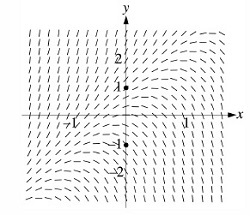
The stem presented the differential equation \displaystyle \frac{dy}{dx}=2y-4x. Now the only kind of differential equation that AP calculus students are expected to be able to solve are those that can be separated. This one cannot be separated, so some other things must be happening.

Part a concerns slope fields. Often on the slope field questions students are asked to draw a slope field of a dozen or so points. While drawing a slope field by hand is an excellent way to help students learn what a slope fields is, in “real life” slope fields are rarely drawn by hand. The real use of slope fields is to investigate the properties of a differential equation that perhaps you cannot solve. It allows you to see something about the solutions. And that is what happens in this question.

In the first part of the question students were asked to sketch the solutions that contained the points (0, 1) and (0, –1). These points were marked on the graph. The solutions are easy enough to draw.

But the question did not stop there, as we shall see, using the slope field could help in other parts of the question.

Part c: Taking these out of order, we will return to part b in a moment. Part c told students that there was a number b for which y = 2x + b is a solution to the differential equation. Students were required to find the value of b and (of course) justify their answer.

There are two approaches. Since y = 2x + b is a solution, we can substitute it into the differential equation and solve for b. Since for this solution dy/dx = 2 we have

2=2\left( 2x+b \right)-4x

2=4x+2b-4x

1=b

So b = 1 and the solution serves as the justification.

The other method, I’m happy to report, had some students using the slope field. They noticed that the solution through the point (0, 1) is, or certainly appears to be, the line y = 2x + 1. So students guessed that b  = 1 and then checked their guess by substituting y = 2x + 1 into the differential equation:

2=2\left( 2x+1 \right)-4x

2=4x+2=4x

2=2

The solution checks and the check serves as the justification.

I like the second solution much better, because it uses the slope field as slope field are intended to be used.

Incidentally, this part was included because readers noticed in previous years that many students did not understand that the solution to a differential equation could be substituted into the differential equation to obtain a true equation as was necessary using either method for part b.

There is yet another approach. Since the solution is given as linear the second derivative must by 0. So

\displaystyle \frac{{{d}^{2}}y}{d{{x}^{2}}}=2\frac{dy}{dx}-4=2\left( 2y-4x \right)-4

2\left( 2y-4x \right)-4=0

4y-8x-4=0

4y=8x+4

y=2x+1

And again b = 1

Returning to part b.

Part b asked students to do an Euler’s method approximation of f(0.2) with two equal steps  of the solution of the differential equation through (0, 1). The computation looks like this:

f\left( 0.1 \right)\approx 1+\left( 2\left( 1 \right)-4\left( 0 \right) \right)\left( 0.1 \right)=1.2

f\left( 0.2 \right)\approx 1.2+\left( 2\left( 1.2 \right)-4\left( 0.1 \right) \right)\left( 0.1 \right)=1.4

So far so good. But this is is about the solution through the point (0, 1). Again referring to the slope field, there is no reason to approximate (except that students were specifically told to do so). Substituting into y = 2x + 1, f(0.2) = 1.4 exactly!

Part d: In the last part of the question students were asked to consider a solution of the differential,  g, that satisfied the initial condition g(0) = 0, a solution containing the origin. Students were asked to determine if g(x) had a local extreme at the origin and, if so, to tell what kind (maximum or minimum), and to justify their answer.

Looking again at the slope field it certainly appears that there is a maximum at the origin, and since substituting (0, 0) into the differential equation gives dy/dx = 2(0) – 4(0) = 0, it appears there could be an extreme there. So now how do we determine and justify if this is a maximum or minimum? We cannot use the Candidates’ Test (Closed Interval Test) since we do not have a closed interval, nor can we easily determine if there are any other points nearby where the derivative is zero (there are). Therefore, the First Derivative Test does not help. That leaves the Second Derivative Test.

To use the Second Derivative Test we must use implicit differentiation. (Notice that two unexpected topics now appear extending the scope of the question in a new direction).

\displaystyle \frac{{{d}^{2}}y}{d{{x}^{2}}}=2\frac{dy}{dx}-4

At the origin dy/dx = 0 as we already determined, so

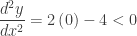
\displaystyle \frac{{{d}^{2}}y}{d{{x}^{2}}}=2\left( 0 \right)-4<0

Therefore, since at x = 0, the first derivative is zero and the second derivative is negative the function g(x) has a maximum value at (0, 0) by the Second Derivative Test .

More: Can we solve the differential equation? Yes. The solution has two parts. First we solve the homogeneous differential equation \frac{dy}{dx}=2y, ignoring the –4x for the moment. This is easily solved by separating the variables y=C{{e}^{2x}}, which can be checked by substituting.

Because the differential equation contains x and y and ask ourselves what kind of function might produce a derivative of 2y – 4x? Then we assume there is a solution of the form y = Ax + B where A and B are to be determined and proceed as follows.

\displaystyle \frac{dy}{dx}=2y-4x

A=2\left( Ax+B \right)-4x=\left( 2A-4 \right)x+2B

Equating the coefficients of the like terms we get the system of equations:

A=2B

0=2A-4

A=2\text{ and }B=1

Putting the two parts together the solution is y=C{{e}^{2x}}+2x+1. This may be checked by substituting. Notice that when C = 0 the particular solution is y = 2x + 1, the line through the point (0, 1).

(Extra: It is not unreasonable to think that instead of y = Ax + B we should assume that the solution might be of the form y = Ax2 + Bx + C. Substitute this into the differential equation and show why this is not the case; i.e. show that A = 0, B = 2 and C = 1 giving the same solution as just found.)

Using a graphing program like Winplot, we can consider all the solutions. Below the slope field is graphed using a slider for C to animate the different solutions. The video below shows this with the animation pausing briefly at the two solutions from part a. Notice the maximum point as the graphs pass through the origin.

Slope field

But wait! There’s more!

The next post will take this question further – Look for it soon.

Update June 27, 2015. Third solution to part c added.

Amortization

This is an example of how sequences and series are used in “real life.”  It could be used in a calculus class or an advanced math class.

When you borrow money to buy a house or a car you are making a kind of loan called a mortgage. Paying off the loan is called amortizing the loan.amortization

The amount you borrow is called the principal. You agree to pay a fixed payment at regular intervals, usually monthly. The payment includes interest on the amount owed during the previous month plus a bit more to decrease the principal. Each month your payment decreases the remaining principal, so in the next month a little less goes to interest and a little more goes to paying off the principal. Let’s say you borrow A dollars (the principal) and agree to pay a monthly interest rate of r%, for a period of n months.

How much is the fixed (constant) monthly payment, P, so that after n months the loan and interest will be paid off?

After one month you make a payment and you now owe {{A}_{1}} = the original amount plus the interest on this amount minus the payment, P.

{{A}_{1}}=A+Ar-P=A\left( 1+r \right)-P

After the second payment is made you owe {{A}_{2}} =  {{A}_{1}}, plus the interest {{A}_{1}r}, minus the payment, P.

{{A}_{2}}=\left( A\left( 1+r \right)-P \right)+\left( A\left( 1+r \right)-P \right)r-P=A{{\left( 1+r \right)}^{2}}-P\left( 1+r \right)-P

And likewise after the third month:

{{A}_{3}}=\left( A{{\left( 1+r \right)}^{2}}-P\left( 1+r \right)-P \right)+\left( A{{\left( 1+r \right)}^{2}}-P\left( 1+r \right)-P \right)r-P

{{A}_{3}}=A{{\left( 1+r \right)}^{3}}-P{{\left( 1+r \right)}^{2}}-P\left( 1+r \right)-P

And after the fourth month a pattern emerges:

{{A}_{4}}=A{{\left( 1+r \right)}^{4}}-P{{\left( 1+r \right)}^{3}}-P{{\left( 1+r \right)}^{2}}-P\left( 1+r \right)-P

{{A}_{4}}=A{{\left( 1+r \right)}^{4}}-P\sum\limits_{k=0}^{3}{{{\left( 1+r \right)}^{k}}}

And so on so that after n months the amount you owe is:

{{A}_{n}}=A{{\left( 1+r \right)}^{n}}-P\sum\limits_{k=0}^{n-1}{{{\left( 1+r \right)}^{k}}}

The sigma expression represents a finite geometric series. The sum of such a series with a first term of 1 and a common ratio of R sum is given by

\displaystyle {{S}_{n}}=\frac{1-{{R}^{n}}}{1-R}.

Therefore

\displaystyle {{A}_{n}}=A{{\left( 1+r \right)}^{n}}-P\left( \frac{1-{{\left( 1+r \right)}^{n}}}{1-\left( 1+r \right)} \right)=A{{\left( 1+r \right)}^{n}}-P\left( \frac{{{\left( 1+r \right)}^{n}}-1}{r} \right)

But after n months you have paid off the loan and you owe An = 0

\displaystyle 0=A{{\left( 1+r \right)}^{n}}-P\left( \frac{{{\left( 1+r \right)}^{n}}-1}{r} \right)

This equation may be solved for P the monthly payment:

\displaystyle P=\frac{Ar{{\left( 1+r \right)}^{n}}}{{{\left( 1+r \right)}^{n}}-1}.

The equation above is a formula for finding the payment on a mortgage. For example, to borrow $25,000 for a car at 3% per year (r = 0.0025 per month) for 5 years (n = 60) the monthly payment is

\displaystyle \frac{25,000\left( 0.0025 \right){{\left( 1+0.0025 \right)}^{60}}}{{{\left( 1+0.0025 \right)}^{60}}-1}=\$449.22.

Of course, in “real life” someone looks up the amount on the internet and we all believe them. But now you can do it yourself and have some math fun at the same time.